












On solar sites where pile positions are densely spaced, a pile driver's typical rhythm is: align one hole, drill, withdraw the auger, then move to the next pile position. If the tracks must move for every point, the machine repeatedly starts and stops and re-levels, and alignment time is dominated by travel. Some machines advertise "360° rotation" as a selling point, but whether rotation can replace repositioning—and to what extent—needs to be examined in detail.
First, distinguish what each of the two movements does in hole alignment
Machine repositioning is chassis travel: it changes the machine's position on site, with a large range and relatively long time, but it changes the "major coordinates." Upper rotation and mast adjustment change the working mechanism's orientation and attitude after the chassis is stable, with a small range and fast response, suitable for handling pile points in multiple directions from an already stable position.
The two are not opposed. When pile spacing exceeds the working mechanism's reach, the tracks must still travel to the next area; only when pile positions are dense and distributed around the same stopping point do rotation and swing arm come into play.
| Movement | What it changes | Typical use case |
|---|---|---|
| Machine repositioning | Chassis position on site | Crossing areas, pile spacing beyond mechanism reach |
| Upper 360° rotation | Working mechanism orientation relative to chassis | Multi-direction pile positions from one stopping point |
| Mast tilt and swing arm | Drill tool attitude and lateral position | Slopes, angled pile positions, lateral alignment |
| Telescopic compensation | Fore-aft fine adjustment | Final alignment after stopping |
PV390R breaks hole alignment into several stages
The PV390R is a four-cylinder 360° rotary hydraulic solar pile driver with a crawler chassis, an 85 kW Yuchai four-cylinder engine, drilling diameter 80–600 mm, drilling depth 0–6 m, reducer torque 13000 N·m, drill rod speed 90 r/min, and chain pressurization.
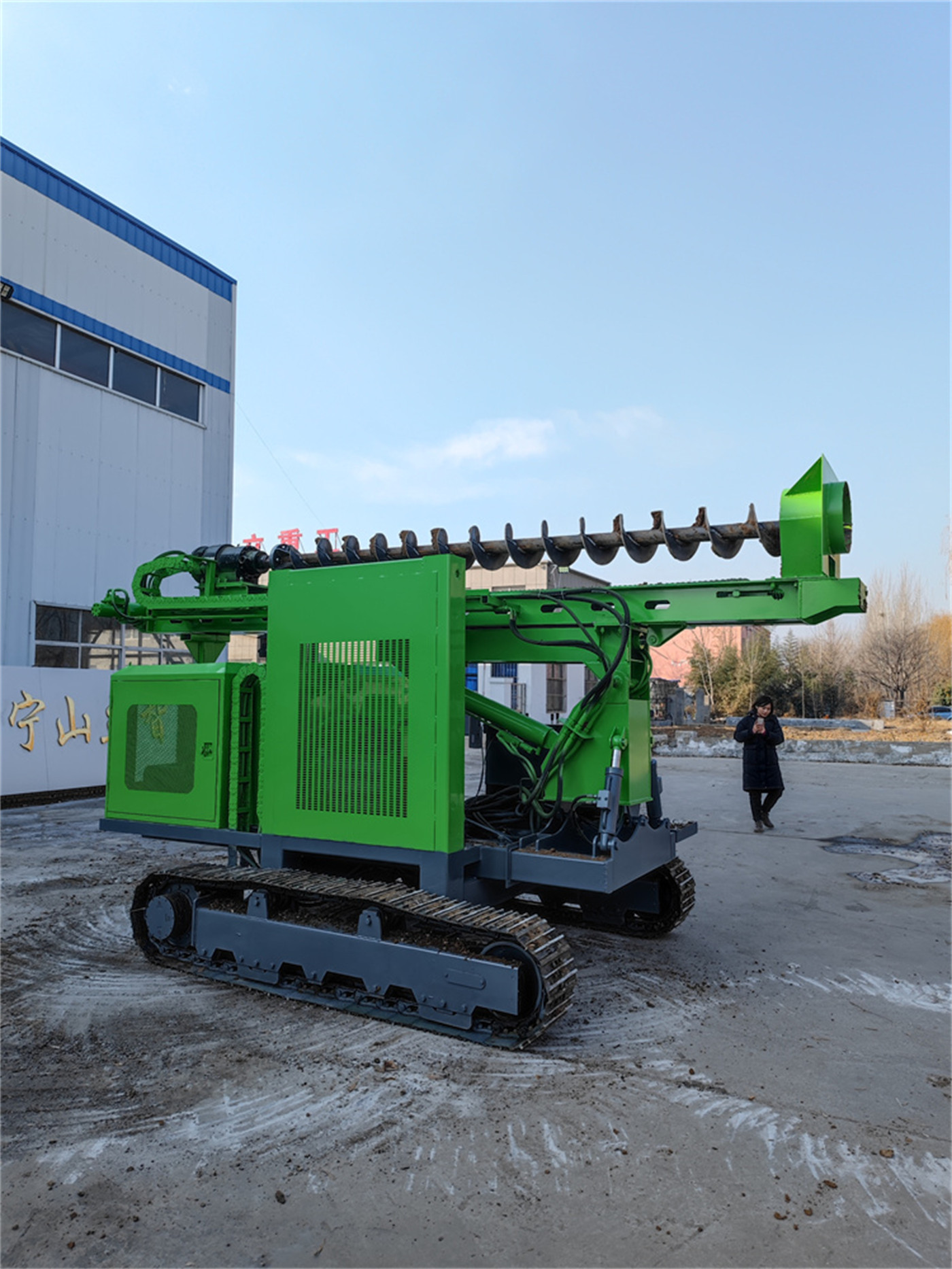
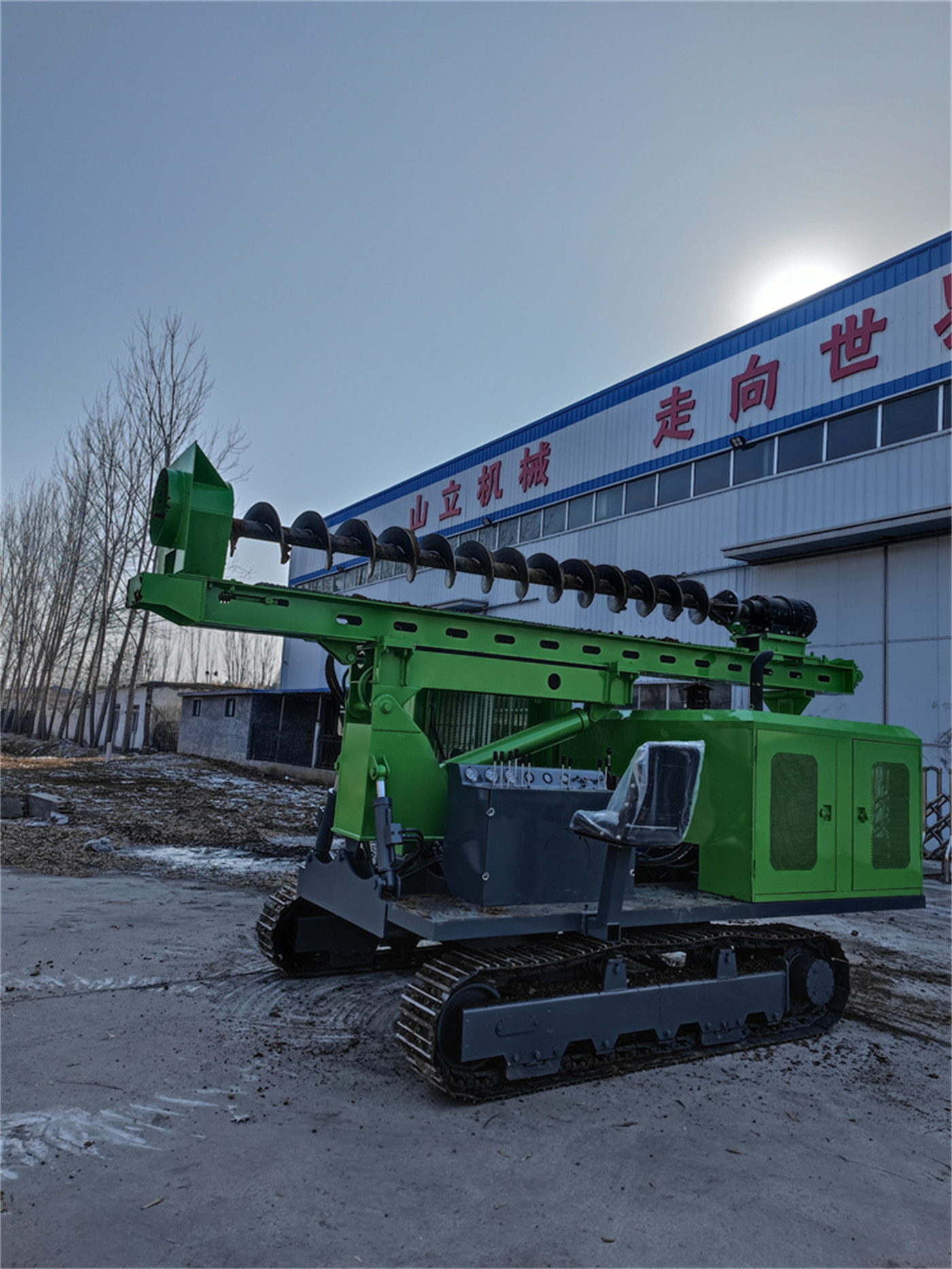
Four structures relate to hole alignment: upper 360° rotation handles the major direction; the mast's dual-cylinder left-right swing arm handles lateral correction; 500 mm telescopic compensation handles fore-aft fine tuning; and the 120° mast tilt range handles attitude adjustment. During construction, holes can be aligned in the order "rotate first, then swing, then telescope, finally adjust attitude," reducing repeated small chassis movements.
Rotation solves orientation, not reach distance
360° rotation lets the upper working mechanism adjust direction around the chassis, suitable for sites where pile positions are distributed around the same stopping point and different orientations must be handled continuously. It cannot extend the horizontal distance from the drill tool to the pile position, nor make pile positions beyond the mechanism's range reachable. Whether the pile layout falls within the combined range of rotation plus swing arm plus telescoping must be calculated based on project pile spacing and stopping positions.
Swing arm and telescopic compensation handle detailed alignment
The dual-cylinder left-right swing arm performs lateral correction after the chassis is stable, and the 500 mm telescopic compensation performs fore-aft fine adjustment. Both have limited range; their role is to reduce the number of times the machine must be repositioned for deviations of a few centimeters or tens of centimeters, not to replace site transfers. When pile position deviation is large, the chassis position should still be adjusted first before alignment.
Mast tilt affects slopes and angled pile positions
The 120° mast tilt range allows drilling attitude to be adjusted according to terrain and pile position requirements on mountainous solar sites and uneven ground. Attitude adjustment and rotation are two different things: the former changes the drill tool's angle relative to the horizontal plane, the latter changes the working mechanism's orientation. On slopes they often must be used together, but whether the chassis parking platform is stable remains the prerequisite for attitude adjustment to take effect.
Which conditions weaken the effect of rotation replacing repositioning
- Cross-slope and soil on slopes: the data lists a climbing angle of 35°, but actual mountain construction must also consider cross-slope, ground slipperiness, soil and machine center of gravity; the center of gravity changes after the working mechanism rotates, so safety cannot be judged by the maximum climbing parameter alone.
- Interference within the rotation radius: before rotating, confirm no people, vehicles, overhead lines or other machinery are nearby; during drilling, personnel must not enter the rotation range of the drill rod, chain pressurization mechanism, mast swing and upper rotation.
- Repeated alignment caused by ground conditions: cobble sand, gravel and backfill debris layers with uneven particles tend to cause drill bit jumping, hole deviation and jamming. When rotary load suddenly increases or abnormal impact occurs, the drill should be withdrawn promptly for inspection rather than continuing to force penetration.
- Clay clogging the drill and poor spoil discharge also slow single-point work, indirectly affecting the rhythm of continuous alignment.
Judge the value of rotation by how project pile positions are organized
Ground-mounted centralized solar power stations have many pile positions in regular arrangements; the crawler chassis handles site movement, while rotation and mast adjustment handle detailed alignment, allowing more directions of pile adjustment from one stopping position. Mountainous solar and complex slopes place more emphasis on passability and attitude adjustment; rotation and swing arm help reduce time spent finding a working angle, but parking platform stability must be addressed separately.
In commercial and industrial solar and plant foundation construction, the machine can also be used for support foundation pre-drilling, fence post holes and other shallow foundation work; 360° rotation helps reduce chassis turning on sites with limited space between buildings, roads and equipment, but is likewise constrained by rotation radius and site clearance.
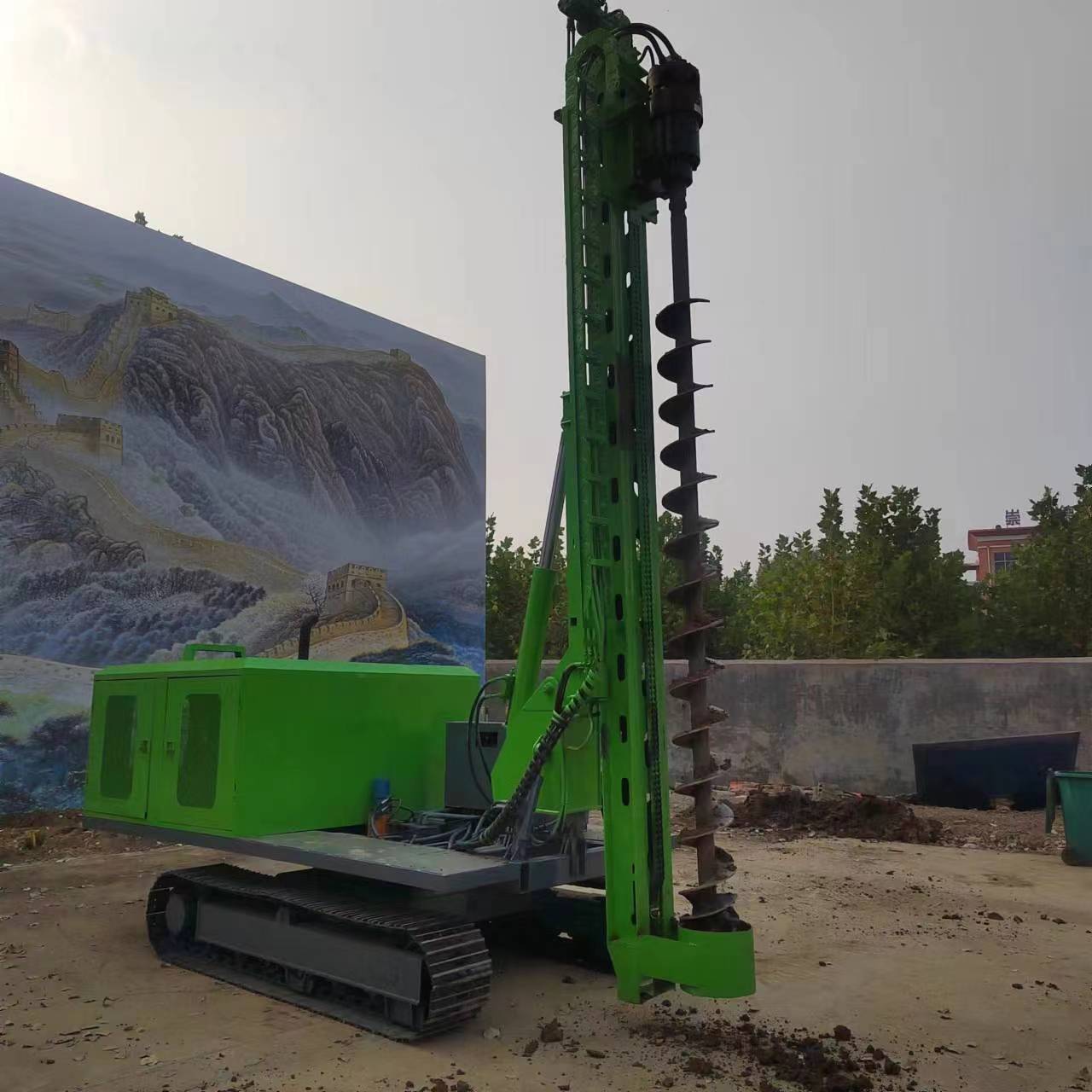
It should be noted that the PV390R is a solar and engineering pile drilling machine, not a water well drill; its positioning is shallow, high-frequency pile position construction. After changing to impact drilling tools it can be used in strongly weathered rock and rock layers, but the original data does not provide impact hammer model or impact energy, so no additional commitment is made regarding hard rock efficiency.
Project information to provide before inquiry
Whether a pile adjustment method is suitable ultimately depends on project conditions. When purchasing or inquiring, it is recommended to prepare: pile type and foundation design, target hole diameter and depth, pile layout and spacing, site terrain and ground conditions, ground description (soil layer, loess, clay, gravel, backfill or rock), whether angled or slope drilling is needed, site roads and transport conditions, and power and on-site supporting arrangements. The 80–600 mm diameter and 0–6 m depth are the equipment data's stated range; actual hole-forming results are also affected by drill tool type, ground conditions and operating method, and should be based on site conditions and project foundation design.