












The difference between a deep well project and an ordinary water well often lies not at the moment of spudding, but in the round of decisions before spudding: which circulation method will be used to drill the well, how the mast will be arranged, and how the drill string and mud pump will be matched. If these three matters are decided separately and changed as work progresses, the cost of adjusting after the hole depth passes several hundred meters will be much greater than spending a few extra days before start-up. This article puts these items on the same checklist and, using the published parameters of a 1000-meter-class trailer-mounted rotary table water well rig, explains which conditions must be settled before spudding and which values can only be used as reference.
Why the circulation method cannot be added after spudding
The circulation method determines what medium carries cuttings out of the hole, what maintains borehole stability, and also affects the subsequent drill string assembly and pumping equipment. In soft formations dominated by clay and silt, normal mud circulation is a common choice, using mud to carry cuttings and stabilize the borehole wall; when entering sand and gravel layers, the risk of hole collapse and mud loss increases, often requiring casing or adjustment of mud properties; in relatively intact hard rock sections, it may be necessary to switch to down-the-hole hammer drilling, which requires a separate air compressor and impactor.
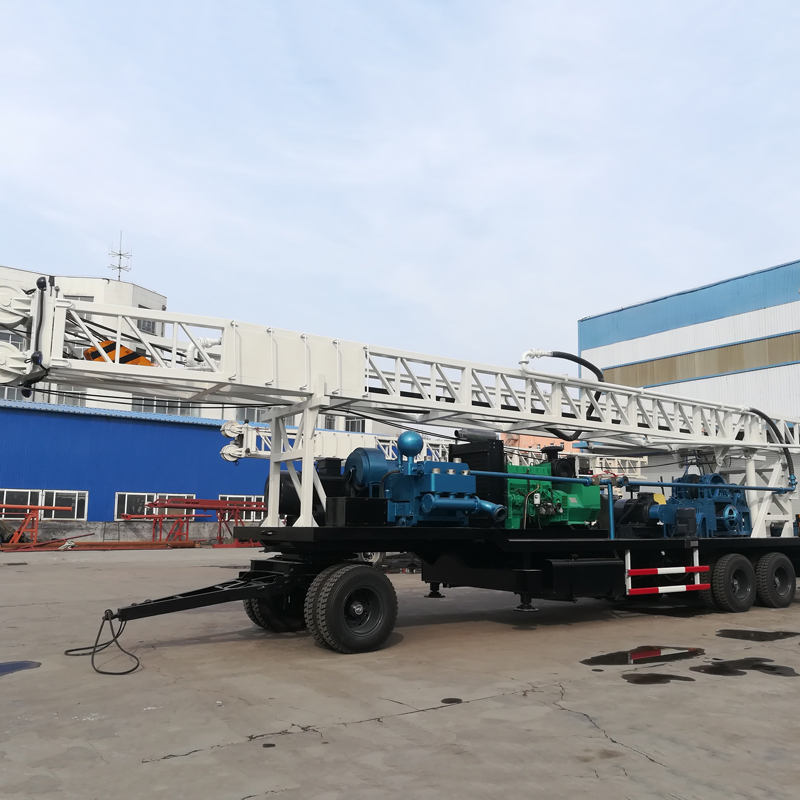
If the formation sequence and corresponding circulation method are not reviewed before spudding, it is easy on site to discover only after drilling into a certain section that the existing pump rate or air supply capacity is insufficient, forcing a stop to modify the supporting equipment. One feature of the trailer-mounted rotary table rig is that the rotary table, winch, mud pump, and power system are integrated on the same chassis. In the factory configuration, it has a set of pumping capacity for normal mud circulation, but air foam, down-the-hole hammer, and optional air-lift reverse circulation belong to other process routes, and supporting equipment must be confirmed separately.
Which operations the mast type affects
The mast is not just a structure for lifting drilling tools; it also constrains drill pipe length, tripping rhythm, and transport status. For this equipment, for example, the K-type hydraulic telescopic mast has a total height of 19.5 m, an effective height of 18.482 m, and a maximum load of 60 T. The mast height determines how long a single drill pipe can be and how many connections are needed per trip; the load capacity relates to the margin for drill string weight and casing operations in deep holes.
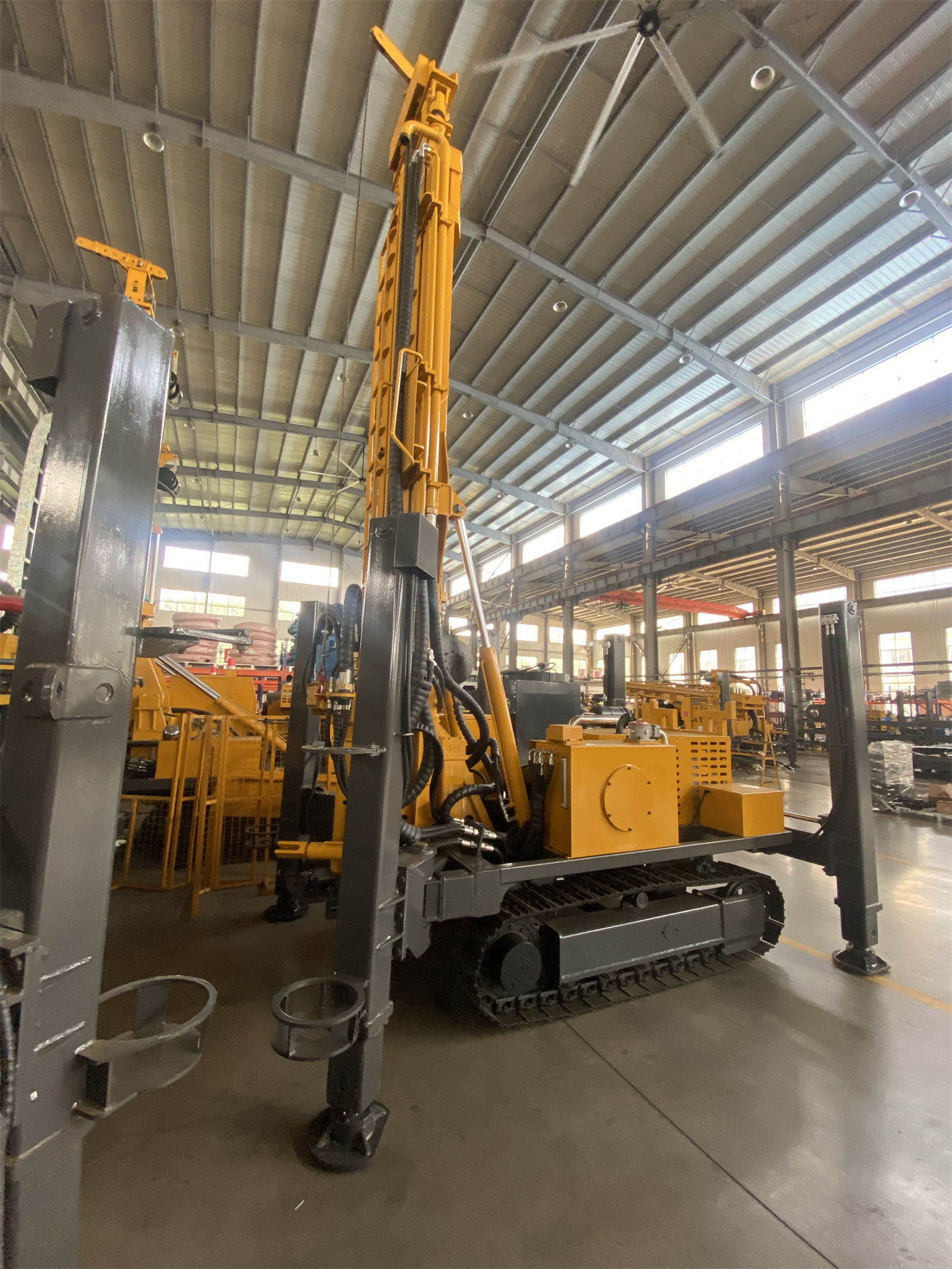
The telescopic structure can reduce part of the working height in transport status. For projects that need to move between different drilling points within a mining area, this affects road height limits and relocation organization. However, the trailer-mounted platform itself has requirements for road width, bridge load capacity, and turning radius. Whether the mast can be retracted and to what extent still must be confirmed against the specific transport route, and cannot be inferred only from the transport status in product literature.
Several types of conditions to be implemented in order before spudding
The checklist below is not a general template, but focuses on the parts of deep well projects where circulation method and mast type are interrelated, for item-by-item verification before start-up.
1. Correspondence between formation and circulation process
- For the upper loose layer, is normal mud circulation planned or casing with wall protection, and on what basis will mud properties be formulated;
- Will mud loss or hole collapse occur in sand and gravel layers, how many casing stages are needed, and at which section will casing be run;
- After entering hard rock, will down-the-hole hammer drilling be used, and can the air compressor pressure and displacement cover the target hole depth;
- Is air foam or air-lift reverse circulation being considered, and if so, has the foam injection method or dual-wall drill pipe and sampling equipment been implemented.
These items must be placed before spudding because they in turn affect the selection of pumps, air compressors, and drilling tools. The equipment itself supports switching among normal mud circulation, air foam, down-the-hole hammer, and optional air-lift reverse circulation, but "supports switching" does not mean "can switch on arrival"; each process corresponds to a set of supporting conditions.
2. Matching of drill string and mast
- Are the planned drill pipe diameter and length within the optional range;
- Does the single drill pipe length match the effective mast height, and are the number of connections and tripping time acceptable;
- Are the drill string weight in deep sections plus casing load within the rated load of the mast, traveling block, and swivel;
- Does large-size casing operation require the rotary table through-hole, and have the well pipe and pump type design been determined.
The data gives a kelly of 108 × 108 × 12192 mm and standard drill pipe of 89 × 9400 mm, with optional drill pipe diameters of 89, 114, and 127 mm. The rotary table maximum through-hole is 660 mm, which leaves space for large-size drilling tools and casing operations, but the completed well diameter still must be designed separately according to the aquifer, well pipe, and formation stability; the through-hole size cannot be treated as a fixed drilling diameter.
3. Mud pump and circulation displacement
- At the target hole depth and diameter, roughly what range should the displacement be to maintain mud return;
- After circulation resistance rises in deep sections, does the existing pump pressure have margin;
- Do the mud pit volume, desanding equipment, and water supply conditions match the pumping capacity;
- If air foam or air-lift reverse circulation is used instead, how should the role of the mud pump be adjusted.
This equipment is equipped with a BW1200/7 mud pump, with maximum pressure 7 MPa and displacement 1200 L/min. In deep holes, both circulation resistance and cuttings transport distance increase; a high-displacement pump helps maintain mud return, but whether the displacement is sufficient still depends on hole diameter, drill string assembly, and formation, and cannot be concluded from pump parameters alone.
4. Site, transport, and power
- Do the width, slope, turning radius, and bridge load capacity of the access road meet the passage requirements of the trailer-mounted platform;
- Does the transport height limit match the mast telescopic status;
- Can the drilling site area accommodate drilling tool placement, mud pits, casing, and auxiliary equipment;
- Is the on-site power supply stable, and if not, can the rig's own diesel engine carry the entire power demand;
- Can the water source distance and supply volume support long-term circulation.
The entire rig uses a 269 kW diesel engine with rated speed 2100 r/min, an independent power configuration suitable for drilling sites without a stable external power supply. However, this does not mean that power generation or auxiliary power supply is unnecessary on site; night lighting, auxiliary equipment, and some process support still need separate calculation.
What role the rotary table parameters play in this scheme
The rotary table has a maximum torque of 25 kN·m and provides four speed ranges: 37, 52, 84, and 145 r/min. Low-speed ranges are suitable for large drilling tools, casing operations, and high-resistance formations, while higher speeds are suitable for relatively stable soft rock and weathered layers. In deep well construction, gear selection should follow torque, mud return, and drilling tool load, rather than using a fixed gear all the way. The significance of these parameters is to leave adjustment space for different hole sections, not to promise a certain drilling speed in any formation.
Which matters must be decided only after data and site conditions are confirmed
The following points often still have no definite answers before start-up and need to be checked item by item with the project owner and equipment supplier:
- The target hole depth of 1000 m is the nominal upper limit of the equipment; the actual depth that can be drilled also depends on hole diameter, drilling tools, formation, and completion design, and cannot be directly treated as the completion depth of every well;
- Air-lift reverse circulation is an optional process; if the project has requirements for the representativeness of cuttings sampling, it is necessary to confirm simultaneously whether dual-wall drill pipe, air compression system, and sampling equipment are matched;
- The number of casing stages, filter pipe length, water shutoff method, and pump type design belong to completion design and cannot be inferred backward from drilling rig parameters;
- The transport route of the trailer-mounted platform needs on-site verification; the transport status in the literature cannot replace road survey;
- The diesel engine model and power are subject to the actual delivery configuration, and the scope of supporting accessories should also be written into the inquiry conditions.
Information recommended to prepare before inquiry
If the project enters the inquiry stage, organizing the following types of information first will help the other party judge whether the configuration matches better than merely asking "how much per unit":
- Drilling purpose: deep water well, geothermal, mining area water supply, or hydrogeological drilling;
- Formation data: lithology sequence from top to bottom, expected aquifer position, and water inflow conditions;
- Target hole depth and completion diameter, and whether casing is needed and how many stages;
- Planned circulation method and whether down-the-hole hammer, air foam, or air-lift reverse circulation is being considered;
- Access road conditions, drilling site area, and relocation frequency;
- On-site water and power conditions, air source conditions, and mud material supply;
- Whether supporting drilling tools, casing, air compressor, or sampling equipment are needed.
The reason circulation method and mast type must be decided together is that they jointly determine how the drill string is matched, how pumps and air compressors are selected, and how the site is arranged. Aligning these items before spudding makes it easier to control the pace than adjusting after start-up.