












When upgrading equipment for a medium-deep water well from the 300 m class upward, the easiest mistake at purchase time is to compare only one number: nominal drilling depth. But what really determines whether the site runs smoothly is often several other things—as hole depth increases, the drill string becomes heavier, pipe connections are more frequent, and tripping in and out takes more time. In hard rock sections, whether the air supply is sufficient also matters; in loose formations, whether mud circulation can be established matters. These processes are interconnected and should be calculated together when upgrading.
The following sections follow the pre-spud preparation sequence and use verified information for a 400 m class crawler-mounted fully hydraulic water well drill rig to explain which features correspond to which needs and which conditions still require on-site confirmation. The values in this article are only used to explain the basis for selection and do not represent actual well completion capability under arbitrary formations.
First, clarify the problems that the upgrade must solve
Common medium-deep water well scenarios include farmland irrigation, centralized rural water supply, mining area water supply, and groundwater investigation. The signal that an upgrade is needed is usually not “wanting to drill deeper,” but rather the simultaneous appearance of the following constraints:
- The target well depth exceeds the economical construction range of the original equipment, and the time occupied by pipe connections and tripping rises noticeably;
- The self-weight of the drill pipe, borehole wall friction, and casing weight increase, and the original lifting capacity has tight margin when handling the drill string;
- In the same well, the upper part is soil and sand layers while the lower part enters weathered rock or intact hard rock, requiring one machine to handle both mud rotation and DTH hammer drilling;
- Well sites are scattered across farmland, village roads, or gravel yards in mining areas, and relocation and positioning conditions are limited.
These constraints point to the combined capability of “drilling system + drill string handling,” not just the maximum drilling depth.
Preparation checklist: items to implement one by one before spudding
1、Hole depth and diameter: define the target first, then discuss margin
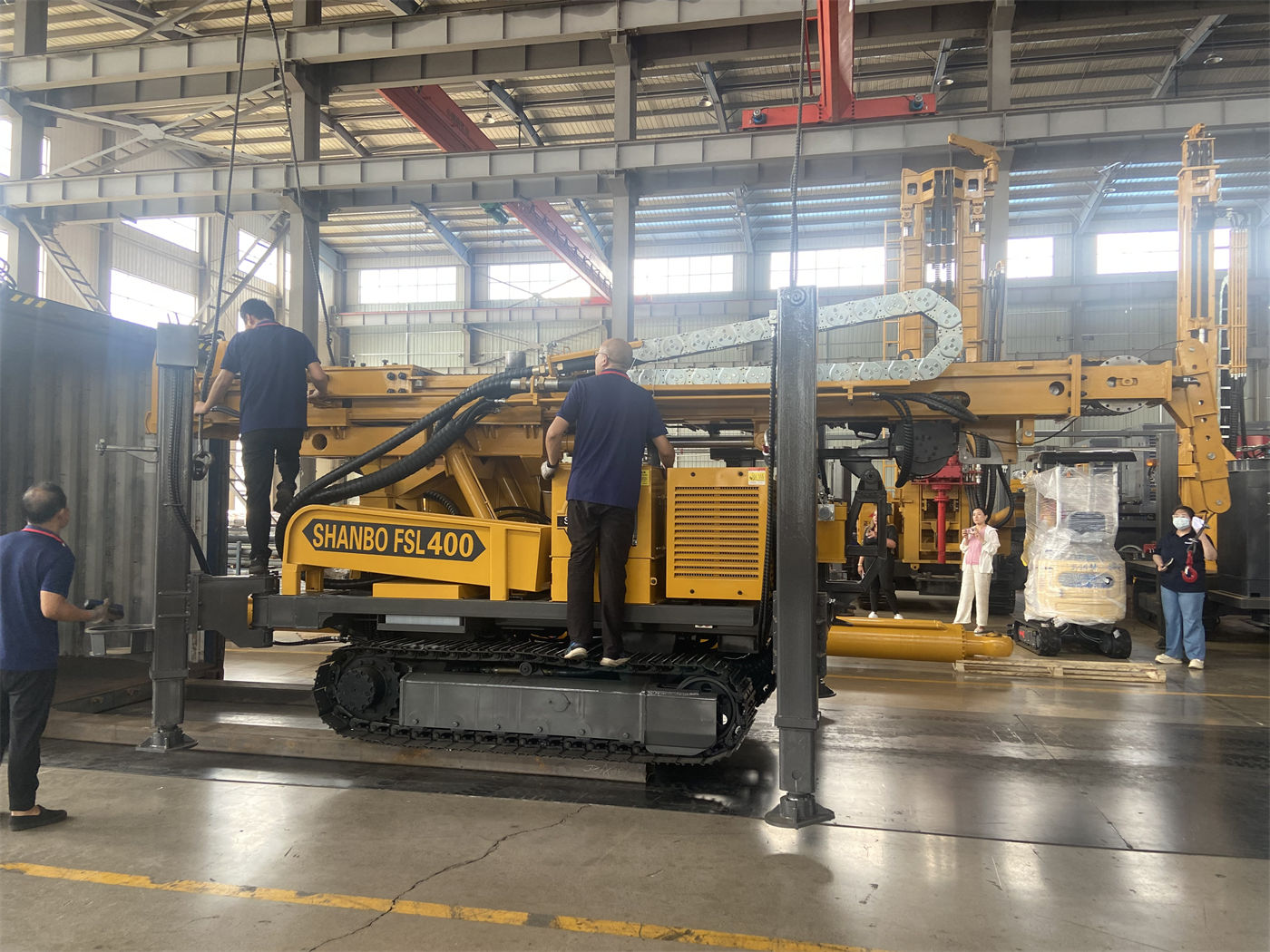
Taking the 400 m class crawler-mounted fully hydraulic water well drill rig associated with this article as an example, the data gives a maximum drilling depth of 400 m and a drilling diameter of 105–325 mm. These two values should be understood as the equipment capability range; actual well depth must still be determined in combination with local hydrogeological conditions. The location of the aquifer and whether margin for water exploration should be left at depth are more worth thinking through first than “drilling the full 400 meters.”
Regarding hole diameter, 105–325 mm covers the common water well caliber range, but the completed well diameter, filter pipe specifications, and pump type need separate design and cannot be directly inferred from the equipment’s hole diameter range to determine water yield.
2、Drill pipe configuration: 6 m pipes reduce the number of connections
This model directly supports 6 m drill pipe, with recommended drill pipe diameters of 89 / 102 mm. The value of longer drill pipe lies in reducing connection frequency: in 300–400 m class projects, fewer make-and-break cycles means correspondingly less auxiliary time and handling burden.
But there is a prerequisite to verify: the transport, on-site placement, and lifting space for 6 m drill pipe must all be reserved during site planning. The longer the drill pipe, the higher the operating space requirement around the well site, especially for narrow sites beside village roads or inside orchards.
3、Rotation conditions: two torque modes correspond to two operation stages
The data shows that the rig’s rotation system has a maximum torque of 8000 / 4000 N·m, corresponding to maximum speeds of 75 / 150 r/min. Low speed and high torque suit large-diameter, hard rock, and high-load conditions; higher speed suits stages with relatively lower resistance. On site, switching should be based on changes in hole diameter, drilling tools, and rock formation, and it is not advisable to stay fixed in a single mode for long periods.
It should be noted that dual-condition operation is not simply a two-speed gearbox; it reflects the trade-off between torque and speed at different operation stages, and the specific switching timing must still be determined by the drilling process and downhole feedback.
4、Drill string handling: lifting force must be considered together with hole depth
The rig’s lifting force is 22 T, noticeably higher than conventional small and medium water well drill rigs. As hole depth increases, the self-weight of the drill pipe, borehole wall friction, and casing weight all rise, and greater lifting capacity helps with normal tripping, drill tool recovery, and casing handling.
The boundary must also be clearly stated: when encountering stuck pipe, hole narrowing, or wall collapse, the priority should still be to solve the problem through hole cleaning and process adjustment rather than relying on maximum lifting force to pull forcefully. Lifting force is the margin for normal operations, not a means of handling downhole accidents.
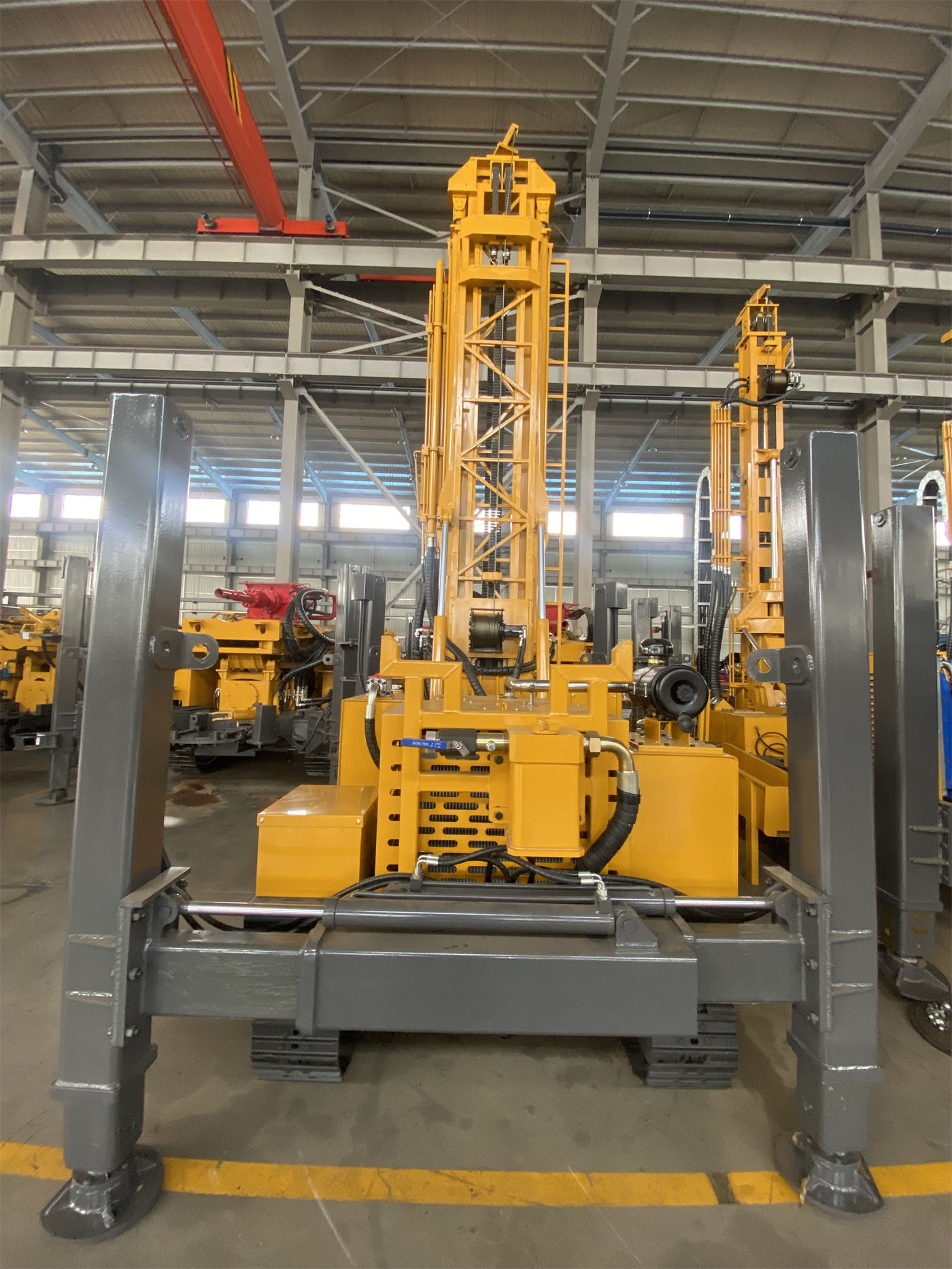
In addition, the axial pressure reference is 4 T, fast feed speed is 56 m/min, and fast lifting speed is 29 m/min. Fast actions are mainly used for non-drilling actions such as power head return and drill pipe handling; actual penetration rate depends on formation, bit, DTH hammer, and air compressor capacity and cannot be inferred from these values.
5、Circulation and air supply: each process has its own supporting threshold
The rig can be equipped with DTH hammer drilling and also supports mud rotary drilling. When using a DTH hammer, the recommended working air pressure is 1.2–3.5 MPa and air consumption is 16–55 m³/min, and it can match medium and high air pressure series DTH hammers. Under large-diameter, intact hard rock, or high-altitude conditions, whether the air compressor displacement is sufficient is often more important than whether the pressure value meets the standard.
Loose formations such as soil, clay, and sand layers rely on mud circulation for wall protection, cuttings transport, and maintaining hole diameter. When the upper overburden is thick, hole wall stability should be addressed first before entering rock formations for pneumatic DTH drilling.
The equipment can be optionally equipped with mud pumps, centrifugal pumps, generators, and foam pumps according to the project. Loose formation projects place more emphasis on mud and drainage systems, while hard rock projects focus more on DTH hammers and air compressors; formations with severe air leakage may require foam assistance—optional equipment should follow the formation, not be fully equipped all at once.
6、Site, outriggers, and relocation
The overall weight is about 8.6 T, dimensions are about 6.25 × 1.7 × 2.39 m, crawler travel speed is about 3 km/h, and the maximum climbing angle reference is 21°. Transport requires a suitable flatbed truck, fixing points, and loading/unloading ramps, and 6 m drill pipe and accessories should be secured separately.
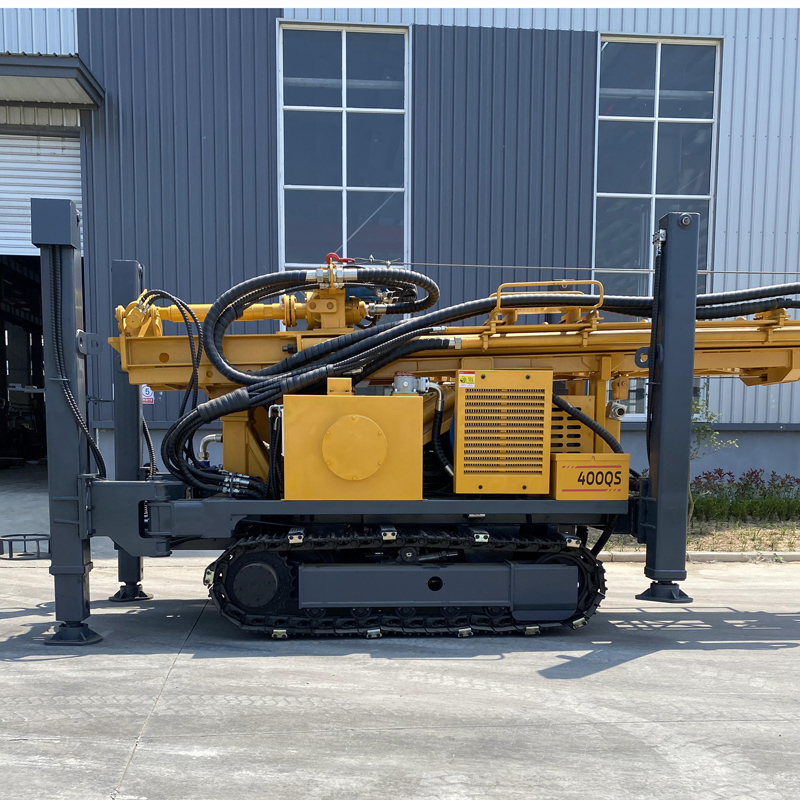
The hydraulic outrigger stroke is 1.6 m, used for leveling and stable support. A 400 m class drilling operation has a long construction cycle, so pads should be used on soft ground to ensure even outrigger loading and avoid long-term settlement causing mast tilt. Movement on wet and slippery ground, soft soil, and side slopes should be done with caution.
For power, a 103 kW diesel engine supplies energy for rotation, feed, crawler travel, outriggers, and auxiliary systems, with relatively little dependence on on-site fixed power. Medium-deep holes and hard rock construction last a long time, so the air filter and radiator should be cleaned regularly, and attention should be paid to cooling and fuel quality. There is also a 1.5 T auxiliary winch for handling accessories such as DTH hammers, drill pipes, and casing tools; load must be controlled during lifting, and personnel must not stand under suspended objects or in the direction of wire rope tension.
Upgrade judgment can be compared as follows
| Operational need | Corresponding feature in the data | Still to be confirmed |
|---|---|---|
| Target well depth close to the 300–400 m class | Maximum drilling depth 400 m, drilling diameter 105–325 mm | Local aquifer depth, completed well diameter, and pump type |
| Reduce pipe connections and handling | Supports 6 m drill pipe, recommended 89 / 102 mm | Whether the site reserves space for lifting and placing long drill pipe |
| Deep drill string and casing handling | Lifting force 22 T, axial pressure 4 T | Downhole friction, casing weight, and process margin |
| Alternating hard rock and loose formations | 8000 / 4000 N·m dual-condition rotation; both DTH hammer and mud rotation possible | Air compressor displacement, mud system configuration, air leakage, and wall collapse conditions |
| Scattered well sites and uneven ground | Crawler travel about 3 km/h, climbing reference 21°, outrigger stroke 1.6 m | Ground bearing capacity, slope stability, and transport route |
Applicable boundaries and places where conclusions should not be drawn directly
This model is positioned for medium-deep water well construction and is suitable for farmland irrigation, mining area water supply, and similar medium-deep projects. The following situations require separate judgment and cannot be concluded directly from the existing data:
- When the project requires high-quality core samples, a dedicated core drill rig should be used rather than treating a water well drill rig as coring equipment;
- Nominal maximum drilling depth does not equal actual well completion depth under arbitrary formations; hard rock, fractured zones, and strong water inflow sections will all change the construction pace;
- Results such as water yield, well completion effect, drilling efficiency, and fuel consumption have no corresponding data in the materials and cannot be presupposed;
- When the equipment matches a certain type of DTH hammer or air compressor, the interface, pressure, and displacement must be verified against the actual supporting components, and compatibility with any host machine is not promised.
Information to provide when requesting a quote
If you are evaluating this class of equipment, organizing the following items before communicating can reduce back-and-forth confirmation:
- Drilling purpose: irrigation, village and town water supply, mining area water supply, or groundwater investigation;
- Formation data: upper overburden thickness, lithology, fractured zones, and estimated aquifer locations;
- Target hole depth and completed well diameter, and whether casing and filter pipes are needed;
- Planned drilling method: DTH hammer, mud rotation, or a combination of both;
- Site access and relocation conditions: road width, ground bearing capacity, slope, and transport vehicles;
- Water, power, and air supply conditions: on-site power supply, air compressor displacement and pressure, water source, and mud materials;
- Supporting requirements: whether mud pumps, centrifugal pumps, generators, foam pumps, etc. are included in the plan.
Checking the drilling system and drill string handling on one checklist makes it less likely that an upgrade will result in rework where “the drilling depth is sufficient but the supporting equipment has not kept up.”