












When a water well designed for a depth of over 200 meters slows noticeably in penetration partway down, with reduced cuttings return and greater resistance during tripping than in previous wells, the common on-site conclusion is that "this water well rig doesn't have enough drilling depth and should be replaced with a larger machine." But this conclusion should be set aside for now—rated drilling depth is the upper capability limit of the complete machine under a specific drilling process. If any link in air supply, drill pipe, hole stabilization or completion structure falls short, the equipment will prematurely appear to "not drill."
This article uses verified information on a 350 m-class crawler water well rig as an example to explain how support conditions constrain actual drillable depth, and when a step up in class should really be considered.
First distinguish: is it insufficient rig capability, or a broken process chain?
Water well drilling is not a single action. Taking DTH hammer drilling as an example, the hole bottom needs sufficient air pressure and volume to carry cuttings out of the collar; the drill pipe must transmit rotation and lifting to the hole bottom; and the upper loose layer or broken zone still needs mud, casing or other means to maintain the hole wall. If any link falls below the requirements of the current hole depth and formation, the result is reduced speed, poor cuttings discharge or difficult tripping.
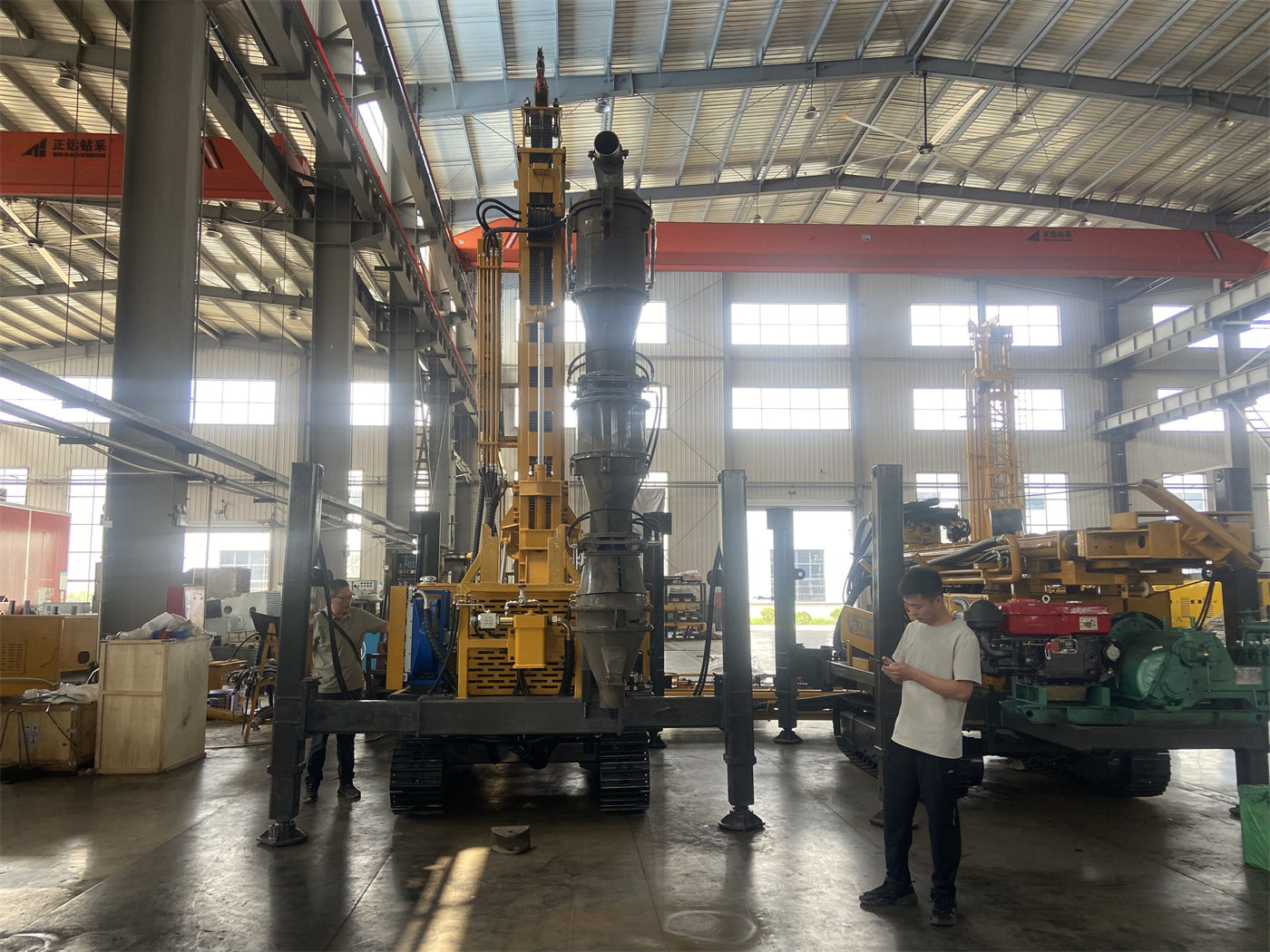
Three common misjudgments:
- Treating reduced cuttings return as the rig lacking power. Insufficient air volume, a DTH hammer specification mismatched to the hole diameter, or water accumulation in the hole changing the cuttings discharge state can all cause reduced return; it is not necessarily insufficient rotation or lifting capability.
- Wanting to switch to larger equipment as soon as drilling slows. Hard rock, alternating soft and hard layers, and fractures leaking air all change penetration rate; the reference drilling efficiency of 10–35 m/h given in the data itself fluctuates with lithology, drilling tools and operator experience, and cannot be treated as a constant value.
- Treating the rated maximum drilling depth as a depth achievable in any formation. 350 m is the rated maximum drilling depth of this machine; actual completed well depth also depends on formation, hole diameter, drill string assembly and completion structure.
The capability conditions of 350 m-class equipment must be matched item by item
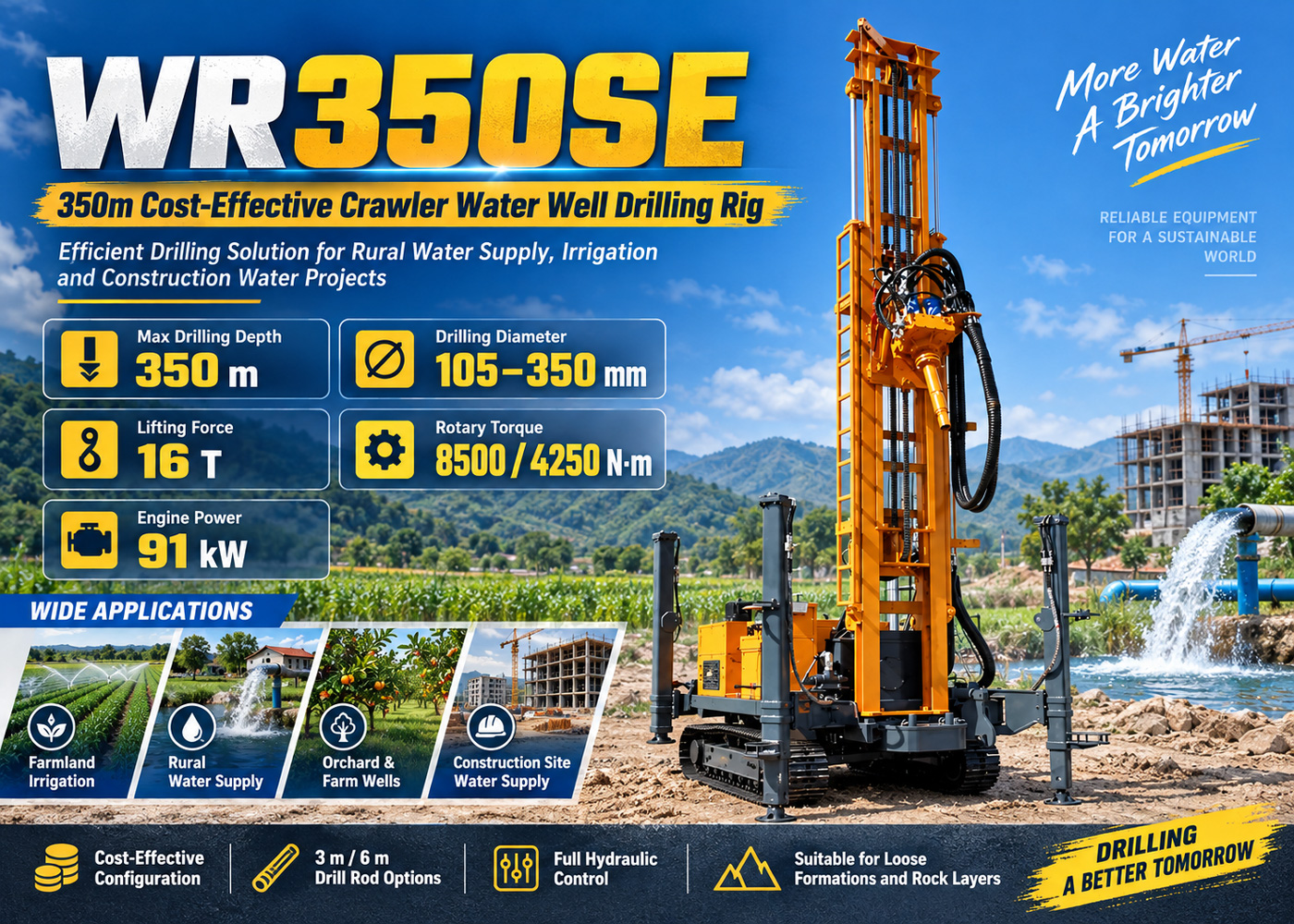
The data for this crawler water well rig gives: maximum drilling depth 350 m, hole diameter 105–350 mm, 91 kW power, 16 T lifting force, dual-condition rotary torque 8500 / 4250 N·m, corresponding maximum rotary speed 80 / 160 r/min, support for 3 m and 6 m drill pipes, and complete machine weight of about 7.5 T. These values are only parameters when viewed alone; only when placed in a specific hole section can it be judged whether they are sufficient.
| Hole section or operation | Relevant capability item | Support equipment to confirm together |
|---|---|---|
| Upper loose layer, sand and gravel layer | Rotary torque, mud circulation | Whether a mud pump is provided, casing plan, matching of hole diameter and bit |
| Medium-deep hard rock section | Lifting force, rotary torque, air supply | Air compressor pressure and volume, DTH hammer specification, drill pipe diameter |
| Fractures and air-leakage zones | Air supply stability, hole cleaning method | Auxiliary measures such as foam, whether to run casing in advance |
| Main aquifer | Hole depth records, hole cleaning | Water inflow observation, layout of filter pipe and sealing section |
Air supply: pressure and volume are paired conditions
When using DTH hammer drilling, the data recommends working air pressure of 1.2–3.5 MPa and air consumption of 16–55 m³/min, and medium- and high-pressure DTH hammers can be used. The key here is that air pressure and volume must be determined jointly according to hole diameter, drill pipe, DTH hammer specification, rock hardness and construction altitude. Insufficient air volume causes poor cuttings discharge, and drilling naturally slows; excessive configuration increases equipment and fuel costs. If the site reports "slower and slower drilling with less and less cuttings return," first check whether the actual output of the air compressor matches the DTH hammer requirements—this is more practical than directly discussing replacing the rig.
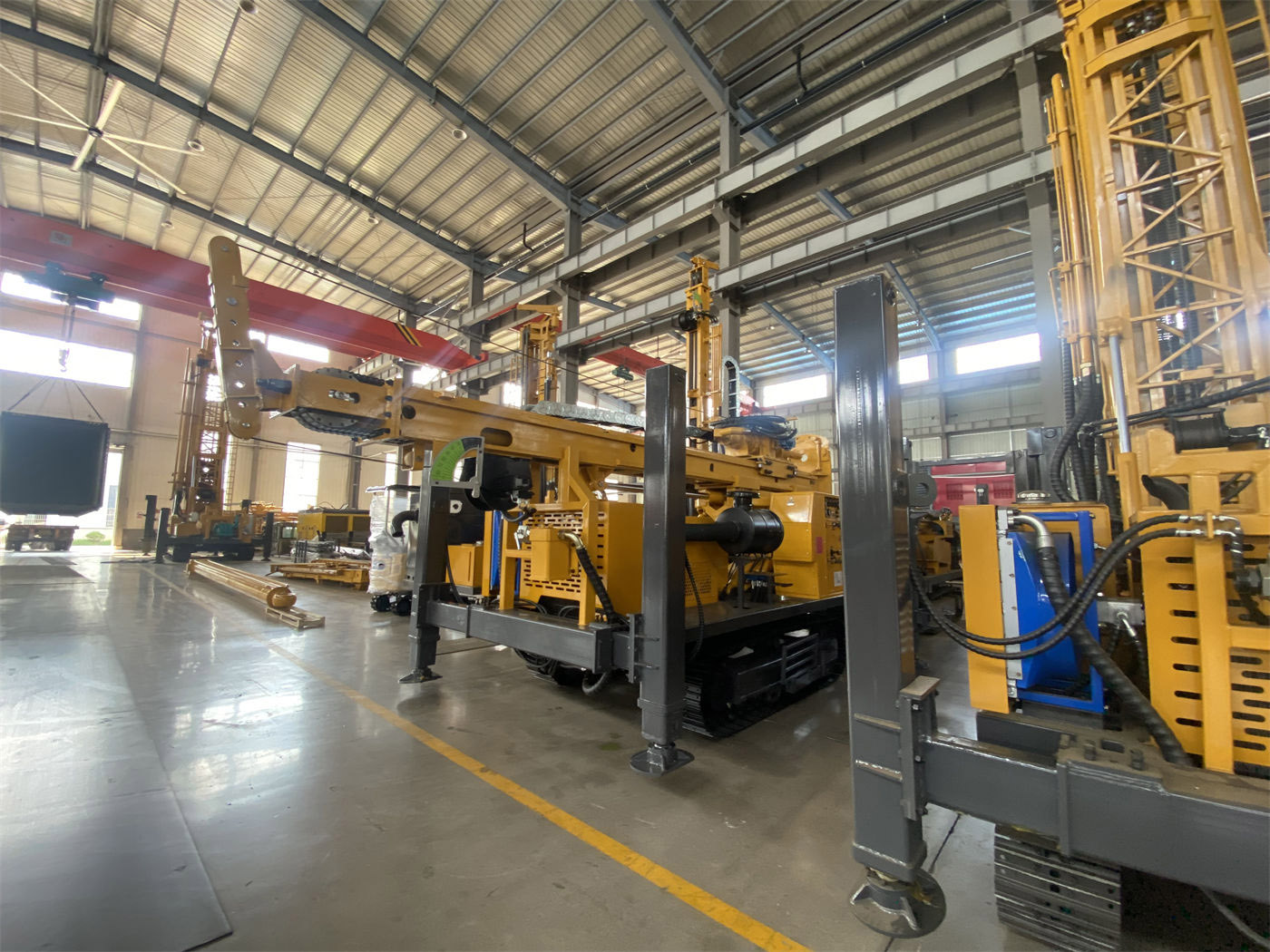
Drill pipe: choosing 3 m or 6 m affects the rod-connection rhythm
This machine supports 3 m and 6 m drill pipes, with recommended drill pipe diameters of 89 / 102 mm. 6 m drill pipes reduce the number of rod connections and suit projects requiring continuous drilling, such as contiguous farmland and connected irrigation wells; 3 m drill pipes are better for well sites with ordinary transport conditions and limited space. Drill pipe length does not change the machine's maximum drilling depth, but it affects effective drilling time within a day and on-site organization. As hole depth increases, drill pipe weight and hole-wall friction rise together; the 16 T lifting force can cover tripping and part of casing operations in most 350 m-class projects, but when abnormal tripping resistance occurs, the hole should first be cleaned, the drill pipe checked and the hole-wall condition judged, rather than relying on maximum lifting force to pull back forcibly.
Hole stabilization and completion: reaching depth does not mean the well is usable
The data clearly states that this machine is suitable for loose formations and rock formations. The upper soil layer, clay, sand layer and sand-gravel layer can use mud rotary, casing or other hole-stabilization methods, and after entering weathered rock and intact rock, it can switch to DTH hammer drilling. At the completion stage, the well diameter, filter pipe and sealing section should be determined according to aquifer burial depth, planned water output and pump type. The drilling diameter of 105–350 mm provides room for completion design, but whether the well can produce water and how much it produces depends on local hydrogeological conditions—a judgment that equipment capability cannot replace.
When is a larger class of equipment truly needed
If the target hole depth clearly exceeds 350 m, or under the same formation conditions lifting force repeatedly approaches the upper limit and rotary torque stays at maximum for long periods, it means the capability margin of this machine is no longer sufficient and there is a basis for stepping up in class. Conversely, if the problems are concentrated in cuttings return, hole-wall stability or rod-connection rhythm, it is more reasonable to address the support equipment first.
Before purchasing or requesting a quotation, it is recommended to clarify the following information:
- Drilling purpose: farmland irrigation, rural water supply, livestock farm water or general engineering water wells; different purposes require different well diameters and completion structures.
- Target hole depth and target hole diameter: provide design values, not just "the deeper the better."
- Formation data: thickness of the upper overburden, rock type, presence of fractured broken zones and depth of the main aquifer.
- Drilling method: mud rotary, DTH hammer or switching between the two, which determines the air compressor, mud pump and drilling tool configuration.
- Site access and relocation conditions: road width, ground bearing capacity, slope and well-site spacing, which relate to transport arrangements for the crawler chassis and the complete machine of about 7.5 T and dimensions of about 5.78 × 1.7 × 2.25 m.
- Water, power and air supply conditions: whether a generator or foam pump is needed, who provides the air compressor, and whether parameters match.
- Completion materials: whether well pipe, filter pipe, sealing material and casing plan have been determined.
Answer these questions clearly first, then compare them with the equipment's rated capability, to judge whether supplementing the support equipment is enough or whether a machine with greater drilling depth is truly needed. Rated drilling depth is the starting point for selection, not a guarantee of construction results.