












On mountainous solar sites, pile positions are often laid out along the slope, with elevation differences between piles in the same group and fore-aft positions not necessarily on the same straight line. After the machine is stabilized, whether the drilling tool can align with the hole depends on the range of mast attitude adjustment, not on frequent machine repositioning. Treating attitude adjustment as a solution to all alignment problems is unreliable: it addresses deviations within a certain range, and beyond that range the undercarriage must still be moved. Based on verified information for a tracked solar pile driver, the following explains which range each attitude adjustment covers and under what conditions alternative arrangements are needed.
First distinguish three types of deviation: elevation difference, lateral offset, and fore-aft offset
Alignment difficulties caused by uneven ground can be broken down into three directions. First is the elevation difference between pile positions, which requires changing the drilling tool's pitch angle to align. Second is the lateral deviation between the drilling tool and the pile position after the machine is stabilized, which requires left-right adjustment. Third is the fore-aft distance deviation, where the machine does not need to restart but the drilling tool must compensate forward or backward. In the PV390 information, the 120° mast pitch corresponds to the pitch direction, the dual-cylinder left-right swing arms correspond to the lateral direction, and the 50 cm fore-aft telescoping compensation corresponds to the longitudinal direction. Together, these three actions constitute the capability range of attitude adjustment.
The 120° mast pitch covers angle, not elevation difference itself
The mast pitch range is specified as 120°, meaning the drilling tool can change its pitch attitude within a relatively large angle range to meet the angle requirements of slope pile positions. However, an angle range is not an elevation difference range: at the same pitch angle, the actual position reached by the drilling tool differs when the mast extension distance differs. Therefore, to judge whether a slope position can be aligned by pitch, one must consider the slope angle, the horizontal distance from the machine's standing position to the pile position, and the mast extension state together, not just the pitch angle. The information does not provide the maximum alignment height difference at different pitch angles; this should be confirmed based on on-site measurements before entry.
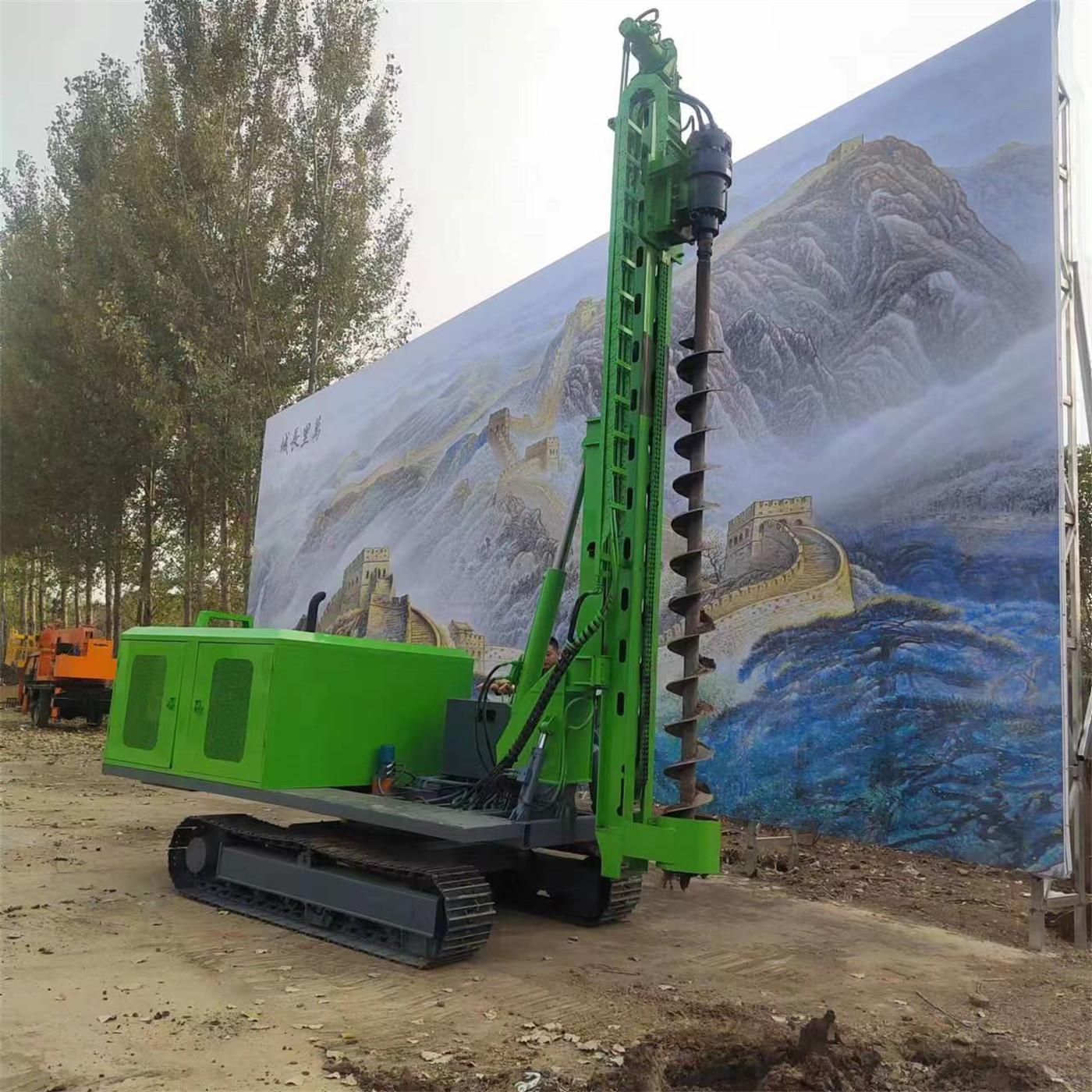
Left-right swing arms and fore-aft telescoping: reducing one repositioning after the machine is stabilized
The dual-cylinder left-right swing arms are used to adjust the lateral position of the drilling tool after the machine is stabilized, and the 50 cm fore-aft telescoping compensation is used for longitudinal fine adjustment. During continuous pile construction, the value of these two actions is that when deviations fall within the range reachable by the swing arms and telescoping, the machine can complete alignment for adjacent pile positions from the same standing position, reducing the cycle of starting, traveling, and stabilizing again. For solar sites with dense, regularly arranged pile positions, this directly affects construction rhythm; however, the available swing arm angle and telescoping stroke vary with the mast pitch state, and the actual compensable distance must be calculated according to working conditions. The 50 cm should not be understood as fully usable at any attitude.
When attitude adjustment cannot cover the situation, machine repositioning is still necessary
The following situations are conditions that attitude adjustment alone is difficult to resolve and where machine repositioning should be considered:
- The elevation difference between adjacent pile positions exceeds the range the mast pitch can cover at that standing position;
- The lateral deviation exceeds the available swing angle of the left-right swing arms, and forced adjustment would shift the machine's center of gravity;
- The fore-aft deviation exceeds the 50 cm telescoping compensation stroke, and the relative position of the drilling tool and mast is near its limit;
- The slope has a significant cross slope, and the machine itself needs to adjust its standing position first to ensure stability.
These situations do not mean the machine cannot work, but indicate that the boundary of attitude adjustment depends on standing position selection. Parking the machine where it can cover multiple pile positions is more effective than repeatedly adjusting in front of each pile position.
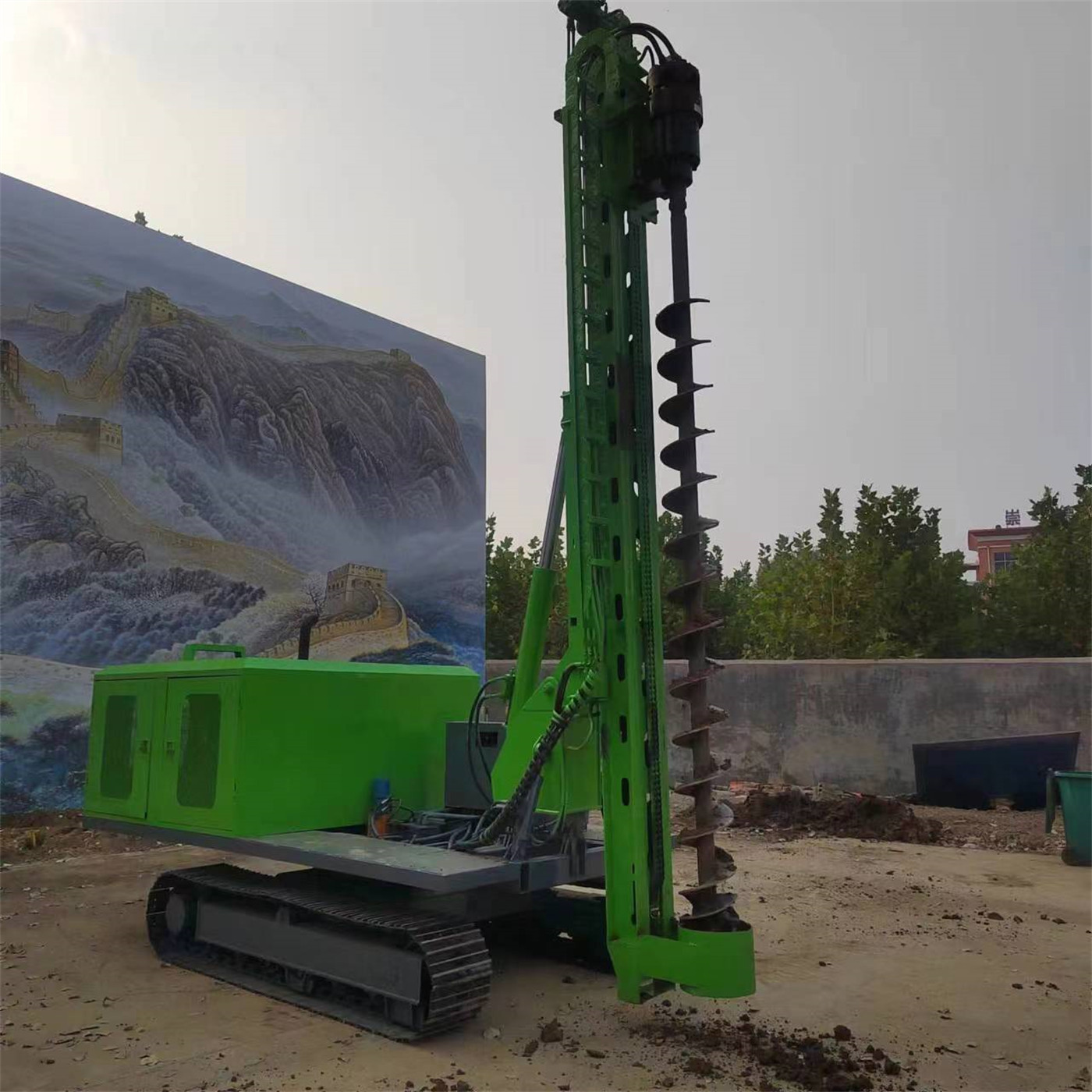
Undercarriage and travel conditions determine whether attitude adjustment can be used
The PV390 uses a tracked undercarriage with 400 mm track shoe width, and the information specifies a climbing angle of 35°. The track structure is suitable for short-distance movement on unpaved ground within solar construction sites, and the 400 mm track shoes help distribute ground pressure. However, 35° is the specified climbing angle; actual slope travel also depends on cross slope, soil moisture, surface slipperiness, and machine center of gravity, and this value alone cannot determine whether a slope section can be safely traversed. If the machine cannot safely reach near the pile position, even the largest mast attitude adjustment range is unusable, so entry routes and standing position selection should be determined before alignment methods.
Formation and hole depth conditions also constrain the actual effect of attitude adjustment
The machine has a drilling diameter of 80–600 mm, drilling depth of 0–6 m, reducer torque of 13000 N·m, drill pipe speed of 90 r/min, chain feed, and power from an 85 kW four-cylinder engine. In conventional solar foundation formations such as soil and loess, drilling resistance is relatively controllable, and drilling can start after attitude adjustment and alignment; in clay, attention should be paid to bit balling and cuttings removal; in pebble sand and backfill debris layers, bit bouncing, hole deviation, or sticking may occur, and even with correct attitude, the drilling process may still require tripping out for inspection. The information states that after changing to impact drilling tools, it can be used for strongly weathered rock and rock formations, but the impact hammer model or impact energy is not provided, and actual efficiency under hard rock conditions must be confirmed separately based on drilling tool configuration and rock properties.
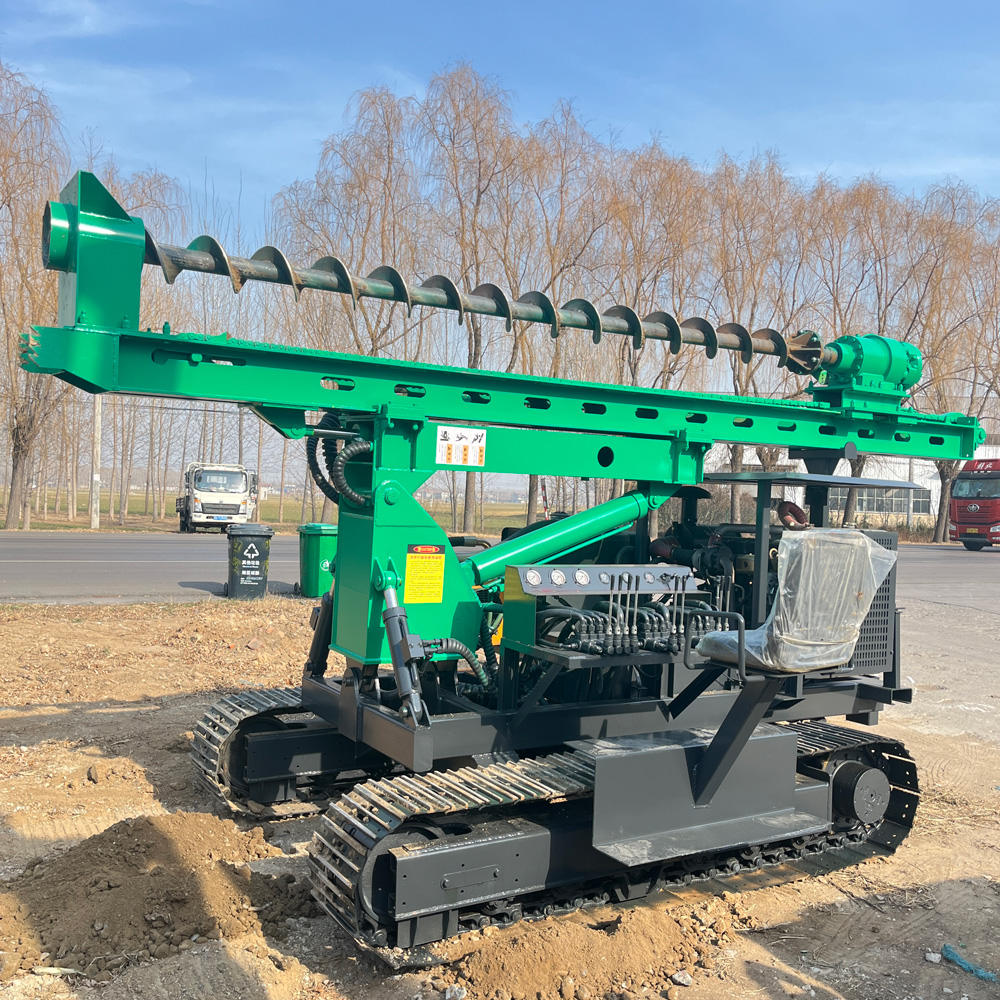
Several conditions to check before entry
| Check item | Purpose |
|---|---|
| Pile elevation difference and slope angle | Determine whether mast pitch can cover it and whether standing position adjustment is needed |
| Pile lateral and fore-aft deviation | Compare with swing arm angle and 50 cm telescoping stroke to confirm whether within compensation range |
| Ground bearing capacity and cross slope at machine standing position | Determine whether the tracked undercarriage can park stably and avoid machine instability during attitude adjustment |
| Underground cables, pipelines, and obstacles | Must be confirmed before pre-drilling; attitude adjustment cannot replace underground obstacle investigation |
| Formation type and target hole diameter | Determine drilling tool selection and feed control, affecting drilling arrangements after attitude alignment |
The first two items in the table determine whether attitude adjustment can complete alignment independently; the latter three are construction organization and safety conditions, and drilling should not proceed directly if any is missing.
Site information to provide when requesting a quote
When requesting a quote for solar foundation pre-drilling equipment, it is recommended to provide: pile type and foundation form, target hole diameter and depth, site slope elevation difference and cross slope conditions, formation description (soil, loess, clay, pebbles, or backfill, etc.), whether strongly weathered rock is present and its thickness, equipment entry road and transfer distance, on-site power supply or fuel supply conditions, and whether impact drilling tools are needed. This information determines whether attitude adjustment can cover site conditions and whether a separate machine repositioning plan is needed. Specific pile position alignment height differences and hard rock drilling efficiency not covered by the information should be confirmed during site survey or trial drilling.