












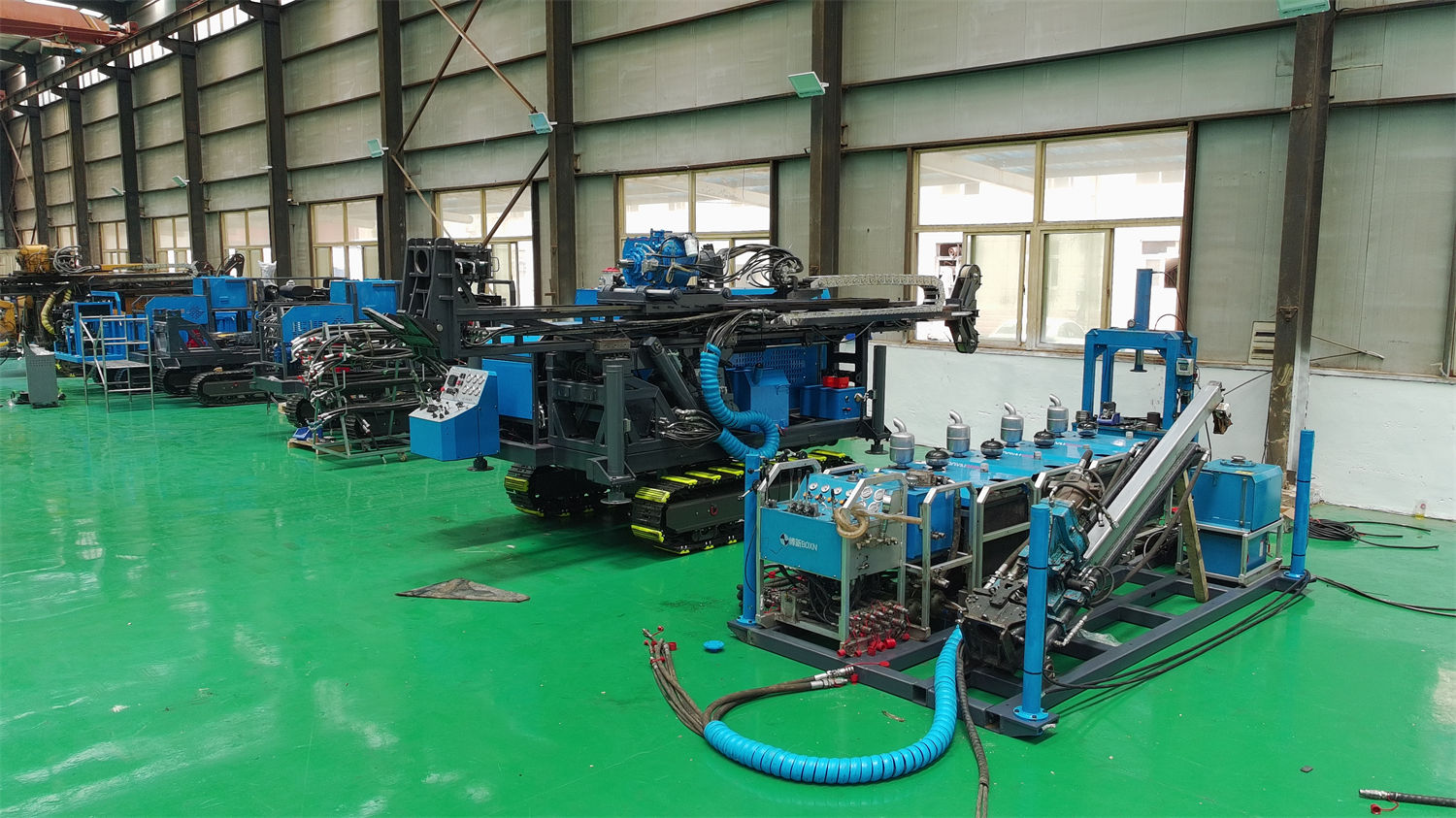
The CR1000I is a 1000m fully hydraulic integrated crawler core drill rig. Its power head has a maximum torque of 1200 N·m and a maximum rotation speed of 1350 rpm, a drilling angle of 45°–90°, a reference drilling depth of 1000 m for N-size, 1200 m for B-size, and 500 m for H-size. When purchasing it for a specific orebody, two questions usually need to be clarified first: whether the orebody dip matches the drilling angle range, and whether the 1200 N·m torque has sufficient margin for the target hole depth and drill string specifications. The following is based on the product information on this website.
1. The 45°–90° drilling angle is a range, not a recommended angle
According to the information, the CR1000I supports drilling within the 45°–90° range. This range means the equipment can arrange inclined holes to near-vertical holes, but it does not mean that every angle is equally suitable under all orebody conditions. Before procurement, the orebody attitude, the designed intersection position, and the collar site conditions need to be considered together, rather than judging whether the equipment can meet the geological target solely by the angle range.
Organizing hole layout requirements according to orebody dip
- For inclined orebodies, faults, veins, and layered mineralized zones, the information points out that a reasonable inclined hole angle is often more important than simply increasing depth.
- In exploration of quartz vein-type gold deposits, structurally altered gold deposits, and concealed orebodies, the information recommends arranging inclined or near-vertical holes within the 45°–90° range to intersect the mineralized zone at a more reasonable angle.
- For spodumene pegmatite, rare metal deposits, and vein-type orebodies, the drilling focus is usually to verify the thickness, dip direction, dip angle, and deep extension of the dyke, which can be achieved through drilling at different angles combined with continuous core collection.
The information does not provide a unique formula for matching a specific orebody dip to a specific drilling angle. During the inquiry stage, buyers can first organize the attitude range of the target orebody, the planned intersection position, and the allowable azimuth conditions at the collar, then confirm with the manufacturer the mast angle adjustment range, collar layout, and the impact of inclined hole construction on drill rods and core barrels.
Basis for choosing between inclined and near-vertical holes
The value of an inclined hole lies in allowing the drill hole to intersect the target body at a more reasonable angle; the advantage of a near-vertical hole is relative simplicity in site layout, drill string gravity direction, and downhole resistance. The information does not provide efficiency comparison data between the two methods, so the procurement judgment should return to the geological target itself: if the hole deviates from the target body or the intersection interval is too short, simply increasing depth may not replace angle design. In the procurement technical agreement, this is best specified in the form of designed hole direction and allowable angle deviation.
2. Correspondence between 1200 N·m torque and drilling depth, drill string specifications
The CR1000I power head uses gear transmission, with a maximum torque of 1200 N·m, a maximum rotation speed of 1350 rpm, a gear ratio of 1:3, and hydraulic side shift. The information states that this configuration can meet the higher rotation speed requirements of intermediate-deep hole diamond coring while retaining torque margin to handle changes in downhole resistance. It should be noted that the torque upper limit and the drillable depth are not in a one-to-one correspondence; actual capability is also affected by drill string specifications, drilling angle, formation conditions, and downhole resistance.
Reference drilling depth by specification
| Core size | Reference drilling depth |
|---|---|
| B-size | 1200 m |
| N-size | 1000 m |
| H-size | 500 m |
The three items in the table are reference values given in the model parameters on this website. The same equipment has different reference drilling depths under different core sizes. During procurement, the 1200 m for B-size cannot be directly equated with the operating capability for H-size, nor can the 1000 m for N-size be simply applied to all hole diameter combinations.
Several parameters that need to be checked together with torque
- Feed force 63 kN, pull force 185 kN: The information mentions that as hole depth increases, drill string weight, borehole wall friction, and the risk of sticking in complex formations all rise. The 185 kN pull force provides capability reserve for deep hole tripping, handling downhole resistance, and tool recovery.
- Clamp through-hole diameter 127 mm, suitable for drill rods NQ, HQ, PQ, NTW, HTW: During procurement, the planned drill string specifications need to be compared item by item with the clamp application range.
- Drill rod handling lengths 1.5 m, 2 m, 3 m: These need to be checked together with the on-site drill rod configuration, mast, and collar operating space.
- Hydraulic side shift: The information states that after the power head side shift, more direct operating space is provided for collar operations, drill rod handling, and maintenance.
3. Procurement confirmation points for the integrated crawler chassis, winch, and mud system
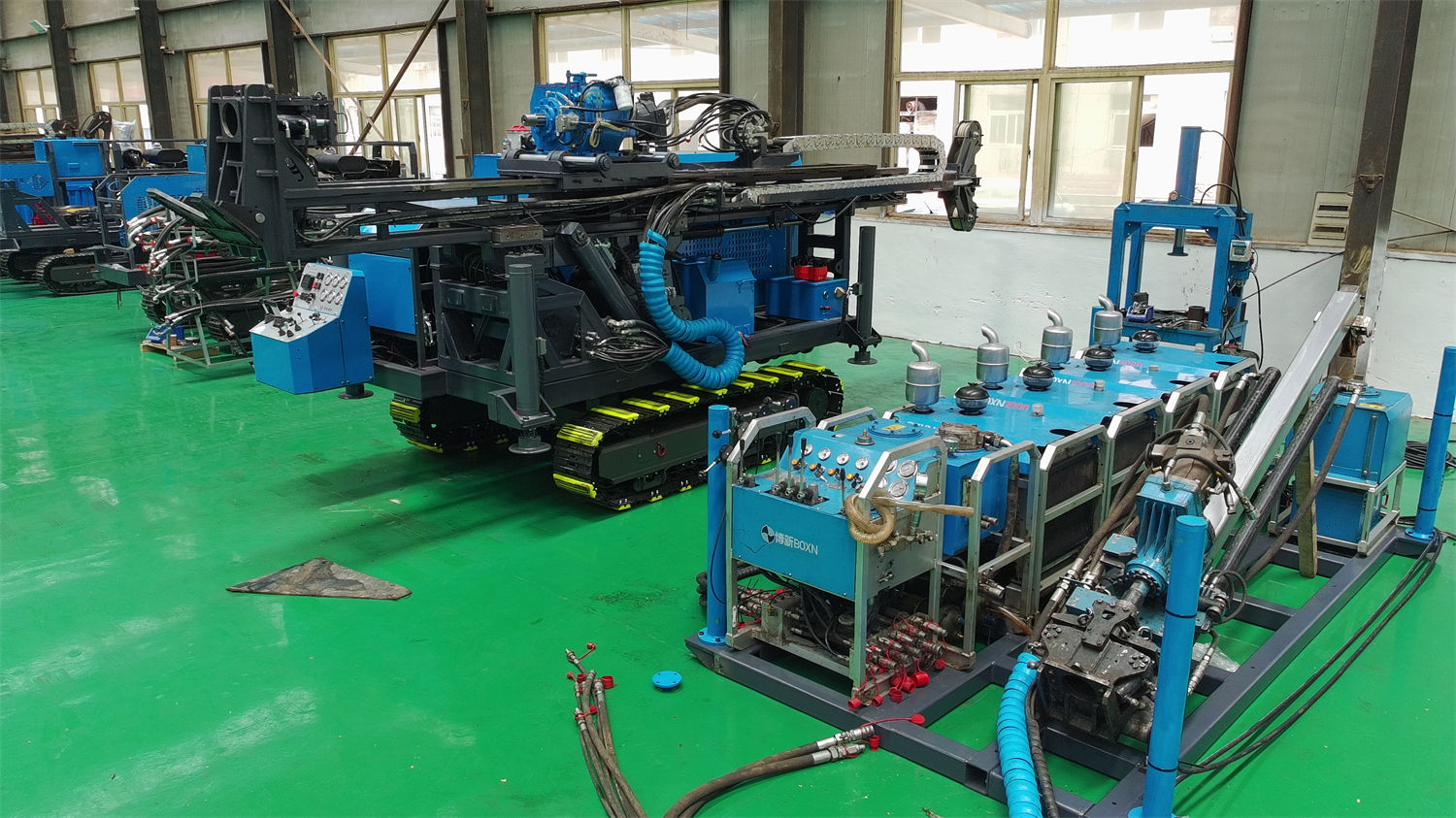
The CR1000I integrates the power assembly, hydraulic system, power head, mast, winch, clamp, and mud circulation system on the same crawler platform. The information states that this reduces on-site disassembly and module connection work, making it more suitable for exploration projects with frequent hole position changes, continuous construction, and multi-area advancement. The crawler chassis is easier to move on mining area roads, gravel ground, mountain platforms, and not fully hardened sites.
Winch and wireline coring process
The winch system uses a 6 mm wire rope, with a rope capacity of 1000 m, a lifting force of 13 kN, and a lifting speed of 98 m/min. The information points out that combined with the wireline coring process, it can reduce the time required to trip the entire drill string for each core run, making it suitable for continuous core collection, deep geological recording, and projects that need to improve single-hole operating efficiency. During procurement, it should be confirmed whether the on-site drill string matches the wireline coring process, and the supply scope of consumables such as wire rope and overshot tools.
Mud system boundaries
The mud system has a flow rate of 150 L/min, a pressure of 7 MPa, a rotation speed of 295 rpm, and a power of 21 kW. It can be used for drill bit cooling, carrying rock cuttings, stabilizing the borehole wall, and improving circulation conditions in complex formations. The information also reminds that when encountering strongly weathered, broken, leaking, or locally water-bearing layers, mud properties, circulation volume, and wall protection measures should be adjusted according to formation conditions, rather than using a single fixed parameter. Before procurement, it is necessary to confirm with the manufacturer whether the mud pump is compatible with the planned circulation method and wall protection scheme.
Hydraulic and power configuration
- Main pump flow 250 L/min, pressure 25 MPa; auxiliary pump flow 80 L/min, pressure 17 MPa; cooling method is air cooling plus water cooling.
- The engine is Cummins QSB4.5, displacement 4.5 L, rated power 119 kW, rated speed 2200 rpm, 4-cylinder turbocharged direct injection, water-cooled, electrical system 24 V.
- The information indicates that temperature control, filtration status, and oil cleanliness of the hydraulic system directly affect the stability of the power head, actuators, and control valves. On-site maintenance should focus on hydraulic oil contamination and heat dissipation conditions.
4. Working condition and specification checklist recommended before procurement
The information lists items to be verified in the selection notes, which can be organized into a preparation checklist before inquiry:
- Site access conditions: road width, slope, site bearing capacity, and drilling platform dimensions.
- Drilling design: target hole depth, hole diameter, drilling angle, and azimuth.
- Formation conditions: distribution of intact hard rock, strongly weathered layers, loose overburden, fault fracture zones, leakage, or aquifers.
- Drill string and coring system: planned N, H, or other sizes; whether drill rod length and clamp through-hole match.
- Consumables and accessories: drill rods, core barrels, drill bits, mud materials, and wireline coring related tools.
- Maintenance items: inspection arrangements for wire rope, clamp, power head, hydraulic filters, and high-pressure lines.
The information clearly states that due to differences in actual geological conditions, downhole tools, drilling angles, and operating methods, the final drilling efficiency, drilling depth, and core recovery results should be based on on-site working conditions. Therefore, the 1200 N·m torque and 45°–90° angle range should be taken as a starting point for procurement verification, not as a commitment to specific project results. The information does not cover price, delivery cycle, certification, or specific customer cases; these need to be confirmed separately in the commercial and technical agreement stage.