












Before construction starts on a slope PV project, the crew usually encounters a specific problem: pile positions are distributed along the slope, and the left and right tracks land at different heights. Ordinary fixed-chassis equipment either requires repeated leveling or struggles to align the drill mast with the pile position angle. High-low leg adjustment is precisely a posture adaptation method for such sites, but what it handles is equipment posture, not all site conditions. Based on verified information about the high-low leg hydraulic PV pile driver, the following separates "what adjustment can cover" from "what adjustment cannot cover."
First, clarify which types of site height differences the adjustment actions correspond to
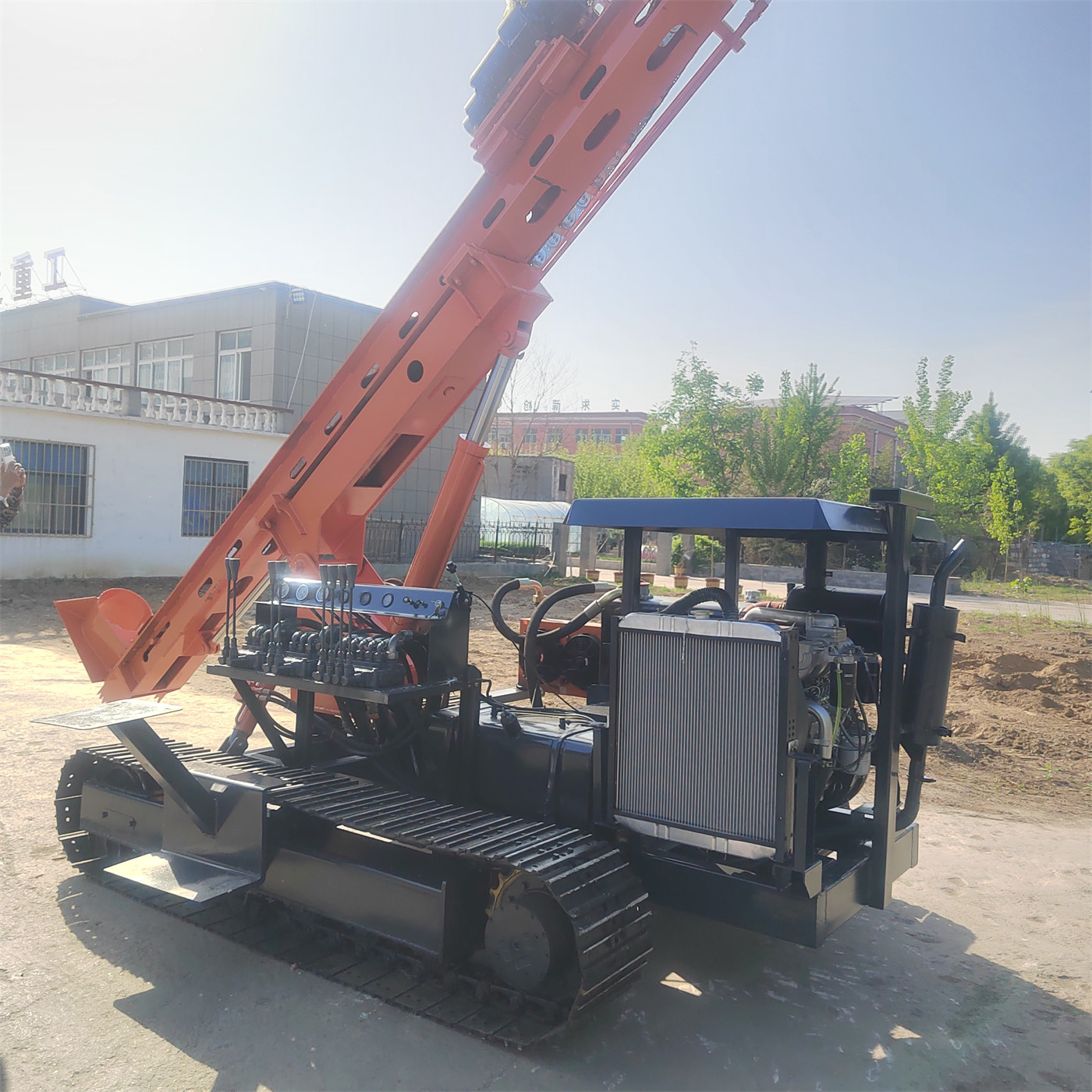
This model is a crawler-type high-low leg hydraulic PV pile driver with a track height telescoping dimension of 1200 mm and a mast pitch range of 120°. These two actions correspond to two different directions of problems: track height adjustment handles ground height differences between the left and right sides, enabling the machine body to obtain a relatively stable support posture on uneven ground; mast pitch handles the angle between the drilling axis and the slope surface, allowing the drilling tool to enter the strata according to pile position requirements. The two cannot substitute for each other—track leveling does not change hole direction, and mast angle adjustment does not solve unilateral suspension of the chassis.
In addition, there are two lateral and longitudinal fine-tuning actions: dual-cylinder left-right swing arms for lateral hole alignment after the chassis is stabilized, and 450 mm telescoping compensation for fine adjustment of the working mechanism in the front-back direction. In array-type sites with dense pile positions, combining these actions can reduce the time spent repeatedly moving the entire machine for each pile position.
Conditions that high-low leg adjustment can cover
- Significant left-right height differences on the slope: the 1200 mm track height telescoping range can handle typical slope positioning scenarios where one side is higher and the other is lower.
- Pile position angles vary with the slope: the 120° mast pitch can adjust drilling posture over a wide range, reducing repeated chassis movement to find the angle.
- Dense pile positions requiring lateral fine-tuning: dual-cylinder left-right swing arms allow hole alignment after the equipment is stabilized, suitable for array-type pile layout.
- Small corrections needed in the front-back direction: 450 mm telescoping compensation is used for front-back fine-tuning of the drilling rig's working mechanism.
- Short-distance transfers within the site: track shoe width is 300 mm, and the crawler chassis is suitable for movement on unpaved surfaces such as dirt roads, grass, and gravel.
- Auxiliary movement on steeper slopes: documentation states that adding a winch allows use on steeper slope conditions, but this is movement assistance, not a substitute for construction posture.
Conditions that adjustment cannot cover and that require separate verification
High-low leg adjustment changes the machine body posture. The following items are outside its coverage and must be separately confirmed before entering the site:
Foundation bearing capacity and slope stability
Documentation explicitly states that the high-low leg function cannot replace a safe construction platform and foundation bearing capacity assessment. When soil adhesion on slope layers decreases after rain, track ground contact conditions and the risk of the entire machine sliding need on-site judgment; in soft soil, wet slippery slopes, and areas with large cross-slopes, even if posture can be leveled, travel speed should be reduced and rollover risk monitored. Excessive unilateral adjustment can also cause the center of gravity to shift; before adjusting track height, ensure the equipment is at low speed or stopped, and observe nearby personnel and obstacles.
Construction roads and work platforms
Being able to adjust posture does not mean every pile position can be reached directly. Travel paths between pile positions, turning space, and platform width still need to be verified against the overall machine dimensions of 5200 × 2300 × 2800 mm. Documentation does not provide minimum turning radius or gradeability values; these two items should be confirmed with the supplier before model selection or site entry.
Strata and drilling tool matching
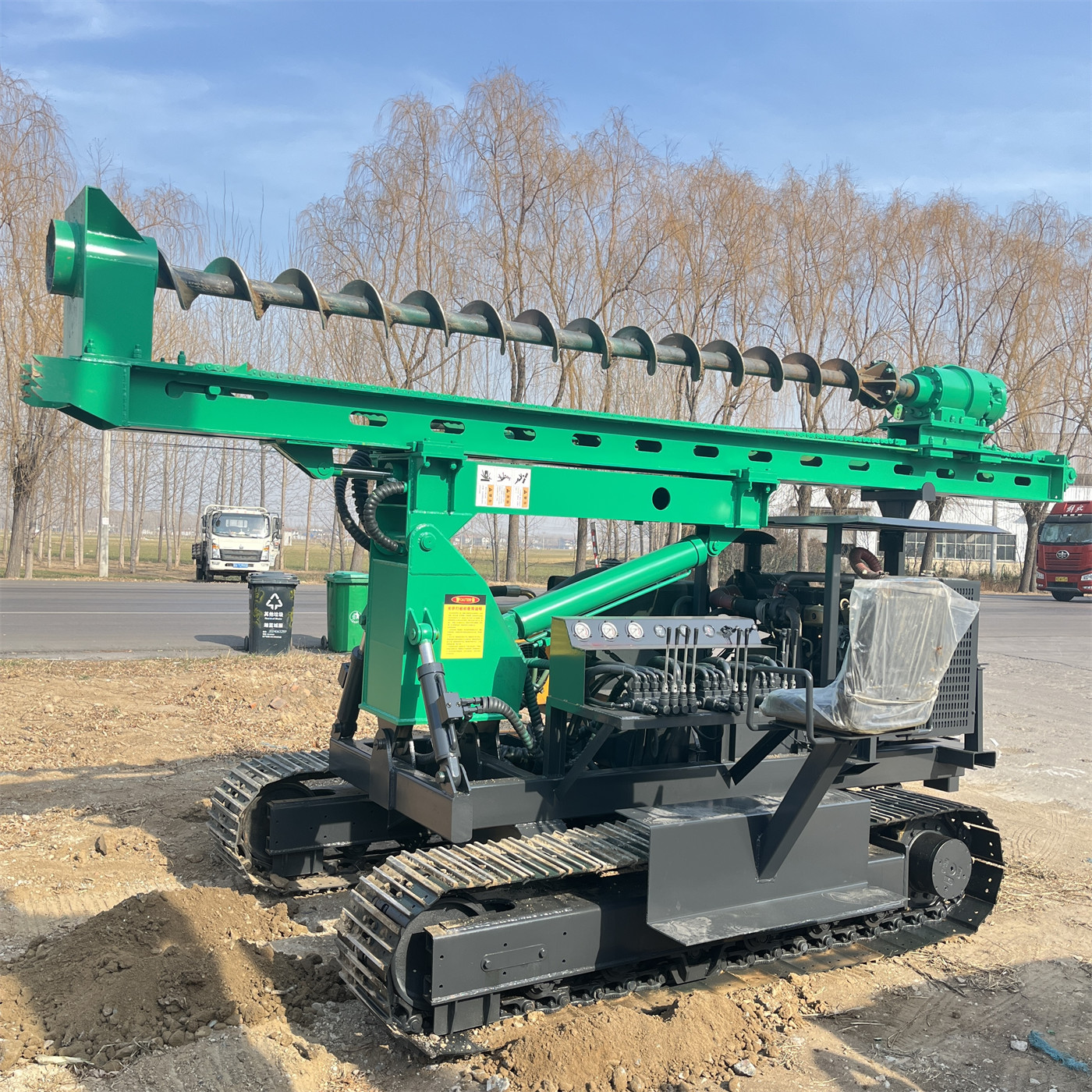
Posture adjustment does not change strata conditions. The applicable strata listed in the documentation include soil, loess, clay, cobble sand and mixed overburden, and backfill waste layers; after changing to impact drilling tools, it can be used in strongly weathered rock and rock layers. Among these, clay easily balls up on the drill and requires timely lifting and cleaning; cobble layers easily cause drill bit bouncing and hole deviation; backfill waste layers contain foreign objects such as bricks and rebar, and abnormal impact or rotary jamming should prompt shutdown and inspection. These responses depend on drilling tool selection and advancement control, and are unrelated to the high-low legs.
Hole diameter and hole depth range
This model has a drilling diameter of 80–600 mm and a drilling depth of 0–6 m, equipped with a 13000 N·m reducer torque and 100 r/min drill pipe rotation speed. The upper limits of hole diameter and hole depth are equipment capability boundaries. The final hole diameter and depth used should be based on the project foundation design drawings and construction process; requirements beyond the range cannot be compensated by posture adjustment.
Correspondence between posture adjustment and drilling capability
| Site Condition | Corresponding Equipment Feature | Items Still Requiring Confirmation |
|---|---|---|
| Left-right track landing height difference | Track height telescoping 1200 mm | Foundation bearing capacity, unilateral adjustment range, center of gravity state |
| Slope drilling angle | Mast pitch 120° | Whether the drilling axis matches the design pile position angle |
| Lateral pile position offset | Dual-cylinder left-right swing arms | Whether the chassis stop position and swing arm stroke are sufficient |
| Front-back pile position fine-tuning | 450 mm telescoping compensation | Adjustable space after matching with drilling tool length and pile position layout |
| Movement within the site | Track shoe width 300 mm | Travel safety in soft soil, wet slippery slopes, and cross-slope areas |
The first four items in the table are posture and alignment adjustments, and the fifth is travel passability; together they determine whether the equipment can be positioned on the slope, but none of them changes the constraints of strata, hole diameter, and hole quality themselves. In terms of power, a 130 kW six-cylinder turbocharged engine provides power for travel, rotation, chain pressurization, and posture adjustment. Larger hole diameters and dense strata require higher power reserves, but the documentation does not provide actual drilling efficiency under different strata, so specific work efficiency cannot be inferred from this.
Information to verify before procurement and site entry
If considering this model for slope PV pile foundations, it is recommended to provide the following information during the inquiry stage to help the supplier assess applicability:
- Project use and pile type: PV support pre-drilling, pile position pilot holes, or other shallow foundation works.
- Strata information: distribution and thickness of soil, loess, clay, gravel, backfill layers, or strongly weathered rock.
- Target hole diameter and depth: whether they fall within the 80–600 mm and 0–6 m range.
- Site conditions: slope height difference range, cross-slope conditions, access road width, available work platform area.
- Construction organization: pile position density, transfer frequency, whether a winch is needed for steeper slope movement assistance.
- Items to confirm: minimum turning radius, gradeability, winch configuration and optional conditions, impact drilling tool models and matching requirements.
High-low leg adjustment is a clear posture adaptation capability, but it only answers the question of "whether the equipment can stand stably on uneven ground and align with the pile position." Foundation stability, road access, strata and drilling tool matching, and hole diameter/depth boundaries still need to be verified item by item according to project data; performance items not covered by the documentation should be raised as conditions to be verified before procurement, rather than extrapolated from the adjustment range.