












Once mine water supply wells enter the kilometer range, discussions about equipment are most easily led astray by a single number: maximum drilling depth. What really troubles drilling crews is often another question—does this drilling site rely on diesel or on the power grid? Remote mining areas and desert exploration sites usually can only bring fuel; fixed mine drilling sites and long-term operations in industrial parks may already have a stable power source. The requirements these two types of conditions place on the overall rig configuration are not the same, and this judgment often has to be made before equipment selection.
This article unfolds in this order: first, look at the energy supply conditions and operational constraints of deep-hole mine water supply wells; then, examine to what extent a dual diesel-electric configuration can adapt; finally, list which features in the equipment documentation correspond to these needs, and which parameters still need to be verified project by project.
The first question for deep-hole water supply wells is not "how deep can it drill"
The goal of mine water supply wells is generally clear: to provide a stable water source for domestic use, dust suppression, equipment cleaning, or auxiliary production. As well depth increases, more conditions come into play—the location of deep aquifers, hole diameter and well casing specifications, drill string weight, casing weight, borehole wall stability, and power assurance under long-cycle continuous operation.
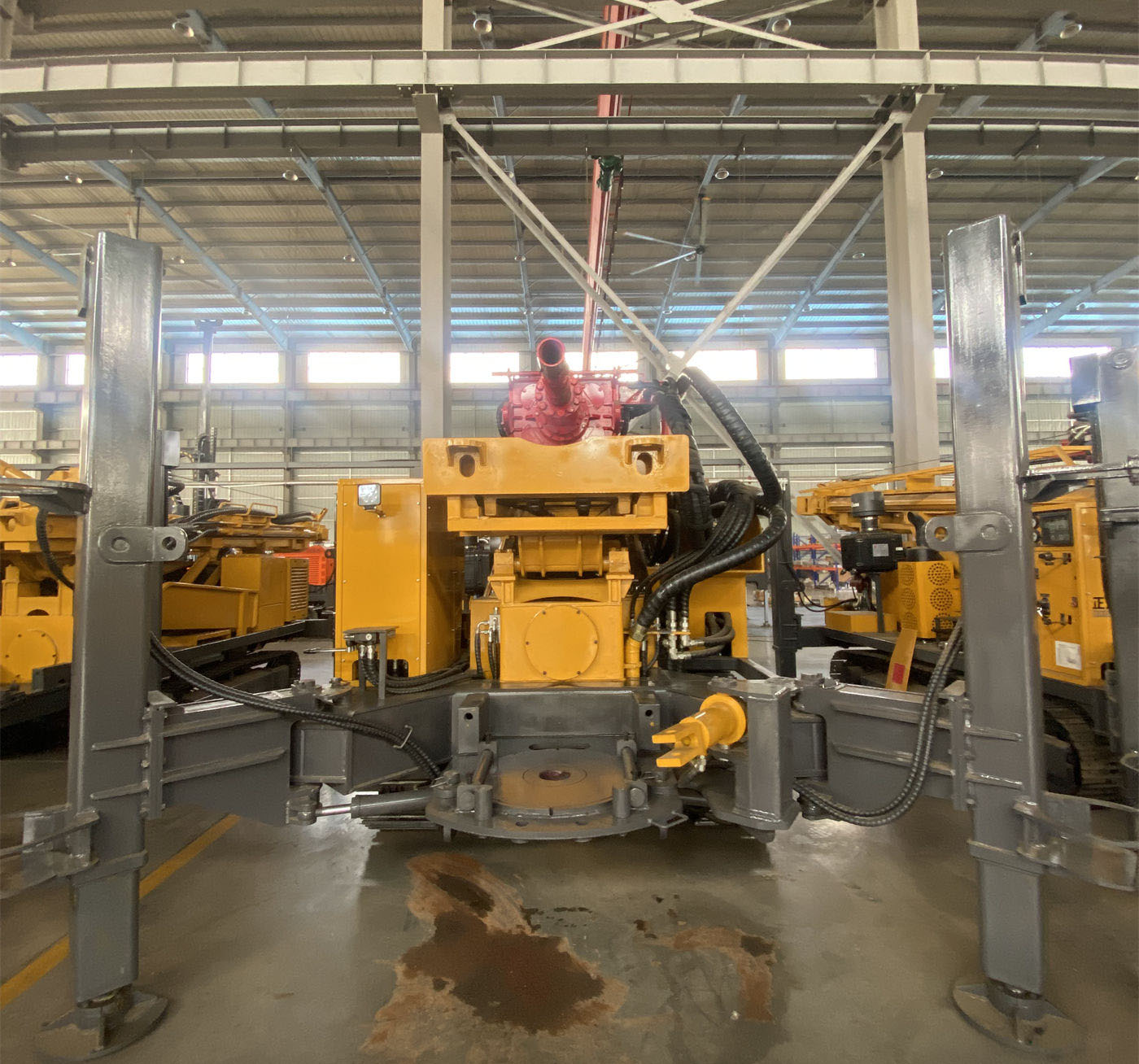
Among these conditions, the form of energy supply is the one decided earliest and hardest to change later. The diesel solution is highly autonomous, but fuel logistics, exhaust emissions, heat dissipation, and noise all need to be included in on-site management; the grid solution offers more stable operating conditions, but voltage, frequency, transformer capacity, cable laying distance, and starting current must be confirmed before work begins. The two are not simply a matter of "which saves more money," but of whether the site has the conditions to use them.
Dual diesel-electric configuration addresses exactly this difference in conditions
The 1200-meter-class crawler water well rig associated with this article adopts a dual diesel/electric power configuration and can be configured between diesel and electric solutions according to site conditions. The value of this feature lies not in the parameter table but in project organization: in field conditions without power, it retains independent diesel construction capability; at fixed mine drilling sites or long-term projects with a stable grid, it can switch to an electric solution, providing an option to reduce fuel consumption and on-site exhaust emissions.
Note that the documentation also states that the final power, voltage, frequency, and starting scheme of the electric part should be determined according to the project's power supply system. In other words, dual diesel-electric is a configuration direction, not a guarantee that any grid condition can be used immediately upon connection. Transformer capacity, cable distance, and starting method are items to verify before implementation and cannot be simply converted from diesel engine power.
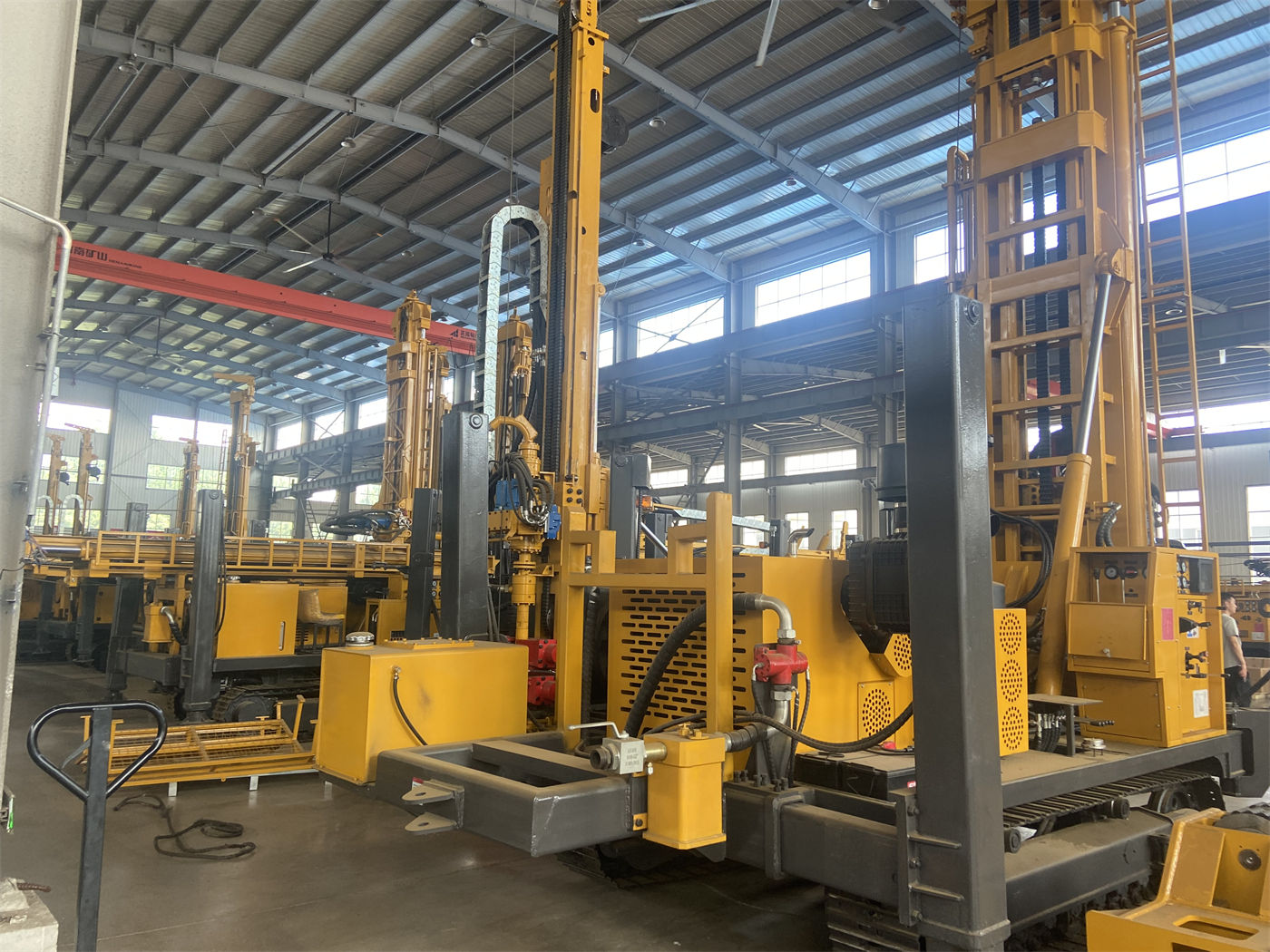
Deep-hole capability and energy supply conditions must be considered together
The equipment has a maximum drilling depth of 1200 m, a hole diameter of 105–900 mm, a lifting force of 60 T, rotary torque of 30000 / 15000 N·m, and diesel power of 264 kW. For kilometer-level water supply wells, these data indicate that the equipment has considerable depth reserve and large-diameter well completion capability, but actual drilling depth still needs to be determined in combination with hole diameter, formation, drill pipe, air compressor, and hydrogeological conditions. The nominal maximum drilling depth cannot be written as the completion depth under any formation.
Under deep-hole conditions, the drill string weight, borehole wall friction, and casing weight add up, significantly increasing the lifting load, and the 60 T lifting force leaves margin for this; however, in case of stuck pipe or hole shrinkage, the hole should still be cleaned first and the downhole condition assessed—equipment margin cannot replace downhole treatment. For pneumatic DTH hammer drilling, the recommended working air pressure is 1.65–8 MPa and air consumption is 16–120 m³/min. Deep holes with large diameters place simultaneous demands on air compressor displacement and pressure; if displacement is insufficient, even if pressure meets the requirement, there may be insufficient impact and difficult cuttings removal.
The telescopic mast and 9.6-meter drill pipe change two processes: relocation and pipe connection
The 1200-meter-class rig is large in both volume and weight, making transport organization more complex than for small and medium rigs. The telescopic mast shortens the transport profile during relocation and then extends to working height on site, improving loading, road passage, and internal site relocation conditions. This feature corresponds to the actual arrangements when mine sites have scattered hole positions and require continuous construction at multiple well locations.
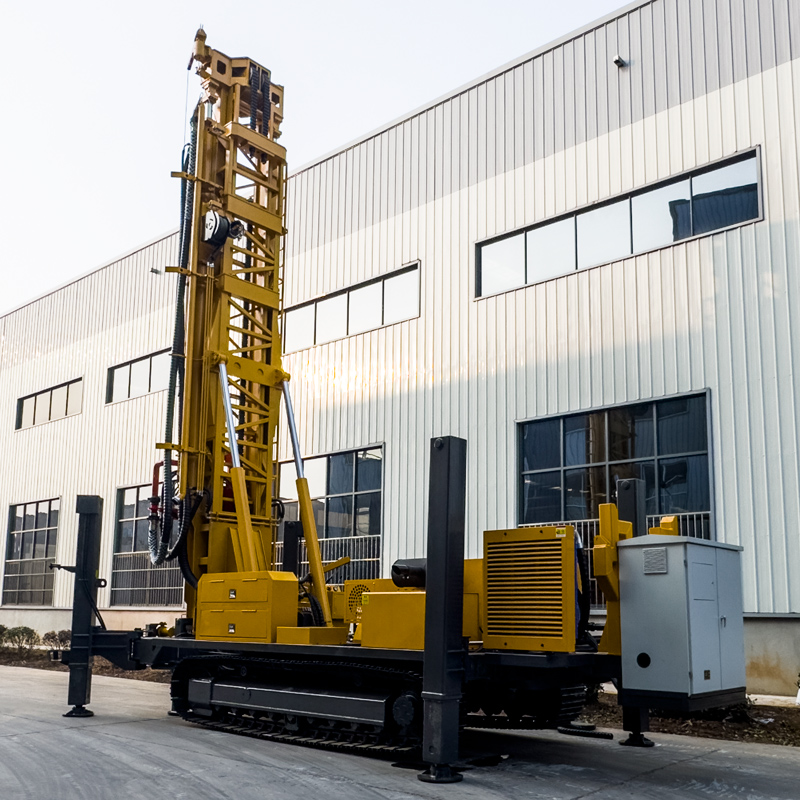
The equipment supports 9.6 m drill pipes, with recommended drill pipe diameters of 114 / 127 mm. For ultra-deep holes, frequent use of short drill pipes increases the number of connections, auxiliary time, and labor intensity; long drill pipes reduce connection frequency and are more suitable for long-cycle continuous construction. Fast lifting at 29 m/min and fast advancing at 51 m/min are mainly used for non-drilling actions such as power head return and drill pipe handling; the savings per single action are limited, but they accumulate continuously in kilometer-level projects.
Application boundaries and items still to be verified
- Drilling purpose and completion goal: drinking water, industrial water supply, dewatering holes, or geothermal investigation—well structure and casing schemes differ.
- Formation data: upper loose layers require mud rotary drilling, casing, or other wall protection methods; deep hard rock may consider medium-to-high pressure DTH hammers; fault fracture zones and strong water inflow sections require contingency plans.
- Power supply conditions: if an electric solution is adopted, voltage, frequency, transformer capacity, cable distance, and starting current need to be confirmed by the project power supply system.
- Supporting capabilities: air compressor pressure and displacement, drill pipe specifications, well casing and screen pipes, and water pump selection need to match hole diameter and water inflow.
- Site and transport: working space after mast extension, crawler chassis passage conditions, and auxiliary winch handling capacity (5 T and 2.5 T) corresponding to on-site lifting arrangements.
- Power maintenance: under continuous operation, engine cooling, air filtration, fuel system, and hydraulic oil temperature need to be included in daily management.
When requesting a quotation, it is recommended to provide: drilling purpose, formation and hydrological data, target hole depth and diameter, intended drilling method, whether the site has a stable power grid and its parameters, access road and site conditions, and air compressor and water/power support conditions. Only when this information is complete can the energy supply form and overall rig configuration be discussed.