












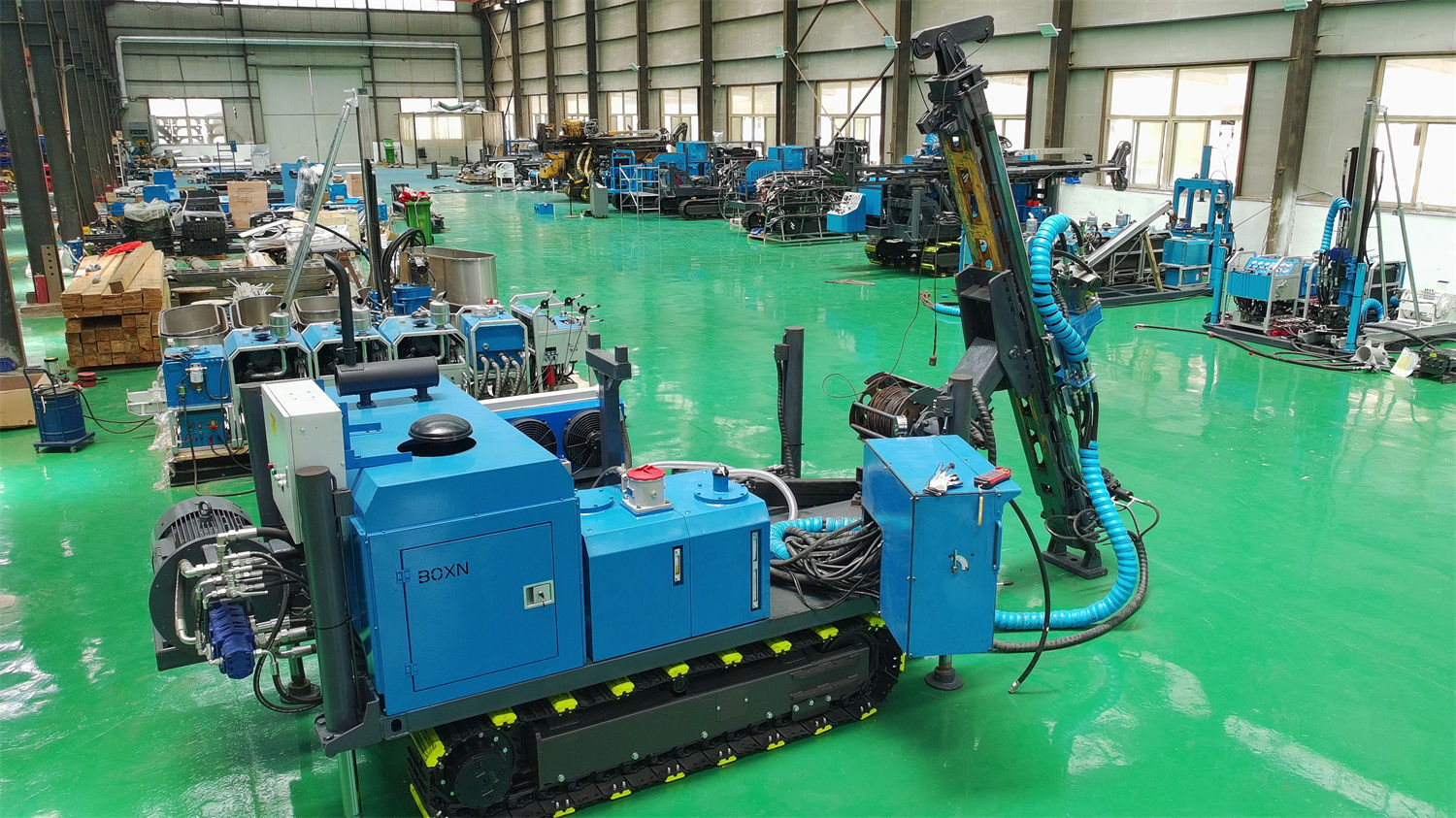
The CR800I is an HJH 800m-class fully hydraulic integrated crawler core drill with a drilling angle range of 45°–90°, reference depths of 800 m for NTW, 500 m for HTW, and 1000 m for BTW. Its inclined hole capability mainly serves two scenarios: inclined extending vein-type orebodies in gold deposits, and mineralized zones requiring continuous cross-layer coring in copper and polymetallic deposits. Whether to select it depends not on "whether it can drill inclined holes," but on whether the project's orebody attitude, exploration line orientation, and the 45°–90° range match.
Why inclined hole angles should be considered together with orebody attitude
The value of inclined holes is to allow the drill hole to pass through the orebody at an angle closer to perpendicular to the mineralized zone. If the orebody itself has a steep dip, drilling with near-vertical holes can cause the hole to "run along the bedding" of the mineralized zone, distorting the core's reflection of orebody thickness and boundaries. The CR800I offers a drilling angle range of 45°–90°. Before requesting a quote, buyers should prepare three types of data—orebody dip, dip direction, and exploration line azimuth—and then judge whether the equipment's angle range can cover the design angle of the target hole.
It should be noted that 45°–90° is the equipment's drilling angle capability range, not a guarantee that the same drilling depth and core quality can be achieved at all angles. Inclined and vertical holes differ in downhole friction, drill string self-weight components, and hole deviation control. Actual achievable depth and core recovery should be based on site conditions and equipment technical confirmation documents.
Gold deposits: Angle selection in vein-type orebody and structural zone verification
Orebodies in quartz vein-type gold, shear zone-type gold, and structurally altered deposits often exhibit inclined extension and local pinch-out and reappearance. The typical requirement for such projects is to use drill holes to intersect as much of the mineralized zone as possible within limited footage, and to obtain cores that can be used to judge orebody thickness, strike, dip, and deep continuity.
- When the orebody dip is steep, consider arranging inclined holes at a reasonable intersection angle with the orebody dip direction to reduce the proportion of drilling along the bedding.
- When the orebody has pinch-out and reappearance, the angles of infill holes and tracking holes should be arranged uniformly based on existing exploration line sections, rather than decided hole by hole.
- Once the hole angle is determined, simultaneously check the mast ground-contact support, platform leveling, and machine fixation conditions. Inclined hole construction is more sensitive to platform settlement.
Copper and polymetallic deposits: Requirements for continuous cross-layer coring on size and power
In copper, lead-zinc, and polymetallic deposit exploration, a single hole often continuously passes through overburden, wall rock, alteration zones, fractured zones, and mineralized intervals. Such holes focus more on the continuity of full-hole coring and size selection.
| Coring Size | Reference Depth | Items to Verify at Procurement |
|---|---|---|
| HTW | 500 m | Drill string matching and mud circulation volume at larger hole diameters |
| NTW | 800 m | Common size for the model positioning; drill pipe and core tool matching |
| BTW | 1000 m | Whether core size at deeper hole sections meets assay sampling requirements |
The power head speed range is 0–1500 rpm, offering two transmission options: high-speed and torque ranges. The high-speed transmission ratio is 1:2.2, and the low-speed ratio is 1:3; the high-speed torque range is approximately 300–800 N·m, and the torque range is approximately 300–1000 N·m. Complete hard rock formations generally require more attention to stable speed and bit matching, while fractured or high-resistance hole sections require reducing speed and increasing the proportion of torque work. Parameter switching between different lithologies should form a written drilling parameter plan before hole opening, rather than relying entirely on on-site improvisation.
Practical significance of 152 kN pull-up force in deep inclined holes
The CR800I provides 152 kN pull-up force and 63 kN feed force. As hole depth increases, drill string self-weight, borehole wall friction, and local diameter reduction gradually accumulate. In inclined holes, the contact state between the drill string and borehole wall differs from vertical holes. Pull-up force is used for normal tripping on one hand, and on the other hand leaves capacity margin for drill string handling and tool recovery in some complex hole sections.
In practice, one should not simply rely on increasing pull-up force to forcibly handle sticking, but should make comprehensive judgments based on downhole resistance, mud circulation status, and formation changes. Equipment capability is a boundary condition, not a substitute for operating methods.
Mast, chassis, and relocation: Site conditions before inclined hole construction
The whole machine adopts a ground-contact integrated mast, with a feed stroke of 2500 mm, crawler travel speed of approximately 2.5 km/h, reference climbing angle of 30°, transport dimensions of approximately 5000 × 1800 × 2550 mm, and weight of approximately 5800 kg. The integrated layout concentrates power, hydraulics, mast, power head, winch, and mud circulation on the same platform, suitable for mining areas with scattered drilling points and repeated short-distance relocations.
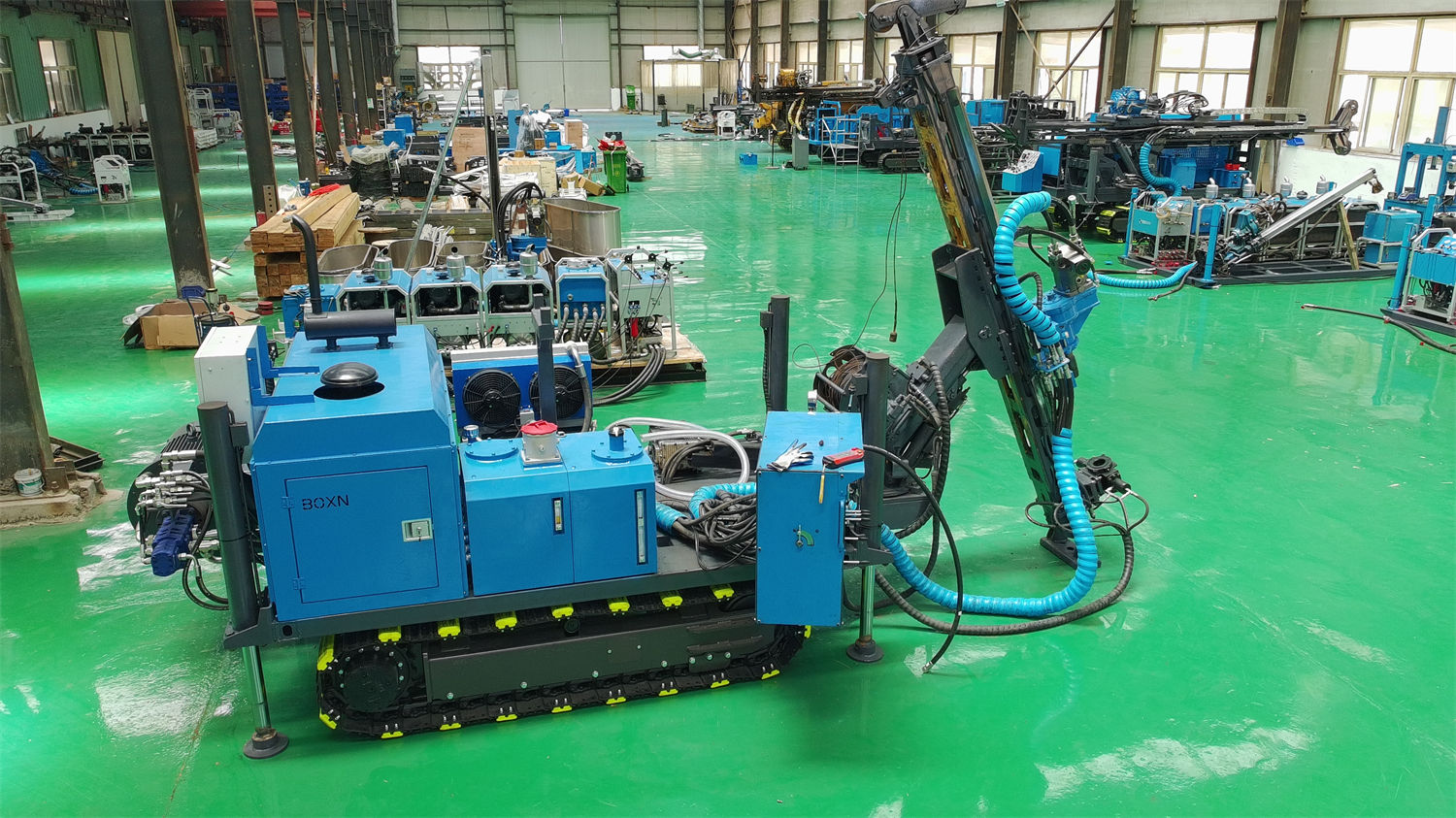
- Before starting inclined holes, site leveling and machine fixation should be completed to avoid platform settlement affecting hole deviation control.
- Before entering the site, verify transport roads, platform dimensions, ground bearing capacity, and slope safety conditions.
- The crawler chassis facilitates repositioning on gravel roads, mountain exploration platforms, and temporary access roads, but does not mean platform preparation work can be omitted.
Hydraulics, cooling, and wireline coring matching verification
The main pump uses an A11 series plunger variable pump with a maximum pressure of 30 MPa; the auxiliary pump uses an A10 series plunger variable pump with a maximum pressure of 20 MPa; the main valve, auxiliary valve, and travel valve all adopt load-sensitive control concepts. The winch uses 6 mm wire rope with a rope capacity of 1000 m, lifting force of 13 kN, and lifting speed of 120 m/min, suitable for wireline coring operations. The hydraulic mud pump has a reference flow of 100 L/min and pressure of 70 bar.
The power system is standard with a Cummins engine, and domestic engines can also be selected depending on configuration, with rated power of 132 hp (97 kW), rated speed of 2200 rpm, and turbocharging with air-to-air intercooling. The equipment adopts integrated air-cooled heat dissipation and is equipped with a high-power water-cooled heat exchanger. In high-temperature seasons, low-wind-speed mining areas, or long-term high-load operations, hydraulic oil temperature, engine coolant, and radiator cleanliness need to be included in daily inspection scope.
Regarding the original expression of the main pump "200L," the time unit was not clearly indicated. This article organizes it as 200 L/min according to common engineering expression. The final production configuration should be based on equipment technical confirmation documents.
Items recommended to confirm with manufacturers before procurement
- Under the combination of target hole diameter and coring size, whether there is a difference in reference achievable depth for 45° inclined holes versus vertical holes, and the range of difference.
- The matching list of winch, drill pipe threads, and lifting tools corresponding to 152 kN pull-up force.
- Mast stress calculation documents, platform fixation requirements, and hole deviation control measures under inclined hole conditions.
- Official statements on hydraulic oil cleanliness, filter replacement intervals, and radiator maintenance requirements.
- The impact of engine brand options (Cummins or domestic) on overall machine price, delivery cycle, and spare parts supply.
- Power correction recommendations for high-altitude or high-temperature areas; actual output cannot be judged solely by plain conditions.
Due to differences in actual geological conditions, downhole tools, drilling angles, and operating methods, final drilling efficiency, depth, and core recovery should be based on site conditions. All parameters listed in this article are limited to product information verified on this site.