












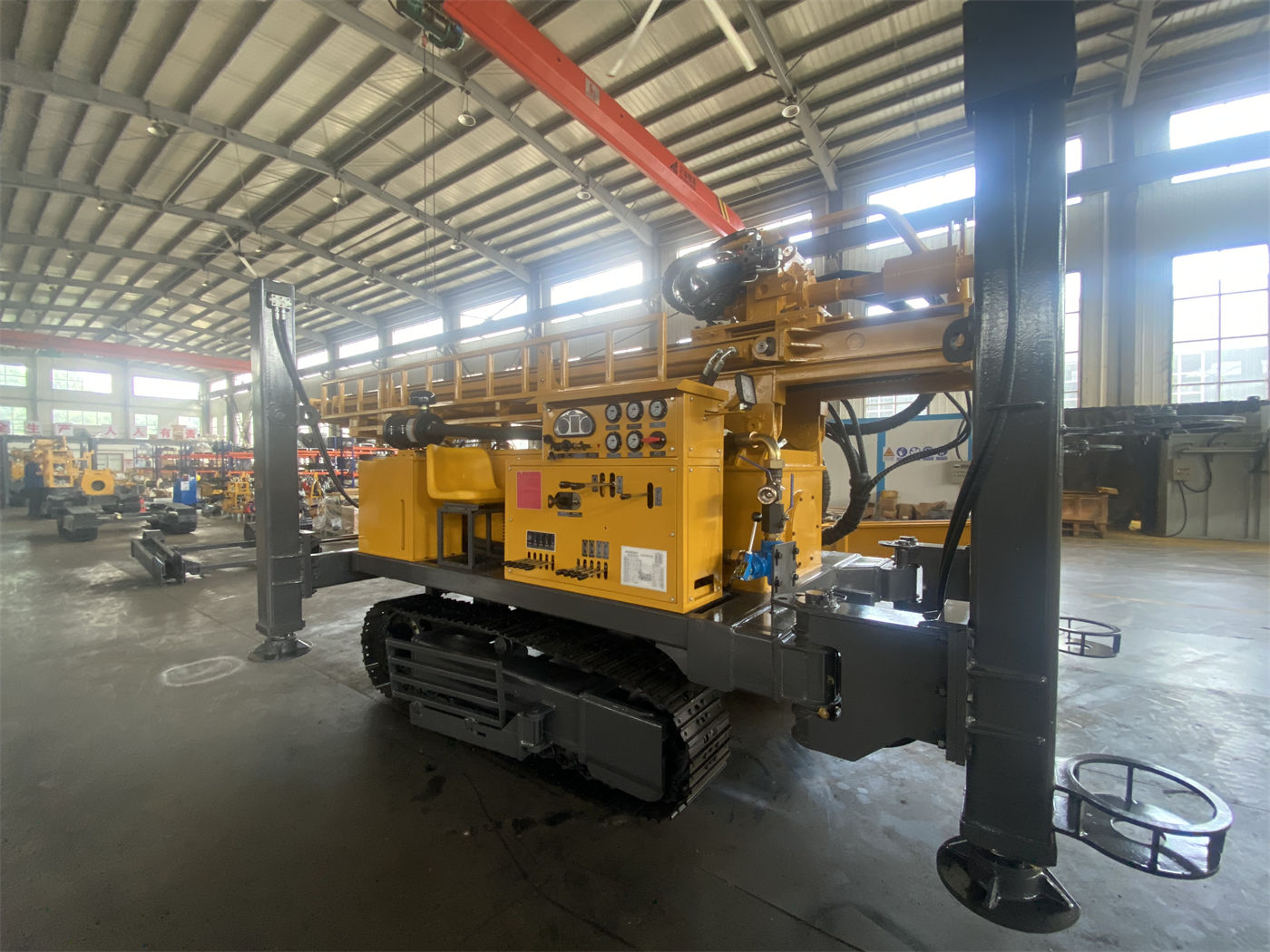
According to the verified product information on this site, the most core difference of the WR300SEL is its 6.6m single-pass feed, which can directly use drill rods up to 6m and is compatible with 1.5m, 2m, 3m, and 6m rods. Its practical significance is reducing the number of drill rod connections, thereby lowering auxiliary time such as rod make-up and break-out. The source material does not provide measured comparison data on 'how many minutes are saved,' so this article does not fabricate specific time-saving figures. It only explains under what conditions this structure can be effective and what supporting conditions need to be verified before purchase.
What part of the time does 6.6m single-pass feed save?
The most practical value of a long-stroke mast is not that the mast is longer, but that completing the same 300m-class borehole requires fewer rod make-and-break cycles. Among non-drilling actions, rod make-up, rod break-out, power head return, and tool adjustment all count as auxiliary time; this time does not produce actual penetration but consumes the crew's effective working day.
The reference drilling efficiency given in the material is 15–35 m/h, which is a reference value for the drilling phase; while the fast lift of 22 m/min and fast feed of 40 m/min mainly serve non-drilling actions. The two cannot be directly multiplied to convert into time savings, because actual auxiliary time also depends on the number of workers, site organization, drill tool handling methods, and formation changes.
What is the difference between using 6m drill rods and short drill rods?
The WR300SEL can use 1.5 m, 2 m, 3 m, and 6 m drill rods, with optional rod diameters of 76 / 89 / 102 mm. In a borehole of the same 300 m depth, the longer each single rod, the fewer connections required; this is the main value of the 6.6m single-pass feed paired with 6m drill rods.
However, long drill rods are not necessarily more suitable in all working conditions:
- When the site is narrow or transport is restricted, shorter drill rods are easier to organize.
- When the site is spacious and continuous drilling is the main mode, the advantages of 6m drill rods are more likely to be realized.
- Long-stroke masts and 6m drill rods place higher demands on site clearance, drill rod handling, and equipment stability.
Therefore, when purchasing, the 'drill rod length selection' and 'site conditions' should be judged together, rather than only comparing mast stroke values.
Which construction scenarios better reflect the value of a long stroke?
The material mentions that continuous irrigation well projects, rural water supply and water wells in remote areas, water supply and dust suppression water for mining areas, and medium-depth water wells for factories and infrastructure projects may all be suitable directions for the WR300SEL. Among them, farmland irrigation areas often require continuous construction of multiple water wells. If each well frequently makes and breaks short drill rods, auxiliary time will be continuously amplified. For contracting crews, this type of efficiency difference directly relates to effective daily working time.
It should be noted that the information on this site does not provide actual working-hour comparisons after using the WR300SEL on a specific project, nor customer cases or transaction data, so it cannot be used to promise time-saving ratios or return figures.
Key parameters and boundaries of the WR300SEL
| Item | Specification |
|---|---|
| Equipment type | 300m-class long-stroke crawler water well drill |
| Single-pass feed length | 6.6 m |
| Compatible drill rods | 1.5 / 2 / 3 / 6 m, optional diameters 76 / 89 / 102 mm |
| Maximum drilling depth | 300 m |
| Drilling diameter | 140–325 mm |
| Lifting force | 18 T |
| Rotary torque | 5700–7500 N·m |
| Rotary speed | 40–70 r/min |
| Working air pressure | 1.7–3.0 MPa |
| Air consumption | 17–36 m³/min |
| Engine | 85 kW Yuchai |
| Fast lift / fast feed | 22 m/min / 40 m/min |
| Auxiliary winch lifting force | 2 T |
| Travel speed | Approx. 2.5 km/h |
| Reference maximum gradeability | 30° |
| Reference overall weight | Approx. 8 T |
| Dimensions | Approx. 5900 × 1850 × 2200 mm |
The parameters in the table are all from the WR300SEL product information on this site. Actual performance under different hole diameters, formations, and drill tool combinations still needs to be confirmed based on project conditions.
Items to confirm with the manufacturer before purchase
Air compressor and pneumatic drill tool matching
The working air pressure given in the material is 1.7–3.0 MPa, with air consumption of 17–36 m³/min. Air compressor selection should consider both pressure and displacement; when hole diameter increases, rock layers harden, or altitude rises, insufficient displacement may lead to insufficient DTH hammer impact and difficult cuttings removal. This part needs to be verified according to actual hole diameter and formation. The material does not provide matching conclusions for specific air compressor models.
Formation adaptability
The material's description of formations includes: intact hard rock can use DTH hammer pneumatic drilling; weathered rock and alternating soft-hard formations require attention to block falling and hole shrinkage; soil layers, sand layers, and loose overburden focus more on hole stabilization and may require mud, casing, etc.; fractured, broken zones, and air-leakage formations require attention to air leakage and sticking. When the loose layer is thick, mud pump and casing solutions should be considered in advance during the equipment matching stage.
Transport and site organization
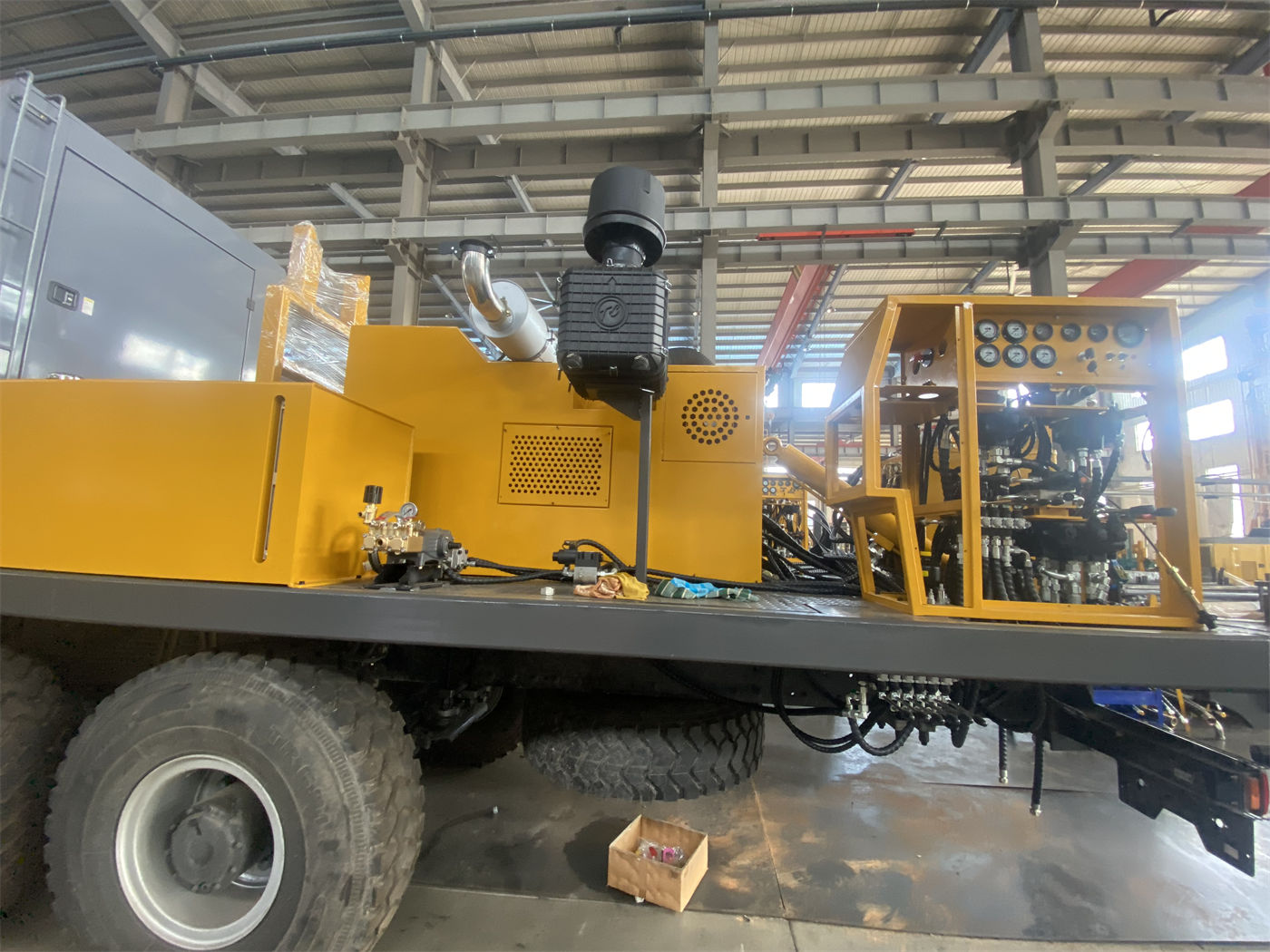
Due to the 6.6m long-stroke configuration, before transport, confirm vehicle length, loading fixation points, and site turning space. The reference overall weight is about 8 T. The long-stroke mast must be in a safe transport position. Before relocation, evaluate slope, wetness, and ground bearing capacity.
Energy configuration and optional power
The material also provides optional configurations such as generator and electric motor power. For fixed mining areas or sites with stable power supply, the electric option can be evaluated based on energy costs and maintenance conditions; remote field projects are usually more suitable for diesel power. The final configuration should be determined based on on-site energy conditions.
Situations where conclusions cannot be drawn directly
- The material does not give the specific time for one rod connection, nor a measured auxiliary time comparison between using 6m drill rods and short drill rods, so 'how many minutes can be saved' cannot be quantified.
- The material does not provide customer cases, transaction records, or actual penetration data for specific formations.
- The reference drilling efficiency of 15–35 m/h in the material is affected by formation, bit, DTH hammer, and air compressor, and cannot be used as a promised value for any specific project.
- If sticking, hole shrinkage, or hole wall block falling occurs, the problem should be solved first through hole cleaning, slow lifting, and process adjustment, rather than directly using maximum lifting force to pull forcefully.
When purchasing the WR300SEL, a more feasible judgment method is to check well depth, hole diameter, formation combination, drill rod length, air compressor configuration, and site organization together; whether the long-stroke structure can translate into actual time savings depends on whether these conditions match, not just on the 6.6m parameter alone.