












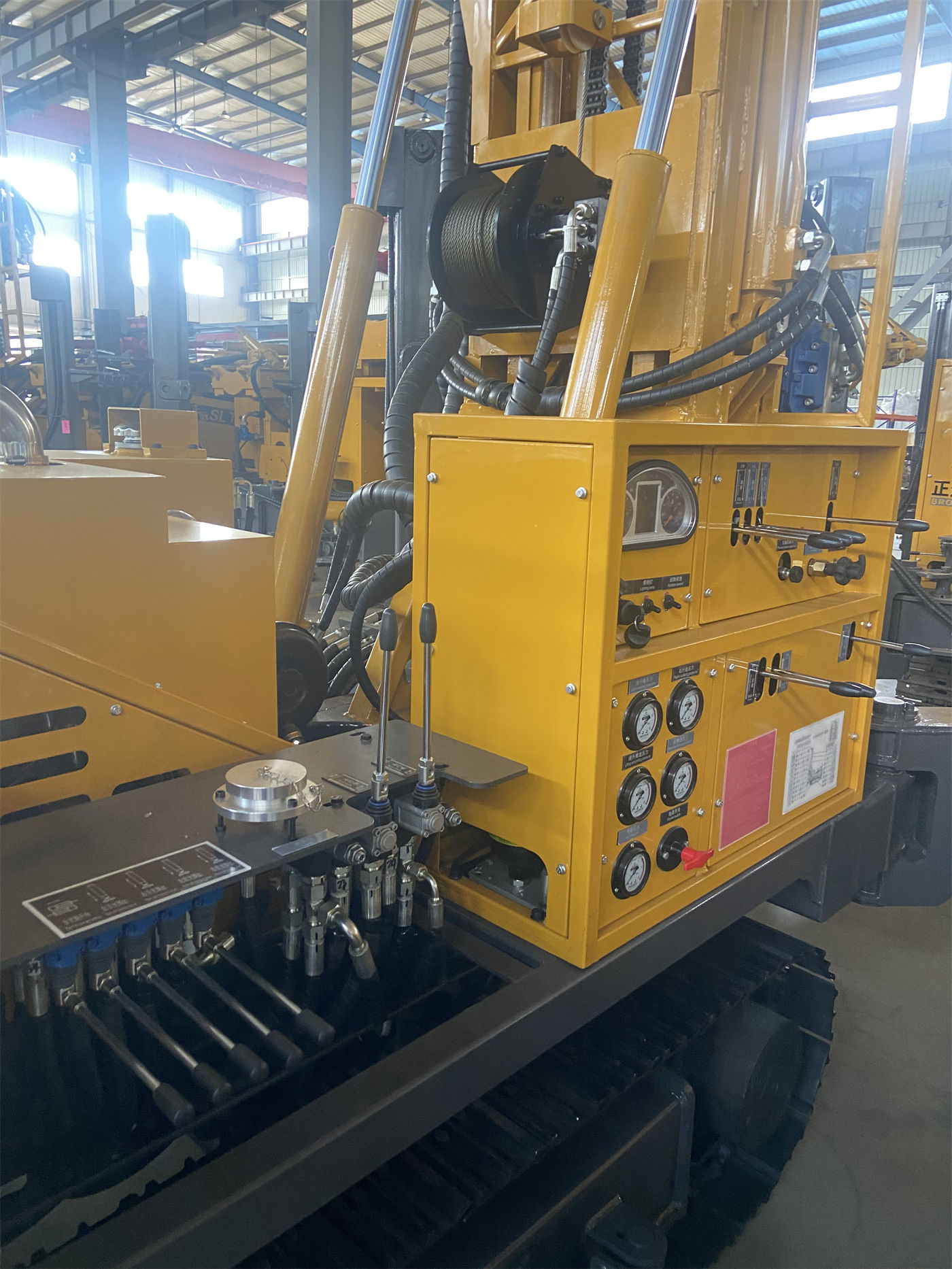
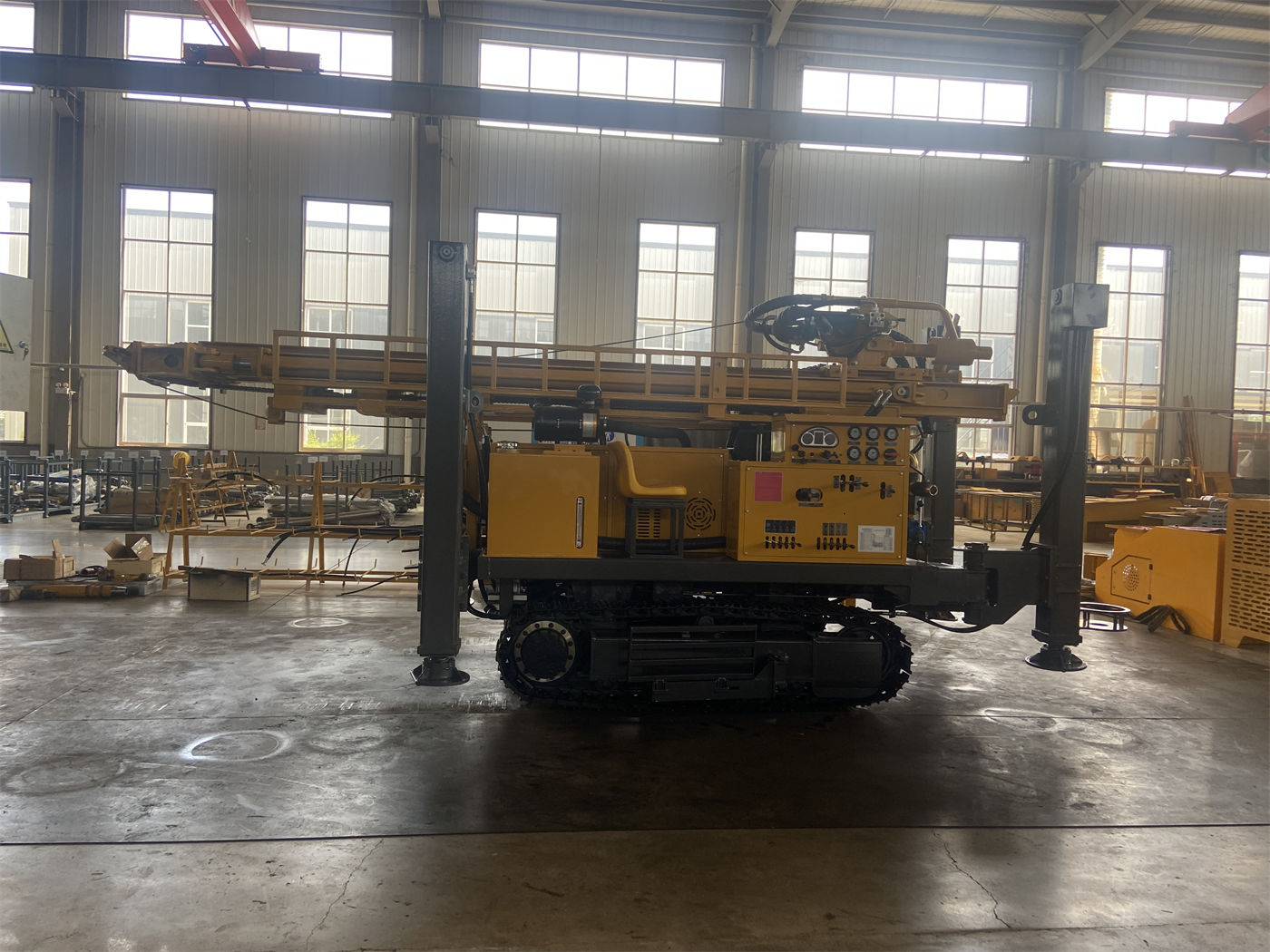
The WR400QS is a 400-meter-class crawler fully hydraulic water well drill. The data shows that its maximum drilling depth is 400 m, hole diameter is 105–325 mm, pulling force is 22 T, the maximum torque of the rotation system is 8000/4000 N·m, corresponding to maximum rotation speeds of 75/150 r/min, and it directly supports 6 m drill pipes. What really needs to be judged during procurement is not whether "22 T and 8000 N·m are large enough," but whether they match the specific hole diameter, rock formation, and supporting capacity.
1. First Look at the Two Parameter Groups Separately: What Pulling Force and Rotation Torque Each Control
The 22 T pulling force and 8000/4000 N·m torque belong to two different systems, and the objects to be verified are also different.
- Pulling force is mainly used for tripping, drill string recovery, and casing handling. The deeper the hole, the greater the self-weight of the drill pipe, borehole wall friction, and casing weight, and the more important the pulling force margin becomes.
- Rotation torque mainly overcomes bit cutting, bottom-hole friction, and drill string rotation resistance. The larger the hole diameter and the harder the rock formation, the higher the required torque.
- Rotation speed corresponds to torque: 8000 N·m corresponds to a maximum of 75 r/min, and 4000 N·m corresponds to a maximum of 150 r/min. The data clearly states that low speed and high torque are more suitable for large-diameter, hard rock, and high-load conditions, while higher rotation speeds are suitable for drilling stages with relatively lower resistance.
These two parameter groups cannot replace each other. If pulling force is sufficient but torque is insufficient, drilling will be difficult; if torque is sufficient but pulling force is insufficient, tripping and casing operations will be limited.
2. Verify Torque and Pulling Force by Hole Diameter
The WR400QS has a hole diameter range of 105–325 mm. As the hole diameter increases, the annular area at the bottom of the hole increases, cutting and cuttings removal loads rise, and torque demand changes accordingly. The data does not provide torque values corresponding to each hole diameter, so inferences such as "325 mm is definitely suitable for maximum torque" cannot be used. Before procurement, the planned hole diameter should be clearly communicated to the manufacturer, and the manufacturer should provide configuration recommendations based on the bit type, drill pipe diameter, and rock formation conditions.
Hole diameter also affects cuttings removal and air supply. The data gives a working air pressure of 1.2–3.5 MPa and air consumption of 16–55 m³/min, which can match medium- and high-pressure series DTH hammers. For larger hole diameters, whether the air compressor displacement is sufficient is often more important than simply reaching a pressure value. In other words, hole diameter verification is not only about torque; the DTH hammer, bit, and air compressor displacement must also be calculated together.
3. Select Rotation Mode by Rock Formation
The WR400QS can use DTH hammer drilling and also supports mud rotary drilling. Different strata require different mode selections:
| Stratum Type | Construction Method Given in the Data | Verification Focus |
|---|---|---|
| Soil, clay, sand | Mud rotary drilling can be used | Mud circulation for wall protection, carrying drill cuttings, and maintaining hole diameter |
| Weathered rock, limestone, sandstone, granite | DTH hammer and bit can be selected | Rock hardness and hole diameter determine DTH hammer selection; stable air supply and reasonable rotation must be maintained |
| Fractured zones and fissured strata | Penetration rate should be reduced and continuous hole cleaning maintained | Block falling, air leakage, and sticking may occur; auxiliary measures should be taken according to air leakage and borehole wall conditions |
| Aquifers and strong water inflow sections | Adjust air supply, hole cleaning, and casing methods | Groundwater changes cuttings removal and DTH hammer working status; the depth of the water-producing layer should be recorded |
From the logic of mode selection, hard rock and large hole diameters tend toward low speed and high torque; higher rotation speeds can be used in drilling stages with lower resistance. The data also mentions that the appropriate mode should be selected on site according to changes in hole diameter, drilling tools, and rock formation, avoiding long-term fixed use of a single rotation speed.
4. What Depth and Operations Is the 22 T Pulling Force Suitable For?
The data states that the WR400QS provides 22 T pulling force, significantly higher than conventional small and medium-sized water well drills. As hole depth increases, the self-weight of the drill pipe, borehole wall friction, and casing weight all rise, and greater lifting capacity is beneficial for normal tripping, drill string recovery, and casing handling. For 300–400-meter-class water well projects, 6 m drill pipes reduce the number of connections, but also mean that each drill pipe is heavier, and the lifting system needs to cover these weights and friction.
However, the data also emphasizes that when sticking, hole shrinkage, or borehole wall block falling occurs, priority should be given to solving the problem through hole cleaning and process adjustment, rather than simply relying on maximum pulling force to pull forcefully. This point is easily overlooked in procurement evaluation: pulling force is an upper capacity limit, not a guarantee that all obstructed drilling tools can be pulled out unconditionally on site.
5. Supporting Capacity Determines Whether Parameters Can Truly Be Applied
The data lists the main supporting information of the WR400QS:
- Axial pressure 4 T, rapid penetration speed 56 m/min, rapid lifting speed 29 m/min;
- 103 kW Weichai engine;
- 1.5 T auxiliary winch, used for handling DTH hammers, drill pipes, casing tools, etc.;
- Crawler travel speed about 3 km/h, maximum climbing angle reference 21°;
- Hydraulic outrigger stroke 1.6 m;
- Overall weight about 8.6 T, dimensions about 6.25 × 1.7 × 2.39 m;
- Mud pumps, centrifugal pumps, generators, and foam pumps can be optionally configured according to the project.
This shows that the 22 T pulling force and dual-mode torque are only part of the overall machine capacity. During DTH hammer drilling, air compressor displacement and pressure and bit type directly affect footage; during mud rotary drilling, the mud pump and circulation system affect wall protection and cuttings removal; formations with severe air leakage may require foam assistance. Before procurement, the planned process, supporting equipment, and consumable conditions should all be included in the verification.
6. Working Condition Data to Confirm with the Manufacturer Before Procurement
The data does not provide the drilling efficiency or footage rate of the WR400QS under specific hole diameters and specific rock formations, because the actual rock formation footage rate depends on the stratum, bit, DTH hammer, and air compressor capacity. Therefore, when requesting quotations, purchasers should prepare the following information:
- Planned well depth and well diameter, especially whether the upper limit of 325 mm needs to be approached;
- Thickness of the upper overburden and rock formation type, to determine the combination of mud rotary and DTH hammer drilling;
- Whether fractured zones, fissures, or strong water inflow sections are encountered, and whether foam, casing, or other measures are needed;
- Planned drill pipe diameter (the data recommends 89 / 102 mm) and drill pipe length;
- Pressure and displacement of the supporting air compressor, DTH hammer model, and bit specifications;
- Transportation conditions, site bearing capacity, and relocation route, because the overall weight is about 8.6 T.
If the project requires high-quality core samples, the data clearly states that a dedicated core drill should be used; the WR400QS is positioned for water well construction and general hydrogeological drilling. Confirming this boundary clearly during procurement can avoid mismatch between equipment and project objectives.
Overall, the WR400QS's 22 T pulling force and 8000/4000 N·m dual-mode torque provide the basic capacity for 400-meter-class water well construction, but hole diameter, rock formation, air compressor displacement, and process combination are the key factors determining whether the configuration is suitable. The final drilling efficiency, drilling depth, and well completion effect should be based on on-site working conditions; specific configuration values not covered by the data need to be verified with the manufacturer.