

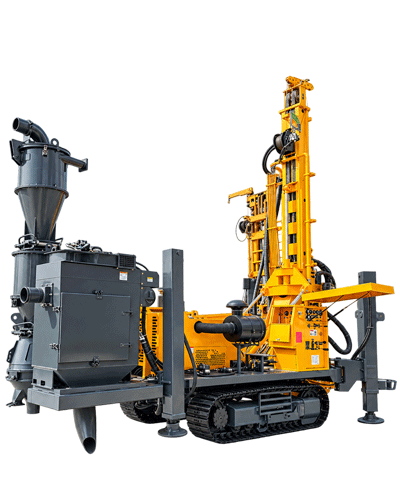
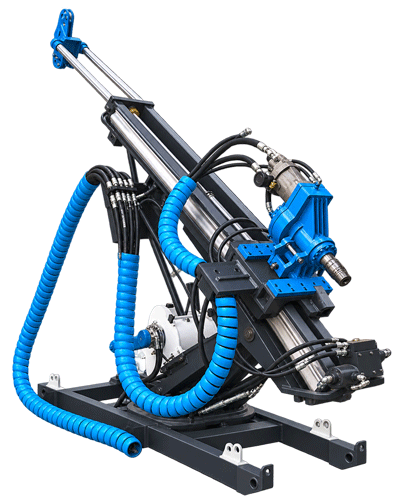
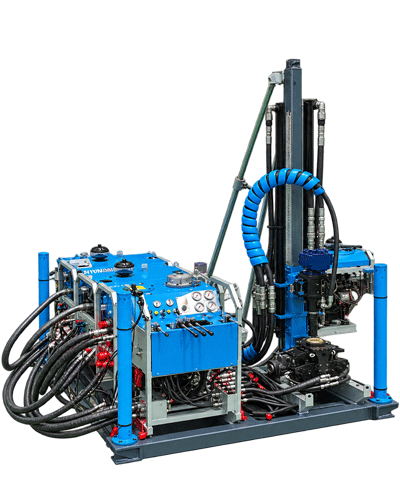
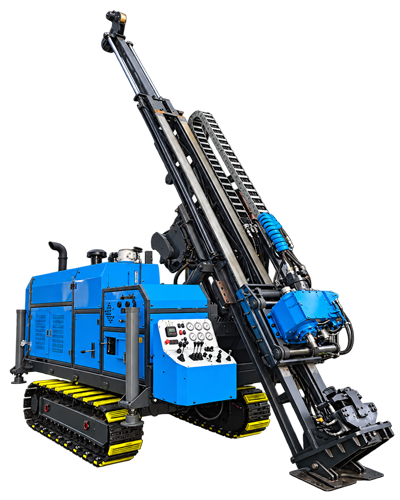
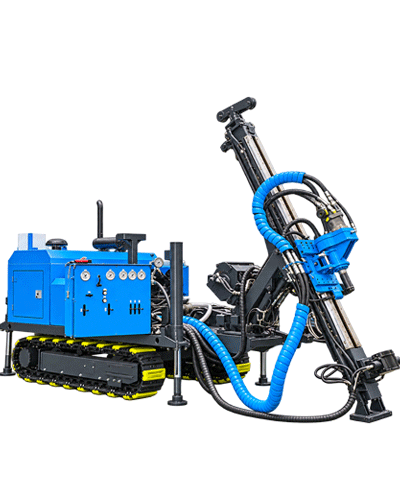
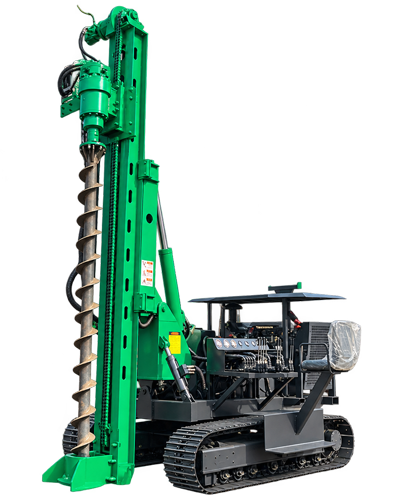
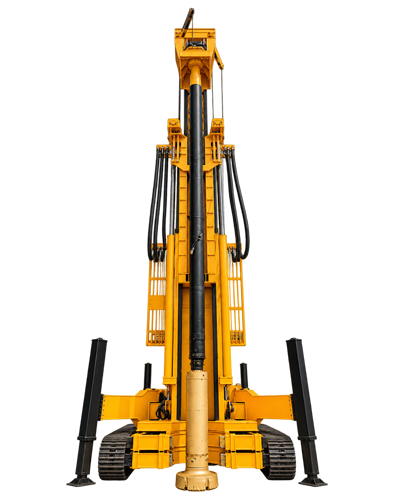
The starting point for a deep anomaly verification task is usually a shallow mineral intersection or shallow anomaly. After mineralization, alteration, or structures are identified at shallow depths, the project needs to continue tracing their downward extension to determine whether the anomaly continues, thins, or pinches out. The target depth of such holes often starts at several hundred meters, and the hole locations are relatively scattered, so they are often assigned to the reverse circulation (RC) method—using continuous cuttings return samples to quickly establish deep control points, and then deciding whether to densify key locations with core holes.
Treating "need to drill to 600 meters" as the only condition would miss the factors that truly constrain construction. Using the published parameters of the WR600RC as a sample, this article breaks deep anomaly verification tasks into five groups of equipment conditions that can be checked item by item. All values come from the information for this model; items not covered are listed separately and are not intended as selection conclusions.
Condition 1: A 600-meter-class drill string must be something someone can handle
The WR600RC has a maximum drilling depth of 600 m. As hole depth increases, the self-weight of the dual-wall RC drill pipe and borehole wall friction rise simultaneously, and tripping, drill tool recovery, and partial casing handling all bear on the same lifting system. This model has a lifting force of 29 T.
This item corresponds not to a static number but to several operations: whether normal tripping is smooth, whether drill tools can be safely recovered when encountering resistance, and how short the auxiliary time for changing drill bits in deep hole sections can be reduced. The information also notes that when pulling resistance remains abnormal, priority should be given to handling it by judging hole cleaning and downhole conditions, and it is not recommended to directly use maximum lifting force to pull forcefully. In other words, 29 T is the upper capacity limit, not a means of handling downhole incidents.
Winch lifting force is 2.5 T, used for handling RC hammers, drill pipes, casing tools, and other site accessories. In deep hole projects, drill tools are heavier, so this item affects the labor intensity and pace of auxiliary operations, with a different division of labor from the main lifting system.
Condition 2: Hole diameter and formation determine which torque range to use
This model has a drilling diameter of 105–450 mm, rotation torque of 12000 / 6000 N·m, corresponding to maximum rotation speeds of 75 / 150 r/min. Low speed and high torque are suitable for large diameters, hard rock, and high-load hole sections, while the high-speed range is suitable for stable formations with lower resistance.
A common combination in deep anomaly verification is: use a larger diameter to open the upper overburden, then reduce diameter and continue drilling after entering stable rock. When the hole diameter changes, the rotation load changes accordingly, and the gear selection must also be adjusted. The information's position is that RC drilling should simultaneously monitor rotation, impact, and sample return status and keep the three coordinated—looking only at torque values cannot determine whether a given hole section is suitable.
Regarding drilling angle, the equipment supports 45° and 90°. 90° is used for conventional vertical holes, while 45° is more suitable for oblique crossing of inclined orebodies, veins, and fault zones. In deep anomaly verification, drilling angle is often directly related to orebody attitude and should be determined according to the exploration design, rather than defaulting to vertical.
Condition 3: Beyond air supply pressure, sample return continuity must also be considered
This model recommends a working air pressure of 1.6–6 MPa and air consumption of 16–75 m³/min. 600-meter-class RC drilling not only drives the downhole drill tools but also returns cuttings to the surface through the inner tube. As hole depth, hole diameter, altitude, and rock hardness increase, the required effective air volume usually also increases. Therefore, the air compressor's pressure and displacement are conditions independent of the main machine.
What is more easily overlooked than parameters is sample return continuity. The site should continuously observe changes in sample return volume, particle size, color, and moisture; if there is a sudden decrease in sample, delayed sample return, or obvious cross-contamination, check drill pipe seals, the sample return channel, air compressor output, and whether there is air leakage downhole. The value of deep anomaly verification comes from continuous cuttings samples segmented by depth; once sample return is interrupted, the geological judgment for that section loses its basis.
Supporting sample return is sample management. The site should collect samples at fixed footage intervals and record hole number, sample number, start and end depths, and abnormal conditions. For mineral samples sent to the laboratory for analysis, duplicate samples, standard samples, and blank samples should also be set up according to the project quality control system. The drill rig is responsible for obtaining samples, but data quality also depends on the sampling process itself.
Condition 4: Prerequisites for handling fractured zones and overburden separately
Deep anomaly verification holes often pass through multiple formations. The information shows that the WR600RC supports RC drilling and conventional DTH hammer drilling, as well as mud rotary methods.
- Intact hard rock (granite, limestone, sandstone, etc.): RC or ordinary DTH methods can be selected according to whether geological samples are needed.
- Loose overburden such as soil, sand, and gravel layers: may not be suitable for direct high-pressure RC drilling; mud rotary can first be used to stabilize the hole, and after entering stable rock, switch to RC or DTH processes.
- Fault fracture zones and fractured formations: prone to wall collapse, air leakage, and abnormal sample return; after entering such hole sections, excessive advance should be reduced, continuous hole cleaning should be maintained, and air pressure changes should be observed; in cases of severe air leakage, foam, casing, or other treatment methods may be needed.
These three types of formations do not correspond to the same set of parameters. During hole location design, the stratigraphic column and process route should be considered together, rather than switching temporarily after mobilization.

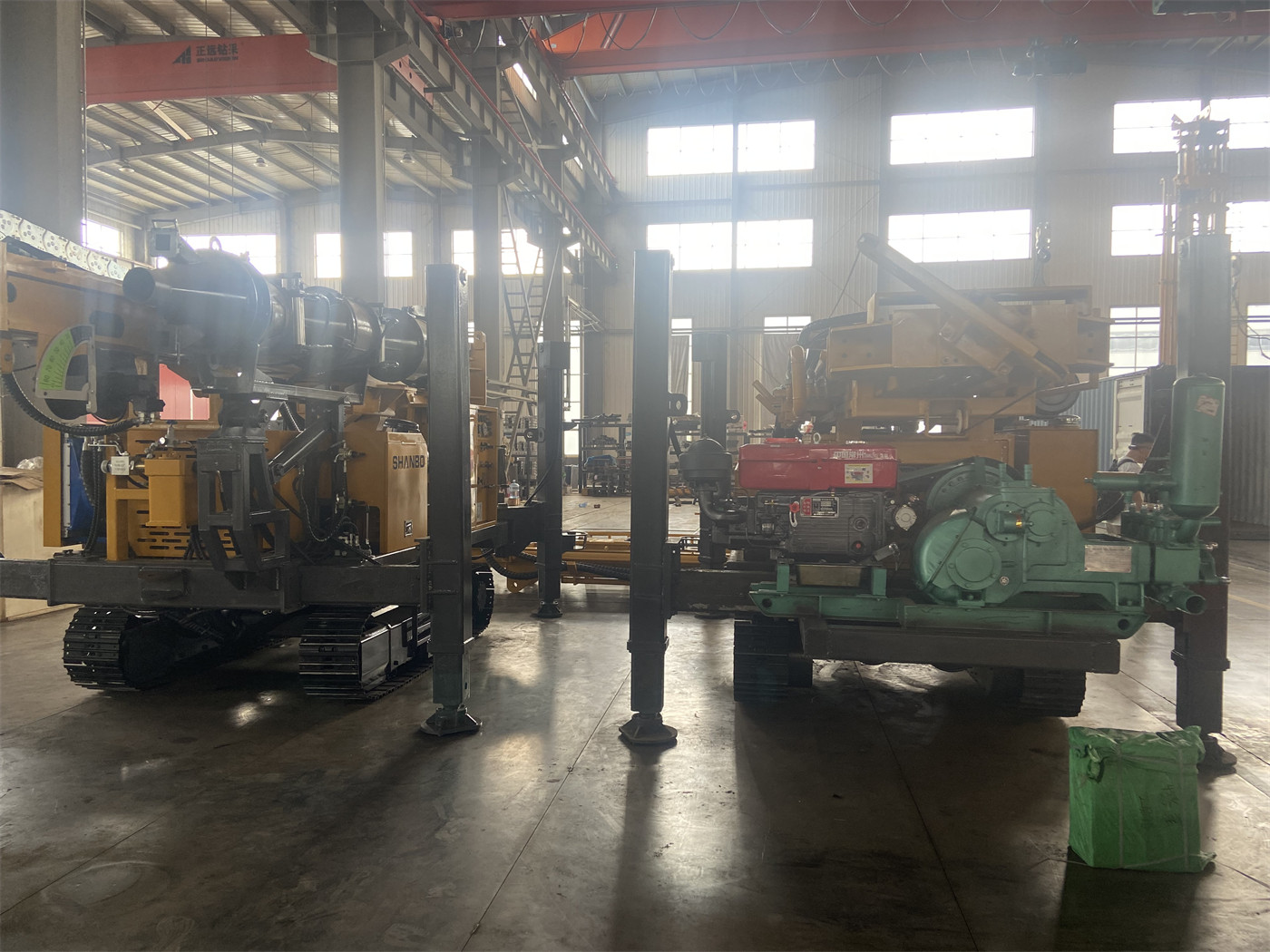
Condition 5: Site arrangement for an approximately 12.5 T complete machine and supporting equipment
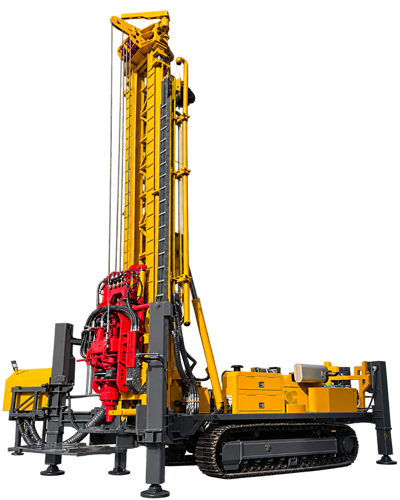
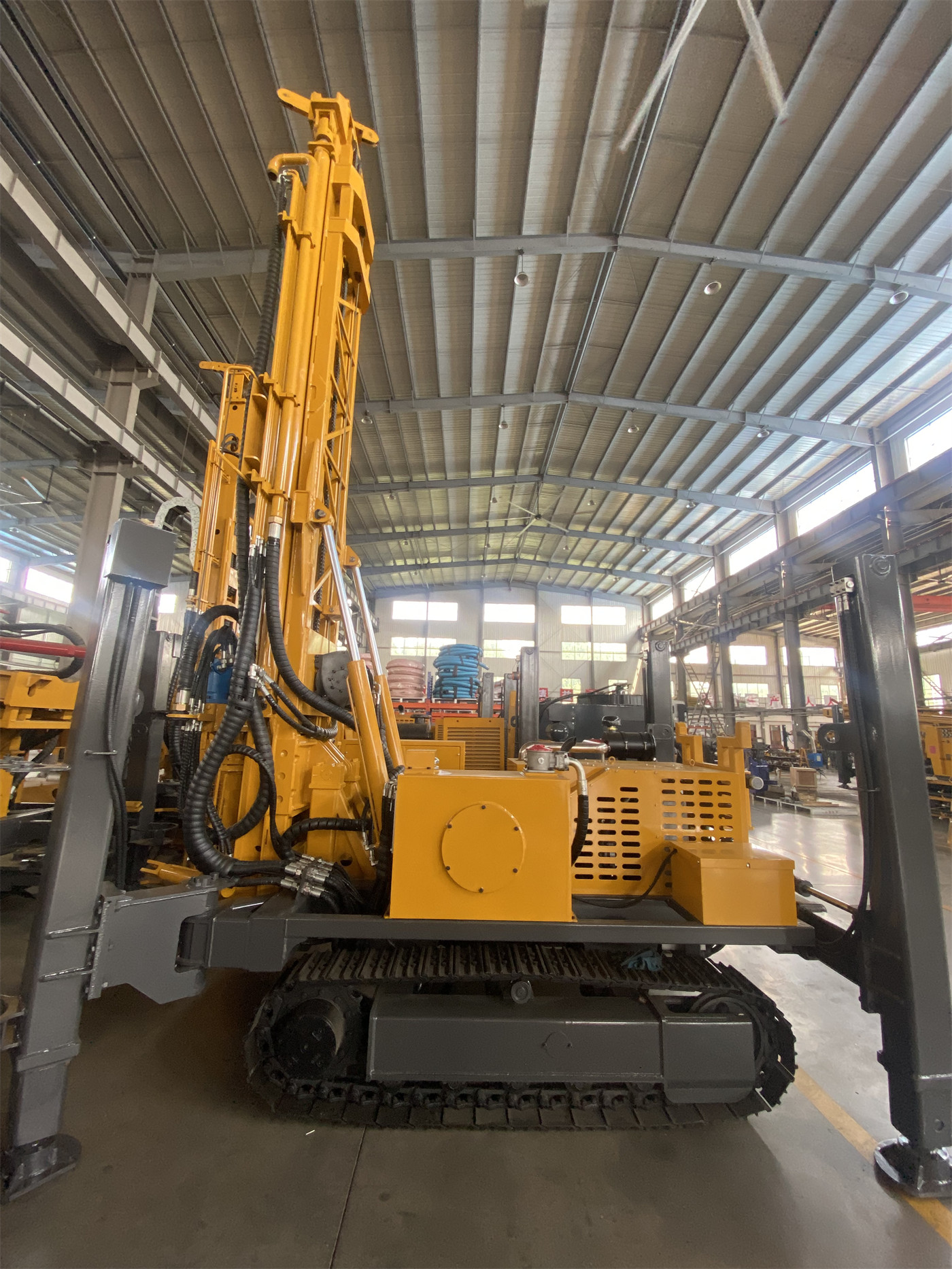
The WR600RC complete machine weighs approximately 12.5 T, has dimensions of approximately 7 × 2.1 × 2.9 m, a travel speed of approximately 3.5 km/h, a maximum climbing angle reference of 21°, and a leg stroke of 1.7 m. Power is provided by a 132 kW Cummins engine.
For deep anomaly verification projects, site constraints are not limited to the drill rig itself. RC projects also require air compressors, sample return hoses, sampling devices, and a sample area. The drilling platform dimensions should be planned in advance to ensure sufficient safe distances and operating passages between equipment. The crawler chassis is suitable for gravel roads in mining areas, field exploration platforms, and generally uneven ground, but before relocation, road bearing capacity, slope, and site stability should be confirmed; during 45° inclined hole or high-torque drilling, the legs, ground bearing, and overall machine levelness directly affect hole direction control.
Check order for the five groups of conditions
| Condition | Corresponding parameters | What it governs in deep anomaly verification |
|---|---|---|
| Drill string handling | Lifting force 29 T, winch 2.5 T | Deep hole tripping, drill tool recovery, and accessory handling |
| Rotation and hole diameter | 12000/6000 N·m, 105–450 mm, 45°/90° | Selecting gear and angle according to hole diameter, rock hardness, and orebody attitude |
| Air supply and sample return | 1.6–6 MPa, 16–75 m³/min | Driving drill tools in deep holes and returning cuttings to the surface |
| Formation and process | RC / DTH / mud rotary | Segmented handling of overburden, hard rock, and fracture zones |
| Site and transport | Approximately 12.5 T, 7×2.1×2.9 m | Platform dimensions, road bearing capacity, and leg leveling |
Checking in this order can translate the phrase "need to drill 600 meters" into specific operations: who is responsible for handling the 600-meter drill string, who is responsible for driving the drill tools in hard rock, who is responsible for continuously returning cuttings to the surface, and whether the site can simultaneously accommodate the drill rig and its supporting equipment.
Items requiring verification with the supplier
The following content is not covered by the existing information on this site and cannot be judged from it; it should be confirmed separately during the selection or inquiry stage: actual drilling efficiency under specific combinations of hole depth, hole diameter, and formation; how air compressor models and displacement match this machine; specific design requirements for site bearing capacity, access road width, and platform dimensions; specific plans for sample splitting accuracy and contamination prevention measures; and air supply correction under different altitude conditions. The 600 m mentioned in the information should be regarded as reference capability under a typical configuration; actual drilling depth will be affected by hole diameter, drill pipe, air compressor, rock formation, hole deviation, and drill tool wear.