












The DTH30C is a 30-meter-class crawler hydraulic DTH drill rig. The core parameters provided in the data are a maximum drilling depth of 30 m, a hole diameter of 76–280 mm, and a maximum rotary torque of 3500 N·m. It is suitable for rock hardness of approximately f = 8–24 and is positioned for short-hole and medium-shallow-hole construction in medium-to-high hardness rock, such as slope anchoring, foundation pre-drilling, quarries, and road engineering. Before purchase, one premise must be accepted: its capability boundary is within 30 meters, and it is intended for engineering holes, not deep water wells.
First Confirm It Is Engineering-Hole Equipment, Not a Deep Water Well Drill
The data states that the DTH30C has a maximum drilling depth of 30 m and is suitable for engineering holes such as slope anchor bolt holes, anchor cable holes, drainage holes, foundation pre-drilling holes, quarry short holes, and short pile pre-drilling. For deep water well construction of 200 m, 300 m, or more, a dedicated water well drill should be selected. This 30-meter-class engineering DTH drill rig must not be used as deep water well equipment. This point determines the direction of the purchase evaluation: if the project mainly requires well completion and deep-hole drill string management, the selection should directly turn to the water well drill series rather than adding out-of-range requirements to the DTH30C.
Matching Relationship Between 3500 N·m Torque and 76–280 mm Hole Diameter
The data gives a maximum rotary torque of 3500 N·m, which can meet the DTH drilling needs of most 76–280 mm engineering holes. Note that hole diameter and torque do not have a fixed one-to-one correspondence. In actual construction, rotation, feed, and impact should remain matched. The data also notes that if rotary resistance continues to increase, return cuttings decrease, or the drill bit jumps noticeably, parameters should be adjusted promptly and the hole should be cleaned. At the procurement stage, this section can be used as a basis for selection judgment—3500 N·m is an upper limit value, not a guaranteed value for any hole diameter. The larger the hole diameter and the harder the rock, the more on-site parameter adjustment is needed.
Beyond Torque, the Feed System Determines Rod Connection and Medium-Short Hole Efficiency
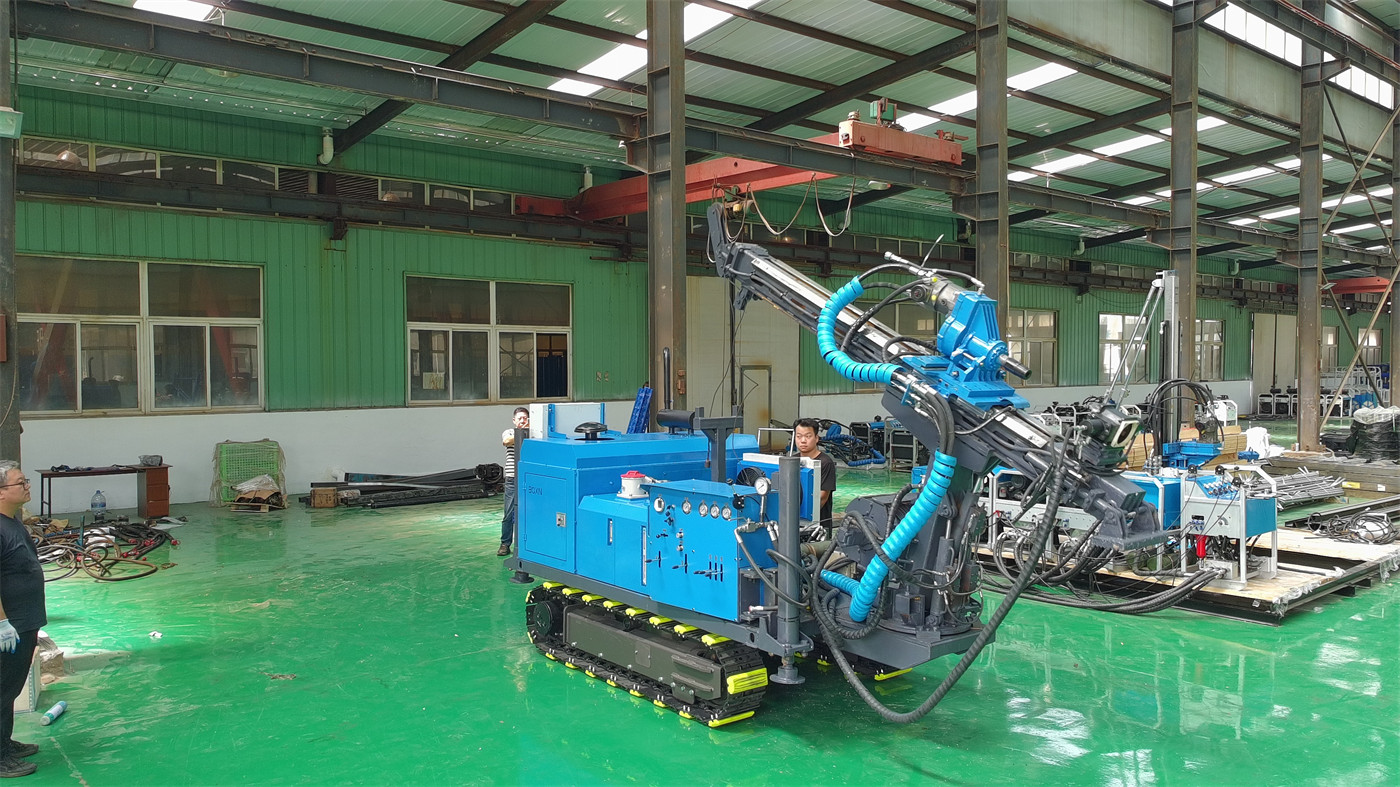
The DTH30C has a slide frame stroke of 3.2 m, an effective stroke of 2.2 m, and a piling height of 2.2 m. The data explains that this combination is suitable for medium-short drill rods and short pile construction, maintaining a compact body while meeting common engineering rhythms. In other words, the 2.2 m effective stroke corresponds to a shorter rod connection rhythm. During purchase, it should be checked against the project's single-hole depth and drill rod length configuration.
Feed Speed of 53 m/min Is Not Penetration Rate
The data clearly states that 53 m/min is the rapid movement speed of the feed mechanism, mainly used for power head return, drill rod handling, and non-drilling actions. It cannot be directly understood as the actual rock penetration rate. Actual drilling efficiency is affected by rock hardness, hole diameter, DTH hammer specifications, air compressor capacity, and drill bit wear. If procurement documents describe 53 m/min as rock penetration, it should be corrected according to the original meaning of the data.
Hole Types and Attitude Conditions Suitable for Slope Anchoring
The data lists slope anchoring as one of the main uses, covering anchor bolt holes, anchor cable holes, and drainage holes in highway slopes, railway slopes, foundation pit slopes, and retaining structures. The equipment has an 18–180° swing angle, can adjust the drilling attitude according to the designed hole direction, and has an inclination adjustment function.
Two items need to be confirmed before purchase:
- The original data only states that it has an inclination adjustment function and does not give a specific inclination angle range. Actual project design should be based on the final production configuration and equipment technical confirmation documents.
- Before slope construction, platform stability, rockfall risk, and support conditions should be checked first to avoid direct operation of the equipment on unstable slopes. This is a construction condition check and cannot be replaced by equipment parameters.
Applicable Scope for Foundation Pre-Drilling, Quarries, and Road Engineering
In the direction of foundation pre-drilling, the applicable scenarios given in the data include equipment foundations, guardrail piles, short piles, and hard rock foundations. When complete rock formations are encountered, DTH drilling can first be used to form pre-drilled holes, reducing resistance for subsequent piling or installation. In the quarry direction, the DTH30C can be used for bench holes, auxiliary rock breaking holes, and local engineering holes. Compared with large blast hole drilling rigs, it is more suitable for construction environments with narrow sites, shallow hole depths, and frequent hole position adjustments. In the road engineering direction, it can be used for medium-shallow hole drilling such as slope reinforcement, drainage holes, rock excavation preparation, and guardrail foundations.
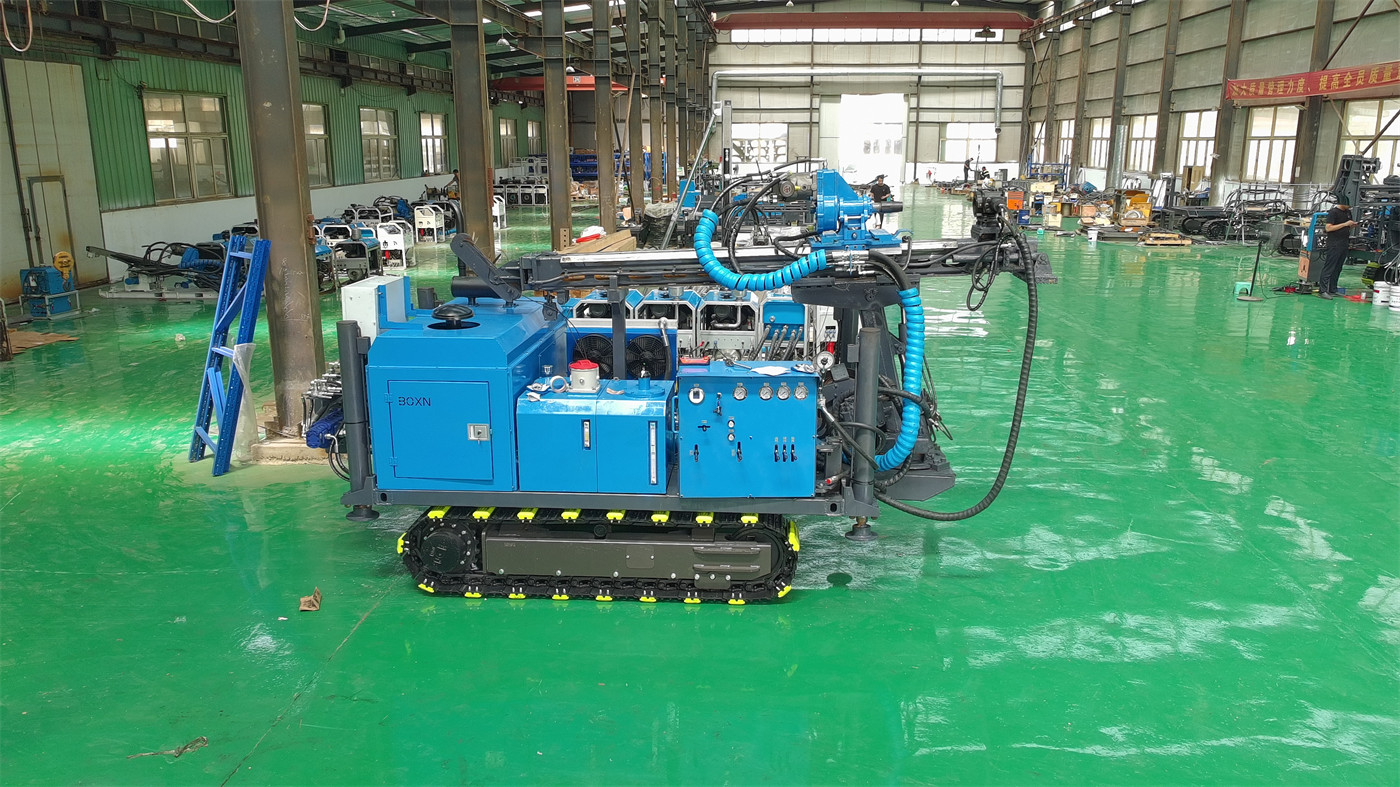
The common point of these uses is limited hole depth, frequent hole position adjustment, and sites that are not necessarily open, which is consistent with the combination of 30 m drilling depth and a compact body.
Matching Boundaries of Air Consumption, Air Compressor, and DTH Hammer
DTH drilling relies on compressed air to drive the DTH hammer and discharge cuttings. The reference air consumption in the data is approximately 8 m³/min, but the original table actually labels it as 8 m²/min. The existing data interprets it as m³/min according to the commonly used unit for compressed air flow and retains a note in the parameter table. This point should be raised separately during procurement inquiries and confirmed with formal technical data. Do not directly use the converted result to sign a contract.
The data also notes that under hard rock conditions, compressed air supply and DTH hammer lubrication must especially be ensured. In actual construction, the DTH hammer and drill bit should be selected according to rock integrity, abrasiveness, and hole diameter. Optional accessories include DTH hammers, drill bits, drill rods, casing tools, air compressors, high-pressure air hoses, oil mist lubricators, dust collectors, or water mist dust suppression devices.
Constraints of Overall Dimensions and Weight on Site Entry and Transfer
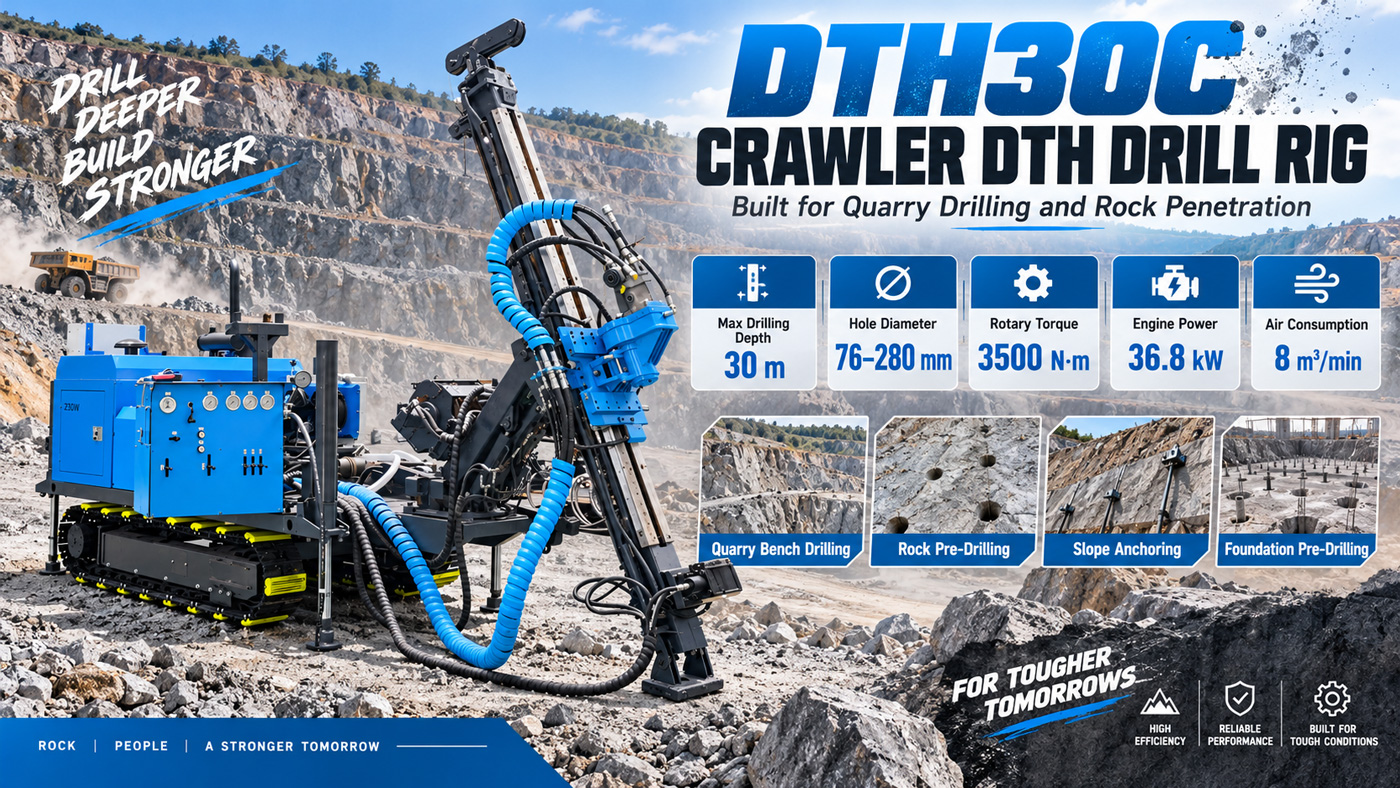
The DTH30C has overall dimensions of approximately 3200 × 1200 × 1850 mm, a width of approximately 1.2 m, and an overall weight of approximately 2500 kg. The data states that it is suitable for some factory areas, construction sites within enclosures, and narrow construction passages, and is relatively easy to transport and load/unload. Before purchase, turning space, ground bearing capacity, underground pipelines, and surrounding buildings should still be confirmed. The equipment uses an engineering rubber crawler chassis. The data states that it has better adhesion on crushed stone, compacted soil, not fully hardened roads, and generally rough terrain, while being friendlier to completed paved surfaces and concrete floors. The travel speed is 5–10 km/h, and the applicable ground is compacted soil, gravel roads, construction access roads, and generally uneven sites.
Main Technical Parameters
| Parameter Item | Parameter Value |
|---|---|
| Product Model | DTH30C |
| Equipment Type | Multifunctional crawler hydraulic DTH drill rig |
| Chassis Type | Engineering rubber crawler chassis |
| Travel Mode | Hydraulic crawler drive |
| Power | 36.8 kW diesel engine (optional) |
| Maximum Drilling Depth | 30 m |
| Hole Diameter | 76–280 mm |
| Applicable Rock Hardness | Medium-to-high hardness, approximately f = 8–24 |
| Maximum Rotary Torque | 3500 N·m |
| Reference Air Consumption | Approximately 8 m³/min (original table labels it as 8 m²/min; subject to formal technical data) |
| Slide Frame Stroke | 3.2 m |
| Effective Stroke | 2.2 m |
| Feed Speed | 53 m/min (rapid movement speed) |
| Piling Height | 2.2 m |
| Inclination Adjustment | Available; original data does not give a specific angle range |
| Swing Angle | 18–180° |
| Travel Speed | 5–10 km/h |
| Overall Dimensions | 3200 × 1200 × 1850 mm |
| Overall Weight | 2500 kg |
Items Requiring Additional Confirmation for Fractured Formations and Weathered Rock
The data points out that weathered rock, soil-rock mixed layers, and upper loose overburden are prone to unstable hole walls. In such formations, the feed speed should be reduced, and casing, starting drilling tools, or other upper hole stabilization methods should be used as needed. In fissures and fractured zones, block falling, air leakage, and sticking are likely to occur. Excessive feed should be reduced, continuous hole cleaning should be maintained, and casing should be used according to hole wall conditions. If high-pressure air circuit pressure is abnormal or return cuttings suddenly stop, drilling should be stopped for inspection first, and forced feeding should not continue. These are construction precautions given in the data. Specific process parameters still need to be determined according to on-site conditions.
Information to Verify with the Manufacturer Before Purchase
- The accurate unit and value of reference air consumption. The original table labels it as 8 m²/min and needs to be confirmed with formal technical data.
- The specific angle range of inclination adjustment. The existing data does not provide a value.
- The 36.8 kW diesel engine is an optional item. The final supply configuration needs to be confirmed.
- The matching list of DTH hammers, drill bits, drill rods, casing tools, and air compressors required for slope anchoring and foundation pre-drilling projects.
- Transport vehicle load capacity and fixing method. The overall machine is approximately 2500 kg, and the loading/unloading ramp must have sufficient bearing capacity.
The data does not provide price, transaction records, test data, or certification information. This article does not supplement these contents. Actual rock hardness, hole diameter, DTH hammer specifications, air compressor capacity, and operating methods vary. The final drilling efficiency and construction results should be based on on-site conditions.