












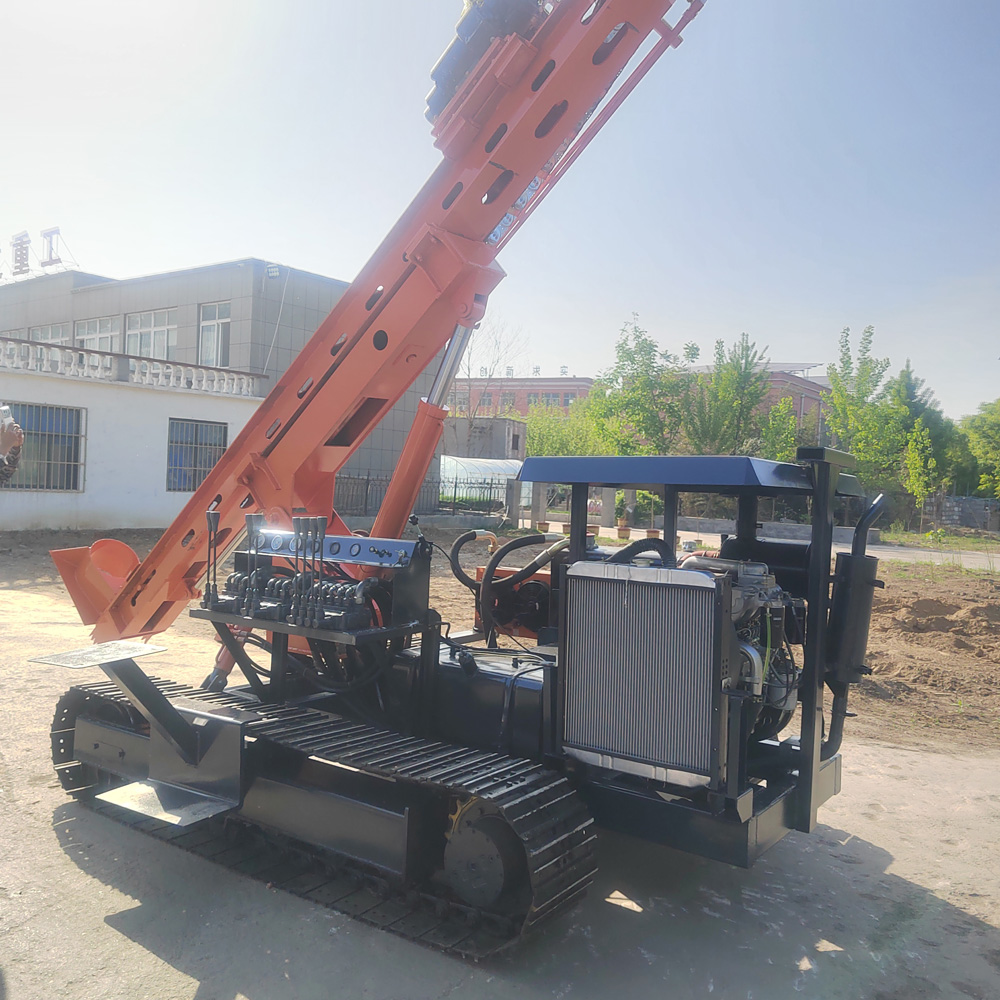
The PV390 Standard is suitable for photovoltaic foundation pre-drilling conditions that can be judged by four factors: hole diameter between 80–600 mm, design hole depth not exceeding 6 m, the need for a crawler chassis to frequently move around unpaved site areas, and pile positions with slopes or posture differences that require adjusting the drilling angle. It is equipped with an 85 kW Yuchai four-cylinder engine and 13000 N·m reducer torque, a drill rod speed of 90 r/min, chain feed, 120° mast tilt, dual-cylinder left-right swing arms, and 50 cm front-rear telescopic compensation. For projects exceeding these four conditions, it should first be confirmed whether they fall within the design scope of this model.
The following explains the judgment basis by hole diameter, depth, terrain, and formation, and lists items to confirm with the manufacturer before purchase.
Hole Diameter and Depth: Shallow Foundation Pre-Drilling Covered by 80–600 mm and 0–6 m
The PV390 has a drilling diameter range of 80–600 mm and a maximum drilling depth of 6 m. This positioning corresponds to shallow foundation projects such as photovoltaic support foundation pre-drilling, pile position hole forming, and fence post installation, rather than deep wells or water well construction.
- Smaller hole diameters are suitable for pre-drilling conventional photovoltaic support pile positions;
- Larger hole diameters are suitable for pile types or pilot hole requirements that need larger foundation holes by design;
- The final hole diameter and hole depth must be based on the project foundation design drawings. The equipment capability range does not mean that any hole diameter can reach 6 m.
13000 N·m is the reducer torque, combined with 90 r/min drill rod speed and chain feed, used to maintain rotation under shallow large-diameter conditions. The data does not provide actual penetration rates for different hole diameters, so construction efficiency cannot be directly calculated from hole diameter. This is content that needs to be confirmed on site based on the drill bit and formation.
Terrain Conditions: Crawler Chassis, Slopes, and Posture Adjustment
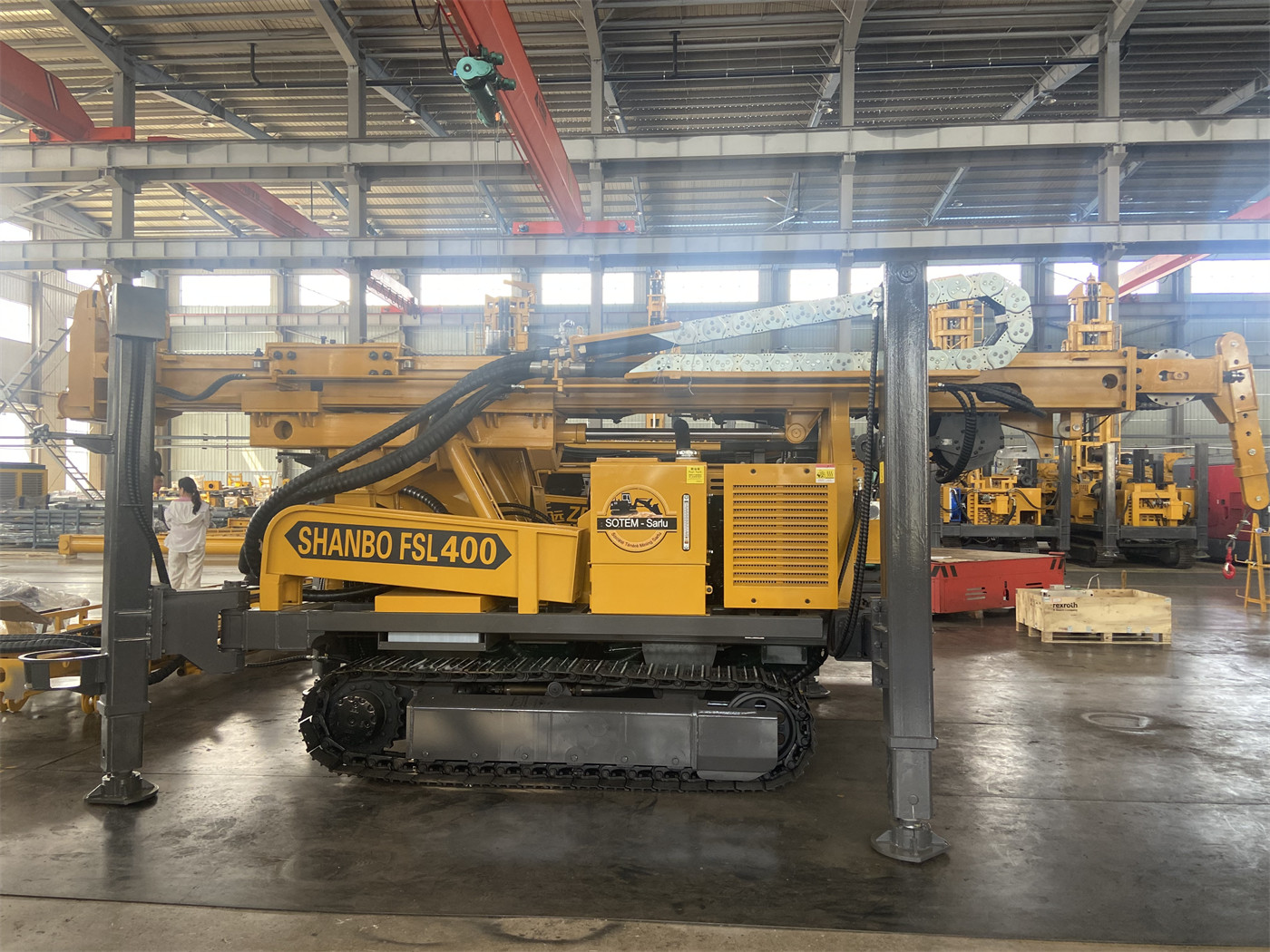
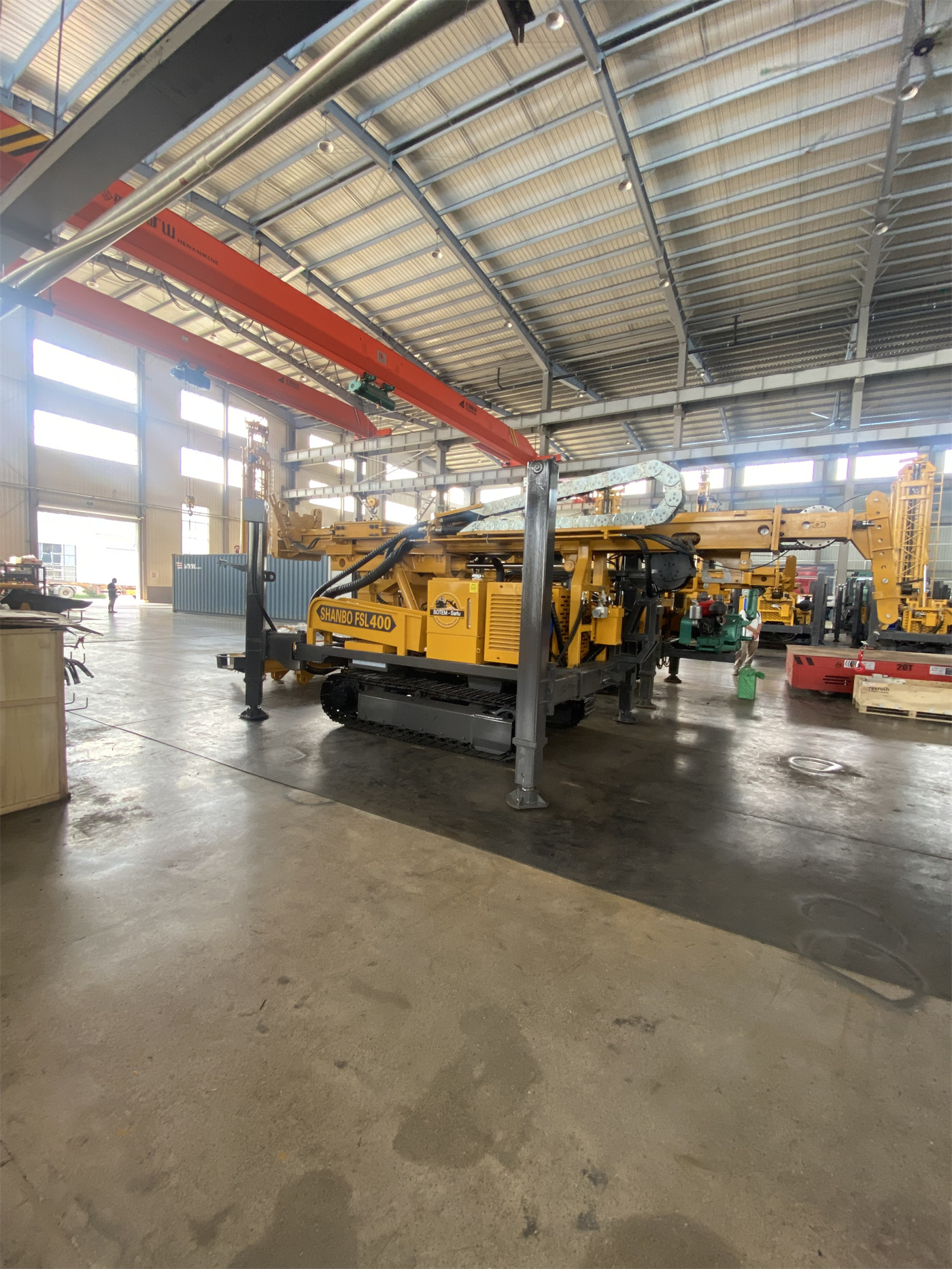
The PV390 uses a crawler chassis with 400 mm track shoe width, overall dimensions of 5200 × 2300 × 2650 mm, and a documented climbing angle of 35°. The 400 mm track shoes help distribute ground pressure and are suitable for short-distance movement within unpaved areas such as dirt roads, grasslands, and gravel ground. This is also the practical use scenario that distinguishes it from wheeled chassis.
35° is the climbing angle given in the data, but it cannot be directly used as a basis for safe travel. Actual slope operations must also consider cross-slope angle, ground wetness and slipperiness, soil quality, and the overall center of gravity of the machine. These conditions do not have corresponding limits in the data.
The 120° mast tilt, dual-cylinder left-right swing arms, and 50 cm front-rear telescopic compensation together provide multi-directional positioning capability:
- Mast tilt is used to adjust the drilling posture according to slope and pile position requirements, reducing repeated movement of the entire machine;
- Left-right swing arms make lateral adjustments to the hole position after the equipment is stabilized, suitable for array-type photovoltaic stations with dense pile positions;
- Front-rear telescopic compensation is used for longitudinal fine-tuning of pile positions, suitable for uneven ground sites.
Combined, the main value of these three features is reducing the number of times the entire machine must be moved for each pile position. How much movement can be reduced depends on pile position arrangement density, site flatness, and slope direction. The data does not provide quantitative figures, so during procurement, the pile position layout drawings should be checked item by item with the manufacturer.
Formation Conditions: Which Formations Are Supported and Which Need Confirmation
The data describes formations by type, and the applicability of one formation cannot be extended to all formations:
| Formation Type | Data Description | Notes |
|---|---|---|
| Soil layer | Suitable for conventional photovoltaic foundation pre-drilling and pile position construction | — |
| Loess | Adjust drilling parameters according to density and moisture content | Hole wall stability is affected by moisture content and density |
| Clay | Pay attention to drill bit mud balling and poor cuttings removal | Adjust feed and rotation according to hole wall condition and drill bit load |
| Pebble sand | Select drilling tools according to particle size and density | Drill bit bouncing, hole deviation, and sticking may occur |
| Backfill waste layer | Focus on preventing foreign objects, voids, and local sticking | When rotation load suddenly increases, pull out the drill to inspect |
| Strongly weathered rock and rock layers | After replacing with impact drilling tools, can be used for corresponding formation construction | The data does not provide impact hammer model or impact energy |
Chain feed is a continuous propulsion method. When encountering pebbles, backfill layers, or strongly weathered rock, the feed speed should be controlled according to rotation load and drilling tool condition. The data indicates that excessive downward pressure may cause hole deviation, drill sticking, or excessive impact on drilling tools, but it does not provide specific feed parameters or grading recommendations. Therefore, a drilling parameter table cannot be compiled based on this.
Regarding strongly weathered rock and rock layers, the original data states that after replacing with impact drilling tools, it can be used for corresponding formation construction, but does not provide impact hammer model, impact energy, or hard rock efficiency data. Therefore, this article does not make any quantitative judgment on the drilling effect in such formations.
Power and Supporting Prerequisites for Field Construction
The PV390 is equipped with an 85 kW Yuchai four-cylinder engine, providing hydraulic power for travel, rotation, chain feed, and mast adjustment. Photovoltaic sites are usually far from fixed power sources, and diesel power is suitable for independent field operations. The data mentions that during continuous high-load operations, focus should be placed on checking cooling, air filters, and the fuel system.
Regarding the hydraulic system, the data indicates the main pump is a triple pump 40 / 40 / 32, the travel motor is TM09, and the reducer is an internal five-star reducer. These configurations together determine rotation and travel performance, but the data does not provide more detailed values such as hydraulic system pressure and flow. If matching calculations are needed for specific working conditions, complete technical data should be requested from the manufacturer.
Items to Confirm Before Purchase
Based on the above information, before purchasing the PV390 Standard, it is recommended to first verify the following conditions:
- Whether all project design hole diameters fall within the 80–600 mm range, and whether there are foundation forms outside this range;
- Whether the design hole depth does not exceed 6 m, and whether there are layered depths requiring staged hole forming;
- Whether the site slope, cross slope, ground wetness and slipperiness, and soil quality are within operating conditions controllable by the crawler chassis and overall center of gravity;
- The formation composition in the geological survey data, especially pebble particle size, backfill layer thickness, and degree of strongly weathered rock integrity;
- If rock layer construction is involved, the model, interface, and supply scope of matching impact drilling tools. This part is not provided in the data;
- Pile position arrangement density, spacing, and slope direction, used to judge how much whole-machine movement can be replaced by mast posture adjustment;
- Standard accessories, drilling tool configuration, and training service scope must be listed item by item in the contract.
The data description also mentions that before construction, underground cables, pipelines, and obstacles should be confirmed; during slope operations, track adhesion and overall machine stability should be checked; during drilling, personnel must not approach the rotating drill rod, chain feed mechanism, or mast swing range; and when replacing impact drilling tools, the machine should be stopped and hydraulic pressure released. These are safety prerequisites, and specific operational requirements should be based on the manufacturer's accompanying documents and on-site management regulations.
Parameter Source Note
The product model in the original data once appeared as SL390. After confirmation, this article uniformly uses PV390, and all other technical parameters are organized according to the provided data. Actual drilling efficiency, hole forming quality, and pile driving effect will be affected by geological conditions, drilling tool type, pile type, hole diameter, construction angle, and operation method, and should be based on on-site working conditions and project foundation design. Values not provided in the data (such as hydraulic pressure, impact hammer parameters, penetration rates in different formations, and operating limits for different slopes) are not supplemented by this article. If needed, further confirmation should be obtained from the manufacturer.