












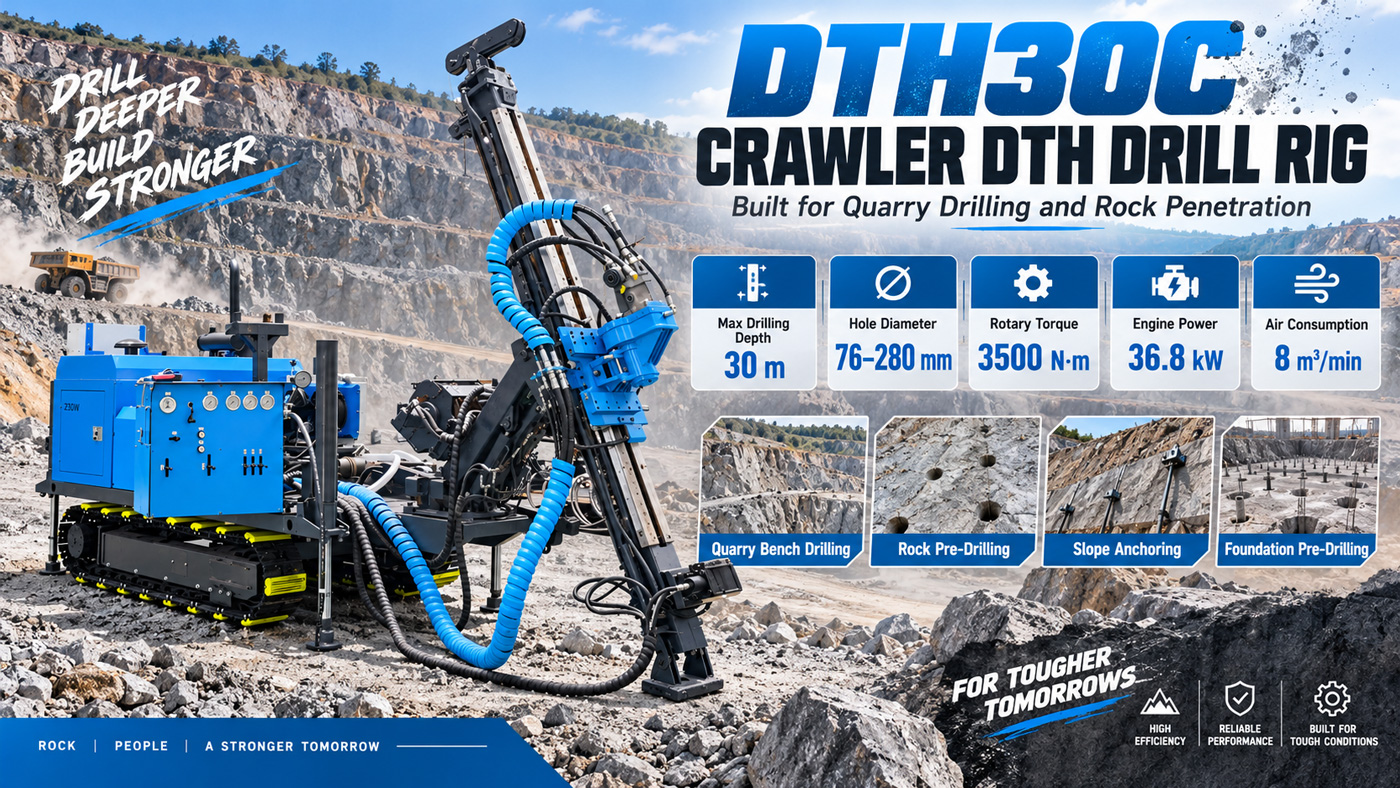
In the DTH30C specification table, the maximum rotation torque is listed as 3500 N·m. The same table also gives a maximum drilling depth of 30 m, a drilling diameter of 76–280 mm, and an applicable rock hardness of approximately f = 8–24. These four values are not parallel: hole diameter and rock hardness determine how much rotation torque is needed at the hole bottom, the 30 m drilling depth limits the drill string length and self-weight, and 3500 N·m is the upper limit of rotation load the equipment can continuously provide within this hole section.
What Section Rotation Torque Controls in DTH Drilling
DTH drilling differs from rotary drilling: rock breakage mainly relies on the impact energy of the DTH hammer, and the role of the rotation mechanism is to turn the drill bit through an angle between each impact so that the spherical buttons act evenly on the hole bottom, while also overcoming the frictional resistance between the drilling tools and the hole wall. Therefore, rotation torque is not directly equal to drilling capability; it is more like a lower-bound constraint—when torque is insufficient, the drill bit cannot turn or the rotation speed drops, the impact energy cannot be evenly distributed to the hole bottom, and penetration stalls.
The materials on this site describe 3500 N·m as "able to meet the DTH drilling needs of most 76–280 mm engineering holes." The "most" here corresponds to the combination of shallow to medium holes and medium to high hardness rock, not a general conclusion for all hole diameters in all formations.
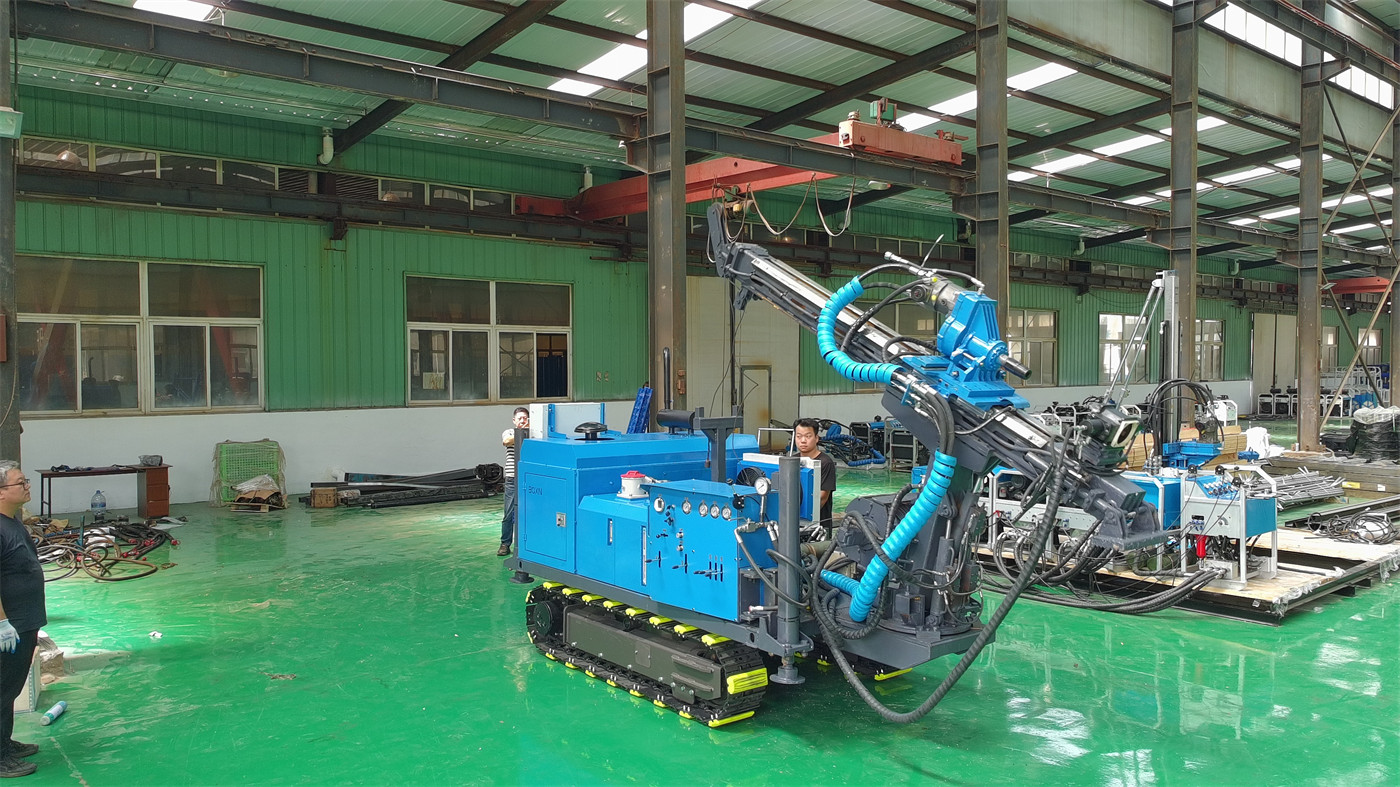
What Consumes Torque as Hole Diameter Increases
The effect of hole diameter on rotation torque comes from two places: the contact area at the hole bottom increases with diameter, requiring greater torque to drive the drill bit to rotate; at the same time, the larger the drilling diameter, the greater the amount of cuttings discharged per unit length, and if cuttings removal is not timely, repeated breakage at the hole bottom further increases rotation resistance.
The diameter range given in the materials is 76–280 mm, with the upper and lower limits differing by about 3.7 times. When the same equipment works within this range, which end the hole diameter falls on directly changes the magnitude of the rotation load. The specification table does not give corresponding torque margins segmented by hole diameter, so questions such as "how much margin remains from 3500 N·m at a 280 mm hole diameter" need to be confirmed separately in combination with the specific DTH hammer specifications, drill bit form, and on-site rock formation.
Rock Hardness Changes the Way the Load Fluctuates
The applicable rock hardness given in the materials is approximately f = 8–24, covering medium to high hardness rocks such as limestone, granite, sandstone, and basalt. The effect of hardness on rotation torque is not entirely linear amplification; more noticeably, it intensifies load fluctuation: in intact hard rock, the drill bit buttons have difficulty cutting in, and rotation resistance shows periodic jumps; when encountering fissures or alternating soft and hard layers, resistance suddenly drops again.
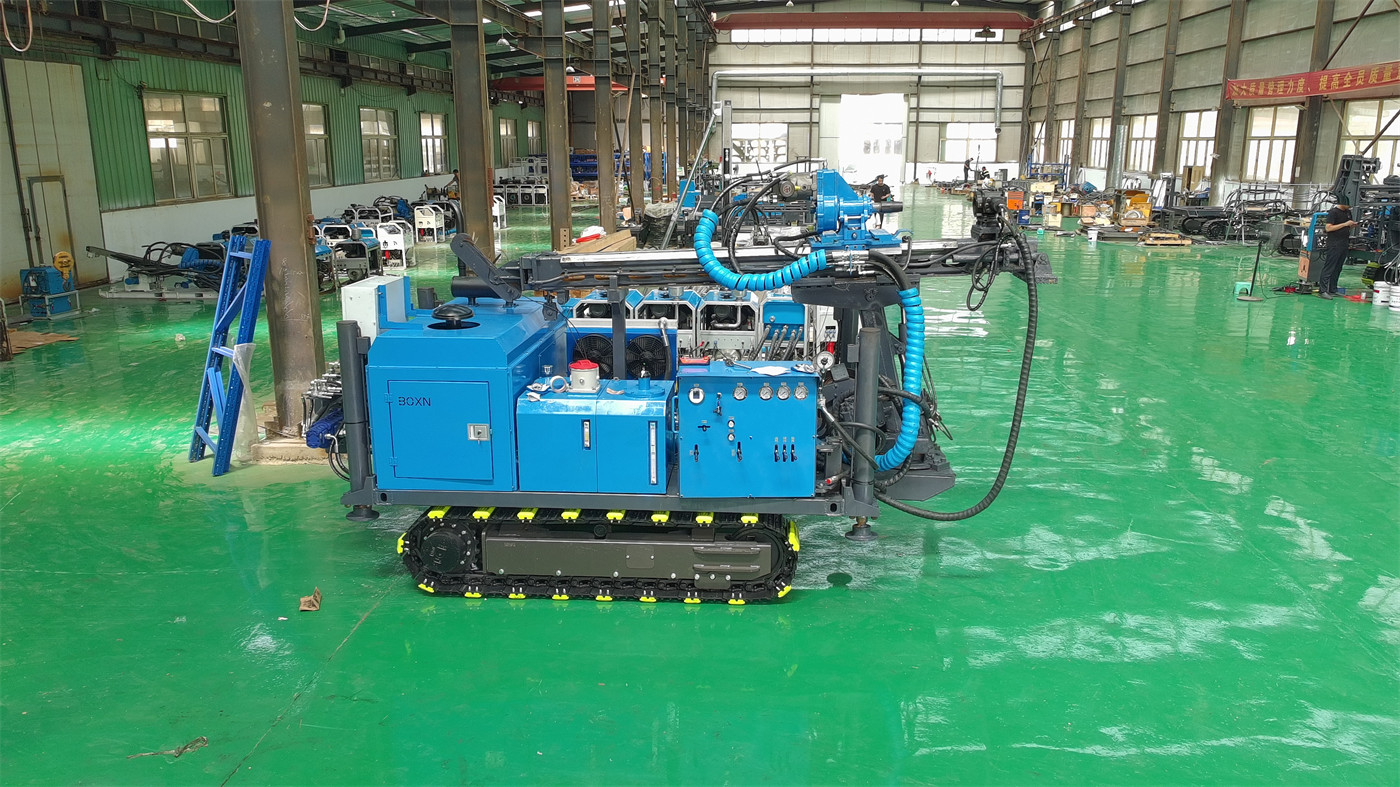
The materials mention in the parameter notes that if rotation resistance continues to increase, the amount of returned cuttings decreases, or the drill bit jumps noticeably, parameters should be adjusted and the hole cleaned. These three signals indicate that 3500 N·m is a boundary description of equipment capability, not a working point that can always be operated at full load.
Additional Requirements on Torque from a Drilling Depth of 30 m
A drilling depth of 30 m means that both the drill string length and self-weight are within this order of magnitude. The longer the drill string, the greater the rotation resistance caused by hole wall friction and the self-weight of the drilling tools, and the rotation mechanism needs to transmit the remaining torque to the hole bottom after overcoming this additional resistance. The 30 m class positioning and compact body of the DTH30C (dimensions approximately 3200 × 1200 × 1850 mm, total weight approximately 2500 kg) indicate that it is aimed at short holes and shallow to medium holes, rather than deep-hole drill string management scenarios.
The materials also list a feed speed of 53 m/min and explain that this value is used for power head return, drill pipe handling, and non-drilling actions, and cannot be directly understood as rock penetration rate. No conversion relationship between rotation torque and penetration is given either.
Other Parameters Working in the Same Section as Torque
| Parameter Item | Material Value | Role in the Rotation Section |
|---|---|---|
| Maximum rotation torque | 3500 N·m | Upper torque limit for driving the drill bit through the angle between impacts |
| Drilling diameter | 76–280 mm | The larger the hole diameter, the higher the rotation resistance at the hole bottom |
| Applicable rock hardness | Approximately f = 8–24 | Determines load level and degree of fluctuation |
| Reference air consumption | Approximately 8 m³/min | Drives the DTH hammer and discharges cuttings, affecting repeated breakage at the hole bottom |
| Swing angle | 18–180° | In inclined holes and lateral holes, the posture of the drilling tools changes, and the direction of rotation load changes accordingly |
These parameters act simultaneously in the same drilling operation. Insufficient air supply from the air compressor will lead to poor cuttings removal, and accumulated cuttings at the hole bottom increase rotation resistance; when the swing angle is used for inclined holes, the component of the drilling tools' gravity in the direction of the hole wall changes, and the friction conditions change accordingly. The materials do not give a quantitative relationship between these factors and rotation torque.
Parts Not Answered by the Materials
- For hole diameters above 270 mm in rock formations with f = 20 or higher, the actual margin of 3500 N·m rotation torque is not given numerically.
- The matching relationship between DTH hammer specifications and rotation torque is not listed in a corresponding table in the materials.
- Regarding the relationship between inclined hole angle and rotation torque demand, the materials only give a swing angle range of 18–180° and support for tilt adjustment, without a specific tilt angle value range.
In the original materials, the "air consumption" column is marked as 8 m²/min, which is understood as approximately 8 m³/min according to the common unit for compressed air flow, and the final value should be confirmed with formal technical materials. 3500 N·m corresponds to the maximum rotation torque of the DTH30C model and cannot be generalized to other drill rig models on this site.