












The core of the PV390H's high-low leg function is a telescopic track height structure with a telescoping dimension of 1200 mm, used to handle left-right height differences and uneven slope surfaces. It can improve the rig's working posture on uneven ground to a certain extent, reducing the need for frequent ground leveling that ordinary fixed-height track rigs require. However, it is not a guaranteed value for slope traversability, nor can it replace a safe working platform and foundation bearing assessment. Whether it is worth purchasing for this function depends on the frequency of slope changes, the magnitude of pile position height differences, site access road conditions, and geological conditions.
First, confirm what the 1200 mm track height telescoping actually means
According to the product information on this site, the PV390H's track height telescoping dimension is 1200 mm, belonging to a high-low leg hydraulic adjustment structure. The information does not provide the maximum climbing angle, maximum cross-slope angle, or allowable single-side adjustment amount corresponding to this dimension, so 1200 mm cannot be understood as a traversable slope value.
The verifiable statement is: track height can be adjusted according to slope height differences, enabling the rig to achieve a better working posture on uneven ground, making it more suitable for PV projects on hillsides, hills, and areas with obvious undulations. During procurement communication, what needs to be confirmed with the manufacturer is: how the single-side adjustable stroke is distributed, whether adjustment is synchronous or can be done separately on each side, and whether the adjustment action and travel are interlocked, among other specific control methods. These details are not given in the original information and are items that need to be verified with the manufacturer.
What problems can high-low legs solve in mountainous and hilly PV sites
When left-right height differences between pile positions are obvious
A common situation in mountainous PV sites is left-right height differences between adjacent pile positions, where the ground is not uniformly sloped overall but continuously undulating. Ordinary fixed-height track rigs often require prior leveling with an excavator or manual soil padding to achieve a relatively horizontal working posture. The role of the high-low leg structure is to adapt to height differences by adjusting the height of the tracks on both sides, reducing such auxiliary leveling actions.
During continuous dense pile position construction
The PV390H is equipped with a dual-cylinder left-right swing arm and 450 mm telescopic compensation, combined with 120° mast tilt, allowing lateral and front-back fine adjustment for hole alignment after the chassis is stabilized. For array-type PV stations, such adjustments can reduce frequent small-range chassis movements. High-low legs, swing arm, tilt, and telescopic compensation work in coordination; no single item determines the construction pace.
Hilly projects with uneven ground but not extreme slopes
Local slopes in hilly areas may not be very steep; the problem is more about frequent height differences between pile positions. The value of high-low leg adjustment in such areas is reflected in reducing reliance on leveling for each pile position, rather than for steep slope traversability.
Under which conditions do high-low legs truly work
- The slope surface has left-right height differences that can be compensated by track height differences, rather than an overall continuous large longitudinal slope.
- Pile positions are dense and require frequent hole alignment, so the lateral swing arm and telescopic compensation can be used simultaneously.
- Site access road conditions are average, but there are basically passable unpaved roads such as dirt roads, grass, and gravel. The PV390H has a 300 mm track shoe width, and the information states it can be used on dirt roads, grass, gravel, and general slopes.
- The stratum belongs to the soil layers listed in the information: soil, loess, clay, pebble sand, mixed overburden, backfill waste layer, or strongly weathered rock and rock layers after changing to impact drilling tools. Sites with frequent stratum changes require posture adjustment capability to work with different drilling tools.
Conversely, if the project is a large centralized PV power station with gentle slopes and already leveled ground, the incremental benefit of high-low legs is mainly in pile position hole alignment efficiency and continuous construction pace, rather than terrain adaptability itself. In this case, procurement judgment should return to power, torque, hole diameter, and pile type matching.
Boundaries and limitations to note
Lack of verifiable values for slope capability
The information only states that track height is adjustable and that with an added winch it can be used for steeper slope conditions, but does not provide maximum climbing angle, maximum cross-slope value, or allowable single-side lifting amount. If the project has clear slope indicators before procurement, the corresponding conditions should be confirmed in writing with the manufacturer, and should not be inferred independently.
High-low legs cannot replace safe platform and bearing assessment
The information clearly states: when using the high-low leg function, avoid excessive single-side adjustment that causes the overall center of gravity to shift; cross-slope construction should be more cautious; before adjusting track height, ensure the rig is at low speed or stopped, and observe surrounding personnel and obstacles. On wet and slippery slopes, soft soil, and areas with large cross-slopes, reduce speed and pay attention to rollover risk. The winch cannot replace necessary construction roads and safe platforms. These are the usage boundaries given in the information, and specific operations should be combined with on-site safety judgment.
Geology and hole quality are still affected by strata
Slope loess may experience reduced adhesion and rig sliding risk after rain; high-plasticity clay is prone to bit balling and poor cuttings removal; pebble sand, gravel, and mixed overburden can cause bit bouncing, hole deviation, and local sticking; backfill waste layers may contain bricks, concrete blocks, rebar, wood, and voids, and abnormal impact, rotary sticking, or sudden pressure loss should prompt shutdown and inspection. High-low legs solve posture and positioning problems, not the hole-forming problems of the strata themselves.
PV390H parameters to verify before procurement
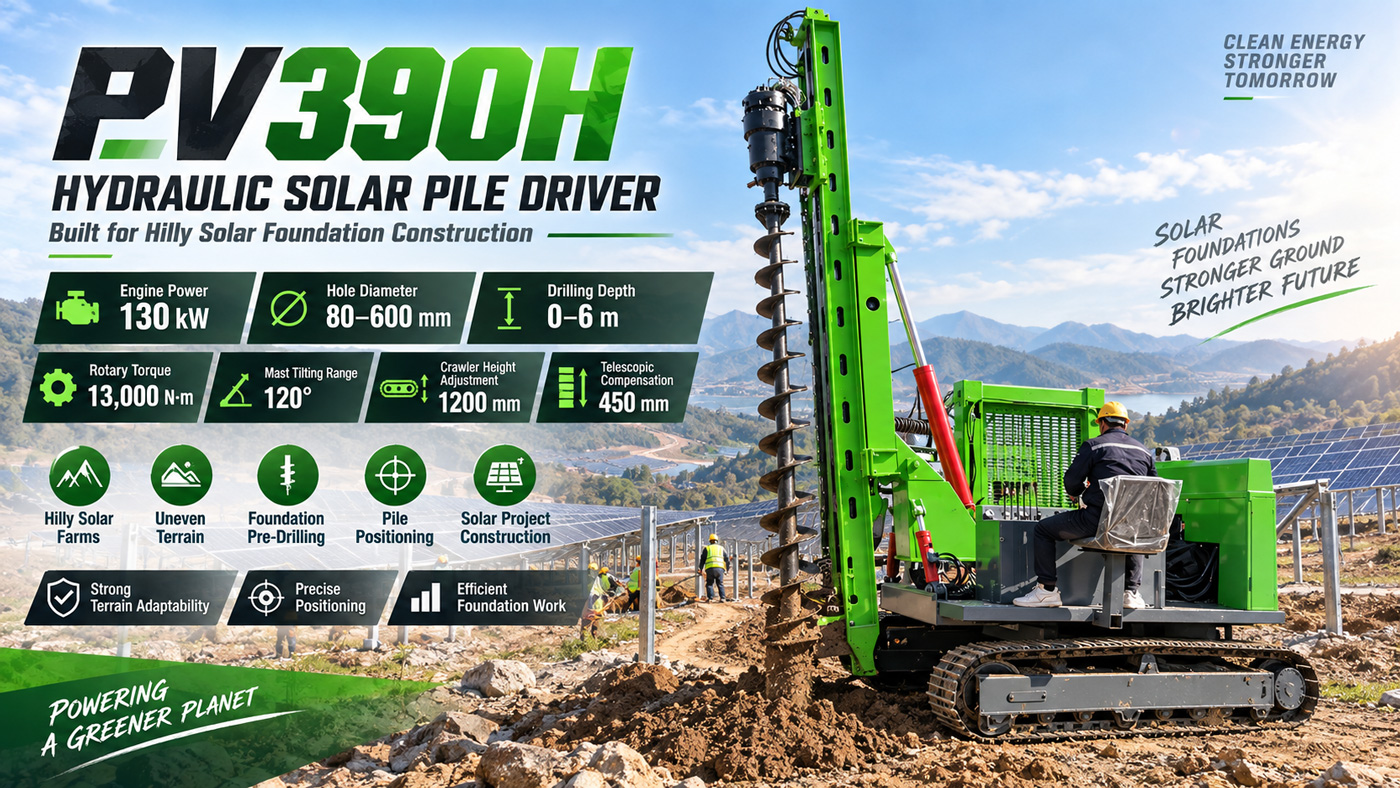
| Item | Information parameters |
|---|---|
| Product model | PV390H |
| Equipment type | High-low leg hydraulic crawler PV piling rig |
| Overall dimensions | 5200 × 2300 × 2800 mm |
| Track shoe width | 300 mm |
| Engine | Yuchai six-cylinder turbocharged engine, 130 kW |
| Main pump | Triple pump 50 / 50 / 40 |
| Travel motor | TM09 |
| Drilling diameter | 80–600 mm |
| Drilling depth | 0–6 m |
| Reducer | Internal five-star reducer, torque 13000 N·m |
| Drill pipe speed | 100 r/min |
| Pressurization method | Chain pressurization |
| Mast tilt | 120° |
| Mast swing | Dual-cylinder left-right swing arm |
| Track height telescoping dimension | 1200 mm |
| Telescopic compensation | 450 mm |
The above parameters are retained as per the original information. Items not given in the information, such as maximum climbing angle, single-side adjustment stroke distribution, impact hammer model, and impact energy, are not supplemented in this article.
Items to confirm in writing with the manufacturer during inquiry
- Control method for track height adjustment: whether separate side adjustment is possible, whether adjustment and travel are interlocked, and how the operating position and observation field are arranged.
- Constructability conditions corresponding to project slopes: ask the manufacturer to explain limitations based on specific slopes and ground conditions, rather than only providing the track height value.
- Winch configuration: whether optional, anchoring and traction requirements, applicable slope conditions, and whether included in the delivery scope.
- Drilling tool matching: drilling tool forms for different hole diameters within the 80–600 mm range, and specifications of impact drilling tools for strongly weathered rock and rock layers.
- Stratum adaptability: correspondence between actual project strata and the strata listed in the information, especially handling methods for backfill layers and strata containing foreign objects.
- Delivery scope and training: random accessories, wear parts, transport dimension restrictions, and service content, listed item by item in the procurement contract.
Conclusion
The PV390H's 1200 mm track height telescoping is a well-matched configuration for mountainous and hilly PV sites with obvious pile position height differences, continuously undulating ground, dense pile positions, and frequent hole alignment needs; its value lies in slope posture adjustment and reducing leveling and repositioning, rather than providing a specific climbable angle. Procurement judgment should first look at the project's actual slope and pile position height difference patterns, then verify power, torque, hole diameter, and geological matching, and finally confirm in writing with the manufacturer the slope limitations, control methods, and winch conditions not covered in the information. Actual drilling efficiency, hole quality, rig traversability, and piling results should still be based on on-site conditions and project foundation design.