












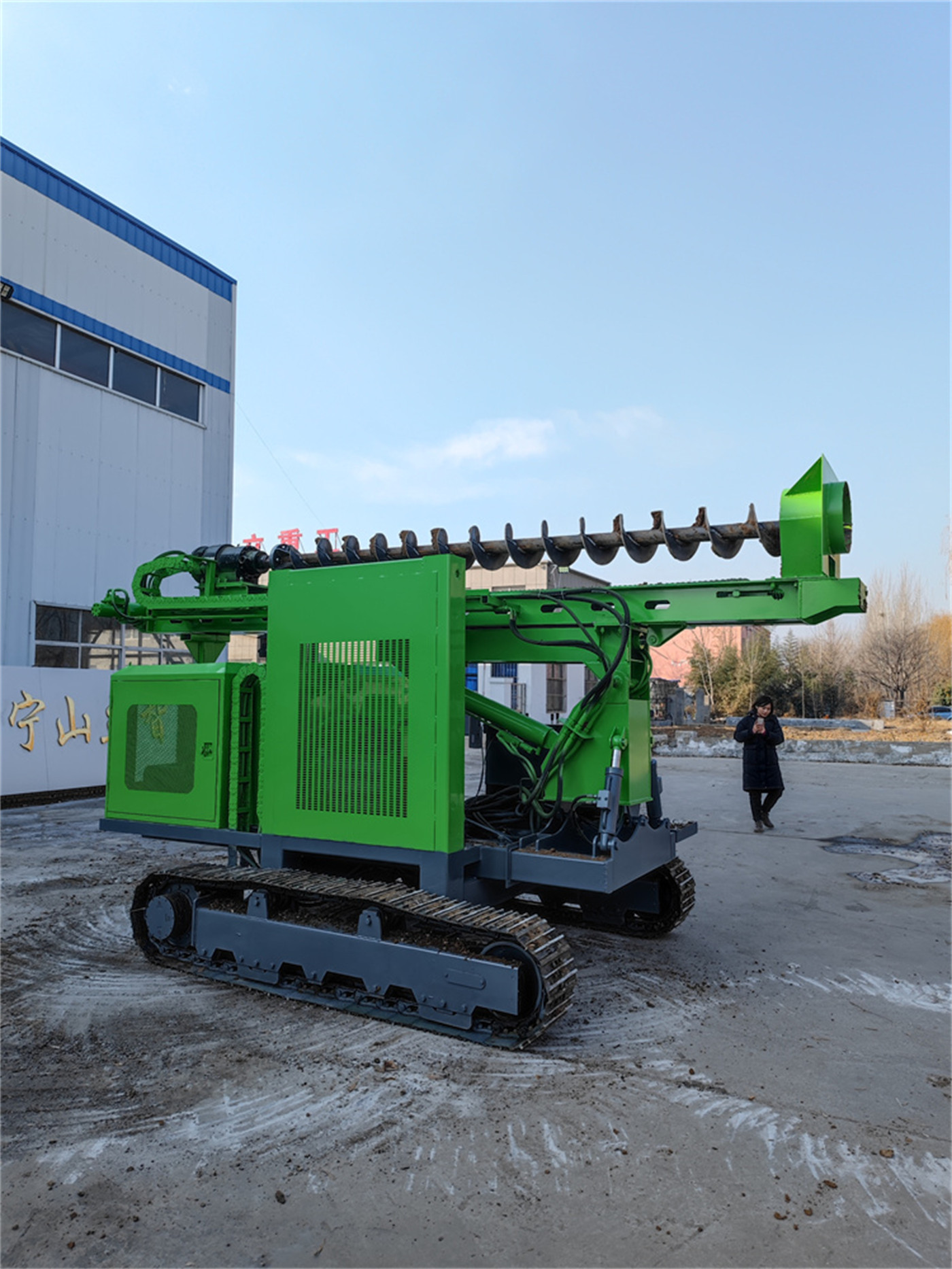
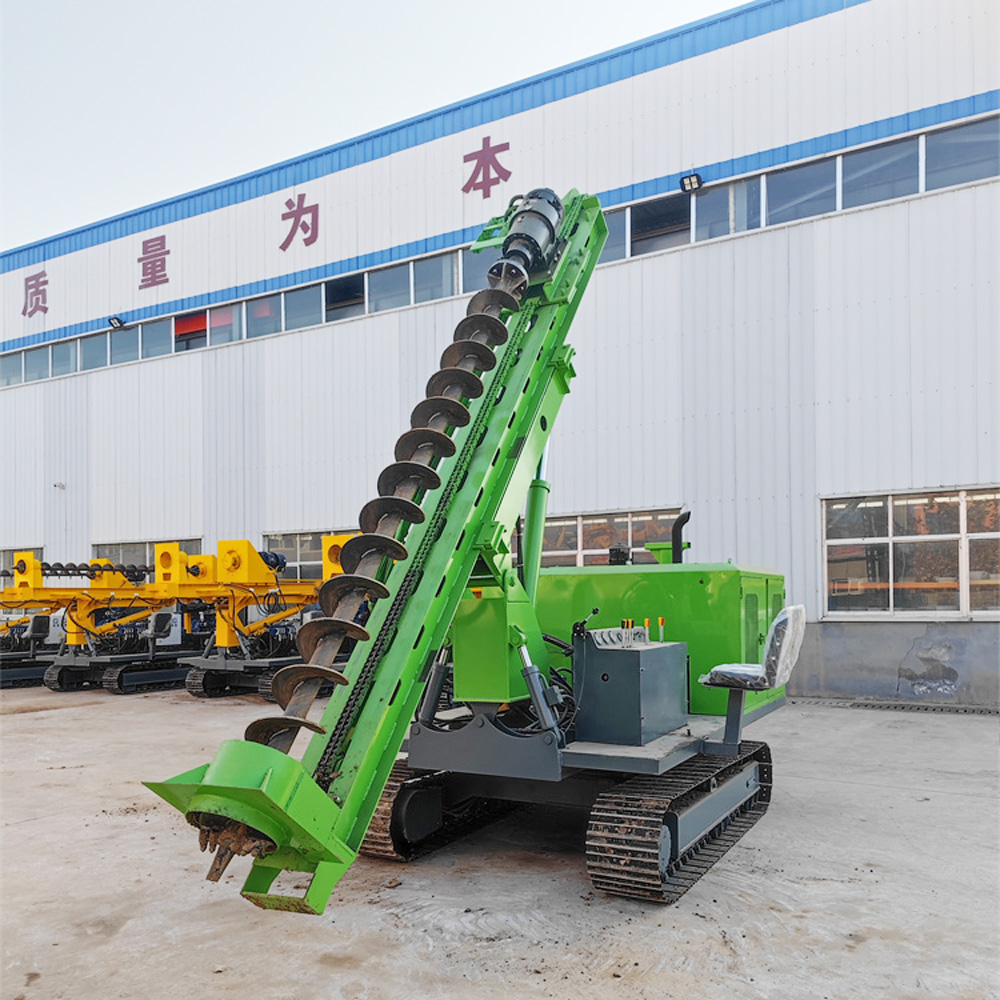
In the PV390R materials, 360° rotation is listed among the first set of capabilities, but it does not replace all hole-alignment actions in the process. The same materials also list 120° mast pitch, dual-cylinder left-right swing arm, and 500 mm telescopic compensation. These functions do not overlap: rotation handles the major directional adjustment of the upper working mechanism relative to the chassis, the swing arm handles lateral correction, and telescopic compensation handles front-back fine adjustment. Conflating the four into one action easily leads to the conclusion that "with rotation, the entire machine does not need to move," but the materials themselves do not support this conclusion.
First, the Answer: It Reduces Machine Turnarounds and Site Repositioning
According to the PV390R materials, 360° rotation enables the upper working mechanism to make a wider range of directional adjustments around the chassis. In photovoltaic projects with dense pile positions, narrow construction surfaces, or the need to continuously handle pile points in multiple directions, it can reduce repeated machine turnarounds and repositioning. This statement is limited to the "entire machine," meaning movement at the tracked chassis level, not all hole-alignment actions.
The chassis's single stopping position is inherently limited. By expanding the operable directions, 360° rotation means the chassis does not need to turn around just to change direction. The materials also note that the tracked chassis handles site movement, while rotation, swing arm, and telescopic compensation handle detailed positioning. These two levels are separate.
Several Actions Easily Lumped Together
- Major directional adjustment: completed by 360° rotation of the upper structure, with the chassis stationary.
- Lateral correction: completed by the dual-cylinder left-right swing arm.
- Front-back fine adjustment: completed by 500 mm telescopic compensation.
- Working posture: adjusted by 120° mast pitch according to site and pile position requirements.
- Site transfer: still completed by tracked chassis movement; rotation does not replace this step.
The materials do not provide the number of pile positions coverable from one stop, nor the conversion relationship between rotation angle and pile position arrangement density. Which portion of repositioning frequency is reduced must be determined by on-site pile layout and operational organization.
360° Rotation, Swing Arm, and Telescopic Compensation Are Not a Substitute Relationship
If the three had the same function, the materials would not list them separately. According to the parameter table: upper rotation 360°, mast swing as dual-cylinder left-right swing arm, telescopic compensation 500 mm. Rotation is a wide-range adjustment in the circumferential direction, the swing arm addresses lateral position deviation, and telescopic compensation addresses front-back position deviation. Combined, these three can reduce repeated chassis movement within a small range, but the swing arm and telescopic compensation actions still occur.
Several Parameters to Read Together
| Parameter Item | Parameter Value |
|---|---|
| Upper rotation | 360° |
| Mast pitch | 120° |
| Mast swing | Dual-cylinder left-right swing arm |
| Telescopic compensation | 500 mm |
| Drilling diameter | 80–600 mm |
| Drilling depth | 0–6 m |
| Track shoe width | 400 mm |
| Climbing angle | 35° |
These values only indicate the adjustment range in each direction. Whether swing arm correction is still needed after one rotation in place, and how large the correction is, depends on the relative relationship between the chassis parking position and the pile position. The materials do not provide a one-size-fits-all conclusion.
Under What Site Conditions This Function Is More Evident
The materials list two types of scenarios: ground-mounted centralized photovoltaic power stations, and projects with dense pile positions, narrow construction surfaces, or the need to continuously handle pile points in multiple directions. These two scenarios share common features: a large number of pile positions, regular arrangement, and limited equipment parking space. Under such conditions, the rotation function corresponds to reducing the number of chassis turnarounds, not changing the drilling itself.
Conversely, in projects with sparse pile positions or ample chassis movement space, the actions saved by rotation are relatively limited. This is a judgment boundary inferred from the materials' description, not an efficiency conclusion.
Mountainous and Sloped Scenarios Require Separate Consideration
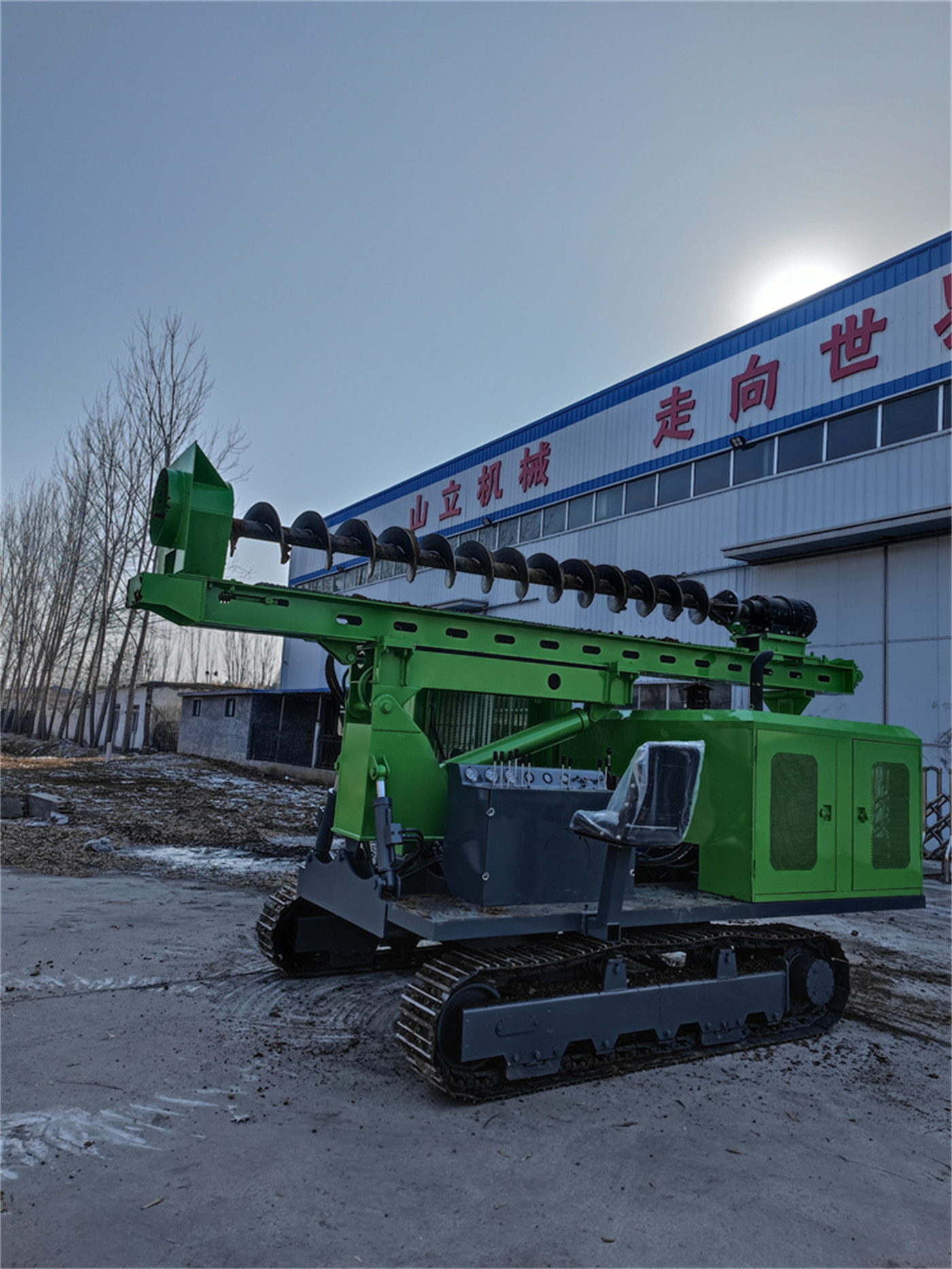
In the materials, the PV390R's mast pitch is 120°, used for adjusting drilling posture in mountainous photovoltaic and uneven sites. However, the same materials also note that when working on slopes, attention should be paid to center-of-gravity changes after rotation. Actual mountainous construction must simultaneously consider cross-slope, ground wetness, soil quality, and overall machine center of gravity; safety cannot be judged solely by the 35° climbing parameter. Here, the rotation function adds posture adjustment capability, but it does not mean that the need for machine position adjustment is eliminated on any slope.
Rotation Reduces Actions, but Does Not Reduce the Scope of Operational Risk
The materials explicitly require: before rotating the upper structure, confirm that no people, vehicles, overhead lines, or other machinery interference are nearby; during drilling, personnel must not enter the rotation range of the drill pipe, chain pressurizing mechanism, mast swing, and upper rotation. The denser the pile positions and the less the chassis moves, the more concentrated the relative position changes between equipment and personnel or existing facilities become, making confirmation of the working radius even more important.
This part is the safety constraint given in the materials and belongs to the operational organization level. This article does not repeat specific operating steps not provided in the materials.
What Questions These Materials Cannot Answer
There is a category of questions often directly attached to 360° rotation, but the materials provide no numerical support:
- How many directions of pile position operations can actually be completed from one stopping position;
- The specific time or labor saved per unit time by the rotation function compared with non-rotating structures;
- The differences brought by rotation under different pile spacings and site layouts.
These require separate calculation based on project pile layout drawings, site conditions, and construction organization methods, and cannot be directly converted from the parameter table.
Logical Order When Verifying This Function
If the goal is to determine whether 360° rotation can reduce actions in a specific project, confirm in sequence: whether pile positions are densely arranged, whether the chassis has space for continuous stopping, whether hole-alignment deviation mainly occurs laterally or front-back, and whether slope and post-rotation center of gravity both hold. The first two determine whether rotation has a role to play; the latter two determine how much the swing arm, telescopic compensation, and pitch each contribute. Looking first at site and pile positions, then at the function combination, is closer to the actual process segment it manages than looking only at the number "360°."