












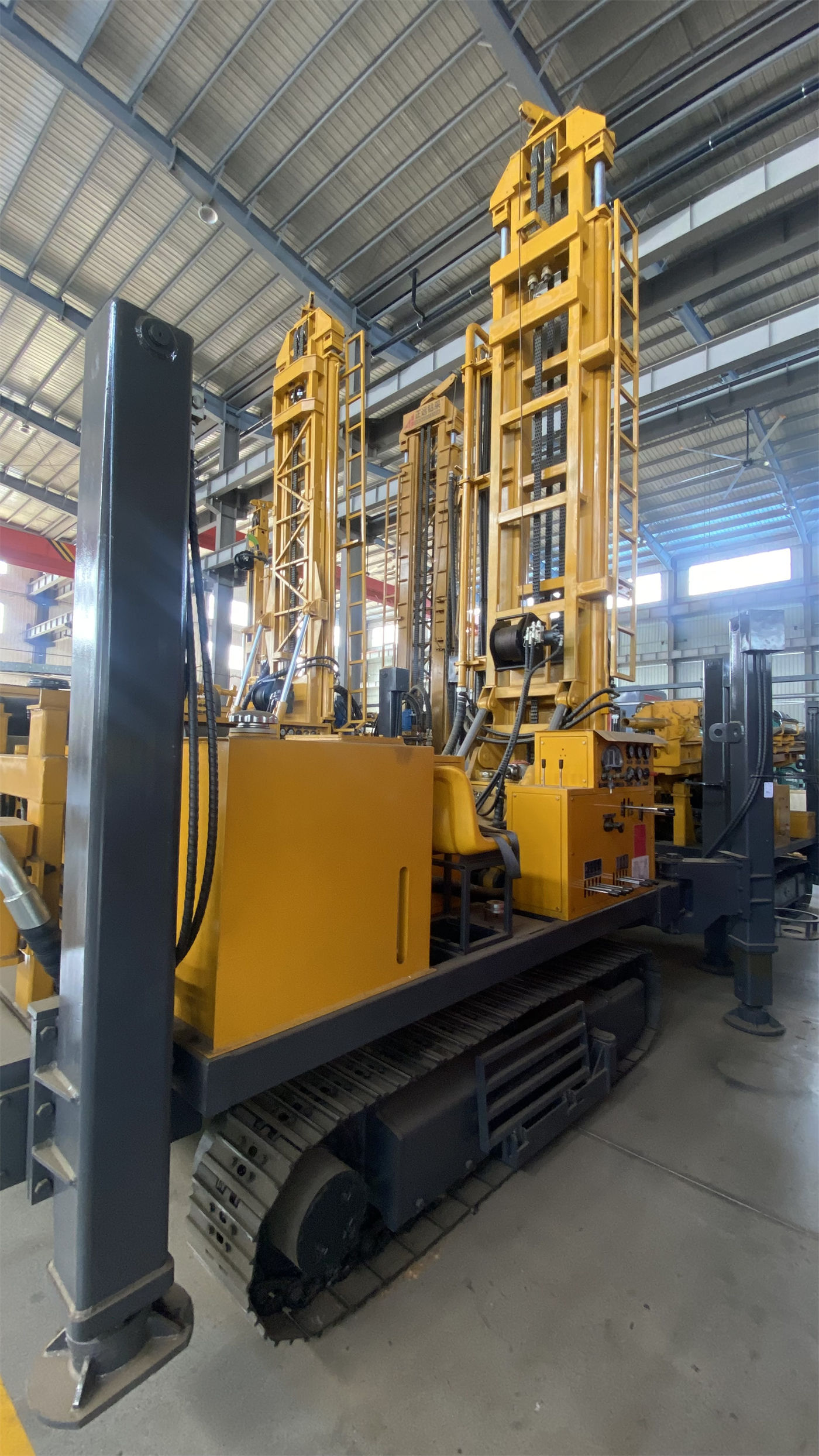
In the WR350SE product information, the drill pipe item is listed as “3 m / 6 m drill pipe,” with recommended drill pipe diameters of 89 / 102 mm. It is listed alongside maximum drilling depth and hole diameter range, and is easily taken as three independent capabilities, each with its own checkmark. But from the positioning description of this machine, compatibility between 3 m and 6 m corresponds to one process: making and breaking drill pipe connections. The S series is stated to focus on compatibility with longer drill pipes and reducing the number of pipe connections, while the E series emphasizes cost-effectiveness; together they form the positioning of the WR350SE. Applied to a single well, what compatible pipe lengths save is not some other quantity, but the repeated connections and disconnections within a 350 m hole depth.
Why the number of pipe connections becomes a cost
A drilling depth of 350 m is a cumulative position. Regardless of which pipe length is used, drilling must proceed from collar to final depth, with pipes connected one by one along the way. Doubling pipe length reduces the number of connections required for the same hole depth, and each connection involves a sequence of actions: breaking out the power head, lifting the pipe, making up the thread, lowering, and re-centering. These actions are not actual drilling, yet they consume the same rig-shift time.
The two speed values published for the WR350SE point to the same type of action: fast lift 30 m/min and fast feed 55 m/min. The information states that they are mainly used for non-drilling actions, such as drill pipe handling, power head return, and tool adjustment. Fewer pipe connections is precisely a portion of such non-drilling actions being eliminated. It should be noted that these two speeds are not equal to penetration rate in actual rock formations—the reference drilling efficiency given in the information is 10–35 m/h, and actual results depend on lithology, drilling tools, air compressor, and operator experience.
What conditions 3 m and 6 m each fall under
The information is not vague about the two pipe lengths: 3 m is more suitable for projects with ordinary transport conditions and limited work sites; 6 m can reduce the number of pipe connections and improve continuous drilling efficiency. These two statements correspond to two types of project organization, rather than one being better and the other worse.
| Pipe length | Application direction given in the information | Points also constrained |
|---|---|---|
| 3 m | Ordinary transport conditions, limited work site | Relatively more pipe connections required for the same hole depth |
| 6 m | Reduce pipe connections, improve continuous drilling efficiency | Increased pipe length places different requirements on site and transport arrangements |
The table does not say “6 m is necessarily faster,” because the information only says it reduces the number of pipe connections. Fewer connection actions only means fewer process steps; total time for a single hole still depends on in-hole conditions, frequency of hole cleaning, and drilling tool condition. Singling out drill pipe length as an efficiency conclusion would miss these factors.
Why “recommended diameter 89 / 102 mm” is written together with pipe length
The drill pipe configuration column actually contains two dimensions: length and diameter. 89 mm and 102 mm are recommended diameters, corresponding to choices under different well diameters, hole depths, and drilling tool combinations. Pipe length and diameter are not bound one-to-one; under the same pipe length, diameter may need to be selected according to project conditions. This point is easily overlooked when reading the information—remembering only “supports 6 m drill pipe” is not enough to decide what specification to run in the hole.
Another item directly adjacent to drill pipe is the 16 T lifting force. As well depth increases, drill pipe weight and borehole wall friction rise together, and the load during tripping falls on the lifting force. The information also gives a handling boundary: when abnormal resistance is encountered during pull-out, the hole should first be cleaned, the drill pipe inspected, and the borehole wall condition assessed, rather than directly relying on maximum lifting force to pull back by force. This shows that lifting force is the upper limit of the equipment-side capability, not a universal answer to in-hole problems.
Which actions correspond to one pipe connection
Breaking down one pipe connection roughly includes the following stages, each constrained by different parameters:
- Displacement actions such as lifting and lowering the pipe are related to fast lift 30 m/min and fast feed 55 m/min;
- Making or breaking the joint is related to drill pipe diameter, thread condition, and operating habits;
- The first stage of reapplying pressure and drilling after connection is related to rotation and feed;
- Placing and counting drilling tools after disconnection falls within the scope of site organization.
The number of stages affected by pipe length is the same; the difference is how many times these stages repeat at the same hole depth. This is the point of the statement “what is saved is the number of pipe connections”—it is not that some equipment parameter becomes larger, but that the number of process repetitions becomes smaller.
Dual-condition torque written in the same section of information
The maximum torque of the WR350SE rotary system is 8500 / 4250 N·m, corresponding to maximum rotary speeds of 80 / 160 r/min. The information explains the two sets of values as follows: the lower-speed, high-torque condition is more suitable for larger hole diameters, higher resistance, or hard rock drilling; the higher-speed condition is suitable for drilling stages with lower resistance. This is a set of choices related to hole diameter and formation, with no direct one-to-one relationship to drill pipe length, but it will be reflected in the stage of resuming drilling after a connection—the starting drilling state after connection depends on which condition set is currently selected.
Which conclusions cannot be drawn from drill pipe length alone
The information does not give the number of pipe connections at a single hole depth, nor does it give a specific time-saving ratio for using 6 m drill pipe versus 3 m drill pipe. Drilling diameter 105–350 mm and maximum drilling depth 350 m are boundaries that hold simultaneously: when the combination of hole diameter and well depth changes, the applicable drill pipe specification may also adjust accordingly. Hydraulic outrigger stroke 1.5 m, maximum gradeability reference 21°, and overall weight about 7.5 T describe the relationship between the machine and the site, unrelated to pipe length, and should not be mixed into the same judgment.
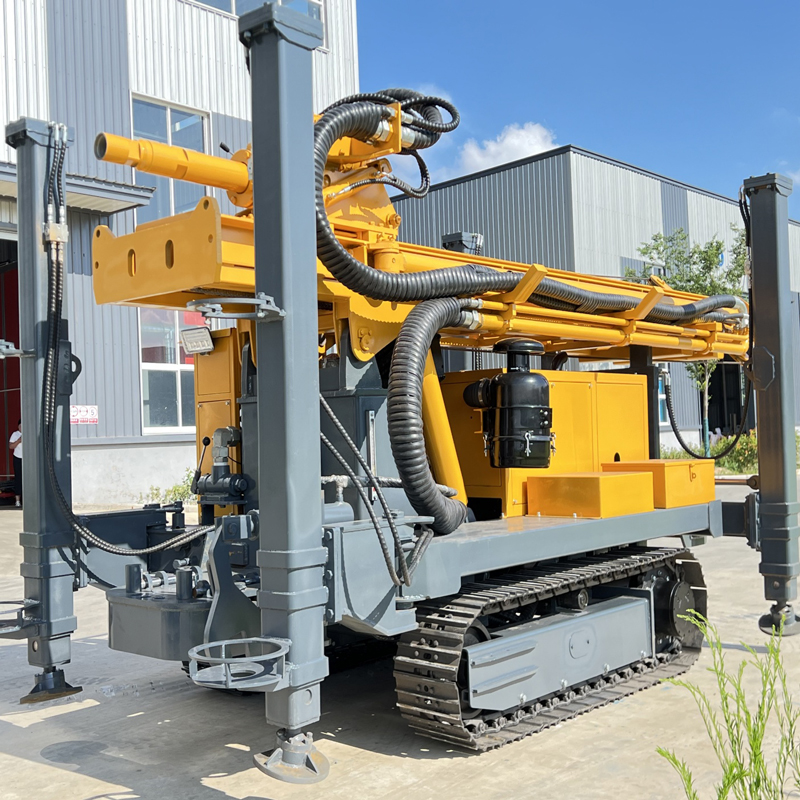
The same applies to matched components selected by working condition. The information lists mud pump, centrifugal pump, generator, and foam pump as optional, and gives the direction for judgment: projects with more loose layers should pay more attention to the mud system, hard rock projects should pay more attention to the air compressor and DTH hammer, and projects lacking a stable power supply may need a generator. These choices follow formation and site conditions, not drill pipe length.
When reading this configuration, first distinguish three things
First, 3 m / 6 m is a compatibility relationship; the same machine can use different pipe lengths in different projects. Second, what is reduced is the number of auxiliary actions such as making and breaking pipe connections, which does not equal doubling drilling efficiency. Third, beyond pipe length, diameter, lifting force, and in-hole conditions all act simultaneously, and any one of them alone is not enough to form a selection conclusion. The information clearly states that due to differences in actual geological conditions, in-hole tools, drilling angle, and operating methods, final drilling efficiency, drilling depth, and well completion results should be based on site conditions.
As for whether a specific project should choose 3 m or 6 m, it depends on transport arrangements, site dimensions, and work organization. These three points are project conditions and need to be confirmed separately in light of site conditions; the information in this article does not cover that judgment.