












After an orebody is initially discovered at shallow depths, the focus of exploration usually shifts from "is there mineralization" to "how far does the orebody extend downward, where are its boundaries, and is it continuous." This shift is not just about drilling deeper; the requirements for drilling hole layout itself also change. The changes are concentrated in several quantifiable aspects: hole depth grade, core size, drilling angle, single-hole construction time, and drill string load. The following sections expand on these lines, with equipment values taken from the published product data for the CR1200I and CR1600I on this site.
Change 1: Hole depth grade moves up, and core size must be re-matched
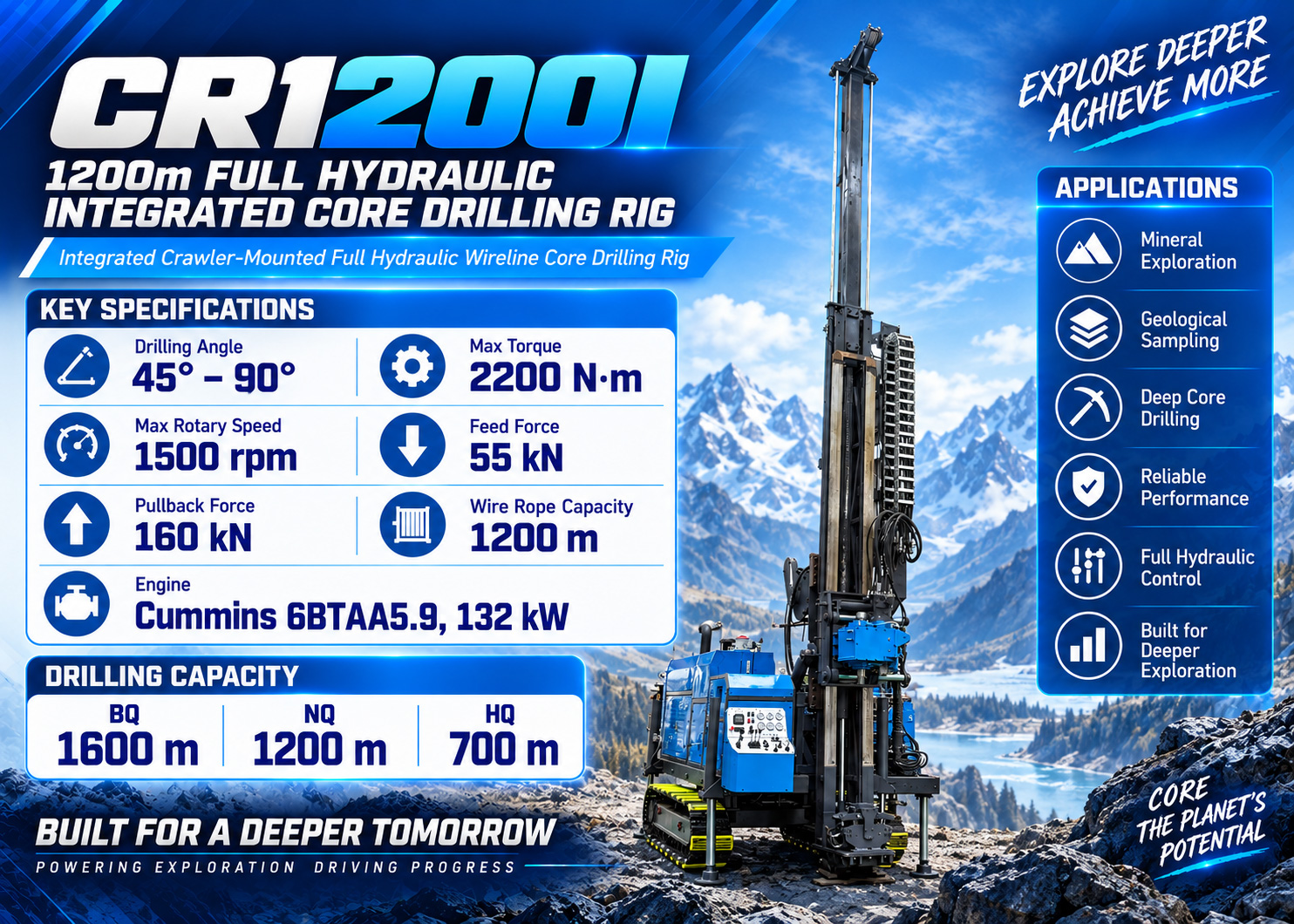
Shallow control holes are usually in the hundreds of meters, while deep control holes need to be increased by one or even two grades. The data for the CR1200I on this site states: N-size reference drilling depth 1200 m, B-size reference drilling depth 1600 m, H-size reference drilling depth 700 m; in the CR1600I data, B-size reference drilling depth is 2000 m. The nominal drilling depth of the same rig varies with core size, which directly affects drilling design when laying out deep holes.
In other words, increasing hole depth is not just a change in a single number. If the deep control section requires H-size core, the maximum available hole depth is noticeably shorter than for N-size. When laying out holes, first confirm the core diameter required by the control target, then work backward to the hole depth range this equipment can cover at that size.
Change 2: The proportion of inclined holes rises, and drilling angle becomes an independent condition
Shallow orebodies can sometimes be cut by vertical holes, but deep orebodies are controlled by attitude and often require inclined holes to pass through the target zone at a suitable angle. The CR1200I data states that it supports drilling angles of 45°–90°. This range means that hole layout can include inclined holes in addition to vertical holes, adjusting the angle according to known orebody attitude and exploration line direction, rather than designing all holes to go straight down.
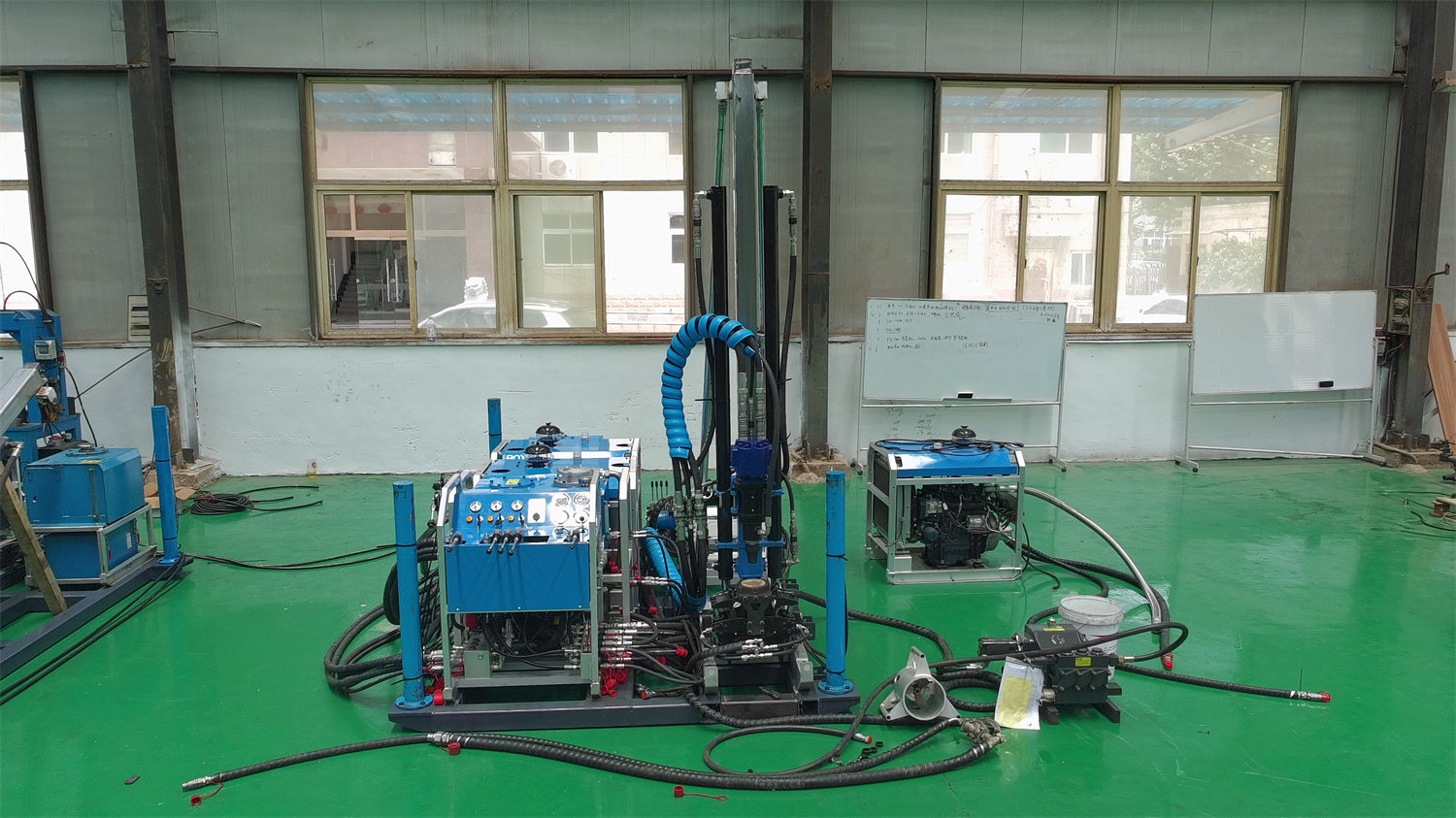
Angle changes do not only affect collar positions. After the drilling angle changes, the stress state of the drill string in the hole, the wear locations on the drilling tools, and the distribution of pull-out resistance all change with angle. Therefore, during the hole layout stage, angle should be recorded as an independent condition, not as a supplementary note to the hole position.
Change 3: Single-hole construction time lengthens, and the share of winch and pull-out stages rises
As hole depth increases, the proportion of time spent retrieving the inner tube during wireline coring rises noticeably. In the CR1200I data, the wireline winch rope capacity is 1200 m and the hoisting speed is 116 m/min. These two values correspond precisely to the auxiliary process of frequently retrieving the inner tube in deep holes. The deeper the hole, the longer the time required for the same run length, so the hole spacing and number of holes arranged during layout need to be considered together with the single-hole cycle.
Hoisting and feed values should be viewed together
The CR1200I has a feed force of 55 kN and a pull force of 160 kN. In deep holes, the self-weight of the drill string increases with depth, and the margin corresponding to pull force is directly related to in-hole resistance and drilling tool weight. The value of 160 kN is an equipment capability item; the margin actually usable depends on the drill string assembly, drilling angle, and hole wall conditions, and must be checked against project conditions.
Change 4: In-hole conditions are more complex, and mud and hydraulic systems must provide stable output for longer periods
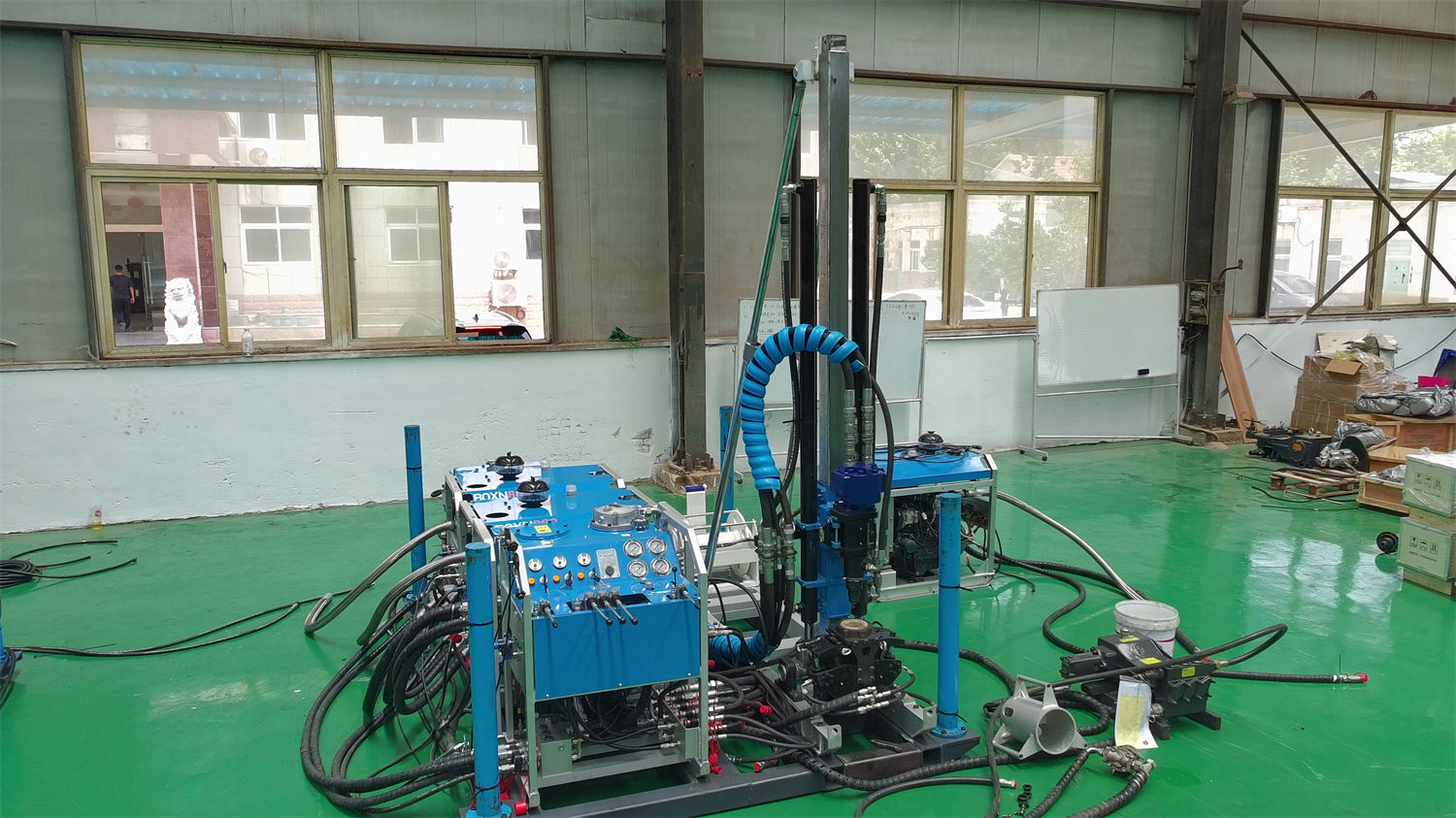
In the CR1200I data, the main pump flow is 300 L/min and main pump pressure is 28 MPa; the auxiliary pump flow is 120 L/min and pressure is 21 MPa; the mud system flow is 150 L/min and pressure is 7 MPa. Deep-hole construction lasts a long time, and these systems are not short-term peak outputs but must maintain stable response over a longer period. When deep hole sections encounter developed fractures, unstable returns, or local loss, mud parameters need to be adjusted according to in-hole performance, and plugging or staged wall protection measures should be considered when necessary.
Clamping and drilling tool compatibility affect collar operations
This model's clamp through-hole diameter is 150 mm, and it is suitable for drill rod systems such as NQ, HQ, PQ, NTW, and HTW. Deep control holes often use multiple sizes of drilling tools in a single hole, and the larger through-hole space leaves configuration margin for different hole diameter tools, casing, and collar operations.
Change 5: Power and transmission must match the alternation of different rock formations in deep holes
Deep holes usually pass through more rock types than shallow holes, with intact hard rock and local fractured zones alternating. The CR1200I power head uses gear transmission, with a maximum speed of 1500 rpm, maximum torque of 2200 N·m, and provides 1:2.2 / 1:3.3 gear shifting. Different speed and torque combinations are used to match different core sizes and rock hardness. The engine is a Cummins 6BTAA5.9, displacement 5.9 L, rated power 132 kW, rated speed 2200 rpm.
Change 6: Site transfer and hole position organization methods adjust accordingly
Deep control holes have long single-hole cycles and many supporting pieces of equipment, so the organization cost of each hole position change is higher than for shallow hole projects. The CR1200I uses an integrated crawler platform, with a folding mast and hydraulic side shift for movement. This type of structure reduces repeated disassembly and assembly between the power station, hydraulic modules, and mast system, making it suitable for continuous hole layout within an exploration area. There is a corresponding relationship between the density of drilling hole layout and the equipment transfer method, which should also be considered when preparing the drilling design.
| Stage | Published CR1200I values | Corresponding change in drilling hole layout |
|---|---|---|
| Hole depth and size | N 1200 m / B 1600 m / H 700 m | The maximum hole depth varies with core size and must be matched to the control target |
| Drilling angle | 45°–90° | Inclined holes can be laid out according to orebody attitude |
| Winch | Rope capacity 1200 m, hoisting speed 116 m/min | The proportion of time for retrieving the inner tube in deep holes rises |
| Feed and pull | Feed force 55 kN, pull force 160 kN | Deep-hole drill string load falls on this set of values |
| Hydraulics and mud | Main pump 300 L/min, 28 MPa; mud 150 L/min, 7 MPa | Long-term stable output is a prerequisite for deep holes |
Which conditions are not specified in the data and need separate confirmation during layout
- The specific hole spacing and exploration grid for deep control holes depend on orebody scale and existing results, and are not covered by the data on this site.
- Whether the actual hole depth can reach the nominal value is related to formation conditions, hole deviation control, drill string assembly, and operating methods; the data notes that final results are subject to on-site conditions.
- The flushing fluid formula, plugging materials, and wall protection plan for the deep-hole stage are process choices and should be determined separately according to formation conditions.
- The deviation control method and measurement frequency for inclined holes need to be arranged in accordance with project technical requirements; the data does not provide specific rules.
Overall, after an orebody transitions from shallow to deep control, drilling hole layout changes simultaneously in hole depth grade, core size, drilling angle, single-hole cycle, and drill string load. These changes correspond to different capability items of the rig, and looking at any one item alone is not enough to judge whether the equipment is suitable.