












The WR600RC supports two working angles, 45° and 90°, but this does not mean the two angles can be substituted arbitrarily. Whether the drilling angle needs to be adjusted depends on the attitude of the target orebody, the exploration grid design, and the stress conditions of the equipment at that angle. A 90° vertical hole is suitable for horizontal or nearly horizontal orebodies and conventional vertical control; a 45° inclined hole is more suitable for geological targets that require oblique crossing of inclined ore veins, fault zones, or mineralized zones. Before purchase, the orebody attitude and exploration objectives should be clarified first, and then the actual operating conditions of the equipment at different angles should be verified.
First Look at Orebody Attitude: Dip Determines the Intersection Relationship Between the Borehole and the Orebody
Gently Dipping and Horizontal Orebodies
When the orebody dip is gentle and nearly horizontal, a vertical hole (90°) can pass through the target horizon with a shorter hole depth. In this case, if an inclined hole is used, it will instead extend the ore-crossing path and increase ineffective drilling footage. For deep anomaly verification and peripheral mineralization surveys, the WR600RC's 600 m drilling depth and 105–450 mm hole diameter can cover a large vertical range, and vertical holes are more convenient for establishing deep control points.
Moderately to Steeply Dipping Orebodies, Ore Veins, and Fault Zones
When the orebody dip is large, a vertical hole may drill along the orebody strike or approximately parallel to the mineralized zone, resulting in shorter effective footage through the orebody and making it difficult to control the hanging wall and footwall boundaries of the orebody. WR600RC documentation clearly states that 45° can be used for oblique crossing of inclined orebodies, ore veins, and fault zones. The value of an inclined hole lies in crossing the target body at a larger intersection angle to obtain more representative cuttings samples.
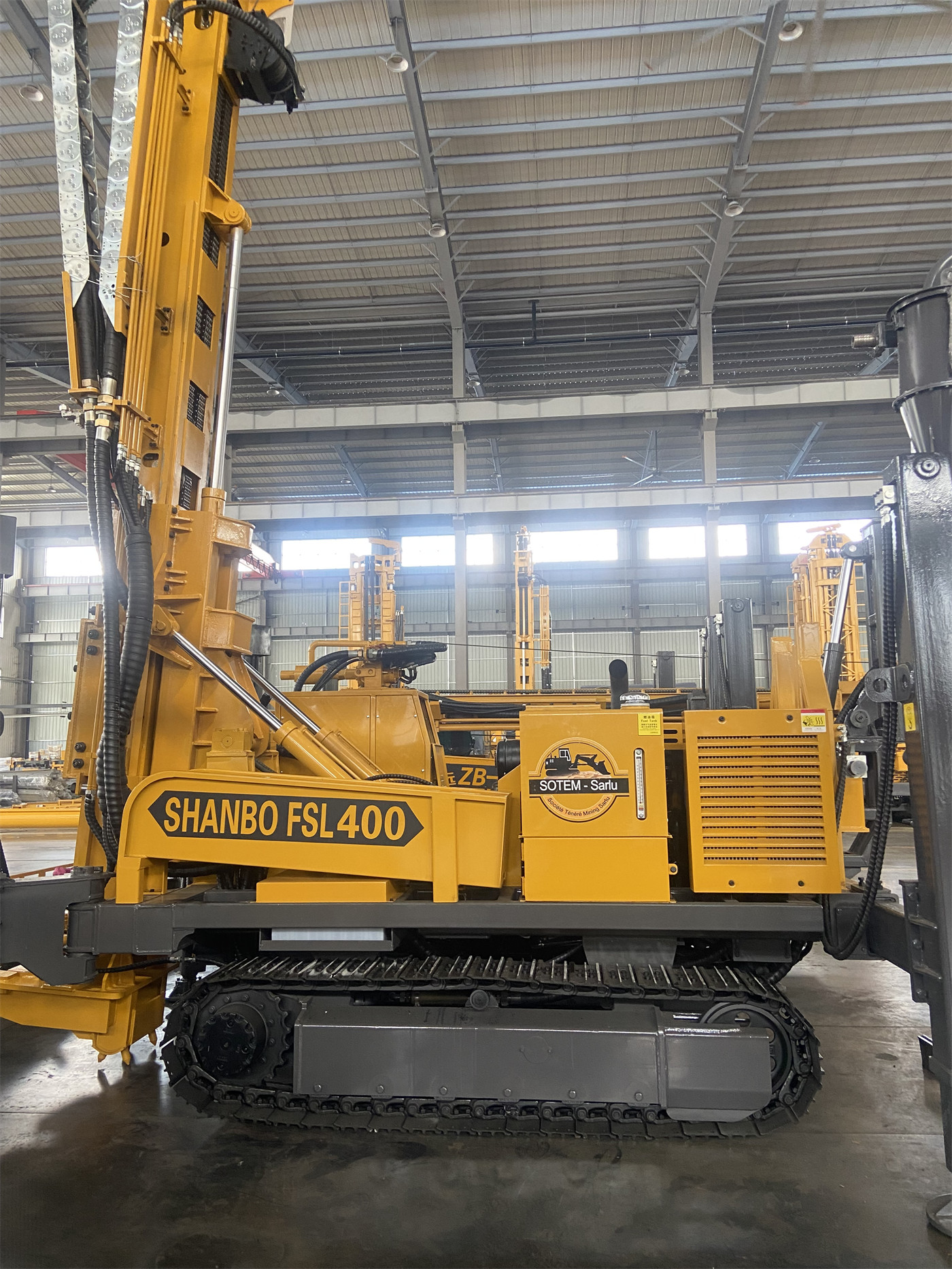
- 90° hole: suitable for horizontal or gently dipping orebodies, conventional vertical exploration, and deep water well construction.
- 45° hole: suitable for oblique crossing of inclined orebodies, ore veins, and fault zones.
It should be emphasized that 45° is a specific working angle parameter, not the only inclined hole angle. Other dip angles may be required in actual exploration design. Before purchase, the implementation methods and limitations of the WR600RC at angles other than 45° should be confirmed. The documentation does not provide support information for angles other than 45° and 90°, so this item needs to be verified with the manufacturer.
Then Compare with Exploration Objectives: Do You Want Samples or Control Points?
The WR600RC is a reverse circulation drill rig, mainly obtaining cuttings samples rather than continuous complete cores. This process characteristic determines another layer of judgment for the drilling angle: whether the samples can represent the target horizon.
- If the goal is to quickly establish a large number of borehole control points, verify deep anomalies, and peripheral mineralization, vertical holes are simpler in site layout and drill string stress.
- If the goal is to determine the thickness, attitude, and hanging wall/footwall contact relationships of an inclined orebody, a 45° inclined hole is more likely to enter the orebody at a larger intersection angle.
- For projects aimed at hole completion, such as mine dewatering and deep water wells, 90° vertical holes are usually the main choice, and angle differences are more related to deviation control than orebody intersection.
Reverse circulation drilling relies on the inner tube of dual-wall drill pipes to return samples, and samples are collected at fixed footage intervals. After the drilling angle changes, the sample return path, cuttings settling in the hole, and upward return conditions will all change. Therefore, angle selection should also be considered together with sample return continuity.
Impact of Angle Changes on Equipment Stress and Operating Conditions
Outriggers and Overall Machine Stability
The WR600RC has an outrigger stroke of 1.7 m, which can be used for equipment leveling and stabilization. When performing 45° inclined hole drilling or high-torque drilling, the stress direction is more complex, and the outrigger status, ground bearing capacity, and overall machine levelness will directly affect hole direction control and construction safety. The overall machine weight is about 12.5 T, and the dimensions are about 7 × 2.1 × 2.9 m. The requirements of inclined hole operations for platform size and ground bearing capacity need to be confirmed before purchase in combination with site conditions.
Rotation, Lifting, and Drill String Handling
The WR600RC has a lifting force of 29 T and a rotary torque of 12000 / 6000 N·m, corresponding to a maximum rotation speed of 75 / 150 r/min. In inclined holes, the axial component generated by the drill pipe's own weight and the friction with the hole wall are more complex, and the lifting and rotation loads will change with hole depth, hole diameter, and hole deviation. The documentation indicates that if the resistance during drill lifting continues to be abnormal, priority should be given to judging and handling it through hole cleaning and in-hole conditions, and it is not recommended to directly use the maximum lifting force to pull forcefully. This principle also applies to inclined holes.

Air Compressor and Sample Return
The recommended working air pressure is 1.6–6 MPa, and the air consumption is 16–75 m³/min. When hole depth, hole diameter, altitude, and rock hardness increase, the required effective air volume usually also increases. In inclined holes, the cuttings upward return path is different from that in vertical holes. Before quotation, the pressure and displacement of the proposed air compressor, hole depth, and angle should be submitted to the manufacturer for verification, rather than estimating only based on the maximum drilling depth.
Questions Recommended to Verify with the Manufacturer Before Purchase
| Verification Item | Why It Needs to Be Confirmed |
|---|---|
| Implementation method and angle range of the 45° working angle | The documentation only lists 45° and 90°; whether other dip angles are supported needs manufacturer confirmation |
| Drill pipe configuration and hole deviation control measures under inclined hole conditions | Angle changes affect drill tool stress and hole direction deviation |
| Site bearing capacity and outrigger layout requirements for 45° operation | The 1.7 m outrigger stroke and 12.5 T overall machine weight need to match platform conditions |
| Switching conditions between RC, DTH, and mud rotary processes in inclined holes | Processes differ for overburden and hard rock sections; whether switching is restricted after angle changes needs confirmation |
| Pressure and displacement of the matched air compressor at the target hole depth and angle | Sample return capability is directly affected by air pressure and air volume |
| Depth recording method for samples collected by footage in inclined holes | There is a difference between inclined hole depth and vertical depth, and the recording basis needs to be unified in advance |
Conclusive Judgment Sequence
To determine whether 45° or 90° is applicable, it is recommended to follow this sequence: first confirm the orebody dip and attitude, and judge whether a vertical hole can pass through the target body at a reasonable intersection angle; then confirm whether the exploration objective is rapid control points or attitude control of an inclined orebody; finally verify whether the site, outriggers, drill string, and air compressor conditions of the WR600RC at the selected angle match. The documentation does not provide specific dip angle thresholds for specific mining areas, nor is there a universal angle selection formula. The actual design should be jointly determined by geological and drilling plans.