












The terms "adjustable track height" and "non-adjustable track height" are often treated as a minor difference in chassis structure. In slope photovoltaic or shallow foundation construction, what it actually changes is the way the equipment achieves a level working posture: whether the ground is leveled first and then the equipment works, or the equipment adjusts the height of one side itself to adapt to existing height differences. In the public information for this site's PV390H, the track height telescoping dimension is listed as 1200 mm, and it is clearly designed for mountainous hills and uneven slopes; the PV390 standard version has a fixed-height track structure. The comparison below is based only on these two types of public information and does not involve any unpublished test data.
First, clarify the structural premises of each
Fixed-height tracks mean that the height relationship of the tracks on both sides relative to the chassis is determined at the factory. When the equipment works on uneven ground, posture adjustment is handled by other mechanisms, such as mast pitch, left-right swing arms, and telescoping compensation. The PV390 standard version is published with 85 kW power and 13000 N·m torque, and is equipment intended for photovoltaic foundation pre-drilling.
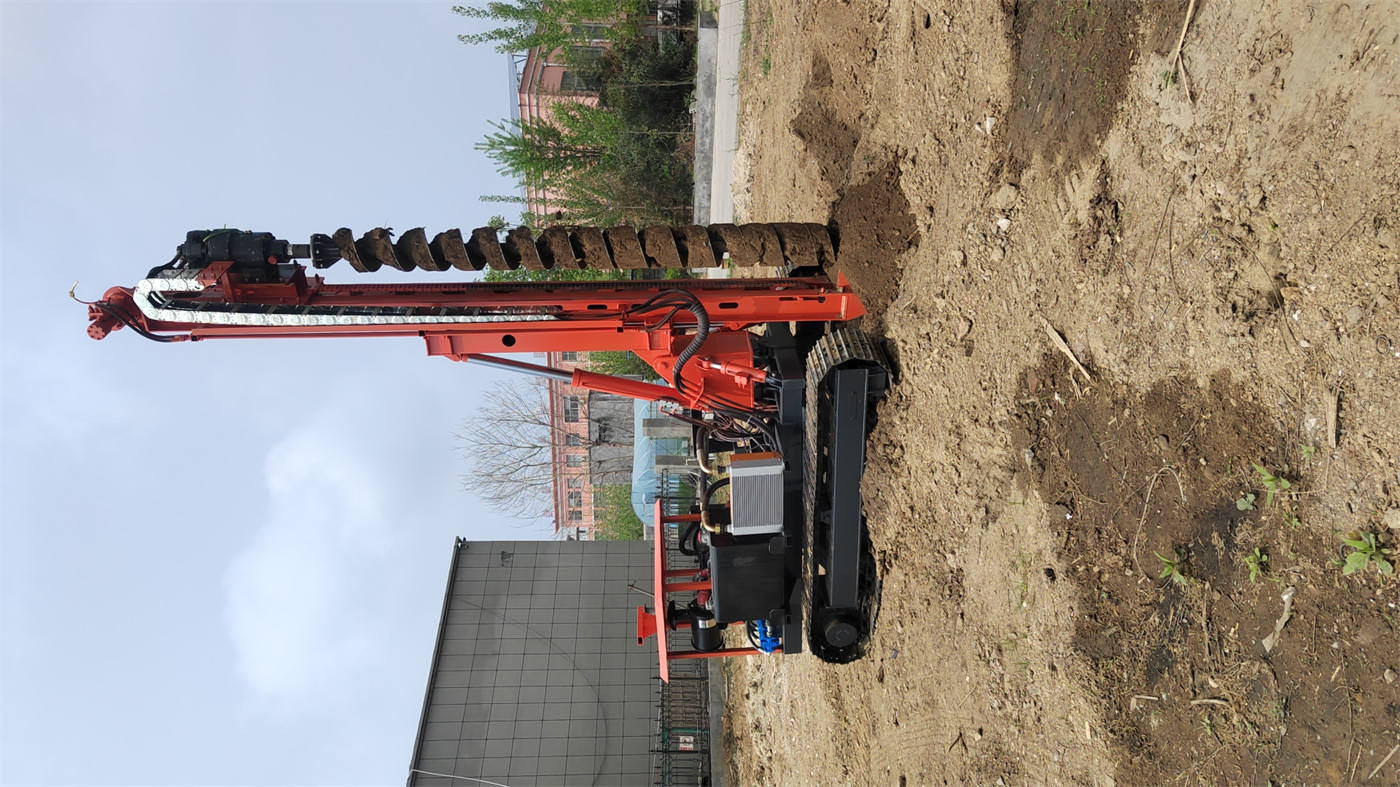
The PV390H high-low leg structure adds height telescoping capability to the track section, with a telescoping dimension of 1200 mm. The information states that it can be adjusted according to slope height, allowing the equipment to achieve a better working posture on uneven ground, making it more suitable for photovoltaic projects on hillsides, hills, and areas with obvious undulations. Here, "high-low legs" describes the adjustability of track height, not the addition of a separate independent chassis.
On slopes, the problems each solves fall at different stages
The difficulty of slope construction is usually not in the hole section, but in "how the equipment stands stably and how the mast is aligned to the designed hole position angle." For fixed-height tracks on such sites, what often must be addressed first are the requirements on the site itself: left-right height differences between pile positions and local undulations all need to be reduced by external means before the equipment can enter an acceptable posture range. The information describes this comparison as: ordinary fixed-height track equipment often requires repeated ground leveling.
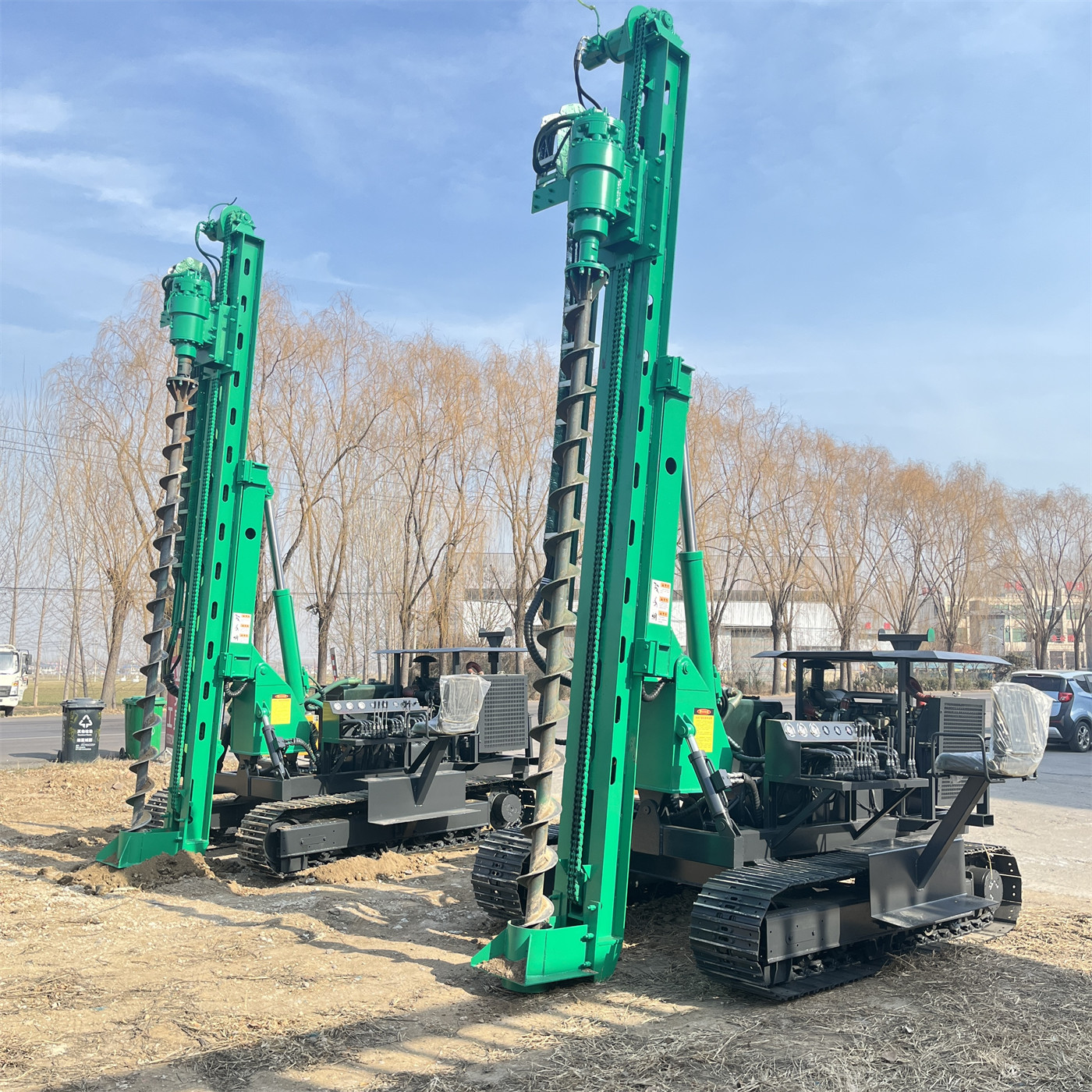
The adjustable section of the PV390H acts exactly here. The information states that the track height can be adjusted according to slope height, and left-right height differences can be handled after the chassis is stabilized. In other words, part of the posture problem is absorbed at the equipment level, and not every pile position must rely on excavator leveling or manual soil padding. The information also mentions that high-low leg adjustment in hilly areas can reduce the need for every pile position to rely on excavator leveling or manual soil padding, but this is a description of functional positioning, not a promise of efficiency.
Posture adjustment is not only in the track section
Looking at adjustable track height alone makes it easy to overestimate its role. The PV390H also publishes several posture adjustment mechanisms, and there is a division of labor between them and the high-low legs:
- Mast pitch 120°: used to adjust drilling posture and adapt to different slopes and pile position angle requirements.
- Dual-cylinder left-right swing arms: perform lateral hole alignment fine-tuning after the chassis is stabilized, reducing frequent small-range chassis movement.
- 450 mm telescoping compensation: used for fine adjustment in the front-back direction of the working mechanism, facilitating pile position positioning.
In other words, hole alignment accuracy on slopes is achieved jointly by these items. Adjustable track height solves height difference adaptation at the chassis level, while the mast and swing arms solve hole position direction and lateral deviation. Conversely, even if a machine has adjustable track height, if the mast pitch range is insufficient, it will still encounter limitations under larger hole angle requirements; the two cannot replace each other.
| Comparison item | PV390H (adjustable track height/high-low legs) | PV390 standard version (fixed-height tracks) |
|---|---|---|
| Track height telescoping | 1200 mm, adjustable according to slope height | Height telescoping capability not published in the information |
| Power | 130 kW Yuchai six-cylinder turbocharged engine | 85 kW |
| Reducer torque | 13000 N·m | 13000 N·m |
| Mast pitch | 120° | Not listed in this comparison in the information |
| Positioning method | High-low legs + dual-cylinder left-right swing arms + 450 mm telescoping compensation | Based on parameters published for the standard version in the information |
In the table, the PV390 standard version column lists only values that clearly appear in the relevant information; items not cited in this comparison are not filled in by inference.
Non-adjustable does not mean unusable on slopes
Understanding the difference as "fixed-height tracks cannot work on slopes" is an overextension. The feasibility of fixed-height track equipment on slopes depends on whether the posture formed jointly by site conditions and the equipment is valid. When the slope is gentle, height differences between pile positions are not obvious, or the project itself has leveling conditions, fixed-height track structures can still undertake construction in flat areas and generally undulating areas. The premise of this solution is that site integration work is included in the construction organization.
The real difference between the two is who handles height differences: the adjustable solution moves part of the work forward into equipment actions, while the non-adjustable solution leaves more work in site leveling and pile position preparation. Which type to choose depends on where the project is willing to invest.
Adjustability also has boundaries, and the information clearly states the limitations
The public information for the PV390H is relatively restrained in describing the capability boundaries of the high-low legs. Several points need to be singled out:
- The high-low leg function can improve slope adaptability, but cannot replace a safe working platform and foundation bearing capacity assessment.
- During use, the tracks on both sides should be adjusted gradually according to slope conditions so that the equipment maintains stable loading.
- Avoid excessive adjustment on one side that causes the center of gravity of the whole machine to shift; cross-slope construction should be more cautious.
- Before adjusting track height, ensure the equipment is at low speed or stopped, and observe nearby personnel and obstacles.
These statements are usage constraints, not conclusions about applicability to a certain slope. The information does not give the maximum slope value at which this equipment can operate, nor does it give bearing or stability calculations under different slopes, so this article does not make related inferences. Before equipment selection and actual operation for slope projects, separate assessment should be made according to on-site terrain, foundation bearing capacity, and safety regulations.
Several pieces of information worth checking first when choosing
If the project is in mountainous or hilly areas with obvious height differences between pile positions, adjustable track height provides an approach to reduce dependence on site leveling; if the site itself is relatively flat, the difference falls more in the construction organization method rather than in hole-forming capability itself. The check can proceed in the following order:
- Whether the left-right height difference of pile positions in the array changes frequently, and whether pile-by-pile leveling is needed;
- Whether the construction access road allows the tracked chassis to reach the site, and whether transfer depends on external equipment;
- In addition to track height, whether mast pitch, left-right swing arms, and telescoping compensation meet pile position angle and front-back positioning requirements;
- Whether the slope surface adhesion state after rain, soft soil, and cross-slope conditions have been included in the safety assessment;
- Whether power and torque meet the target hole diameter and stratum. The PV390H is published as 130 kW, 13000 N·m, drilling diameter 80–600 mm, depth 0–6 m.
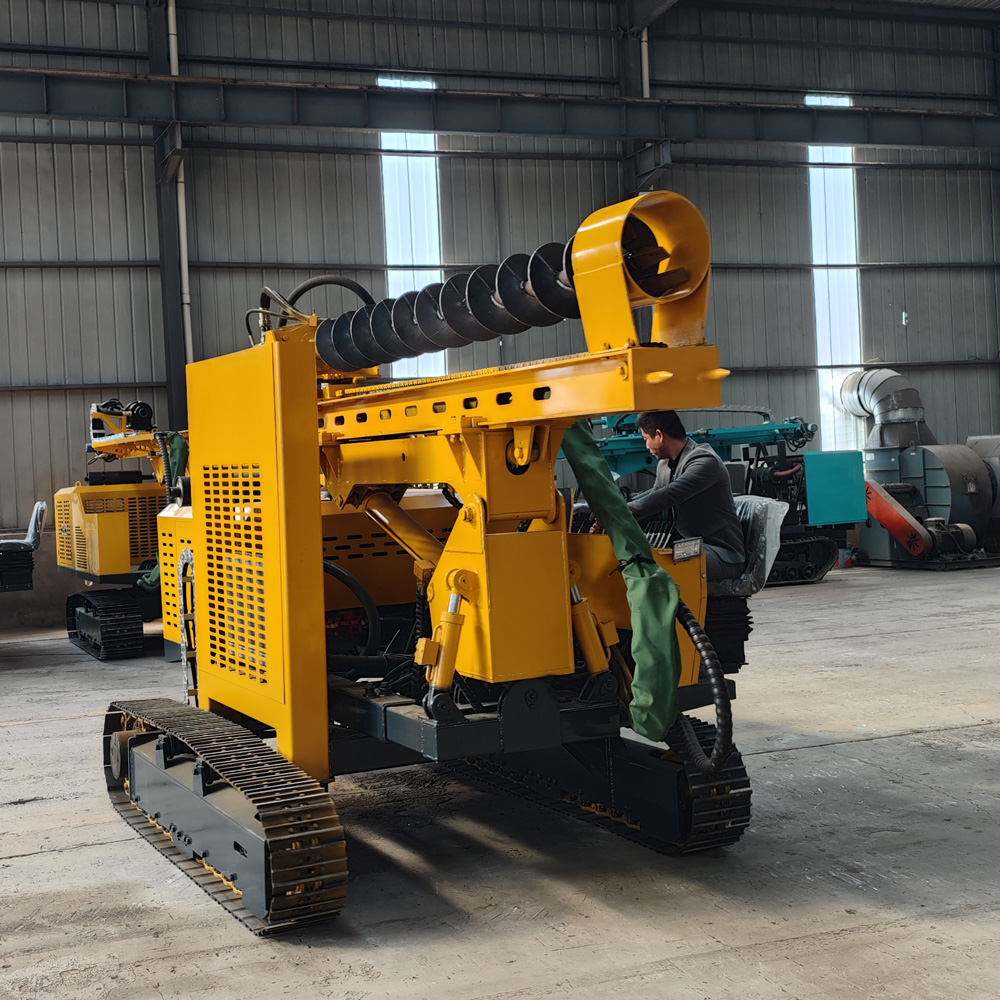
It should be noted that the public positioning of the PV390H is for shallow foundation projects such as photovoltaic support pre-drilling and pile position pilot holes. Its core value lies in high-frequency pile position construction and adaptation to complex slopes, not deep hole drilling. Applying it to uses such as water well drilling exceeds the capability range described in the information.
Where the difference lands
Putting the two solutions together, the difference can be summed up in one sentence: adjustable track height transfers part of the terrain adaptation work from the site to the equipment, while the non-adjustable solution requires site conditions to be met first. However, the adjustable range, applicable slope, and operating method are all constrained by specific on-site conditions and safety requirements, and it is impossible to judge whether a certain slope can be constructed based only on the value "1200 mm." Beyond the equipment's own data, slope, bearing capacity, and road conditions still need to be verified separately at the project level.