












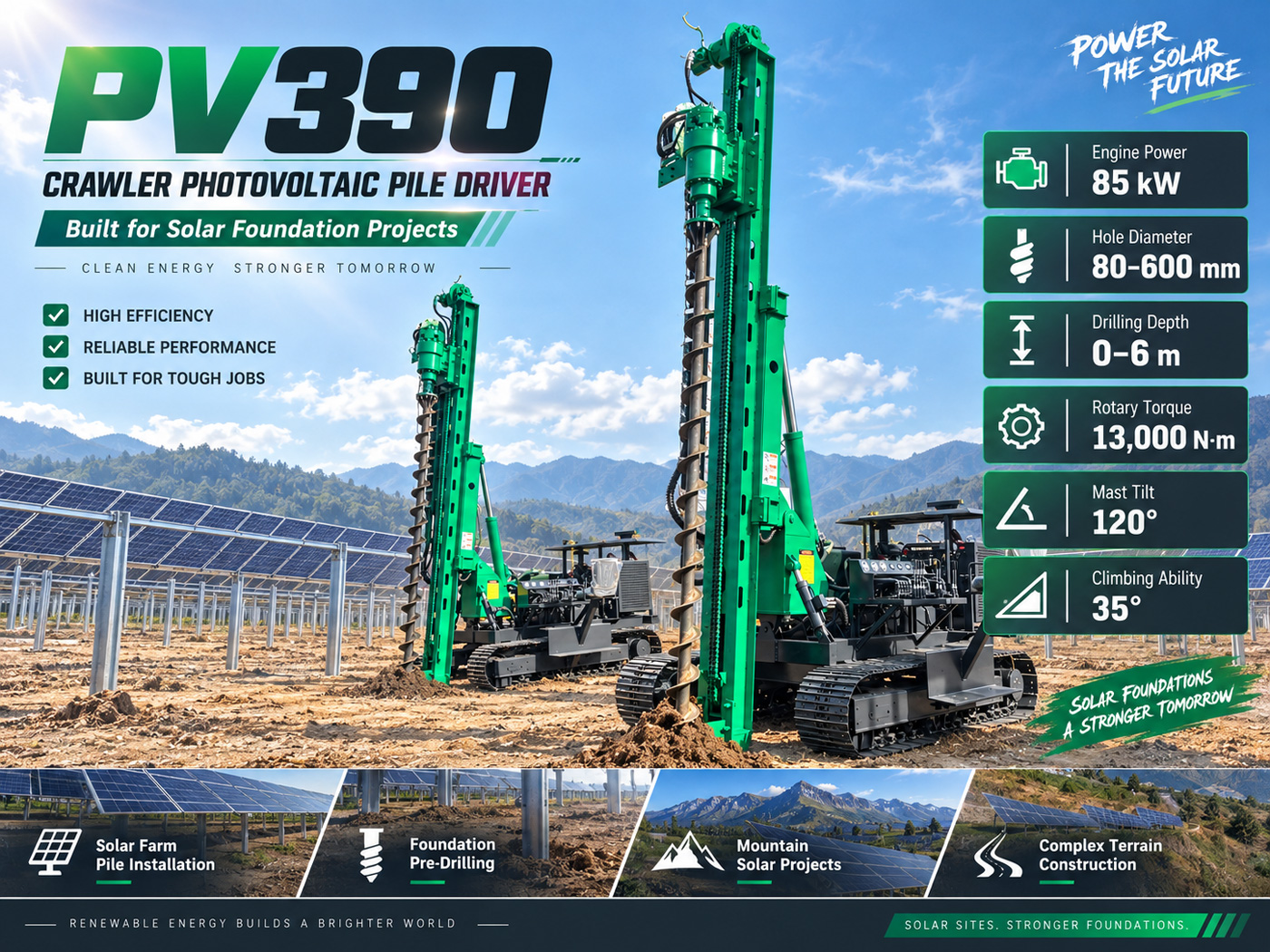
Mobilization preparation for photovoltaic foundation pre-drilling is somewhat different from geological exploration projects: there are many pile positions with regular spacing and shallow single holes, but the site is often simultaneously occupied by several work lines such as station roads, fences, and support installation. What actually blocks the start of work is usually not equipment capability, but several documents not being in place—the versions of pile coordinates and foundation types are not finalized, there is no drawing of underground cable routes, and the road for the equipment to climb has not been walked. Using the PV390 parameters published on this site as a reference, this article lists in order the documents and site conditions that should be prepared before mobilization. The PV390 is a four-cylinder hydraulic crawler-type photovoltaic pile driver with a drilling diameter of 80–600 mm and a drilling depth of 0–6 m. These values are meaningful only within the range specified by the project foundation design.
Four categories of documents to prepare first
If any of the following four categories of documents is missing, it will become a work stoppage item on the day of mobilization. Their correspondence with equipment is not the same, so they are not mixed together in one table.
1、Foundation design documents
This category determines whether the equipment parameters can fall within the project requirements. At minimum, it requires: pile position plan layout and coordinates; foundation type and pile type (cast-in-place pile, pre-drilled hole for precast pile, or others); design aperture and design depth of a single pile; pile position elevation and site vertical design. By directly comparing the design aperture and design depth with the PV390's 80–600 mm and 0–6 m, obviously mismatched sections can be ruled out first. The aperture and hole depth shall ultimately be based on the project design drawings and foundation type; the range in the equipment documentation is not a design basis.
2、Underground facility documents
Underground facilities in a photovoltaic site usually include collection lines, communication optical cables, water supply and drainage pipes, and existing pipelines outside the site. The purpose of this category of documents is to delineate no-drilling zones around pile positions, rather than to judge whether the equipment can drill. The following need to be confirmed: comprehensive underground pipeline drawing of the site; cable laying depth and routing; temporary lines already laid but not marked; contact information of the property owners of existing pipelines around the site.
The documents do not provide equipment handling capability related to underground facilities, so this part can only rely on pre-construction disclosure and on-site confirmation, and cannot be solved by equipment parameters.
3、Site and access documents
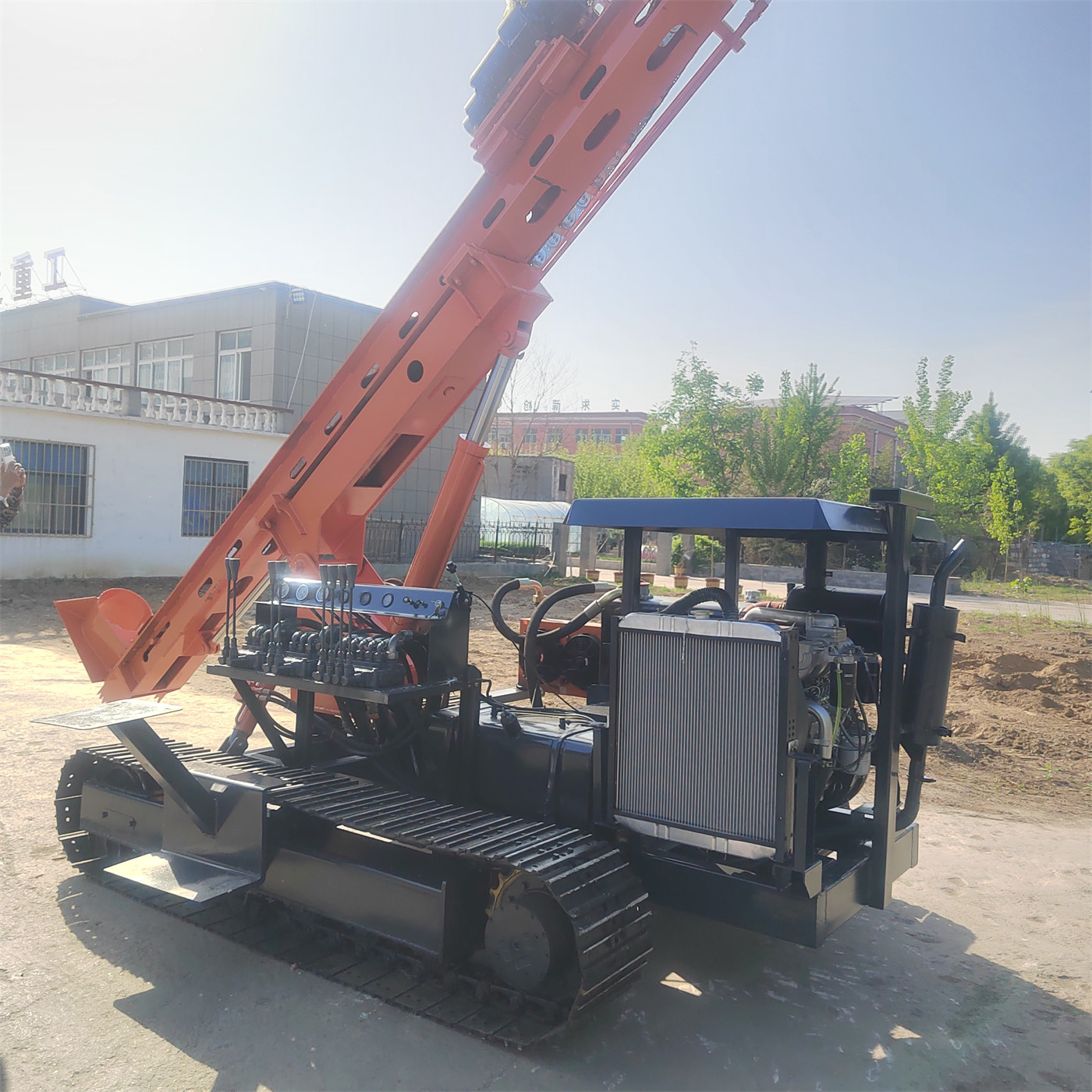
This category determines whether the equipment can be in place and can operate stably. The values in parentheses are the parts already published in the PV390 documentation that can be used for verification: overall dimensions 5200×2300×2650 mm; track shoe width 400 mm; climbing angle 35°. The documents to be confirmed include:
- The minimum turning radius, road width, and bearing conditions of the access road, to be verified against the overall dimensions;
- The soil quality and compaction of temporary roads within the site, to be verified against the ground contact conditions of the 400 mm track shoes;
- The maximum slope, cross slope, and slipperiness between work faces, to be verified against the 35° climbing angle—note that this value is a documented value; actual slope construction must also comprehensively consider cross slope, soil quality, and the center of gravity of the whole machine, and the maximum climbing angle should not be used alone as the basis for safe travel;
- The minimum working space around the hole position, which must accommodate the overall dimensions of the equipment when parked stably and the swing range of the mast;
- The distribution of ground elevation differences and sections with uneven hardness and softness, which directly affects the number of posture adjustments when aligning holes.
4、Geological and stratum documents
The PV390 documentation separately explains the response methods for soil layers, loess, clay, pebble sand, backfill waste layers, strongly weathered rock, and rock layers. Therefore, before mobilization there must be at least one survey document that can correspond to these descriptions: stratum genesis and layering; density and moisture content of each layer; pebble particle size and content, composition and burial depth of the backfill layer; burial depth and integrity of strongly weathered rock and rock layers.
Among these, the backfill waste layer and pebble sand need to be highlighted. The documentation's explanation for them is to prevent foreign objects, voids, and local jamming, and to select drilling tools according to particle size and density. If the survey only provides a general description such as "soil layer," its reference value for hole alignment rhythm and drilling tool selection is limited.
Beyond documents, site conditions to verify on the spot during mobilization
Whether the work face has a stable parking position
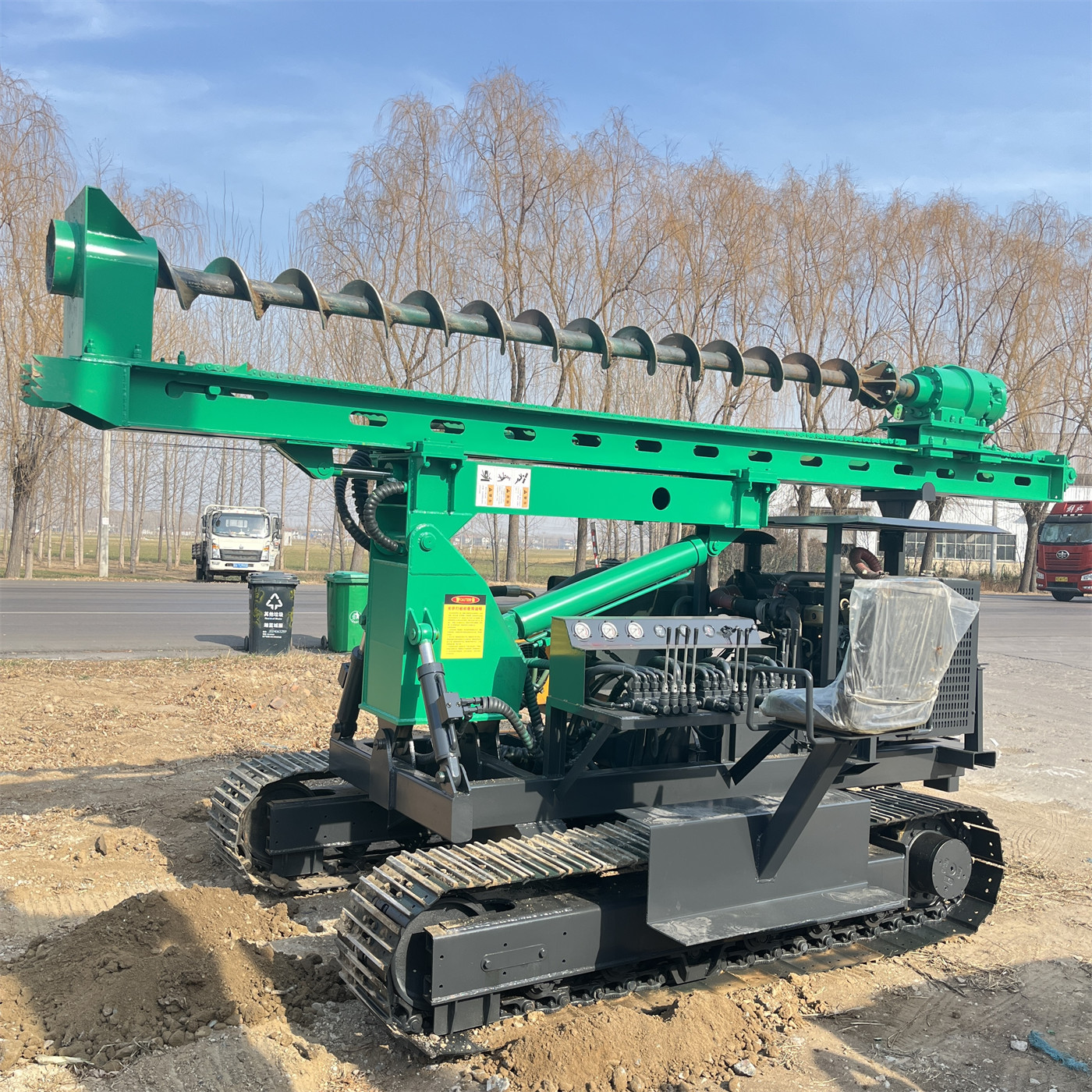
The PV390 uses a crawler chassis, and the mast has 120° pitch, dual-cylinder left and right swing arms, and 50 cm forward and backward telescopic compensation. These three posture adjustment capabilities can reduce repeated fine-tuning of the whole machine, but their premise is that the equipment itself has already been parked stably. What needs to be confirmed one by one during mobilization is whether there is a parking position that allows the tracks to rest firmly and the machine body to be roughly level, rather than expecting posture adjustment to absorb excessive elevation differences.
Whether the array direction and the mast swing direction are coordinated
Pile positions in array-type photovoltaic sites are usually arranged regularly along one direction. The angle between the equipment parking direction and the array direction affects the number of pile positions that the left and right swing arms of the mast can actually cover. There is no corresponding parameter for this in the documentation, so it is necessary to walk the site according to the pile position drawing during the mobilization survey stage to determine a reasonable parking method.
Whether materials and supporting items are mobilized simultaneously
Supporting items in the photovoltaic foundation pre-drilling stage usually include drilling tools, wall protection or immediate treatment materials after hole formation, and surveying and setting-out tools. The documentation does not cover the specification requirements for these supporting items, so they are not used as conclusions in this article and need to be separately confirmed at the project level according to the foundation design.
Several confirmations that are easily missed
- Whether the pile position drawing and the design aperture and hole depth are the same version. Photovoltaic project drawings change frequently, and inconsistent versions will directly lead to rework;
- Whether surveying and setting-out have been completed in the site. Drilling rig hole alignment relies on calibrated coordinates rather than drawing coordinates;
- Whether underground cables have been disclosed and marked. This item is usually confirmed jointly by the construction party and the electrical discipline;
- The traffic condition of the access road after rain or snowmelt. The 400 mm track shoes help distribute ground contact pressure, but the adhesion conditions of dirt roads still change with moisture content;
- Personnel management arrangements within the equipment operating radius. During drilling, personnel must not approach the rotating drill pipe, chain pressurizing mechanism, or mast swing range;
- Whether the shutdown and pressure relief procedures for replacing impact drilling tools (used for strongly weathered rock and rock layer construction) have been implemented at the team level.
Matters requiring separate confirmation
The documentation gives the capability range of the PV390 under drilling diameter 80–600 mm, drilling depth 0–6 m, and chain pressurization conditions, as well as the adapted site and stratum descriptions. This article cannot provide conclusions for the following situations, which need to be confirmed with the manufacturer or project designer: actual penetration rate and efficiency under specific geological conditions; model and impact energy of impact drilling tools (this item is not given in the original documentation); supporting scheme for wall protection or hole formation technology; productivity estimation for continuous operation of a large number of pile positions.
In addition, the original model in this project's documentation was SL390, which has been confirmed as PV390, and this article uniformly uses PV390. Actual geological conditions, drilling tool forms, pile types, apertures, construction angles, and operating methods vary. The final drilling efficiency, hole formation quality, and construction effect shall be based on on-site working conditions and the project foundation design.