












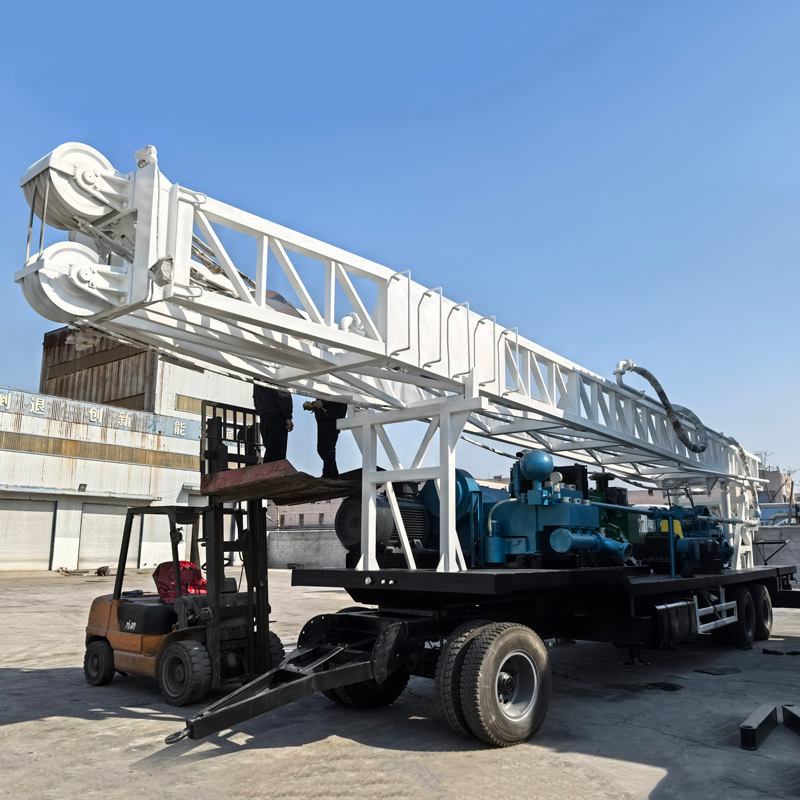
The publicly available information for the WRTR600 states that the equipment centrally mounts a diesel generator, a 3NB-130 mud pump, a rotary table, a double winch, a mast, outriggers, and an auxiliary breakout mechanism on a towed chassis. The generator model is SCGC-200kW, rated at 200 kW, 380 V, 360 A, 50 Hz; the mud pump is a 3NB-130 with a specified displacement of 8.4–16.6 L/s and a rated working pressure of 5–10 MPa, driven by a 90 kW electric motor. Putting these parameters together, the centralized layout is not an aesthetic choice but a direct result of the relationship between the power source and the powered equipment.
First, look at this drive relationship
The 3NB-130 has an input speed of 565 r/min and is driven by a 90 kW electric motor. This means the mud pump is not mechanically driven directly by a diesel engine through a transfer case, but is electrically driven. Since the main pump uses electricity, the entire rig cannot rely on the on-site power grid by chance—it needs a stable power source, and that source is the SCGC-200kW diesel generator set on the same chassis, with a rated current of 360 A. The generator supplies power to the mud pump, hydraulic oil pump, and auxiliary electrical equipment simultaneously.
This chain can be understood as follows: diesel generator produces electricity → 90 kW motor drives the 3NB-130 → mud circulates at a displacement of 8.4–16.6 L/s and a pressure of 5–10 MPa. Having the power source and the powered equipment on the same rig means there is no need to first solve "where does the electricity come from" on site, and it is not limited by whether a stable power grid exists at the site. The information explicitly states it is "suitable for remote areas and projects lacking a stable power grid," which is exactly where this drive relationship lands in practical use.
What centralized layout mainly saves is the mobilization phase
Water well construction is characterized by scattered sites: after finishing one well, you move to the next village, the next orchard, or the next geothermal site. If the power, mud system, and drilling mast main unit are transported separately, each new site requires reorganizing cranes, trailers, and on-site assembly.
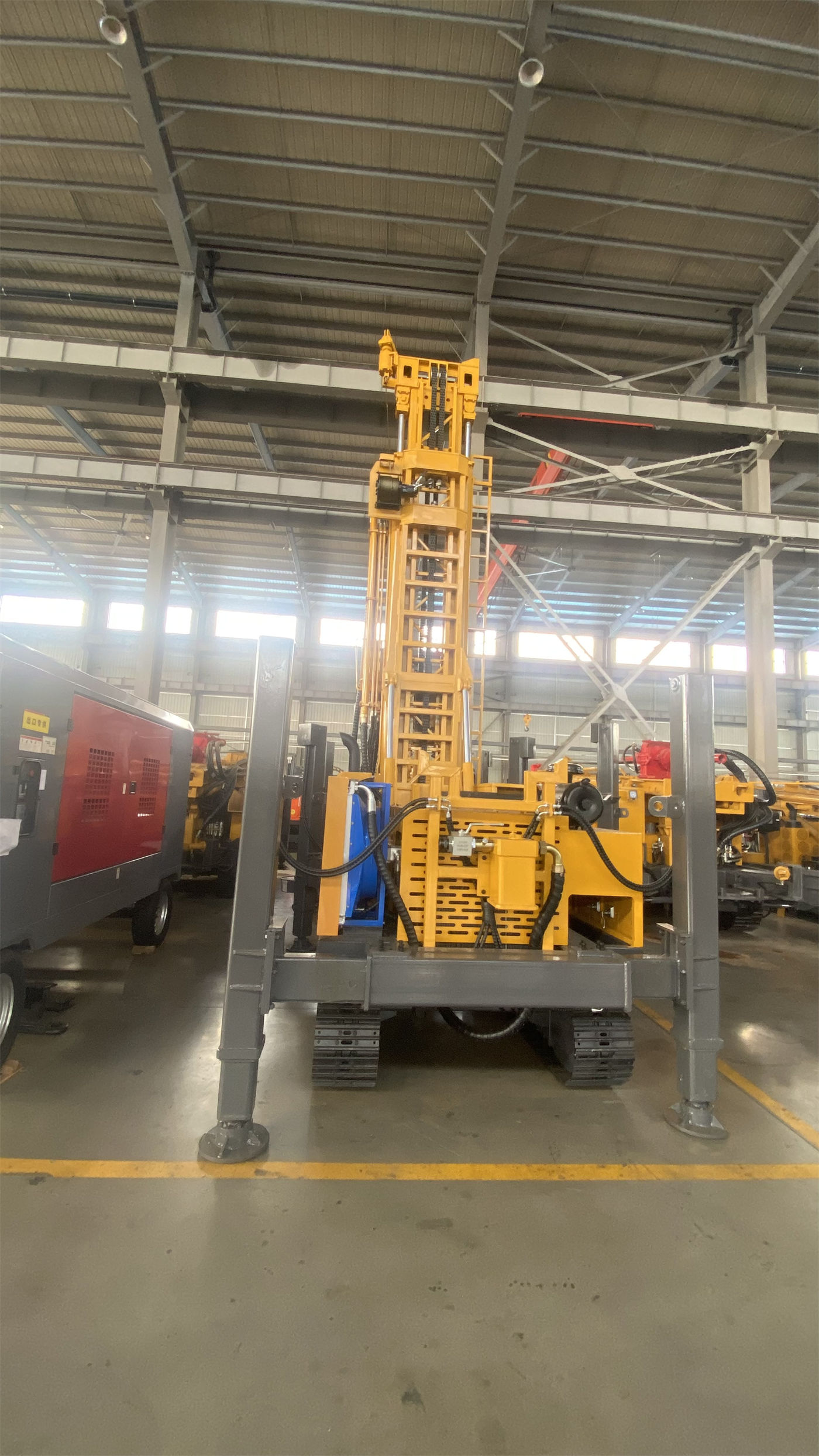
The entire WRTR600 rig is mounted on a towed chassis, so for relocation it can simply be towed away by a suitable towing vehicle. The information states it "reduces the complexity of scattered transport of the mast, power, and mud system" and notes that this structure is "more suitable for continuous construction across multiple sites." It is important to note that what is reduced is the organizational workload of one-time loading, separate lifting, and piece-by-piece alignment—not the elimination of transport entirely. The chassis itself still needs to meet towing and road conditions.
Centralized layout changes how work sites are selected
With the generator and mud pump fixed on the chassis, it effectively means that once the rig is in place, the power and circulation systems are already in position. The on-site workload before startup therefore shifts from "lifting the generator, positioning the mud pump, connecting power and piping" to primarily checking the entire rig: as listed in the information, before startup one should inspect the mast, winch, wire rope, swivel, rotary table, mud pump, generator, and electrical system.
The length and routing of the mud circulation piping are no longer variables to be redesigned at every new site—the piping runs with the chassis. This has a direct impact on projects such as deep water wells and geothermal wells that require maintaining mud circulation for extended periods: the position of the circulation system is essentially determined before mobilization.
Transport dimensions are the direct cost of centralized layout
Centralized layout is not without constraints. The information provides transport dimensions for two mast versions:
| Item | Short mast version | Long mast version |
|---|---|---|
| Transport dimensions | 15100 × 2480 × 4100 mm | 16630 × 2480 × 4100 mm |
| Effective height | 12 m | 15 m |
| Kelly | 108 × 108 × 7500 mm | 108 × 108 × 10500 mm |
| Drill pipe | Ø89 × 10 × 5500 mm | Ø89 × 10 × 9000 mm |
The two transport dimension sets differ by about 1.5 m in length, with the same width and height. Before cross-regional construction, the information explicitly requires confirming road width, turning radius, bridge load capacity, height restrictions, and local towed transport regulations. These are direct prerequisites brought by centralized layout, not additional clauses.
Continuous supply of cuttings removal capacity comes from the combination on the chassis
The WRTR600 is designed for 600 m class medium-to-deep water wells and some geothermal wells with a maximum hole diameter of 500 mm. The deeper the hole and the larger the diameter, the greater the amount of cuttings the mud must continuously carry, and the higher the demands on pump displacement and pressure stability. The 3NB-130's displacement of 8.4–16.6 L/s and pressure of 5–10 MPa will face different circulation resistances in various formations such as soil, clay, sand, and gravel—the information recommends adjusting mud viscosity in soil and clay based on permeability, hole diameter, and return conditions; too thin may lead to insufficient cuttings removal and borehole wall instability, while too thick increases circulation resistance and mud pump load.
The relationship in which the mud pump is powered by the generator links pressure and displacement adjustments with the power supply load. The 200 kW generator simultaneously supplies power to the mud pump, hydraulic oil pump, and auxiliary electrical equipment. This centralized power supply structure offers convenience in power coordination, but the specific power distribution method and margins are not given further numerical values in this site's information and should be verified with the manufacturer before purchase.
Centralized layout does not replace verification of site conditions
The towed chassis integrates the equipment into one unit, but verification work for entry and operation still exists, and some items differ from ordinary towed equipment:
- Whether the towing vehicle matches the rig's curb weight—the information does not provide the chassis curb weight and must be confirmed separately
- Whether the transport route meets the turning radius requirements corresponding to the 15100 mm or 16630 mm length
- Whether there is sufficient space around the well site to accommodate the chassis placement and working dimensions (short mast working dimensions 15100 × 2480 × 14170 mm, long mast 15100 × 2480 × 17170 mm)
- No overhead lines or obstacles above when raising the mast
- Whether the layout of the mud pit or circulation system connects with the fixed piping on the chassis
The information also notes: during mud circulation, pay attention to high-pressure lines, pump pressure, and leaks; personnel must not stand under suspended drilling tools or near rotating drilling tools; during deep hole construction, regularly inspect wire rope, braking system, and drum spooling status.
What this layout suits, and what cannot be inferred
Based on the information, it can be judged that mounting the generator, mud pump, rotary table, winch, and mast on a single towed chassis is suitable for water well contractors engaged in continuous construction across multiple sites, uncertain on-site power supply conditions, and frequent mobilization, such as village and town water supply, agricultural irrigation, geothermal surveys, and some foundation engineering drilling.
However, it cannot be inferred that "any site can be towed into and drilled directly." Centralized layout solves the transport and positioning of the power and circulation systems, but whether the road can accommodate it, whether the site can fit it, and whether the towing vehicle matches are issues that exist independently of the equipment integration method. Similarly, the 600 m maximum drilling depth and 500 mm maximum hole diameter given in the information are also affected by formation, drilling tools, mud circulation, casing design, and downhole resistance; final drilling efficiency and well completion results should be based on actual site conditions. The chassis curb weight, power distribution margins between the generator set and mud pump, and mud formulations for different formations are not provided with specific values in this site's information and should be verified item by item with the manufacturer before purchase.