












When selecting a spiral drill pipe, two figures often fail to line up: the designed hole depth is close to or exceeds the recommended depth in the drill pipe data, and the bit diameter falls at either end of the compatible range. In this situation, it is difficult to answer whether the pipe is "sufficient" by looking at one figure alone, because the recommended drilling depth and the compatible bit diameter refer to two different things. The former constrains the total length of the drill string in the hole and the load conditions, while the latter constrains the fit between the bit and the spiral pipe body. Using the published parameters of the Φ42S spiral geological drill pipe as a reference, this article separates these two conditions and explains the order of judgment and the matters that still need confirmation.
First, distinguish what each of the two figures constrains
The Φ42S data states a recommended drilling depth of 100 m and a compatible bit diameter of 65–146 mm. These two items are not limits on the same dimension: the recommended drilling depth refers to the total length of the drill string assembly during continuous drilling and the transmitted load that results from it; the compatible bit diameter refers to the geometric and cuttings-removal fit between the bit, the spiral pipe body, and the spiral diameter. To judge whether a spiral drill pipe is sufficient, these two conditions should be checked separately rather than letting one figure cover the other.
Judging by hole depth: 100 m is a recommended value, not a capability limit
The data lists 100 m as the recommended drilling depth and notes that it applies to mine blasting, deep-hole drilling in coal mines, and geological drilling. "Recommended" here means a reference value under the medium-hard geological conditions described in the data and when used with a conventional drill string assembly. It does not mean that the depth can be reliably reached in any formation or at any drilling angle, nor does it mean that the pipe cannot be used beyond 100 m. When the actual hole depth approaches or exceeds this value, formation hardness, drilling angle, cuttings-removal conditions, and rig output capability must all be included in the check. The data does not provide depth corrections for different formations or different inclination angles; this part can only be confirmed with the manufacturer or on-site technical personnel.
Judging by bit diameter: 65–146 mm is the matching range
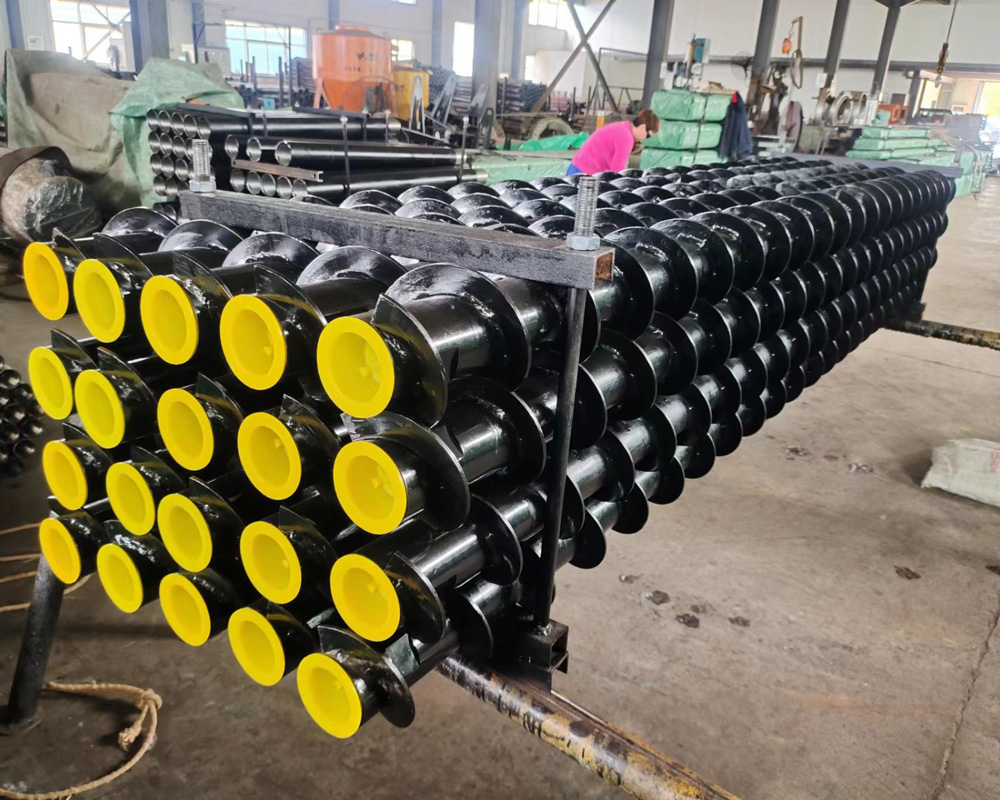
The compatible bit diameter of 65–146 mm corresponds to the geometric relationship of a 42 mm spiral pipe body diameter and a 50–100 mm spiral diameter. If the bit diameter falls within the range, it means that the fit between the bit and the spiral section is within the range given in the data; however, the cuttings-removal space and torque requirements at the two ends of the range are not the same. The larger the bit diameter, the greater the amount of rock cuttings per unit of advance, and the heavier the burden on spiral cuttings removal. The data states that the spiral pipe body helps carry rock cuttings and debris out of the hole and reduces accumulation of cuttings in the hole, but it does not provide cuttings-removal efficiency data for different bit diameters. Therefore, when using the pipe toward the upper end of the range, the air compressor or flushing conditions and the matching of rig rotation speed and feed should be included in the items to confirm.
Torque and pipe body specifications: determining whether the drilling process can remain stable
This model has a maximum torque of 3000 N·m, a pipe body diameter of 42 mm, steel grade DZ50, and joint hardness HPC28-32. The torque value corresponds to the ability to transmit rotational load under medium-hard formations; it is not an indicator independent of hole depth and bit diameter: the deeper the hole, the longer the drill string, and the more attention must be paid to the gap between the effective torque transmitted to the bit and the output at the hole collar; the larger the bit diameter, the higher the rotational resistance required for rock breaking is usually. The data states that this model is suitable for continuous drilling and cuttings-removal operations under medium-hard geological conditions, but it does not provide a comparison of torque requirements for different rock types. Whether the actual combination matches must be calculated separately in conjunction with rig capability.
Length combinations affect the number of pipe connections and total length control
Common lengths such as 1 m, 2 m, and 3 m are available. The choice of length affects both whether the target hole depth can be approximated with a combination of whole sections and the number of pipe connections and the operating space at the hole collar. The data does not require any particular length combination; the actual combination must be determined together with the rig structure, construction space, and target hole depth.
Put the conditions into a single checklist
| Check item | Content given in the data | Points to note when judging |
|---|---|---|
| Target hole depth | Recommended drilling depth 100 m | This is a recommended value; depths beyond this or complex formations require separate confirmation |
| Bit diameter | Compatible with 65–146 mm | Cuttings-removal and torque requirements differ at the two ends of the range |
| Pipe body and spiral | Pipe body Φ42 mm, spiral diameter 50–100 mm | Forms a geometric fit with the bit diameter |
| Torque | Maximum 3000 N·m | Must be calculated together with rig output and formation conditions |
| Length | 1 m / 2 m / 3 m | Combine according to hole depth and construction space |
Parts not covered by the data that require separate confirmation
- Rig model and power head output interface: the data does not give the specific connection type; interface dimensions and matching requirements must be confirmed before ordering.
- Formation hardness and drilling angle: the data states that different geological conditions, drill string assemblies, drilling angles, and operating methods will affect actual performance, cuttings-removal efficiency, and service life, but it does not provide correction factors or classification data.
- Actual performance when exceeding the recommended depth: the data only gives a recommended value and does not provide capability information for use beyond that depth.
- Cuttings-removal support when the bit diameter is close to 146 mm: the data does not provide corresponding recommendations for air volume, water volume, or rotation speed.
In summary, to judge whether a spiral drill pipe is sufficient, check item by item in the following order: whether the target hole depth is near the recommended value—whether the bit diameter falls within the compatible range and at which end—whether the rig output torque and interface match—whether the length combination can cover the hole depth. The Φ42S data can answer questions about pipe body specifications, compatible range, and recommended depth, but the interface type, performance beyond the recommended depth, and actual effects under different formations still need to be confirmed with the manufacturer before purchase.