












When matching an air compressor to a DTH hammer, two figures in the ZCS100 documentation are easily cited side by side: a discharge volume of 33 m³/min and a rated pressure of 2.5 MPa (25 bar). But being listed together does not mean they hold simultaneously. Starting the hammer requires pressure above a certain threshold, while continuous drilling requires enough air flow to carry rock cuttings away from the hole bottom; the two constrain each other within the same air supply system—the higher the pressure, the less actual air flow the same machine can deliver; when part of the flow is diverted for cuttings removal, the pressure reaching the hammer also changes. This article focuses on a specific judgment: under what operating conditions should 33 m³/min and 2.5 MPa be considered together, and what else must be checked when doing so.
Which hammer requirement each rated value corresponds to
The working state of a DTH hammer is determined jointly by two things: the air supply pressure obtained by the piston determines the impact frequency and single-impact energy, while the air flow passing through the hammer and the bottom-hole annulus determines whether cuttings can be continuously carried out of the hole collar. The documentation lists the ZCS100 rated pressure as 2.5 MPa (25 bar) and notes that "for deep holes, hard rock, or larger hole diameters, matching should be comprehensively carried out in combination with the hammer's recommended pressure and air consumption." This statement actually provides two input items: the hammer's nominal working pressure and how much air flow it requires at that pressure.
33 m³/min corresponds to discharge volume, in units of volumetric flow; 2.5 MPa corresponds to rated pressure. The two are marked separately on the air compressor nameplate, but whether a screw air compressor can simultaneously output the rated discharge volume at rated pressure depends on the machine's design operating conditions. The documentation does not provide the flow curve of the ZCS100 at different discharge pressures, so it cannot be directly inferred that "33 m³/min can be obtained at any pressure." This point requires requesting air supply data for the corresponding operating conditions from the manufacturer during the selection stage.
Under what conditions both parameters must be satisfied simultaneously
Not all DTH drilling pushes the air compressor to its rated point. The application directions listed in the documentation are water well drilling, mining drilling, quarries, and engineering construction, and it mentions that the three conditions of deep holes, hard rock, and larger hole diameters require reserved margins for air flow and pressure. Based on this, several situations can be identified in which both parameters approach their upper limits at the same time:
- Larger hole diameter: the bottom-hole annulus cross-sectional area is large, the air flow required to maintain the upward return velocity increases, the share of flow consumed by cuttings removal rises, and the effective flow left for the hammer is reduced.
- Increased hole depth: resistance accumulates along the pipeline and inside the hole, the pressure reaching the hammer is lower than the pressure at the machine outlet, and a higher outlet pressure is needed to compensate.
- Hard rock drilling: the hammer needs to maintain a relatively high working pressure to keep its impact rhythm, while cuttings particles are coarser, imposing no low requirement on the return cuttings velocity.
Only when these three conditions occur together does an air supply requirement arise in which "pressure must be close to the rated value while flow must not shrink." If drilling is only in shallow holes, small diameters, or soft formations, the hammer's operating point is often some distance from the rated value; in such cases, treating 2.5 MPa as a threshold that must be reached may instead lead to unnecessary supporting investment.
What judgments the ZCS100 documentation can support
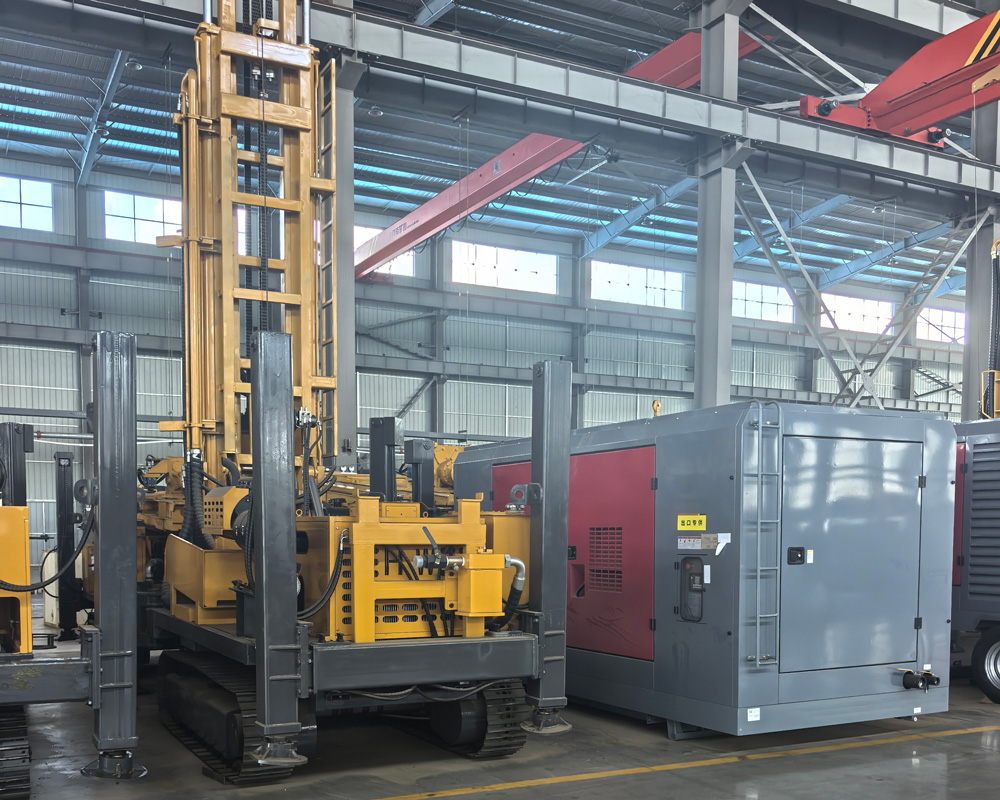
According to verified product documentation, the ZCS100 is positioned as an industrial screw air compressor for continuous air-use scenarios: 315 kW power, 33 m³/min discharge volume, 2.5 MPa rated pressure, overall dimensions 3960×2000×2000 mm, and the manufacturer is Zhejiang Zhigao Machinery Co., Ltd. The documentation states that it can provide compressed air for DTH hammers and pneumatic drilling tools, and emphasizes that "stable air supply is beneficial for DTH impact, bottom-hole cuttings removal, and continuous drilling."
These statements correspond to a selection logic rather than a conclusion: air flow and pressure are the two input conditions for matching a DTH hammer, and during selection one should provide the drilling rig model, hole diameter, target depth, main formations, hammer model, and the required working pressure and air consumption. The documentation also mentions that the equipment uses a closed industrial enclosure and is equipped with control, electrical, intake filtration, cooling, oil filtration, and oil separation systems—the relevance of this item to the air supply boundary is that during continuous high-pressure, high-volume operation, the loads on cooling and oil separation rise accordingly, which is part of the supporting operating conditions; however, the documentation does not provide data such as the maximum ambient temperature or continuous operating duration, so performance under specific climates cannot be inferred from it.
When both hold simultaneously, what other constraints exist on the supporting side
When 33 m³/min and 2.5 MPa are used together, the air compressor is only one link in the air supply chain. The following conditions are not elaborated in the documentation, but in actual matching they directly affect whether the two parameters can reach the hammer end:
| Supporting link | Items to confirm |
|---|---|
| Piping and fittings | Hose diameter, length, and fitting type from the air compressor outlet to the drilling rig air circuit; pressure drop along the route consumes machine outlet pressure before it reaches the hammer |
| Hammer specifications | The nominal working pressure and corresponding air consumption of that hammer model, and whether they fall within the ZCS100 air supply range |
| Drilling tools and hole diameter | The annulus area determined by the drill bit diameter, and the share of air flow corresponding to the upward return velocity required for cuttings removal |
| Site and power supply | Power connection conditions and placement space for the 315 kW unit; overall dimensions are given, but power supply, foundation, and heat dissipation clearances are not covered in the documentation |
Among these, pipeline pressure drop and hammer air consumption are the keys to converting rated parameters into actual air supply at the hole bottom. The documentation only gives the machine outlet rated values and does not provide a method for converting between effective bottom-hole pressure and air flow, so this part must be checked against the hammer manufacturer's recommended values and the on-site piping layout.
Applicable boundaries and parts not covered by the documentation
Based on the available documentation, the ZCS100 air supply capability can be described as "33 m³/min and 2.5 MPa are rated on the same machine," but this description can only be used to judge the equipment's upper capability limit and cannot be directly equated with "both can be fully delivered on a given well." The documentation itself already notes that different geological conditions, hole depths, hole diameters, drilling tool specifications, and operating methods will affect actual air consumption and construction efficiency, and that on-site working conditions, the matched drilling rig, and the hammer's technical requirements shall prevail.
Therefore, if a project falls mainly in the range of shallow holes, small diameters, and soft formations, whether this pressure and displacement class must be selected should first be calculated according to the hammer's recommended operating point; if a project does fall into the combination of deep holes, hard rock, and large diameters, then three pieces of information outside the documentation should be checked in particular: the actual discharge volume curve of the ZCS100 at 2.5 MPa, the pipeline pressure drop from the machine outlet to the hammer, and the air consumption of the selected hammer at the target hole depth. None of these three can be read directly from the available product documentation and are items that must be separately confirmed during the selection stage.