

"If the equipment is rated at 1000 meters, does that mean it can drill 1000 meters?" This is a question often asked first when inquiring about deep water well projects. The question itself easily treats drilling depth as an isolated number, but whether a drilling depth can actually be used depends on how deep the target aquifer is, how large a borehole diameter the completed well requires, how much load the drill string must bear in the hole, and whether the equipment can enter the site smoothly. This article, centered on the public information on the WRT1000, breaks these matters apart and explains under which working conditions a 1000 m drilling depth corresponds to actual operational needs.
First, clarify: 1000 meters is the upper limit of equipment capability, not the project objective
The WRT1000 documentation states a maximum drilling depth of 1000 m. This is a capability boundary, not an indication that every project must drill to this depth. What the project side needs to answer is another question: at what depth the target aquifer lies, and what final borehole diameter the completed-well structure requires. These two items determine whether the borehole needs to reach the kilometer level.
The documentation also explains that a 1000 m drilling depth can cover deep groundwater development that ordinary 300–600 m equipment struggles to handle. Applicable scenarios include unstable shallow aquifers, mining areas that need to find deeper water sources, industrial projects that need long-term stable water supply, and geothermal investigations that require verification of deeper strata. The common feature of these scenarios is that the hole depth is determined by hydrogeological objectives, not inferred backward from equipment parameters.
Working condition 1: The target aquifer is indeed deep
If hydrogeological data show that the main aquifer lies deeper than 600 meters, then a kilometer-level drilling depth has practical significance. The documentation mentions that a 1000 m-class drilling depth provides greater construction margin for projects such as unstable shallow aquifers, mining areas seeking deeper water sources, and long-term industrial water supply.
Conversely, if the target aquifer is at 300–500 meters, choosing kilometer-class equipment does not mean better completed-well results; instead, it entails greater overall machine weight and relocation constraints. This point should first be confirmed by hydrogeological data during the selection stage before discussing equipment.
Working condition 2: The final borehole diameter and completed-well structure require a larger diameter
The WRT1000 has a borehole diameter range of 105–800 mm. The documentation also notes that increasing the borehole diameter simultaneously raises drilling tool load, air compressor demand, casing weight and hole-forming difficulty. In other words, a deep hole with a large diameter is the superposition of two conditions, not a single one.
| Condition | Documented value | Corresponding constraint |
|---|---|---|
| Maximum drilling depth | 1000 m | Capability upper limit; whether to use it fully must be determined by aquifer depth |
| Borehole diameter | 105–800 mm | A large diameter increases drilling tool load, casing weight and hole-forming difficulty |
| Lifting force | 51 / 52 T | Deep-hole tripping, casing and tool handling |
| Rotary torque | 20000 / 10000 N·m (70 / 140 r/min) | Low speed and high torque correspond to large diameters, hard rock and high-friction hole sections |
Actual projects should select the borehole diameter based on water yield and completed-well structure, rather than setting it first according to the equipment's maximum diameter. Well casing size, pump type and screen layout determine the lower limit of the final borehole diameter, while aquifer thickness and expected water yield determine the upper limit.
Working condition 3: Deep-hole drill string handling requires sufficient margin
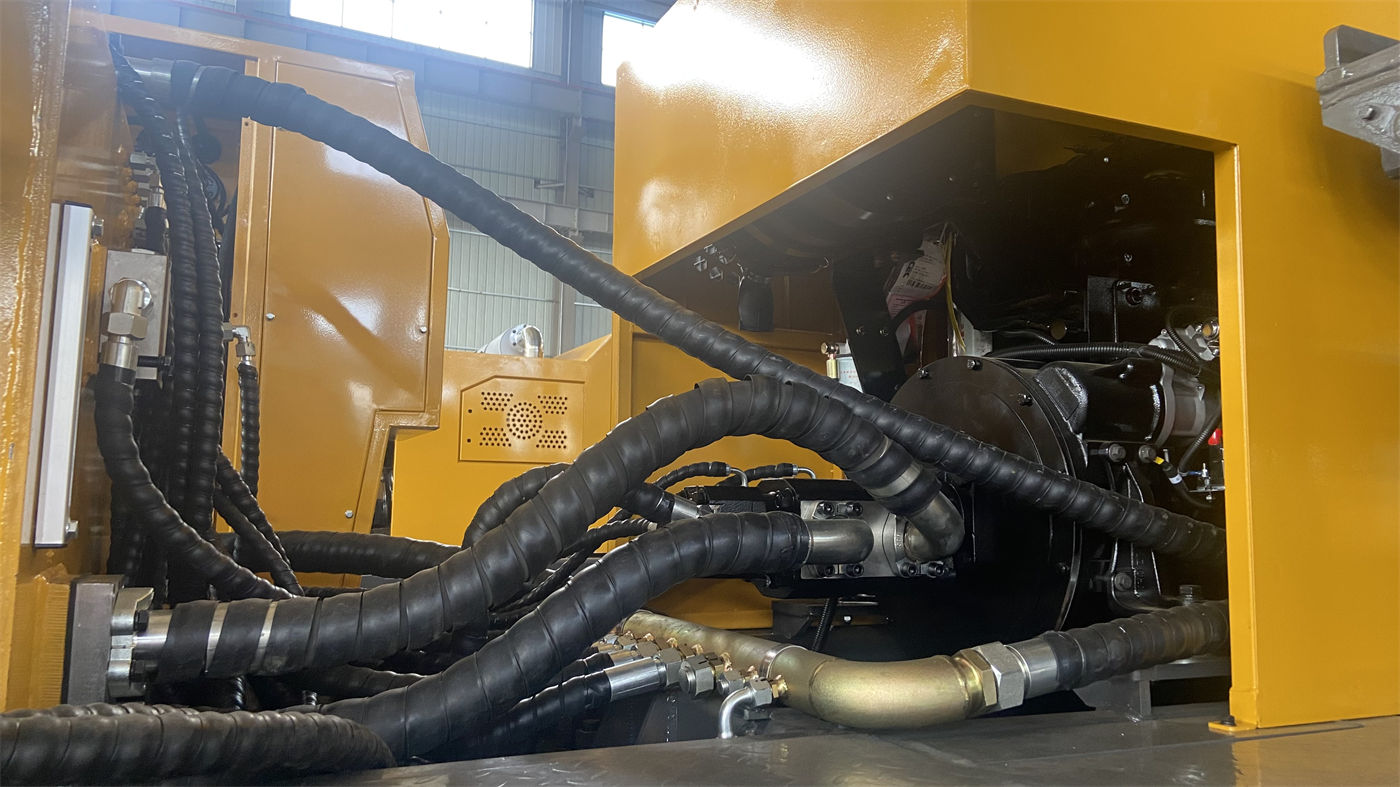
At a hole depth of 1000 meters, the self-weight of the drill pipe, the weight of the casing and the friction of the borehole wall all increase significantly. The 51/52 T lifting force and 11 T axial pressure given in the WRT1000 documentation correspond to actions such as deep-hole tripping, DTH hammer recovery, certain casing operations and tool handling in abnormal hole sections.
The documentation also states a boundary: when resistance during tripping continues to rise, the hole should first be cleaned and the downhole condition assessed, rather than directly relying on maximum lifting force to pull forcefully. This limitation shows that lifting force is an operational margin, not a substitute for handling downhole incidents.
For rotation, 20000/10000 N·m corresponds to a two-speed configuration of 70/140 r/min. The documentation maps low speed and high torque to large diameters, hard rock and high-friction hole sections, and the high-speed gear to stable formations with lower resistance. Deep-hole construction should dynamically adjust working conditions based on rotary load, cuttings return and drilling tool wear; the two speeds should not be understood as two fixed gears.
Working condition 4: The formation combination requires linking multiple processes
The formation applicability described in the WRT1000 documentation covers soil, clay, sand, gravel, weathered rock, fractured zones and intact hard rock. The upper loose formations can use mud rotary drilling, casing or other hole-stabilizing methods; after entering more intact rock, medium- and high-pressure DTH hammers can be configured for DTH drilling.
The documentation recommends a working air pressure of 1.65–8 MPa and an air consumption of 16–96 m³/min for DTH hammer drilling. During selection, a comprehensive judgment should be made based on DTH hammer specifications, borehole diameter, hole depth, altitude and rock hardness, rather than looking only at the rated pressure. Kilometer-level deep holes and large-diameter hard rock place high demands on air compressor pressure and displacement; these supporting conditions are outside the scope of the drilling rig's own documentation and need to be checked separately.
Another easily overlooked constraint is the aquifer. After entering the main aquifer, increased water in the hole affects DTH hammer cuttings discharge and circulation status. The documentation recommends recording the depth of the main water-producing zones and adjusting air supply, hole cleaning and casing plans according to water inflow. During the well completion stage, screens, water-stop sections and the final pump type also need to be set in accordance with the aquifer distribution.
Working condition 5: The project is distributed across multiple distant drilling points
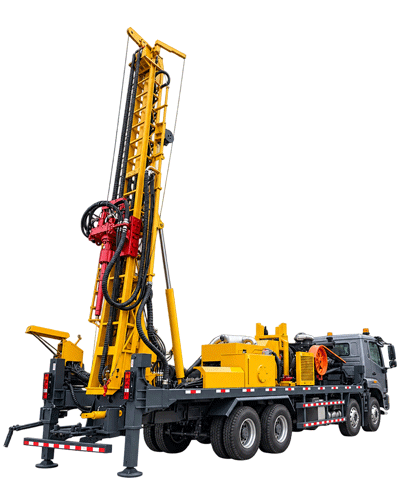
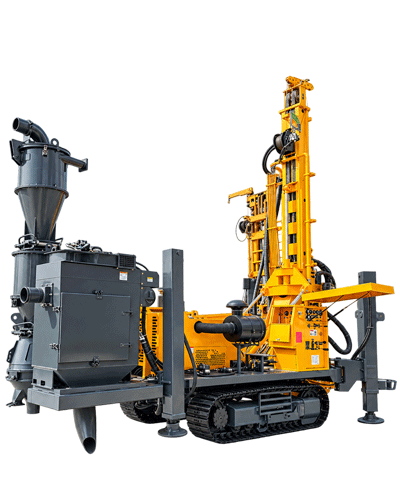
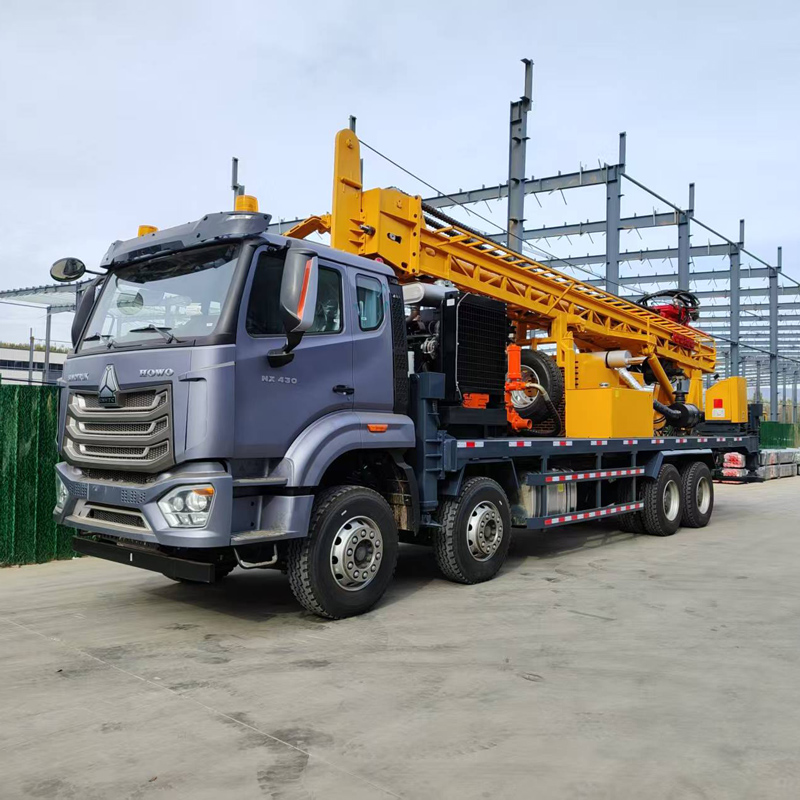
The WRT1000 uses a truck-mounted straight mast structure. The documentation explains that the truck-mounted chassis is suitable for mining areas, farms, industrial parks and cross-regional well drilling projects where drilling points are scattered and relocations are frequent. After completing one hole location, it can move by road to the next construction point without repeatedly arranging flatbed loading and unloading as with crawler rigs.
However, a truck-mounted structure does not mean there are no site access constraints. The overall machine weight is about 26 T, and the transport dimensions are about 10.8 × 2.5 × 4.23 m. A transport height of 4.23 m means that before site access, road height limits, bridges, overhead lines, factory gate openings and other overhead obstacles must be verified. When road conditions in mining areas are complex, the road passage, slope, turning and platform bearing conditions for the truck-mounted chassis also need to be confirmed. These conditions do not disappear because of the truck-mounted structure; they simply shift from crawler relocation to road driving and need to be rechecked.
Which projects do not need to treat a 1000 m drilling depth as a primary condition
If the target aquifer is at 300–500 meters, the final borehole diameter is within the conventional water well range, drilling points are concentrated, and site conditions are unsuitable for the entry of 26 T-class truck-mounted equipment, then the probability of actually using a kilometer-level drilling depth is relatively low. The documentation does not provide an efficiency or cost comparison of the WRT1000 against one class smaller equipment in the low-depth range, so it is impossible to conclude on that basis that it is "unusable"; it can only be said that drilling depth is not a decisive condition in these projects.
The documentation also does not cover the following, which need to be confirmed separately during the selection stage: actual drilling speed under different formation combinations, water yield after well completion, specific configuration of casing and screens, the matching relationship between air compressor selection and the drilling rig, and measured data on local road and platform bearing capacity. These matters are outside the scope of the WRT1000 public parameters and cannot be directly inferred from drilling depth and torque values.
Put the judgment sequence before the equipment
Whether a 1000 m drilling depth is actually needed depends on four prerequisite conditions: the target aquifer depth confirmed by hydrogeological data, the final borehole diameter determined by the completed-well structure, the drill string and casing loads in the hole, and the road conditions for equipment site access and relocation. The WRT1000 public documentation provides corresponding parameters for drilling depth, borehole diameter, lifting force, two-speed torque, feed stroke and power, but these parameters only indicate capability boundaries and cannot replace the project side's hydrogeological and site judgments.
The documentation also includes several supporting items that can serve as reference for verification: a feed stroke of 7 m, compatibility with 3 m or 6 m drill pipes, and a recommended drill pipe diameter of 114 mm; 6 m drill pipes are suitable for long-cycle deep-hole construction and can reduce the number of pipe connections; fast lifting at 28 m/min and fast advancing at 42 m/min are mainly used for non-drilling actions; dual auxiliary winches of 4 T and 3 T can be used for handling DTH hammers, drill pipes, casing, air hoses and on-site accessories; power comes from a 194 kW diesel engine. These configurations correspond to the drill string handling, tool transport and continuous power needs of deep-hole projects, but whether they meet a specific project still needs to be calculated based on hole depth, borehole diameter and formation.