












In the WRTR1000 product materials, two figures are often cited side by side: 1000-meter-class drilling depth and 25 kN·m maximum rotary table torque. They both appear to be "capability indicators," but they do not describe the same thing. Drilling depth describes the range of hole depths the equipment is expected to cover, while torque describes the upper limit of the rotary table's ability to transmit rotation to the drill string at the wellhead. Interpreting 25 kN·m as "the torque capable of drilling 1000 meters," or conversely using drilling depth to judge whether the torque is sufficient, conflates two different languages. The following is based solely on publicly available information on this site, explaining where the 25 kN·m figure sits within the overall machine, which parameters it holds true alongside, and what the materials themselves are insufficient to determine.
Where 25 kN·m Appears
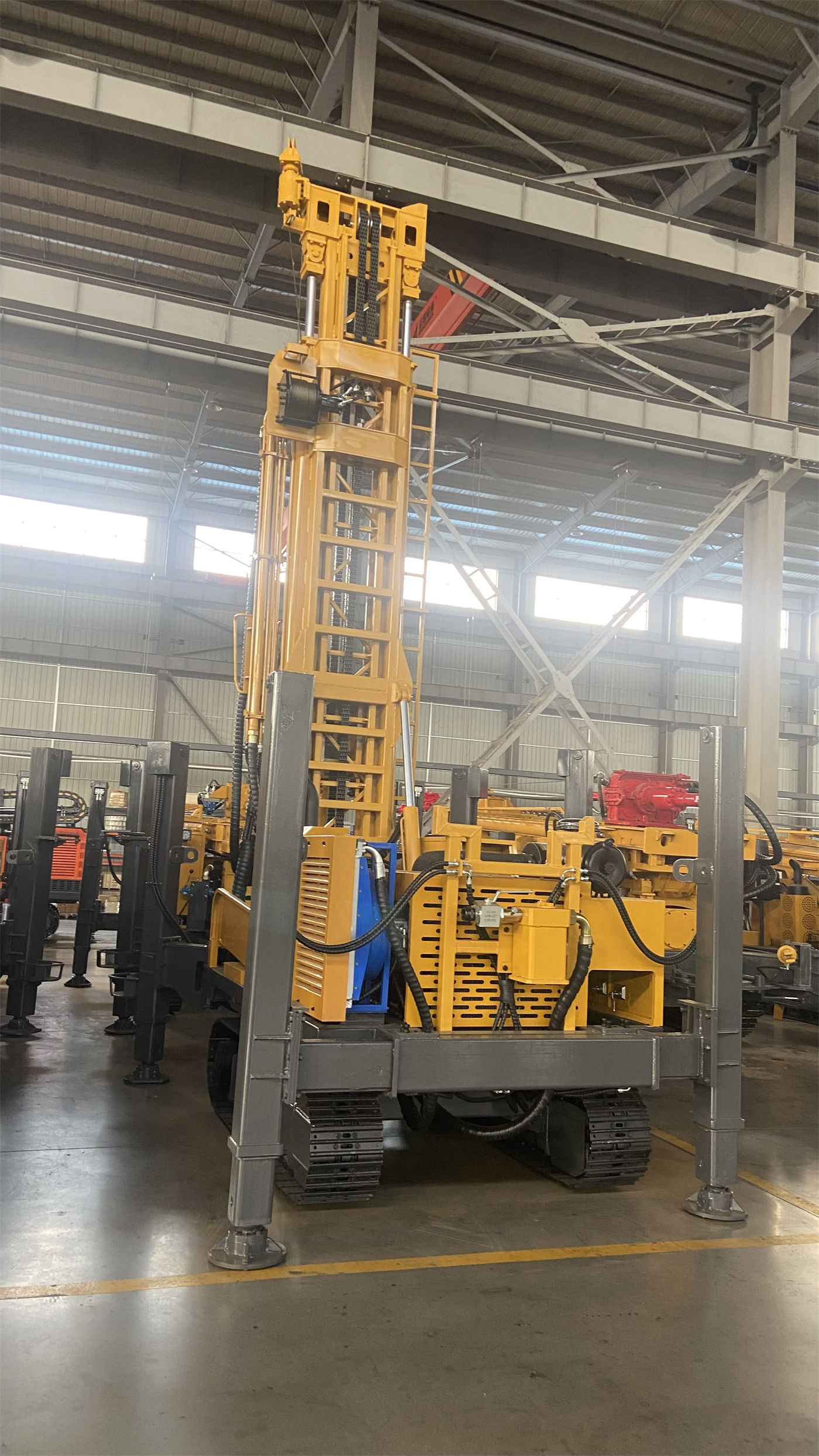
The WRTR1000 is a 1000-meter-class trailer-mounted rotary table water well drilling rig. The rotary mechanism is a rotary table with a maximum torque of 25 kN·m, paired with four speed ranges: 37 / 52 / 84 / 145 r/min. This torque value describes the rotary table's driving capacity for rotating the drill string. It is an output limit on the equipment side, not a drilling capacity that is necessarily achievable under any given formation condition, nor a conversion result for completed well depth or hole diameter.
On the same machine, the torque limit does not automatically change with hole depth. What actually changes in deep holes is the drill string's own weight, the friction between the drill tools and the hole wall, the return slurry condition, and the resistance at the hole bottom. These factors determine how much torque is needed at the moment, not how much torque the rotary table can deliver.
Four Speed Ranges and 25 kN·m Are Two Manifestations of the Same Structure
The rotary table's maximum torque and speed ranges come from the same transmission configuration. The four ranges given in the materials are 37, 52, 84, and 145 r/min. Lower speed ranges correspond to higher available torque, while higher speed ranges correspond to lower torque margin. The materials do not provide the specific torque values corresponding to each range, so the torque at any individual range cannot be calculated independently. It can only be understood, as stated in the materials, that the rotary table's overall maximum torque is 25 kN·m.
According to the formation descriptions in the materials, lower speeds are suitable for large drill tools, casing operations, and high-resistance formations; higher speeds are suitable for relatively stable soft rock, weathered layers, and some sedimentary formations. During deep hole construction, the speed range should be adjusted promptly based on torque, return slurry, and drill string load—this statement itself is an operational direction, not a fixed parameter.
What 25 kN·m Should Not Be Read As
- It should not be read as "still capable of rotating at 25 kN·m at a hole depth of 1000 meters." The deeper the hole, the longer the drill string, and the actual available torque at the hole bottom is affected by factors such as friction. The two are not the same concept.
- It should not be read as the drilling capacity at a certain hole diameter. The materials give a maximum through-hole diameter of 660 mm for the rotary table, but the through-hole is the dimensional space through which drill tools and casing can pass. It is not the completed hole diameter, nor is it a basis for converting between torque and hole diameter.
- It should not be linked to drilling depth alone. The drilling depth limit of the same machine also involves the mast load, lifting force, mud pump displacement, and other stages. Torque is only one of them.
What Other Figures Hold True Alongside 25 kN·m
| Parameter | Value in Materials | Relationship to Torque Judgment |
|---|---|---|
| Maximum rotary table torque | 25 kN·m | Upper limit of the rotary table's rotational output capacity |
| Rotary table speed | 37 / 52 / 84 / 145 r/min (four ranges) | Speed ranges under the same structure; lower ranges for high-resistance conditions |
| Maximum through-hole diameter of rotary table | 660 mm | Dimensional space for passing drill tools and casing; not equal to completed hole diameter |
| Mast | 60 T hydraulic telescopic K-type, total height 19.5 m, effective height 18.482 m | Bears drill string and casing loads; a load-bearing stage |
| Mud pump | BW1200/7, maximum pressure 7 MPa, displacement 1200 L/min | Responsible for cuttings transport, wall protection, and cooling; affects downhole conditions rather than torque itself |
| Main winch / auxiliary winch | 90 kN / 50 kN, both with 160 m rope capacity | Drill string and casing handling; a lifting stage |
| Traveling block / swivel | Both rated load 60 T | Load-bearing components under deep-hole heavy-load conditions |
| Kelly / standard drill pipe | 108 × 108 × 12192 mm / 89 × 9400 mm | Long drill pipes reduce the number of connections while increasing mast and lifting requirements |
This table shows that torque is only the upper limit of the rotary table stage. Whether the drilling depth can be achieved also depends on whether the mast load-bearing capacity, lifting system, mud pump displacement, and circulation method can all hold true simultaneously in the same well. The materials on this site do not provide calculation formulas or comparison tables between torque and drilling depth, hole diameter, or formation.
What the Materials Can Provide for Judging Whether 25 kN·m Is Sufficient
The materials clarify the WRTR1000's intended applications: deep water wells, geothermal, mining area water supply, and hydrogeological drilling. They also state that actual drilling depth must be determined in conjunction with hole diameter, drill tools, formation, circulation method, and well completion design. This statement also applies to torque judgment: the larger the hole diameter, the higher the formation resistance, and the heavier the drill string assembly, the more different the requirements for rotational capacity—but the materials do not provide specific corresponding relationships.
What can be confirmed is that the WRTR1000 supports mud direct circulation, air foam, DTH hammer, and optional air-lift reverse circulation. Downhole conditions differ under different circulation methods: DTH drilling relies on the air compressor, DTH hammer, and bit for cuttings removal; air foam involves adjustments to foam concentration, air volume, and injection method. Whether these process switches change the actual demand for rotary table torque is not elaborated in the materials.
Content Not Covered by the Materials and Requiring Written Confirmation Before Purchase
- The available torque curve for 25 kN·m at different rotary table speed ranges is not provided in the materials.
- Estimates of required rotational torque under different hole diameters and formation combinations are not provided in the materials.
- The selection boundaries of the four speed ranges as actual hole depth increases are only described in terms of applicable direction in the materials.
- The difference in rotary table torque demand under air foam and air-lift reverse circulation conditions is not explained in the materials.
- The design relationship between the 660 mm through-hole and specific completed well diameters and casing stages is not covered; the materials clearly state that completed well diameter should be designed according to the aquifer, well casing, pump type, and formation stability.
Reading 25 kN·m as an isolated capability figure easily obscures its division of labor with speed, through-hole, mast, and pump displacement. A more reliable approach is to read the overall machine parameters separately in four categories—rotation, load-bearing, lifting, and circulation—and then, against the specific project's hole diameter, formation, and well completion requirements, confirm with the manufacturer the matching relationships not covered in the materials.