












Pile positions in PV sites are usually arranged in rows by array, with only a few meters or even less between adjacent pile points. If the machine must first be moved and then re-aligned for every pile position, the construction rhythm will be fragmented by a large number of repetitive actions. What needs to be determined is: in dense pile fields, can the number of whole-machine movements be reduced, what is used to complete hole alignment after reduction, and which conditions must still be guaranteed by site preparation and operating procedures.
Separate "machine repositioning" and "hole alignment" into two stages
Whole-machine repositioning addresses the transfer of equipment from one pile position to the next, while hole alignment addresses the coincidence of the drill bit axis with the designed pile position. The two are adjacent in the process, but their constraints differ: repositioning is affected by the passability of the crawler chassis, site flatness and pile spacing; hole alignment is affected by the mast posture adjustment capability, the machine's stable stopped state and the accuracy of pile position layout. Viewing the two together easily leads to the assumption that the equipment only needs to "be able to move," or that as long as it "can adjust," the site does not need to be managed.
For sites with dense pile positions, a more realistic approach is to reduce whole-machine fine adjustment and let the mast adjustment absorb hole-position deviation. The boundary of this approach is: deviations within the mast adjustment range can be handled by the equipment, while those beyond the range still require moving the whole machine or re-laying out the positions.
Several structures in the PV390 information corresponding to the needs of dense pile fields
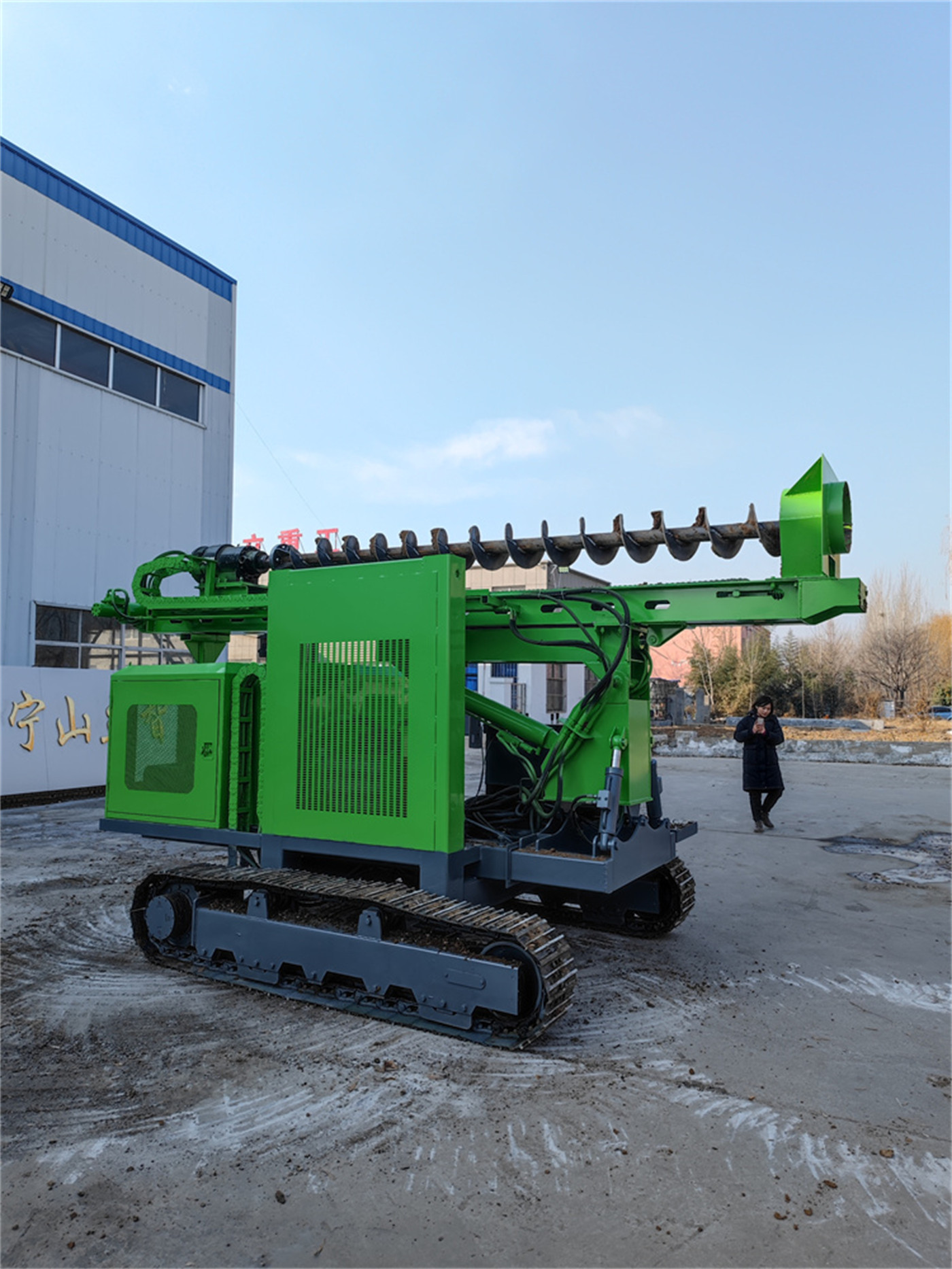
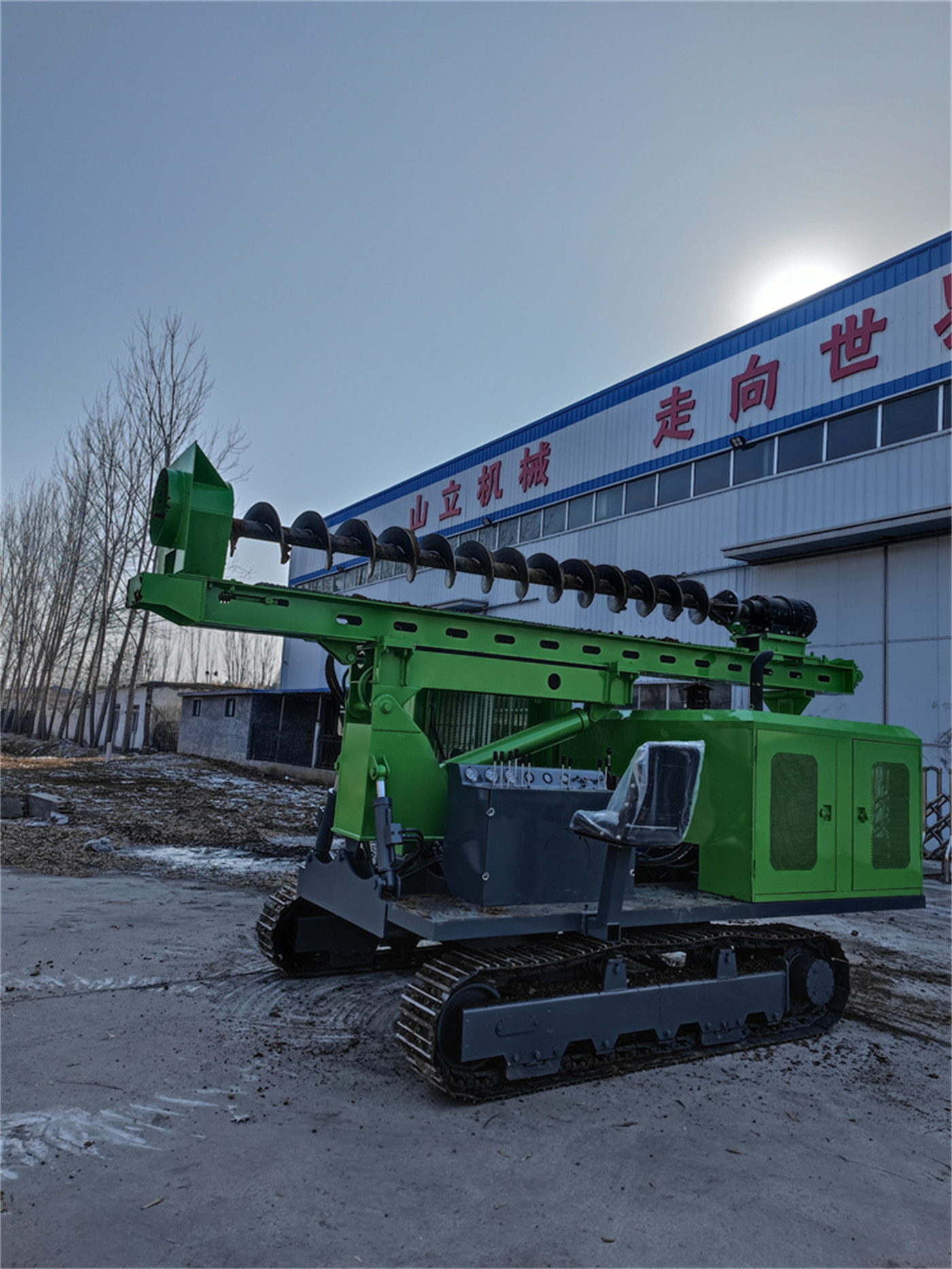
The PV390 is a four-cylinder hydraulic crawler-type PV pile driver, equipped with an 85 kW Yuchai engine, 13000 N·m reducer torque, drilling diameter 80–600 mm, drilling depth 0–6 m, and features 120° mast pitch, dual-cylinder left-right swing arm and 50 cm front-rear telescopic compensation. The following maps the structures in the information to the two types of actions in dense pile fields.
Short-distance transfer handled by the crawler chassis
The 400 mm track shoe helps distribute ground pressure and is suitable for adhesion on dirt roads, grassland, gravel and slopes. Compared with wheeled chassis, it is more suitable for frequent short-distance transfers within PV construction sites. The 35° climbing angle is a value marked in the information; actual slope travel must still comprehensively consider cross slope, ground wetness and slipperiness, soil quality and the machine's center of gravity, and the maximum climbing angle cannot be used alone as the basis for safe travel.
Posture adjustment handled by mast pitch and swing arm
The 120° mast pitch helps mountain PV projects adjust the drilling posture according to slope and pile position requirements, reducing repeated whole-machine movement. The dual-cylinder left-right swing arm can laterally adjust the drilling position after the equipment is stably stopped. For array-type PV sites, this structure helps reduce whole-vehicle fine adjustment for each pile position. The 50 cm front-rear telescopic compensation is used for longitudinal fine adjustment of pile positions and, combined with pitch and left-right swing, forms multi-directional positioning capability, suitable for construction environments with uneven ground or dense pile positions.
Together, these three adjustments correspond to the division of "less whole-machine repositioning, more hole-position adjustment." It should be noted that the information does not give the maximum pile-position deviation that the swing arm and telescopic compensation can absorb, nor the time required for hole alignment per pile, so efficiency improvement cannot be calculated on this basis; the specific layout deviation that can be covered must be judged according to on-site measurement and the range confirmed by the manufacturer.
Drilling capability must first cover the pile type before discussing repositioning and hole alignment
The prerequisite for reducing the number of machine repositionings is that the equipment can complete the hole-forming task in the site. The PV390 has a drilling diameter of 80–600 mm and a drilling depth of 0–6 m, and is positioned for PV pile foundations and shallow foundation projects, not deep water well construction. For conventional PV mounting, fence posts and other shallow foundation projects, drilling tools and construction methods can be selected according to the design depth; the final hole diameter must be based on the project design drawings and foundation form.
With 13000 N·m torque, drill pipe speed of 90 r/min and chain pressurization, it can cover the 80–600 mm drilling range. For large hole diameters, dense soil layers and strata containing gravel, higher torque helps maintain rotation, but actual penetration still depends on the drill bit type, stratum structure and advancement control. Chain pressurization is suitable for continuous advancement. When encountering cobblestone, backfill layers or strongly weathered rock, advancement should be controlled according to rotation load and drilling tool condition to avoid excessive downward pressure causing hole deviation, sticking or excessive impact on the drilling tool.
Stratum conditions will change the rhythm of hole alignment and repositioning
| Stratum | Information description | Impact on construction arrangement |
|---|---|---|
| Soil layer | Suitable for conventional PV foundation pre-drilling and pile position construction | Lower resistance, but the machine must still be stably stopped before hole alignment |
| Loess | Adjust drilling parameters according to density and moisture content | Hole wall stability is affected by moisture content; the pace cannot be set only by pile spacing |
| Clay | Pay attention to bit balling and cuttings removal | Cleaning the bit after balling increases auxiliary time per pile |
| Cobblestone sand | Select drilling tools according to particle size and density | Bit jumping and hole deviation may occur; hole position changes still need to be observed after alignment |
| Backfill waste layer | Focus on preventing foreign objects, voids and local jamming | When conditions below the pile position are unclear, advancement cannot follow only the rhythm of densely arranged pile positions |
| Strongly weathered rock and rock layers | After replacing with impact drilling tools, it can be used for construction in corresponding strata | The information does not give the impact hammer model or impact energy, and no additional commitment is made regarding hard rock efficiency |
The information in the table comes from product materials. In dense pile fields, if the upper part is a backfill layer or contains block stones, hole deviation or jamming may still occur after alignment; in this case, the idea of shortening the per-pile pace should give way to handling in-hole conditions.
Supporting conditions and safety boundaries
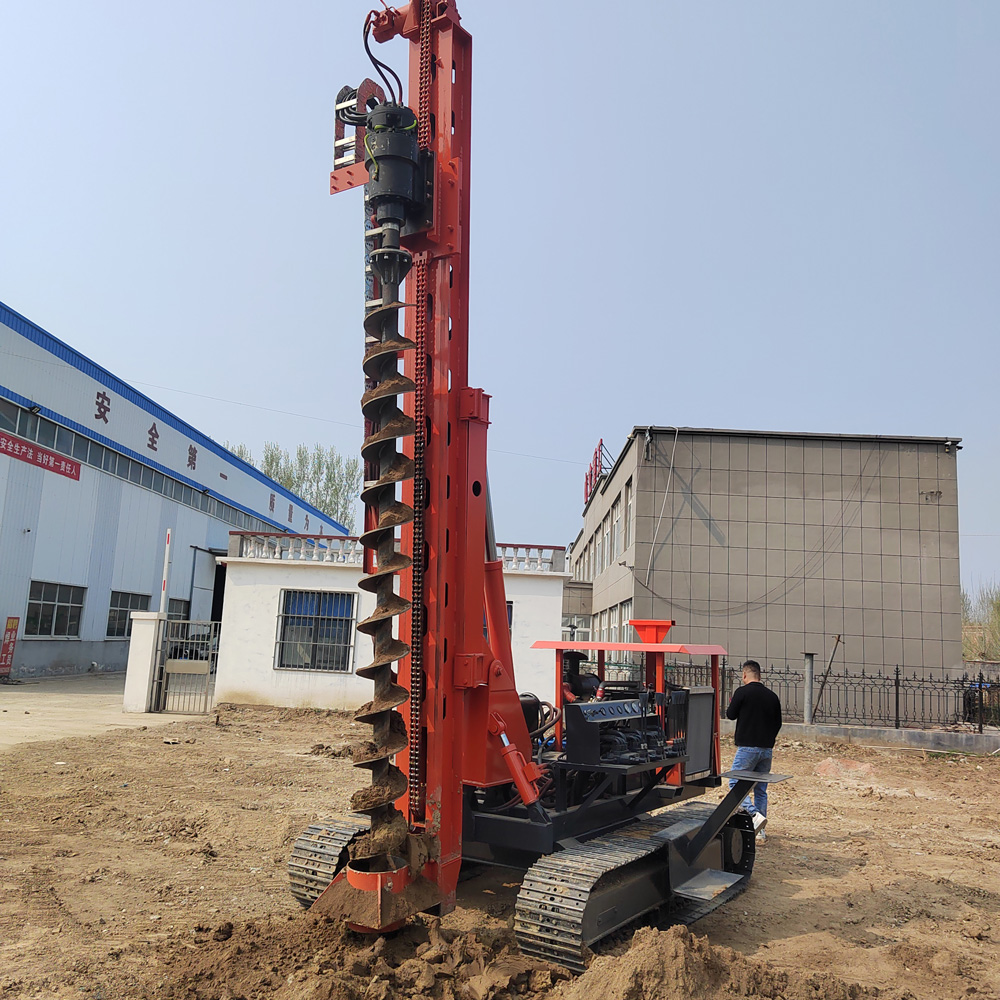
- Confirm underground cables, pipelines and obstacles before construction; in dense pile fields, especially verify already buried facilities.
- During slope operations, check track adhesion and machine stability; do not rely only on mast adjustment to compensate for the machine not being stably stopped.
- During drilling, personnel must not approach the rotating drill pipe, chain pressurization mechanism or mast swing range.
- Stop the machine and release hydraulic pressure when replacing impact drilling tools.
- Power comes from an 85 kW Yuchai four-cylinder engine. When PV sites are far from fixed power sources, diesel power is more suitable for independent field construction; during continuous high-load operation, focus on checking cooling, the air filter and the fuel system.
Which sites are worth including this approach in comparison
When pile positions are densely arranged in arrays, short-distance frequent transfers are required within the site, the slope surface is undulating and multi-angle hole alignment is required, the crawler chassis, mast pitch, dual-cylinder swing arm and telescopic compensation in the PV390 information correspond to these needs. If the project pile diameter or pile depth exceeds the 80–600 mm, 0–6 m range, or the stratum is mainly intact hard rock and the information does not cover impact hammer configuration, whether the equipment can meet the requirements must be verified separately and cannot be judged solely on the above structures.
Items still to be confirmed
- The range that the swing arm and telescopic compensation can cover under actual pile position layout deviation; the information does not give specific values and confirmation from the manufacturer is required.
- Whether the project design pile diameter and pile depth fall within the 80–600 mm, 0–6 m range, and the hole-forming requirements corresponding to the pile type.
- Whether site slope, cross slope and surface adhesion conditions are within the range in which the equipment can safely travel and stop stably.
- Drilling tool configuration and impact drilling tool matching when encountering backfill layers, block stone layers or strongly weathered rock; the information does not give specific models or energy parameters.
The product model in the information is uniformly referred to as PV390, and the remaining technical parameters are organized according to the provided information. Actual drilling efficiency, hole-forming quality and piling effect are affected by geological conditions, drilling tool form, pile type, hole diameter, construction angle and operating method, and the final basis should be on-site working conditions and the project foundation design.