












After a shallow anomaly is confirmed, projects often do not immediately settle into a fixed approach; instead, they must first answer a judgment: is this round of drilling intended to quickly establish the distribution outline of deep lithology, alteration, and mineralization, or to obtain more continuous samples suitable for detailed description. This judgment determines the sampling method and also determines which capabilities the equipment must have. The following sections unfold along a decision path, first clarifying common trade-off branches, then using public information on a 600-meter-class crawler-mounted reverse circulation rig to explain why such equipment may be considered under certain conditions and which conditions still require verification.
First separate “what information is needed” from “how deep to drill”
After a shallow anomaly appears, follow-up work usually has two types of objectives: one is to trace the anomaly along strike and dip, using more drill holes to control the spatial form of the mineralized body; the other is to focus on key sections and use continuous core for more detailed description of structure, alteration, and grade. The former places more emphasis on the number of holes and coverage depth, while the latter places more emphasis on sample form. The two routes are not mutually exclusive; in actual projects, a round of cuttings sampling is often conducted first, followed by core holes arranged in key anomalous sections.
Therefore, when determining the sampling method, do not start from the equipment model; instead, answer three questions: whether the samples needed in this round are cuttings or core; what range the target hole depth falls into; and whether the site has the air compressor, fuel, and sample handling conditions required for pneumatic drilling. These three answers will directly narrow the range of selectable equipment.
Following the decision path: when to consider the reverse circulation route
If the project's main objective is to quickly establish depth control points for a large number of drill holes, and there is already some shallow mineralization information that needs to be traced deeper, reverse circulation cuttings sampling is usually a method worth considering. This process uses dual-wall drill pipes to bring bottom-hole cuttings to the surface through the inner tube, making it convenient to collect samples in fixed footage intervals. Compared with conventional outer annulus discharge, the inner-tube sample return path is more concentrated, and depth-interval segmentation is more operable.
The reverse circulation route also has boundaries. What it obtains is cuttings samples, not continuous complete core, and sample representativeness and depth attribution depend on on-site sampling management. If the project requires observation of rock formation structure, joints, or mineralization contact relationships, cuttings alone are not sufficient to replace core. Treating reverse circulation as a simple substitute for coring is a common deviation when making choices.
Several capabilities corresponding to 600-meter-class crawler-mounted reverse circulation equipment
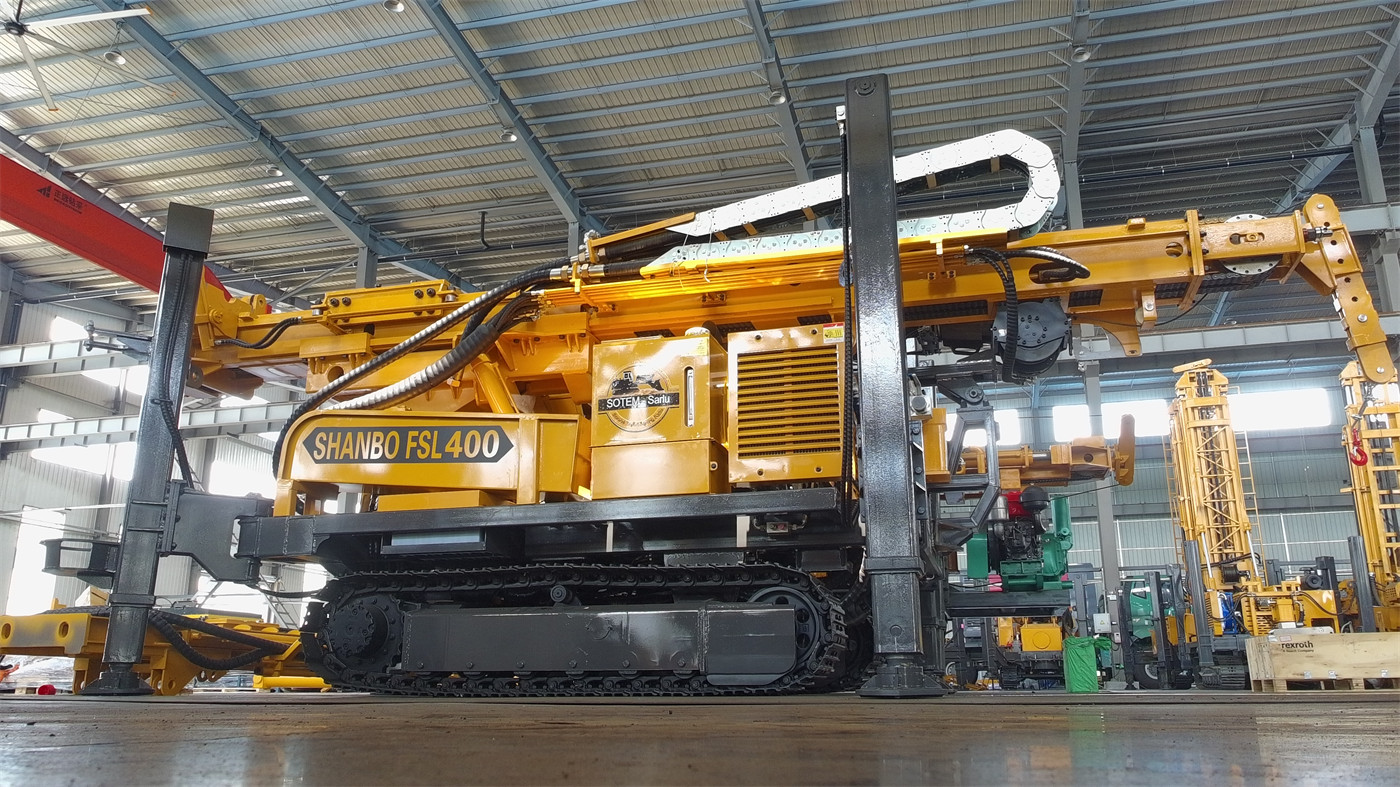
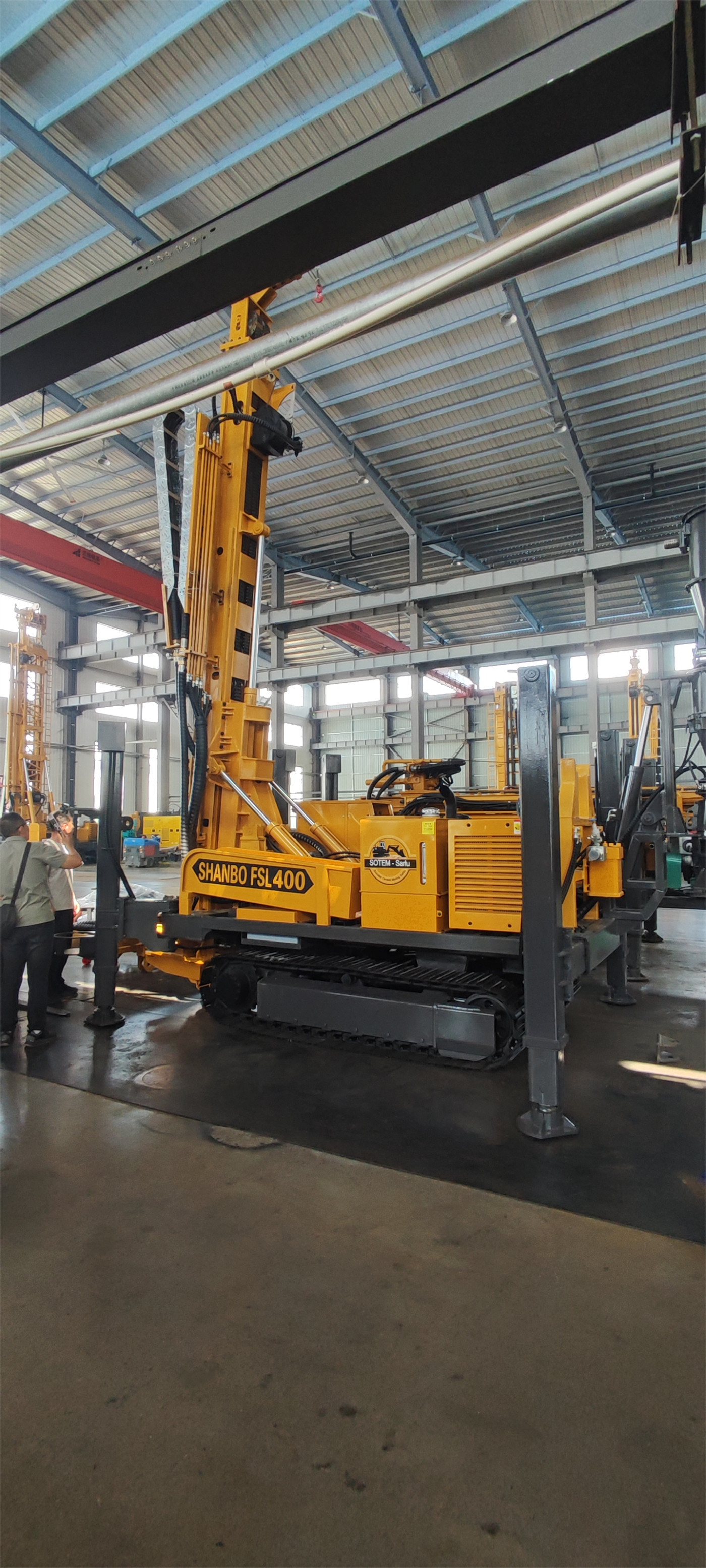
After determining to take the cuttings sampling route, check whether the equipment capabilities cover the hole depth and hole diameter requirements of this round. The RC600 information associated with this article shows a maximum drilling depth of 600 m, a hole diameter of 105–450 mm, a 132 kW engine, 29 T lifting force, and dual-condition rotary torque of 12000/6000 N·m. These parameters address different levels of issues and should not be viewed in isolation.
- The nominal 600 m drilling depth corresponds to reference capability under typical configuration; the actually achievable depth will be affected by hole diameter, drill pipe combination, air compressor output, rock formation conditions, hole deviation, and drilling tool wear.
- The 105–450 mm hole diameter range allows the same equipment to handle both exploration holes and some large-diameter deep water wells and mine dewatering holes, but the completion structure requirements differ for different uses.
- The 29 T lifting force is used for tripping deep-hole drill strings and handling casing. As hole depth increases, the self-weight of dual-wall drill pipes and borehole wall friction rise; lifting capacity is a practical condition for deep-hole operations, but sustained abnormal resistance should first be judged by downhole conditions rather than directly pulling hard with lifting force.
- The dual-condition torque of 12000/6000 N·m corresponds to maximum rotary speeds of 75/150 r/min. Low-speed high-torque is suitable for large-diameter, hard-rock, and high-load hole sections, while the high-speed gear is suitable for stable formations with lower resistance; actual use must be coordinated with percussion and sample return conditions.
Air supply is an unavoidable supporting condition for the reverse circulation route
Reverse circulation drilling does not rely on the rig alone. The information gives a working pressure range of 1.6–6 MPa and an air consumption of 16–75 m³/min. Under deep-hole conditions, compressed air must both drive the bottom-hole drilling tool and carry cuttings back to the surface through the inner tube; therefore, the pressure and displacement of the air compressor must match the hole depth, hole diameter, and rock formation conditions. As hole depth increases, hole diameter expands, or altitude rises, the required effective air volume usually also increases.
This means that before procurement, the air compressor configuration should be confirmed as part of the overall plan, including exhaust volume, pressure rating, connection method with the rig, and on-site fuel support. Inferring the capability of the entire system solely from the rig's drilling depth parameter can easily lead to insufficient sample return in deep hole sections.
Angle, site, and relocation conditions also affect route selection
The information shows that the equipment supports 45° and 90° working angles; 90° is used for conventional vertical holes, and 45° is suitable for inclined crossing of inclined ore bodies, veins, and fault zones. For projects tracing inclined anomalies, drill hole angle design is often as important as hole depth and should be determined according to ore body attitude rather than uniformly arranged as vertical holes.
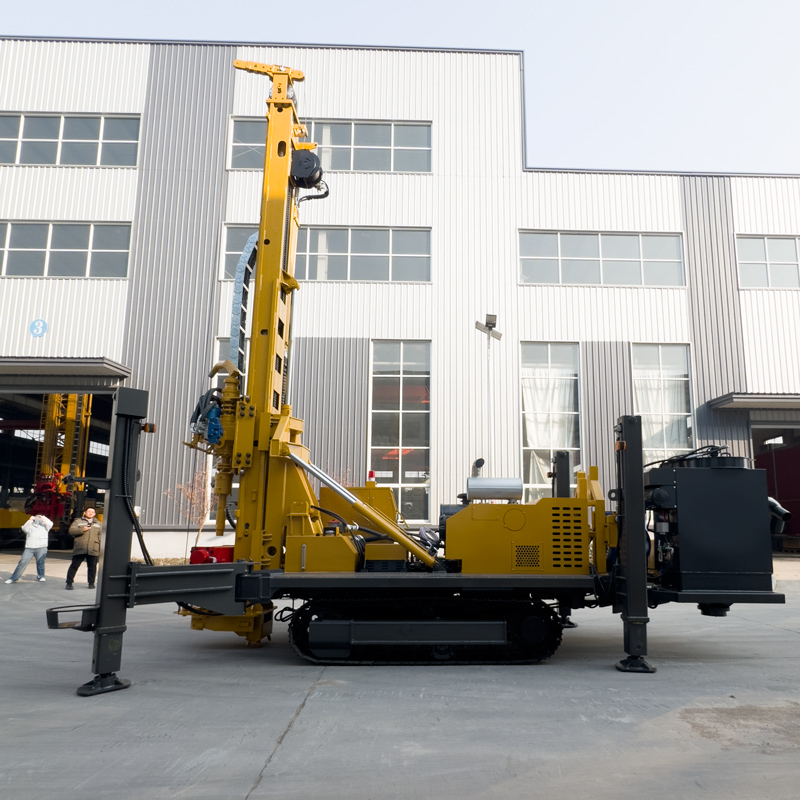
The equipment has a crawler chassis, a travel speed of about 3.5 km/h, a maximum climbing angle reference of 21°, an overall weight of about 12.5 T, dimensions of about 7 × 2.1 × 2.9 m, and a leg stroke of 1.7 m. Crawler relocation can be considered for gravel roads and generally uneven ground in mining areas, but before actual entry, road bearing capacity, slope, and platform stability should be confirmed. Reverse circulation projects also need space for air compressors, sample return hoses, sampling devices, and sample areas, and the drilling platform size should be planned in advance.
Loose layers and broken zones require separate arrangements
If the upper overburden is soil, sand, or gravel, it may not be suitable for direct high-pressure air reverse circulation. The information mentions that the equipment supports mud rotary mode, which can first stabilize and complete the upper hole section, and then switch to reverse circulation or down-the-hole hammer process after entering stable rock. Fault broken zones are prone to block falling, air leakage, and abnormal sample return; after entering such hole sections, advance speed should be controlled, hole cleaning maintained, and air pressure changes observed; in case of severe air leakage, foam, casing, or other treatment methods need to be combined, and these specific plans should be determined during the construction organization stage.
Items to confirm before procurement
If project conditions match the above reverse circulation route, the following information is recommended to be prepared during inquiry and plan confirmation:
- Drilling purpose: mineral exploration, geological sampling, deep water wells, or mine dewatering; different purposes have different concerns.
- Formation data: overburden type, bedrock lithology, broken zones, and aquifer conditions.
- Target hole depth and hole diameter: used to check the margin between the equipment's nominal capability and actual configuration.
- Drilling method: reverse circulation, down-the-hole hammer, or a combination with upper mud rotary.
- Air supply conditions: planned air compressor pressure, displacement, and fuel support.
- Entry and site conditions: road bearing capacity, slope, platform size, and sample area layout.
- Sampling management: footage intervals, sample numbering, depth records, and quality control arrangements.
The sampling route after shallow anomaly confirmation is not a permanent choice between two processes. A more prudent approach is to first determine the sample form according to the information objectives of this round, then check the hole depth coverage, air supply support, and site conditions required by that route. The 600-meter-class crawler-mounted reverse circulation rig is suitable for projects that need to trace deeper and establish control points with cuttings samples; if the project's core requirement is continuous core or fine structural description, coring equipment should be included in the comparison rather than reluctantly substituting reverse circulation equipment.