


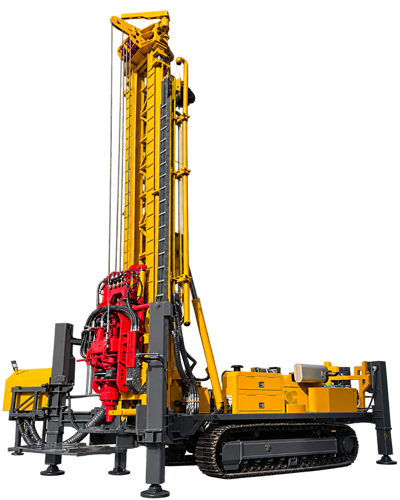
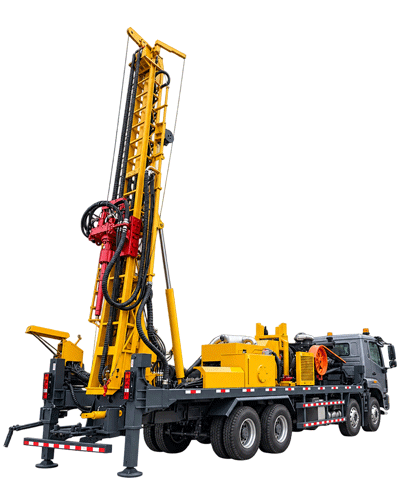
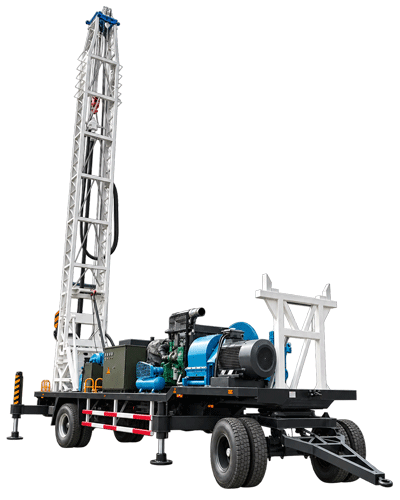
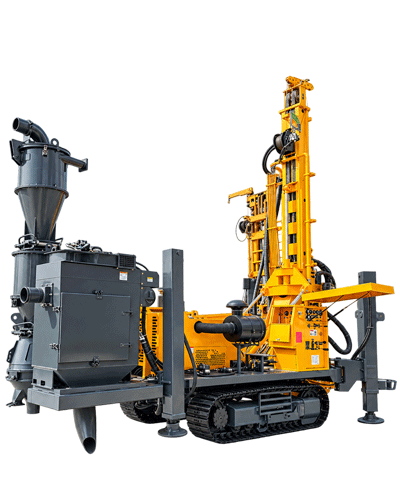
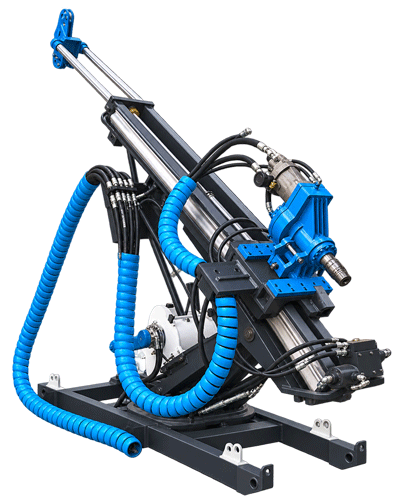
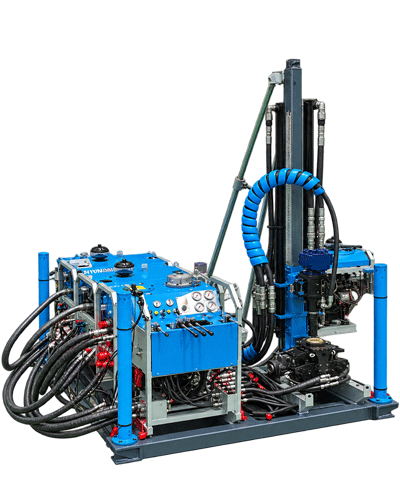
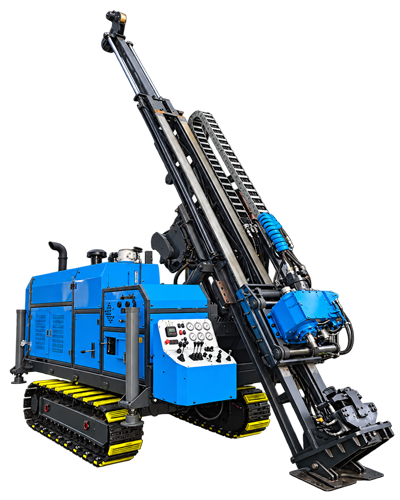
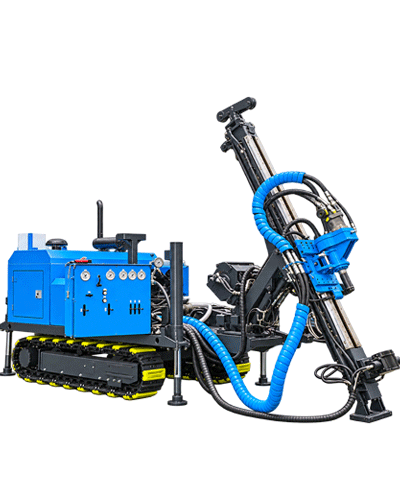
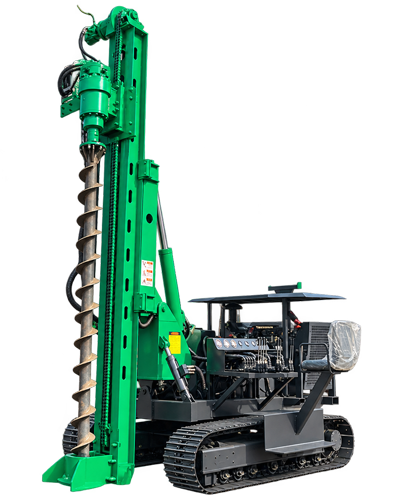
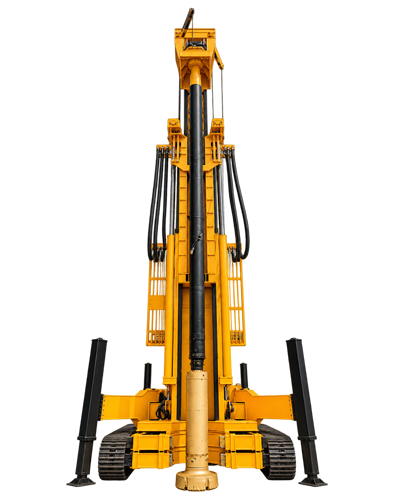
The PV390 documentation contains a set of interrelated figures: drilling diameter 80–600 mm and drilling depth 0–6 m. These two ranges are not isolated parameters but together define the operational boundaries of this crawler hydraulic photovoltaic pile driver. Also in the documentation are 13000 N·m reducer torque, 90 r/min drill rod rotation speed, 85 kW Yuchai four-cylinder engine, 120° mast pitch, 50 cm front-rear telescopic compensation, 400 mm track pads, and 35° climbing angle. This article unfolds by explaining what each group of figures constrains and what they collectively define, without making efficiency promises beyond the documentation.
First, the two ranges: 80–600 mm and 0–6 m
The drilling diameter of 80–600 mm covers a wide range. Smaller diameters correspond to pre-drilling for conventional photovoltaic support pile positions, while larger diameters are used for pile types requiring larger foundation holes or pilot hole needs. The documentation does not provide recommended drilling tools and step-by-step drilling sequences for different diameters, so the hole-forming method for a specific diameter must be confirmed according to the project foundation type and design drawings.
The drilling depth is set at 0–6 m, pointing to photovoltaic pile foundations and shallow foundation projects, not deep water well construction. This directly excludes its use as deep-hole equipment. The documentation also states that conventional photovoltaic supports, fence posts, and other shallow foundation projects can select drilling tools according to design depth, meaning 6 m is the depth range for this purpose, not a depth value applicable to all foundation types.
Where does the 13000 N·m torque figure act?
The 13000 N·m is the nominal reducer torque, corresponding to a drill rod rotation speed of 90 r/min. It describes the rotational capability of the rotary system output to the drilling tool, located in the rotary link of the power chain. The documentation explains this item as follows: for large diameters, dense soil layers, and formations with mixed gravel, higher torque helps maintain rotation, but actual penetration still depends on drill bit type, formation structure, and feed control.
In other words, this value can be used to judge whether the equipment has the basic conditions to maintain rotation at a certain diameter or formation, but it cannot be read as penetration rate at a certain depth, nor converted into the bearing capacity of the pile foundation. The documentation does not provide stepped torque or dual-condition settings, so there is no description of switching torque gears according to formation.
Mast, swing arms, and telescopic compensation address posture, not passability
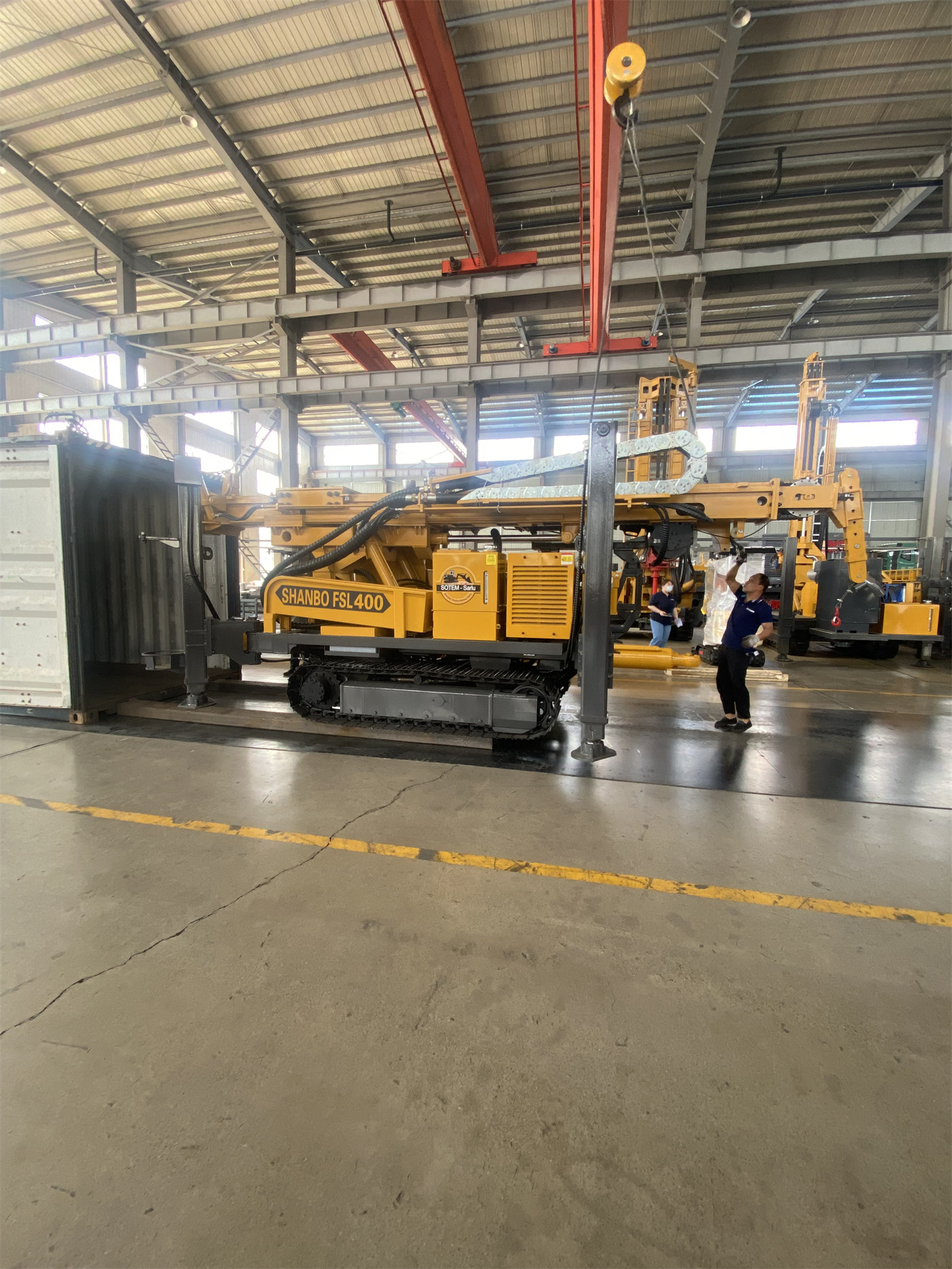
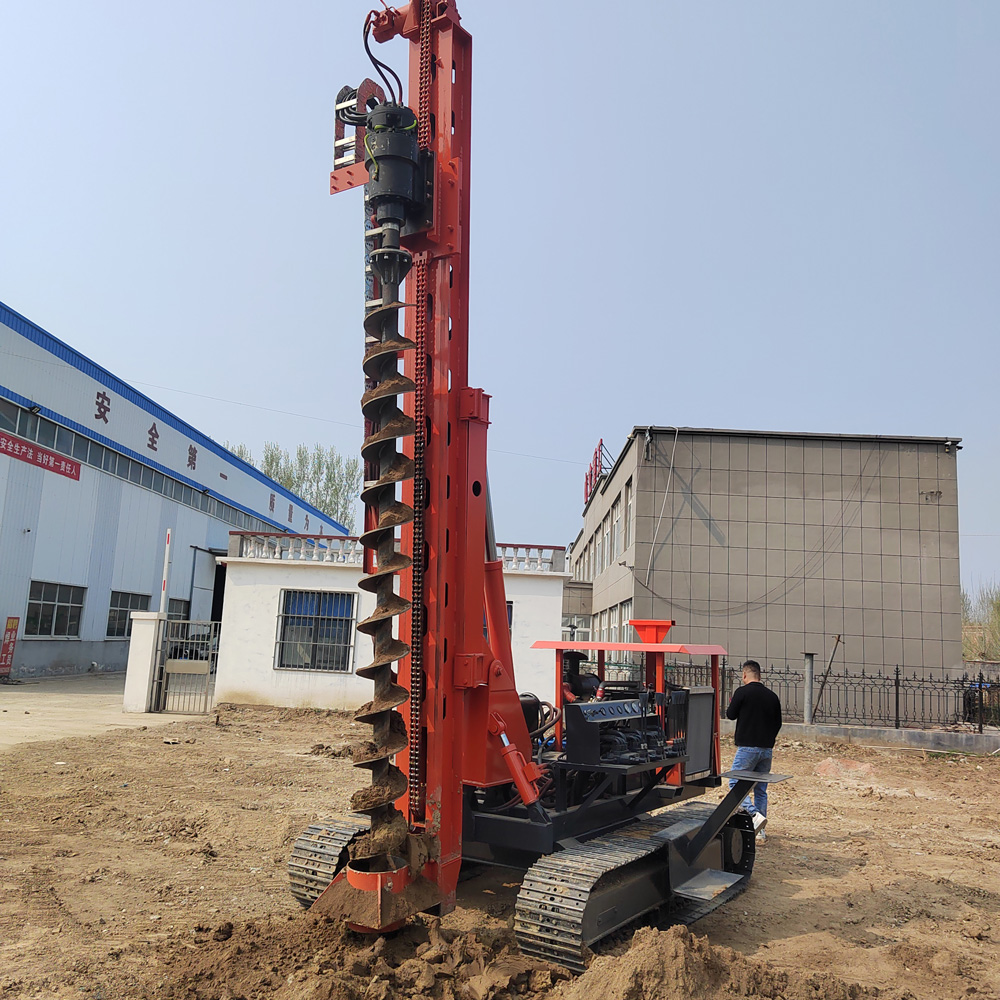
The PV390's mast pitch range is 120°, using dual-cylinder left-right swing arms, and has 50 cm front-rear telescopic compensation. These three items together point to the same thing: after the equipment is stabilized, adjust the drilling posture and complete hole alignment without repeatedly moving the entire machine.
- Mast pitch 120°, used to adjust the drilling angle according to slope and pile position requirements;
- Dual-cylinder left-right swing arms, used for lateral position adjustment after the equipment is stabilized;
- 50 cm front-rear telescopic compensation, used for longitudinal fine-tuning of pile positions.
The documentation links these three items to "multiple pile positions, slopes, and complex construction postures," and states that multi-angle adjustment can reduce repeated movement of the entire machine, making it more practical for photovoltaic sites with obvious undulations. Note that posture adjustment capability and obstacle-crossing passability are not the same type of indicator. Whether slope construction is feasible also depends on the combination of track adhesion, cross-slope conditions, soil quality, and the center of gravity of the entire machine; the documentation does not provide lateral stability data.
The second constraint on applicability: chassis conditions
The PV390 uses a crawler chassis with 400 mm track pad width, and the documentation specifies a climbing angle of 35°. The 400 mm track pads serve to distribute ground pressure and improve adhesion on dirt roads, grass, gravel, and slopes; compared to wheeled chassis, the crawler structure is more suitable for short-distance frequent transfers within photovoltaic construction sites.
Regarding the 35° figure, the documentation itself states: actual slope construction should still comprehensively consider cross-slope, ground wetness, soil quality, and the center of gravity of the entire machine, and the maximum climbing angle should not be used alone as a basis for safe travel. This passage is a usage condition limitation provided by the equipment side and is part of the applicability judgment in this article.
Operational limitations under different geological conditions
The documentation provides explanations for various formations, which can be viewed by two types of factors: drilling resistance and hole wall conditions:
| Formation | Documentation notes |
|---|---|
| Soil layer | Suitable for conventional photovoltaic foundation pre-drilling and pile position construction |
| Loess | Adjust drilling parameters according to density and moisture content |
| Clay | Watch for bit balling and poor cuttings removal |
| Cobble sand | Select drilling tools according to particle size and density |
| Backfill waste layer | Focus on preventing foreign objects, voids, and local jamming |
| Strongly weathered rock and rock layers | After replacing with impact drilling tools, can be used for corresponding formation construction |
The equipment uses chain feed to continuously provide thrust to the drilling tool. The documentation notes that when encountering cobbles, backfill layers, or strongly weathered rock, feed should be controlled according to rotary load and drilling tool status to avoid excessive downward pressure causing hole deviation, stuck drill, or excessive impact on the drilling tool; when abnormal impact or sudden increase in rotary load occurs, the drill should be lifted promptly for inspection.
Regarding rock layers, the original documentation clearly states that after replacing with impact drilling tools, it can be used for strongly weathered rock and rock layers, but does not provide impact hammer models or impact energy, so this article makes no conclusions about specific efficiency under hard rock conditions.
Main technical parameters
| Parameter item | Parameter value |
|---|---|
| Product model | PV390 |
| Equipment type | Four-cylinder hydraulic crawler photovoltaic pile driver |
| Overall dimensions | 5200 × 2300 × 2650 mm |
| Engine | Yuchai four-cylinder engine, 85 kW |
| Main pump | Triple pump 40 / 40 / 32 |
| Travel motor | TM09 |
| Reducer | Internal five-star reducer, torque 13000 N·m |
| Drill rod rotation speed | 90 r/min |
| Drilling diameter | 80–600 mm |
| Drilling depth | 0–6 m |
| Feed method | Chain feed |
| Mast pitch | 120° |
| Mast swing | Dual-cylinder left-right swing arms |
| Front-rear telescopic compensation | 50 cm |
| Track pad width | 400 mm |
| Climbing angle | 35° |
| Chassis type | Crawler |
Items to confirm first when exceeding this set of parameters
Putting together hole diameter, drilling depth, posture adjustment, chassis, and geological notes, it can be judged that the PV390's applicability is concentrated on the purpose of photovoltaic support foundation pre-drilling, hole forming, and pile foundation construction with corresponding attachments. The original documentation states "suitable for ground and mountain photovoltaic foundation pre-drilling," and does not describe it as deep-hole equipment or multi-process well completion equipment.
The following are parts not covered by the documentation that need to be confirmed separately at the project level, written to avoid treating parameter limits as unconditionally applicable:
- The specific lateral adjustment distance corresponding to the 50 cm telescopic compensation and mast swing angle; the documentation does not provide converted values;
- The model, impact energy, and corresponding constructible rock hardness range of impact drilling tools;
- Recommended drilling tool combinations and step-by-step drilling plans for different hole diameters;
- Quantitative data related to safe travel such as lateral stability and operable cross-slope angle;
- The actual penetration rate and hole quality achievable under specific formation and hole diameter combinations.
The documentation's statement on efficiency and effectiveness is: due to differences in actual geological conditions, drilling tool types, pile types, hole diameters, construction angles, and operating methods, the final drilling efficiency, hole quality, and piling effect should be based on site conditions and project foundation design. This also applies to the items to be confirmed above.
Model note: The product model in the original documentation is SL390, and the user's latest confirmed model is PV390. This article uniformly uses PV390, and the remaining technical parameters are organized according to the provided documentation.