












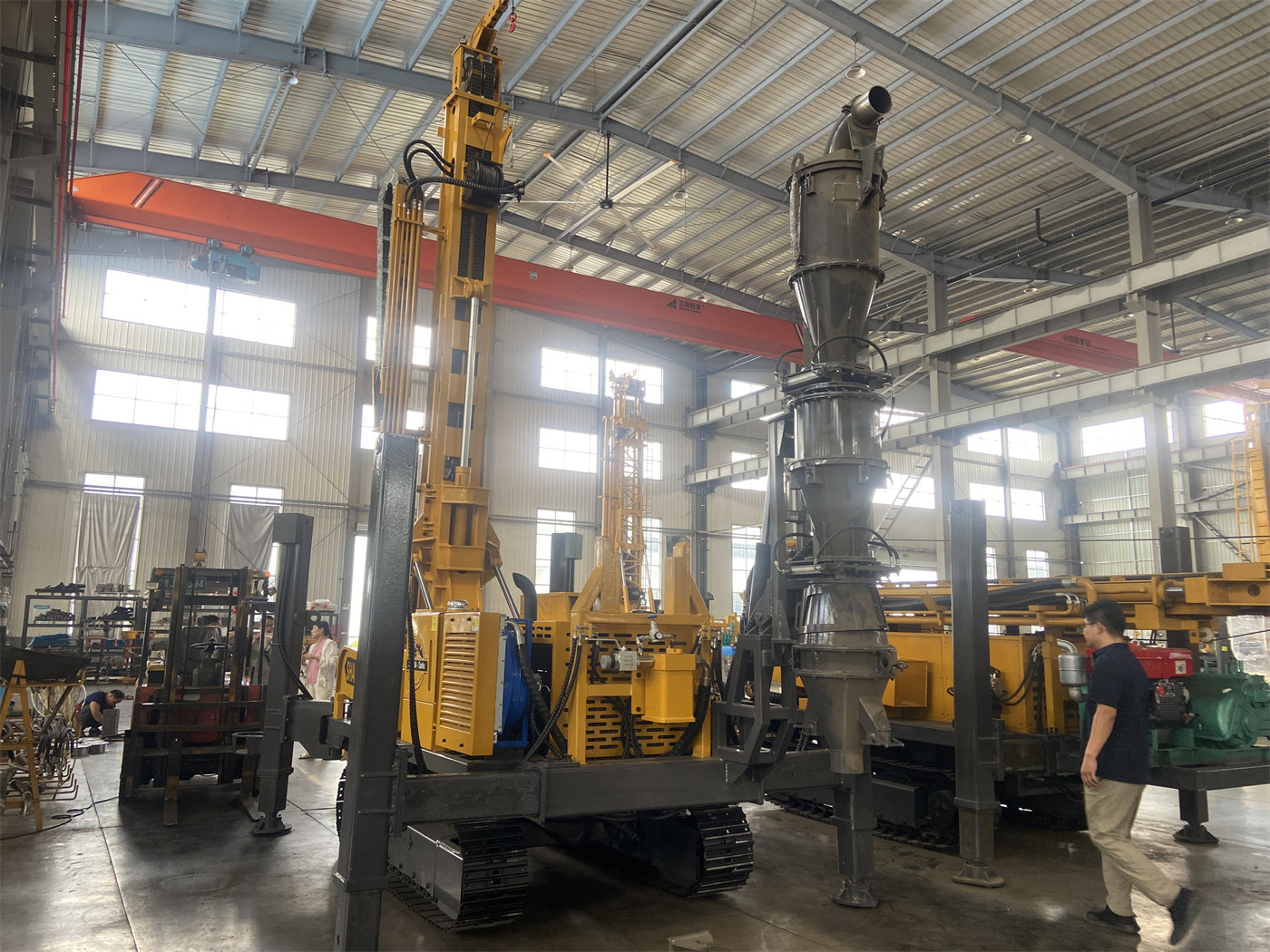
In the PV390H's equipment description, more than one component can adjust posture: the track height extension is 1200 mm, the mast pitch range is 120°, the mast uses dual-cylinder left-right swing arms, and there is an additional 450 mm telescopic compensation. These figures point to the same thing—allowing the chassis to find a relatively stable working posture on uneven ground and to align with pile positions without repeatedly moving the entire machine. But this does not mean 'it can be used on all mountain PV sites.' Whether it can be used depends on whether the slope height difference falls within the adjustment range and whether there are other ways to handle the parts that exceed the adjustment range.
First, look at which directions the adjustment capabilities act in
Breaking down the PV390H's posture adjustment, the directions it covers are not the same. Discussing them together can easily overestimate the actual range of adaptability.
- Track height extension 1200 mm: acts on the height difference between the left and right tracks, handling lateral height differences.
- Mast pitch 120°: adjusts the angle of the drill mast relative to the chassis, corresponding to the slope angle and the hole direction required by the pile position.
- Dual-cylinder left-right swing arms: provide lateral fine adjustment after the chassis is stabilized, reducing the number of times the entire machine must be moved to align with a pile position.
- 450 mm telescopic compensation: fine adjustment in the front-back direction of the drilling work mechanism, corresponding to deviations in the pile layout direction.
These four sets of movements correspond to lateral height difference, slope angle, lateral hole alignment, and front-back fine adjustment. The materials do not give the maximum slope values that can be handled in each direction, nor do they explain the limits on the machine's center of gravity and stability at maximum adjustment. Therefore, one cannot directly convert 1200 mm and 120° into 'how many degrees of slope it can adapt to.'
What the 1200 mm track height extension can cover and cannot cover
The track height extension is 1200 mm. The materials describe it as 'the track height can be adjusted according to the slope to give the equipment a better construction posture on uneven ground,' and 'it can be used to handle relatively obvious left-right height differences.'
According to this description, the corresponding work position conditions are: there is a height difference between the left and right sides of the ground at the same machine position, but the height difference falls within the adjustable track height range, and the equipment can maintain stable load-bearing after adjustment. Typical cases are lateral height differences along contour lines on a slope, or local undulations near pile positions.
What cannot be directly inferred from this figure is:
- Long-distance steep slope traversing capability along the slope direction—track height adjustment changes posture, not climbing ability.
- How to handle height differences exceeding the adjustment amount—the materials do not give a handling method; on-site leveling or changing the machine position is required.
- The safety boundary of the machine's center of gravity after adjustment—the materials only mention that 'the tracks on both sides should be adjusted gradually according to slope conditions,' without giving quantifiable stability criteria.
The 120° mast pitch is not the same thing as the existing slope angle
120° is the mast pitch range. It describes the angle range within which the drill mast can swing relative to the equipment itself, used to make the drilling posture match the slope or pile position requirements. It is a different concept from 'how many degrees of slope the equipment can stand on': standing firm belongs to chassis and ground contact conditions, while drilling correctly belongs to mast posture. The two need to be verified separately.
The relevant statement in the materials is that 'a larger pitch adjustment capability can reduce the time the entire machine spends repeatedly searching for an angle.' This is an efficiency-level effect and does not constitute a promise of slope applicability.
Swing arms and telescopic compensation solve hole alignment, not traversability
The dual-cylinder left-right swing arms and 450 mm telescopic compensation both point to the pile position alignment step:
- The swing arms provide lateral fine adjustment after the chassis is stabilized, corresponding to 'reducing frequent small-range movement of the chassis.'
- Telescopic compensation is used for fine adjustment in the front-back direction.
What they reduce is hole alignment time; they do not improve the equipment's own traversability. If pile positions require crossing gullies, steep steps, or soft ground, the swing arms and telescopic compensation cannot help.
Which mountain PV work positions are more likely to fall within the adjustment range
Combined with the materials' description of applicable directions—mountain PV, hilly sites, and uneven slope foundation construction—the following working conditions correspond more directly to the equipment's adjustment capabilities:
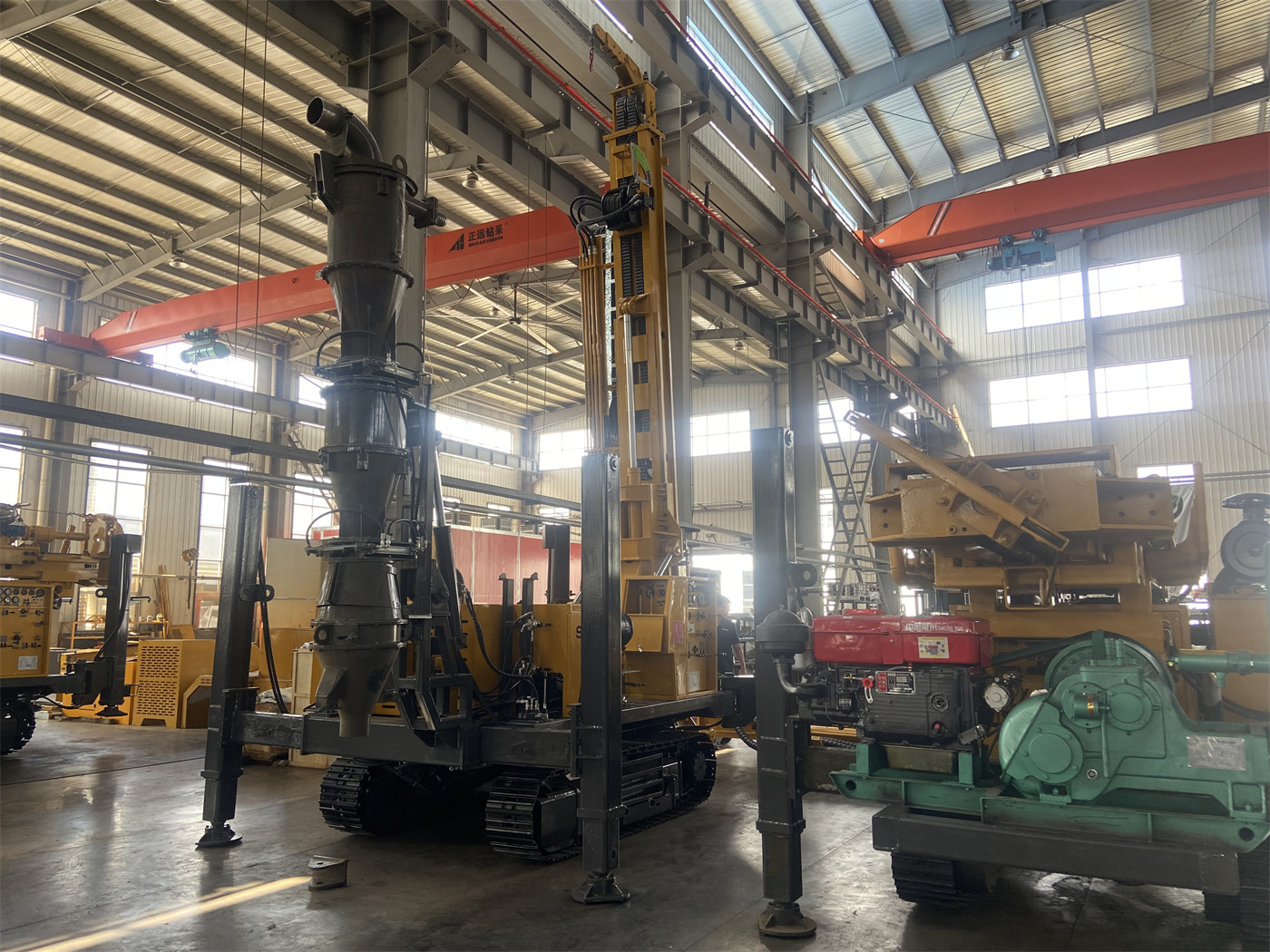
- Slopes with left-right height differences but limited amplitude and dense pile positions can use track height adjustment to obtain a working posture.
- In hilly sites where the ground between pile positions undulates frequently and single-point leveling is costly, swing arms and telescopic compensation help reduce the number of machine moves.
- For relatively flat centralized PV power stations, the equipment can also handle pre-drilling and hole forming for support foundations.
No specific slope threshold can be given here because the materials do not provide one. Before selecting equipment, the project party should verify item by item with the manufacturer using measured slope and pile layout drawings, rather than judging by the words 'mountain PV.'
Four types of conditions that still require separate confirmation
Foundation bearing capacity and construction platform
The materials clearly state: the high-low leg function can improve slope adaptability, but it cannot replace a safe construction platform and foundation bearing capacity assessment. In other words, adjustment capability and platform conditions are two different things; the platform still needs to be built.
Cross slope and rollover risk
The materials warn that cross-slope construction should be more cautious, and mention that in wet slippery slopes, soft soil, and areas with large cross slopes, speed should be reduced and rollover risk monitored. Such risks are not eliminated by track height adjustment.
Effect of gravity on machine posture
When using the high-low leg function, avoid excessive single-side adjustment that causes the machine's center of gravity to shift; before adjusting track height, ensure the equipment is at low speed or stopped, and observe nearby personnel and obstacles. No quantifiable center-of-gravity limit values are seen in the materials.
Conditions after adding a winch on steeper slopes
The materials state that after adding a winch, it can be used for steeper slope conditions, but the winch's role is auxiliary traction, not a substitute for a construction platform or traversability conditions. Before use, confirm that the anchor point, wire rope, and traction direction are reliable; the materials do not give anchoring load requirements, so this part should be confirmed in writing with the manufacturer or project party.
Formation conditions to consider together with site conditions
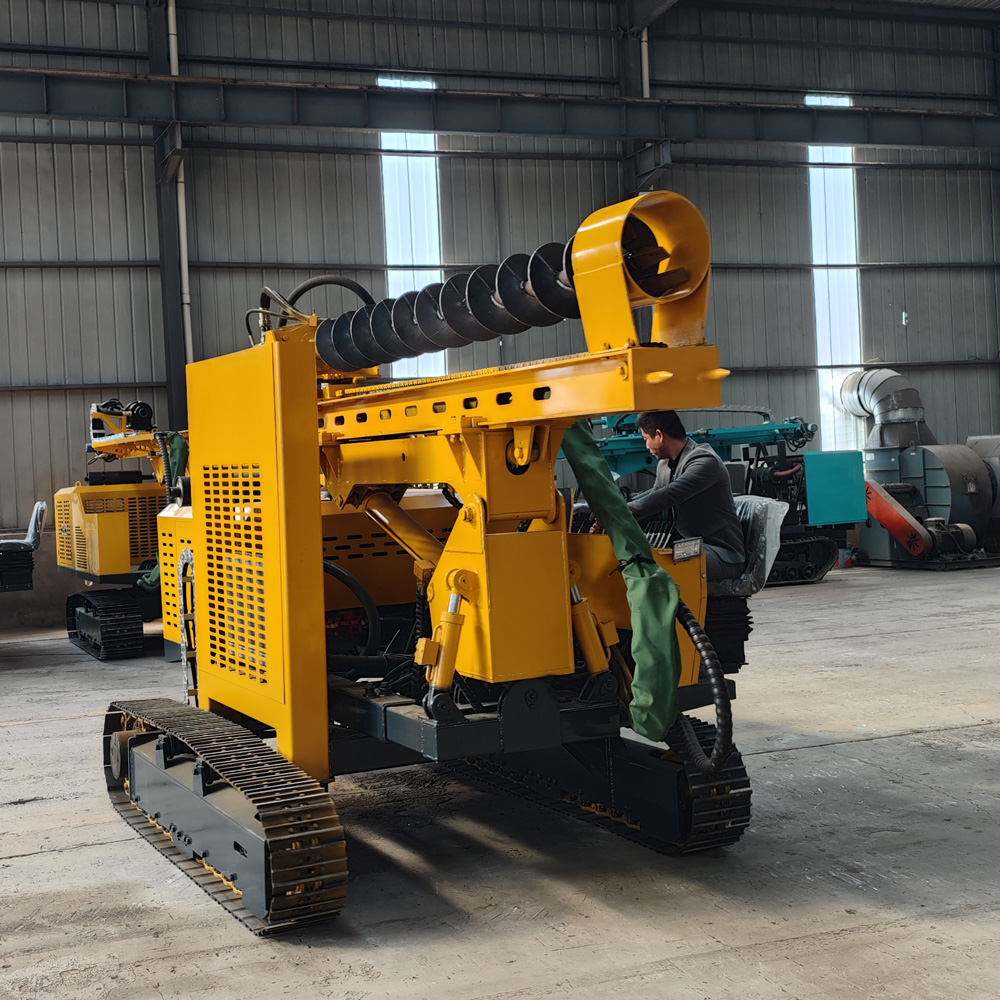
The PV390H has a drilling diameter of 80–600 mm, drilling depth of 0–6 m, chain pressurization, reducer torque of 13000 N·m, and drill rod speed of 100 r/min. Posture adjustment solves the equipment's standing position and angle issues; hole forming itself is still affected by the formation. The formation conditions listed in the materials include:
- Soil and loess formations are generally more suitable for PV foundation drilling, but moisture content and density affect hole wall stability. On slopes, loess after rain may experience reduced adhesion and equipment sliding risk.
- High-plasticity clay easily causes bit balling and poor cuttings removal. Rotation and feed should be adjusted according to drill bit load, and the drilling tools should be pulled out and cleaned in a timely manner.
- Cobble sand, gravel, and mixed overburden have obvious particle size variations, easily causing drill bit jumping, hole deviation, and local sticking.
- Backfill waste layers may contain bricks, concrete blocks, rebar, wood, and voids. If abnormal impact, rotation sticking, or sudden pressure loss occurs during drilling, stop and inspect promptly.
- After replacing with impact drilling tools, it can be used for strongly weathered rock and rock formations; the materials do not give the impact hammer model and impact energy, so no judgment is made on specific hard rock efficiency.
When these formation conditions are superimposed with slope conditions, the question is whether to solve the standing position problem first or the hole forming problem first. The two cannot cancel each other out.
The place of power and structural parameters in posture adjustment
The equipment is equipped with a 130 kW Yuchai six-cylinder turbocharged engine. The materials state that its role is to provide power for track travel, drill rod rotation, chain pressurization, mast swing, and high-low leg adjustment. In other words, posture adjustment itself also consumes power; it is part of the equipment's power chain, not a purely mechanical passive action. The main pump is a triple pump 50/50/40, the travel motor is TM09, the track shoe width is 300 mm, and the crawler chassis is more suitable for short-distance transfers within the site.
| Parameter Item | Parameter Value |
|---|---|
| Product Model | PV390H |
| Equipment Type | High-low leg hydraulic crawler PV pile driver |
| Overall Dimensions | 5200 × 2300 × 2800 mm |
| Track Shoe Width | 300 mm |
| Engine | Yuchai six-cylinder turbocharged engine, 130 kW |
| Main Pump | Triple pump 50 / 50 / 40 |
| Travel Motor | TM09 |
| Drilling Diameter | 80–600 mm |
| Drilling Depth | 0–6 m |
| Reducer | Internal five-star reducer, torque 13000 N·m |
| Drill Rod Speed | 100 r/min |
| Drilling Pressurization | Chain pressurization |
| Mast Pitch | 120° |
| Mast Swing | Dual-cylinder left-right swing arms |
| Track Height Extension | 1200 mm |
| Telescopic Compensation | 450 mm |
Back to the question itself
Adjustable track height on high-low legs solves the problems of equipment working posture and pile position alignment on slopes. The corresponding parameters are 1200 mm track height extension, 120° mast pitch, dual-cylinder left-right swing arms, and 450 mm telescopic compensation. What it cannot replace is also clear: construction platform, foundation bearing capacity assessment, stability judgment under cross-slope and soft soil conditions, and handling of height differences exceeding the adjustment range. Whether it 'can be used on all sites' depends on the project's measured slope, pile layout, formation, and on-site road conditions. These need to be verified item by item. This site's materials do not provide slope thresholds or stability criteria, so it is not appropriate to directly infer from the parameters.