












The organization of hard rock engineering hole construction differs from that of deep water wells or deep exploration holes. It often occurs on highway and railway slopes, foundation pit support, equipment foundations, guardrail posts, short pile pre-drilling and quarry benches. Hole depths are generally limited, but hole positions are scattered, hole directions vary, the ground is hard, and the equipment must be able to get in, stand firm and maneuver. If you start by screening equipment on whether the drilling depth is large enough, it is easy to focus on specifications that are not actually tight while missing the conditions that determine whether the job can be done at all.
The key specifications for these holes are not at the hole bottom
Slope anchor bolt holes, anchor cable holes, drainage holes and foundation pre-drilled holes are mostly mid-to-shallow holes. Hole depth is usually determined by the designed anchorage length or foundation embedment depth, and can be covered within tens of meters. What truly affects construction is whether the equipment can be positioned at the designed hole direction, whether rotation and feed are matched in hard rock, and whether slag removal and repositioning are continuous. Nominal drilling depth is only one of the capability limits, not the starting point for judging whether a particular machine can take on a project.
Looking at equipment from four operational constraints
Hole direction and positioning attitude
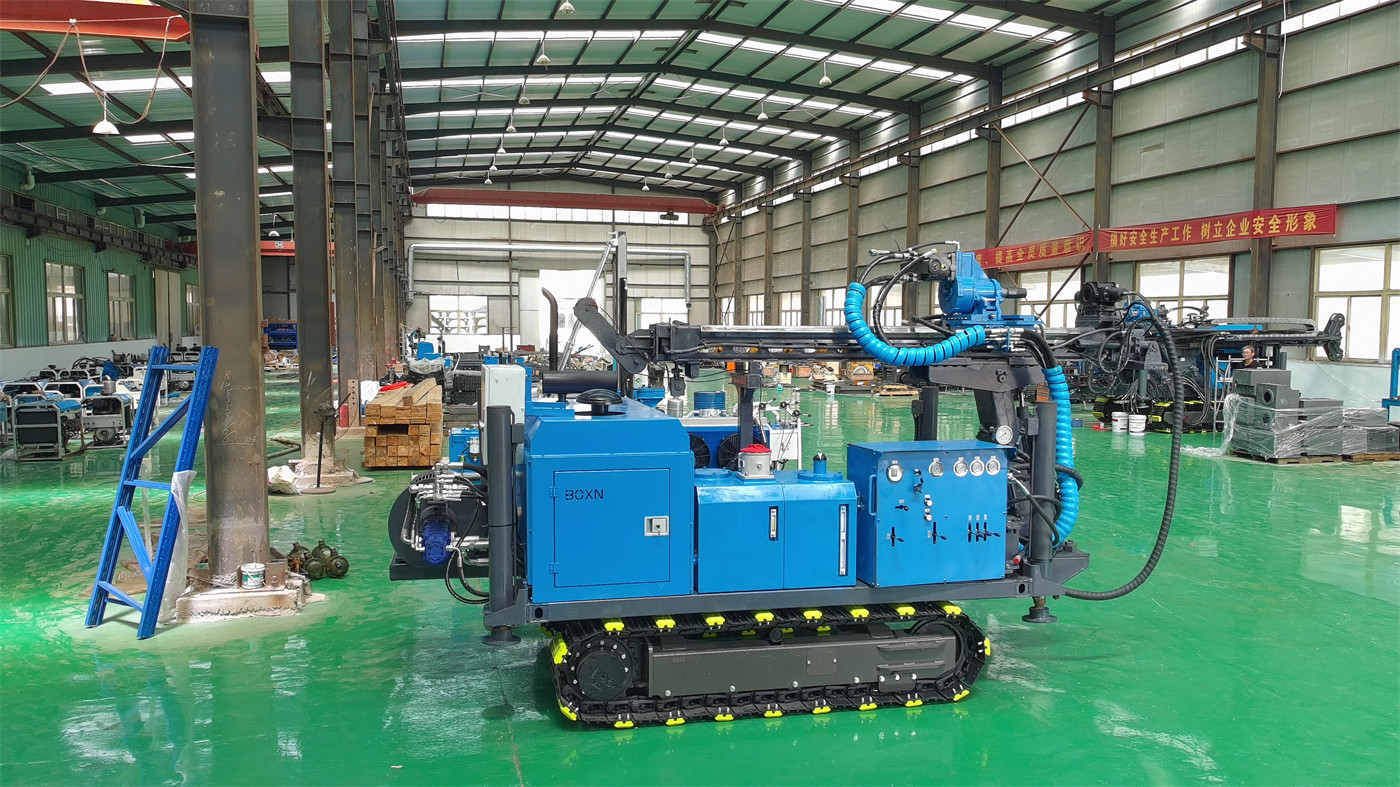
The hole direction of slope anchoring holes varies with the slope design; there are vertical holes as well as inclined holes and some lateral holes. The crawler hydraulic DTH drill rig in the materials has an inclination adjustment function and an 18–180° swing angle, allowing the drilling attitude to be adjusted on a slope or platform. The original materials do not give an explicit numerical range for inclination, so actual projects cannot infer that any angle can be constructed on this basis; the correspondence between the designed hole direction and the final equipment configuration should be confirmed in formal technical documents.
Rock hardness and drilling method
The materials state an applicable rock hardness of approximately f = 8–24, covering medium-to-high hardness rocks such as limestone, granite, sandstone and basalt. This range indicates that the equipment uses DTH percussion-rotation to handle hard rock engineering holes, rather than being used for rapid hole forming in soil layers or deep water well drilling. When encountering weathered rock, soil-rock mixed layers or loose upper overburden, hole wall stability and slag discharge conditions will change, and arrangements such as casing, starting drilling tools or reduced feed speed need to be considered separately.
Rotary torque and hole diameter range
The equipment's maximum rotary torque is 3500 N·m, and the drilling diameter range is 76–280 mm. The larger the hole diameter and the more intact the rock, the higher the rotational resistance usually is, but this does not mean a single torque value can determine the hole-forming result. In DTH drilling, rotation, feed and percussion need to match one another; if slag return decreases, the bit jumps or rotational resistance keeps increasing, the problem should be investigated in the drilling tools, air supply and parameter coordination rather than simply increasing one item.
Air supply and dust removal matching
The DTH hammer is driven by compressed air, and air supply capacity directly affects percussion efficiency and cuttings discharge. The reference air consumption in the materials is about 8 m³/min, but the same position in the original table is marked as 8 m²/min; this article interprets it as m³/min according to the flow unit commonly used in engineering, and the final value should still be confirmed in formal technical materials. Whether the air compressor's actual displacement and pressure match on-site pipeline losses is a matching condition to be settled before purchase. Dust is noticeable in dry hard rock, and a dust collector or water mist suppression device can be configured according to the project.
Machine dimensions and site conditions
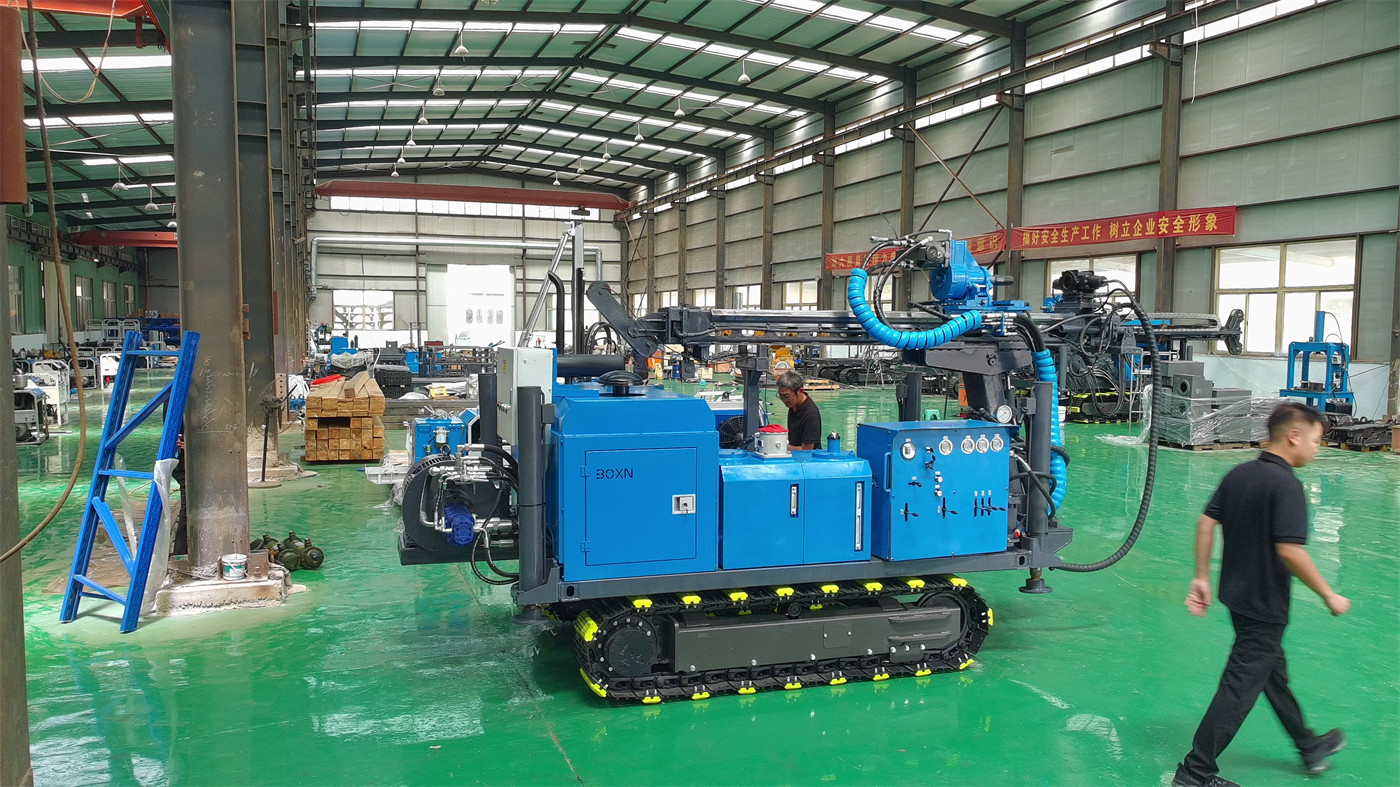
The machine's dimensions are approximately 3200 × 1200 × 1850 mm, with an overall weight of about 2500 kg. It uses an engineering rubber track chassis with a travel speed of 5–10 km/h. The body width of about 1.2 m makes it easier to enter some plant areas, fenced construction sites and narrow construction passages; rubber tracks offer traction advantages on compacted soil, gravel roads and construction access roads, and are relatively friendly to paved surfaces. However, before entering the construction point, turning space, ground bearing capacity and underground pipeline locations still need to be confirmed; dimensions alone cannot determine whether access is possible.
The chassis uses rubber tracks, which provide traction on gravel, compacted soil and mildly uneven ground, but the materials do not describe passability in mud, sharp gravel or steep slopes, which are conditions requiring on-site verification.
Supporting drilling tools and operational boundaries
DTH hammers, bits, drill pipes, casing tools, air compressors, high-pressure air hoses and oil mist lubricators form the basic setup for DTH drilling. Bit and DTH hammer specifications should be selected according to hole diameter and rock abrasiveness, and DTH hammer lubrication should also be ensured in hard rock. The materials also mention that the machine can be equipped with corresponding attachments for short piles or specific foundation pre-drilling, but the specific interfaces and matching conditions between attachments and the host machine are not listed in the available materials and should be confirmed item by item before purchase.
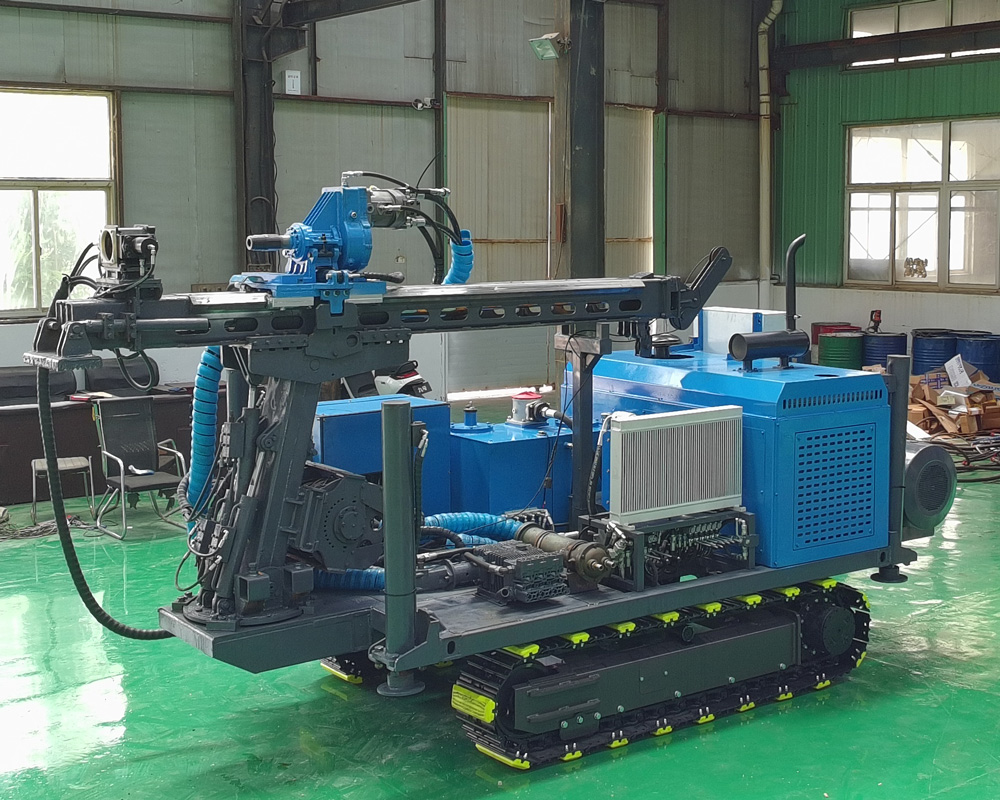
It is necessary to distinguish: this equipment has a maximum drilling depth of 30 m and is suitable for mid-to-shallow hole applications such as engineering rock drilling, slope anchoring, foundation pre-drilling and quarry short holes; it should not be used as deep water well equipment. Water supply well construction above 200 m or 300 m falls within the scope of dedicated water well drilling rigs and is not the same application as this 30-meter-class engineering DTH drill rig.
Items recommended for verification before purchase
- Whether the designed hole depth, hole diameter and hole direction range correspond to the equipment's nominal capability and actual configuration;
- Rock hardness, integrity and abrasiveness, and whether loose overburden or fractured zones are interbedded;
- Whether the air compressor's displacement, pressure and pipeline configuration can meet the air requirements of the selected DTH hammer;
- Access road width, turning radius, ground bearing capacity and working platform stability;
- Whether the dust removal or water mist suppression configuration meets local construction environmental requirements;
- The gaps in the original materials regarding the specific inclination range and the unit marking for air consumption must be subject to formal technical confirmation documents.
When requesting a quotation, providing the drilling purpose, formation data, target hole depth and diameter, designed hole direction, access and transport conditions, air and water supply conditions, and whether short pile pre-drilling attachments are needed can help suppliers judge whether the configuration matches and reduce repeated confirmation caused by incomplete information later.