












"Are hole diameter and depth enough?" is a very common question in PV foundation pre-drilling equipment selection. Being able to drill the hole is indeed the minimum threshold; but the operating characteristics of a PV site are not drilling one hole and finishing—pile positions are arranged in rows with regular spacing and continuous advancement, while also facing undulating slopes, gravel backfill, and repeated repositioning of the whole machine. Looking only at hole diameter and depth can easily put a machine that is "sufficient" on single-hole metrics into a construction rhythm it struggles to keep up with.
First answer: sufficient is a necessary condition, not a sufficient one
Hole diameter and depth determine "whether this hole can be formed"; they do not answer "whether an entire row of pile positions can be advanced continuously," "whether the drill rod can be aligned on a slope," or "whether rotation can be stabilized when gravel is present." For PV foundation pre-drilling, selection must simultaneously consider at least four categories of conditions: pile type and designed hole shape, site and slope conditions, stratum composition, and how the equipment moves and adjusts posture between pile positions. Hole diameter and depth are one item among these, and must hold together with the other three.
What hole diameter and drilling depth cover
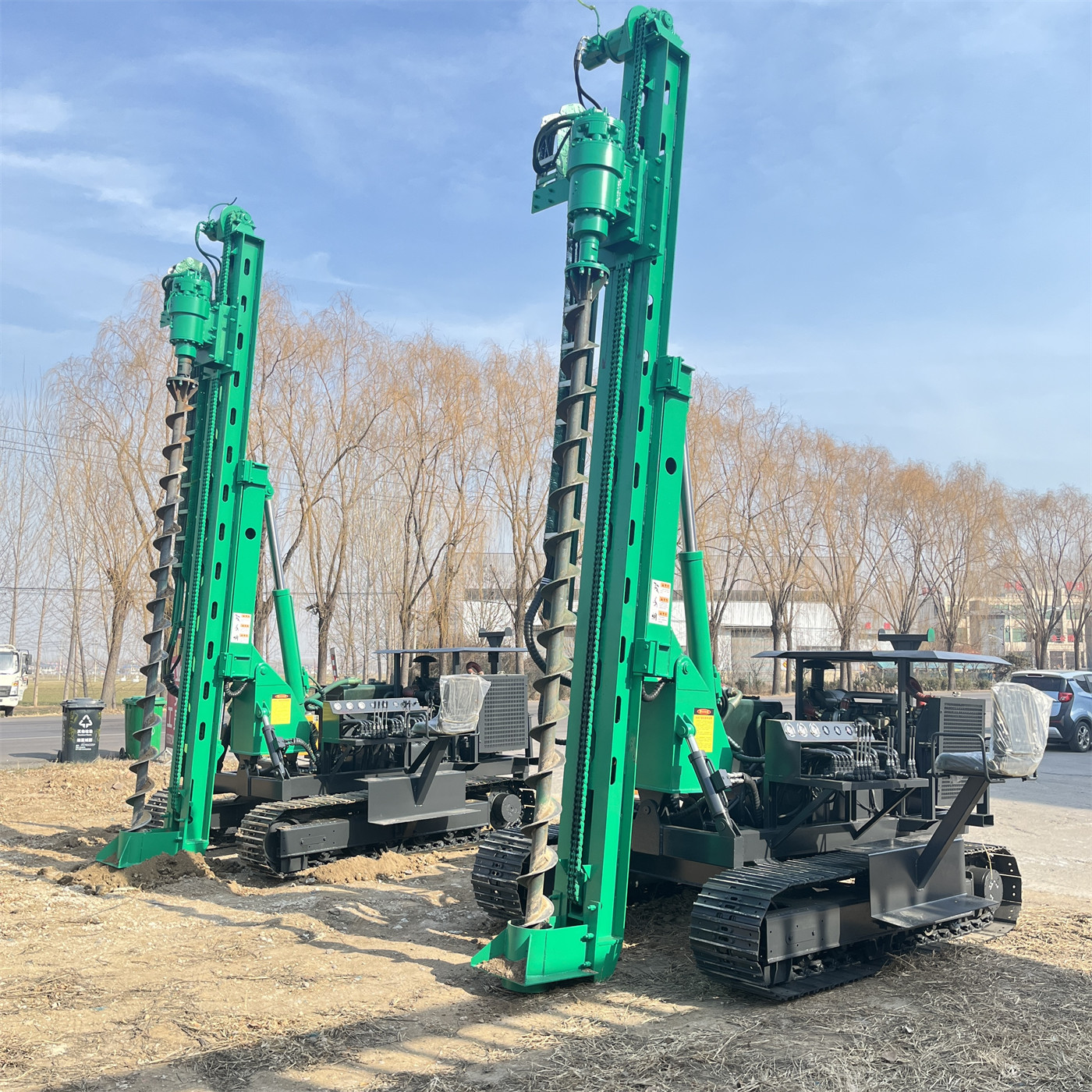
Taking the crawler-type PV pile driver referenced in this article as an example, its drilling diameter is 80–600 mm, drilling depth is 0–6 m, the matched reducer torque is 13,000 N·m, drill rod speed is 90 r/min, and it uses chain pressurization. This set of data positions it for PV mounting foundation pre-drilling, hole forming, and shallow foundation construction with corresponding attachments—not deep water wells or deep-hole exploration equipment.
The 80–600 mm hole diameter range means it can cover different pile types and pilot hole requirements, but the final hole diameter must still be based on project design drawings and foundation forms; the 0–6 m drilling depth corresponds to common PV shallow foundations and should not be understood as being able to reliably drill to 6 m in any stratum. The data also clearly states that actual penetration depends on drill bit type, stratum structure, and advancement control.
When pile positions are dense, alignment method affects rhythm more than single-hole parameters
Pile positions at large PV sites are arranged in arrays, and after the machine stops, lateral, longitudinal, and angular fine adjustments are often still needed. The equipment in the data is equipped with dual-cylinder left-right swing arms, 50 cm front-back telescopic compensation, and 120° mast pitch. Taken together, these three change "how many times the whole machine must be moved per pile position": the swing arms handle lateral positioning, telescopic compensation handles front-back fine adjustment, and mast pitch handles slope and angle requirements.
This does not mean the machine need not be moved at any pile position, nor does it mean alignment time can be ignored. It shows that in sites with dense pile positions and uneven ground, posture adjustment capability can reduce the number of full-machine repositioning moves, making the rhythm of continuous pile placement smoother. Whether this is worth the corresponding whole-machine cost depends on pile position density and the proportion of sloped ground, not on hole diameter alone.
Site and slope conditions determine whether chassis and posture match
The data specifies that the equipment has a crawler chassis, track shoe width of 400 mm, and climbing angle of 35°. The crawler structure suits frequent short-distance transfers within PV construction sites and unpaved ground; 400 mm track shoes help distribute ground pressure. It should be emphasized that 35° is the climbing angle stated in the data; actual slope work must still comprehensively consider cross-slope, ground wetness and slipperiness, soil quality, and whole-machine center of gravity—the maximum climbing angle cannot be directly treated as a basis for safe travel.
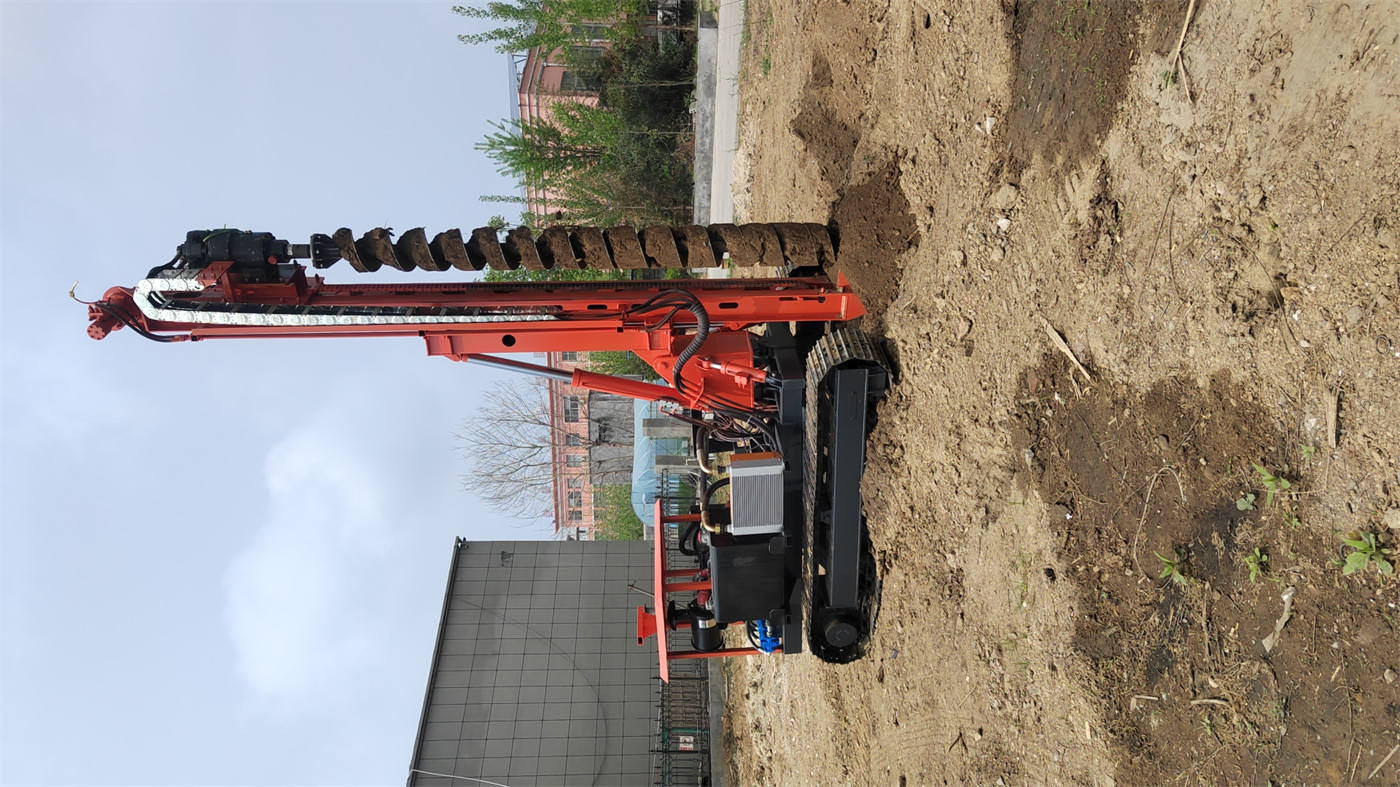
Mountain PV projects often have both cross-slope and longitudinal slope, with large height differences between the left and right sides of pile positions. In this case the roles of mast pitch and swing arms are more obvious, but the machine standing stably is still the prerequisite. During selection, the site's maximum slope, slope surface soil quality, and traffic conditions after rain should all be provided to the supplier for verification.
Different strata mean different construction methods for the same machine
The data describes strata fairly specifically: soil layers suit conventional PV foundation pre-drilling; loess requires adjusting drilling parameters according to density and moisture content; clay requires attention to bit mud clogging and spoil discharge; cobble sand requires selecting drilling tools according to particle size and density; backfill waste layers require focusing on preventing foreign objects, voids, and local jamming. For strongly weathered rock and rock layers, the data clearly states that after replacing with impact drilling tools it can be used for construction in the corresponding strata, but does not give impact hammer models or impact energy, so specific hard-rock efficiency should not be inferred from this.
This suggests a selection order: first confirm the site's stratum composition and proportions, then judge whether conventional rotary drilling tools are sufficient and whether impact drilling tools need to be prepared. If the project is mainly strongly weathered rock, rock hardness, integrity, and target hole diameter should be listed as items to confirm before purchase, rather than drawing conclusions based only on hole diameter and depth.
Conditions recommended to check item by item before purchase
- Pile type and foundation design: target hole diameter, hole depth, whether pilot holes or reaming are needed.
- Stratum data: distribution and proportion of soil, loess, clay, cobble, backfill, and strongly weathered rock.
- Site conditions: maximum longitudinal and cross slopes, surface soil quality, rainy-season traffic conditions, underground pipelines and obstacles.
- Construction organization: pile position density, planned number of pile positions per day, transfer distances within the site.
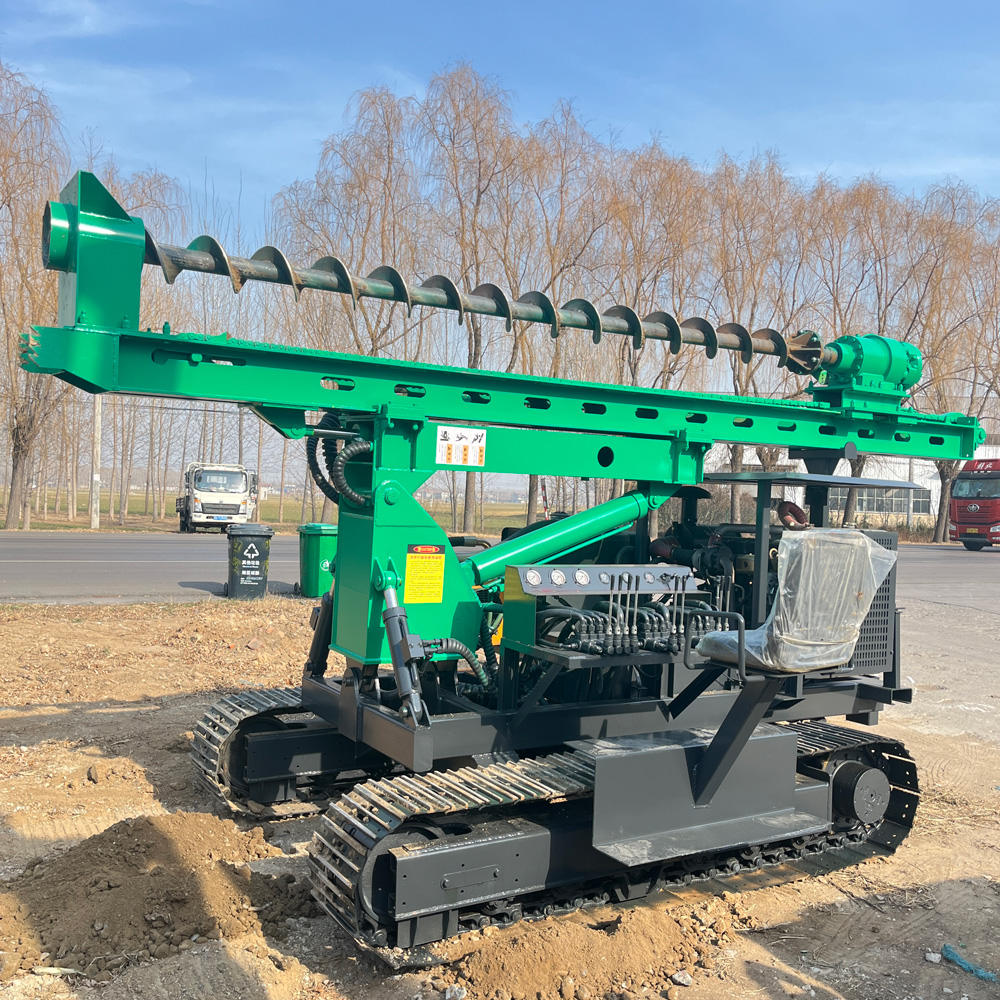
- Transport and site entry: transport and entry passage conditions corresponding to overall dimensions of 5200 × 2300 × 2650 mm.
- Power and supporting systems: 85 kW diesel power for independent field construction requires confirming fuel supply, cooling, and air filter maintenance conditions; when replacing with impact drilling tools, tool matching must also be confirmed.
Information to provide when requesting a quote
Rather than only asking "are hole diameter and depth sufficient," it is better to provide project information all at once: drilling purpose (PV mounting foundation, fence posts, or other shallow foundations), designed hole diameter and depth, stratum composition, site slope and pile position density, site entry and transport conditions, fuel and on-site support conditions, and whether impact drilling tools are needed. Only then can the supplier judge whether the equipment's hole diameter, drilling depth, torque, and posture adjustment capability match the project, and which conditions still need on-site verification.
Sufficient hole diameter and depth are the first step onto the candidate list; whether pre-drilling can be completed continuously and stably across the entire site also depends on whether alignment posture, chassis trafficability, and drilling tool matching correspond to real construction conditions.