












When selecting equipment for medium-deep hole coring projects in mountainous areas, two questions often arise together: whether the drill site can be reached, and how deep the hole must go. These two criteria are not always equally urgent. If the project is still at the shallow anomaly verification stage, with scattered hole locations and limited single-hole depth, accessibility often becomes the first bottleneck. If mineralization outcrops have been confirmed and deep extensions must be traced along dip, hole depth and continuity of in-hole operations become the primary constraint. Different selection sequences lead to different equipment priorities.
The following decision path is used: first clarify the operating stage, then determine whether accessibility is a hard constraint, then use public data on a portable split hydraulic core drill to explain which needs each capability addresses, and finally describe supporting conditions and items still to be verified with the supplier.
Step 1: Determine the project's coring stage
Core drilling serves different purposes, and equipment requirements vary widely. At the reconnaissance and anomaly verification stage, hole locations are often scattered along exploration lines, single-hole depths are limited, and hole-to-hole moves are frequent. At the orebody verification and deep tracing stage, the number of holes may decrease, but single-hole depth increases, raising requirements for lifting force, wireline winch rope capacity and mud circulation stability.
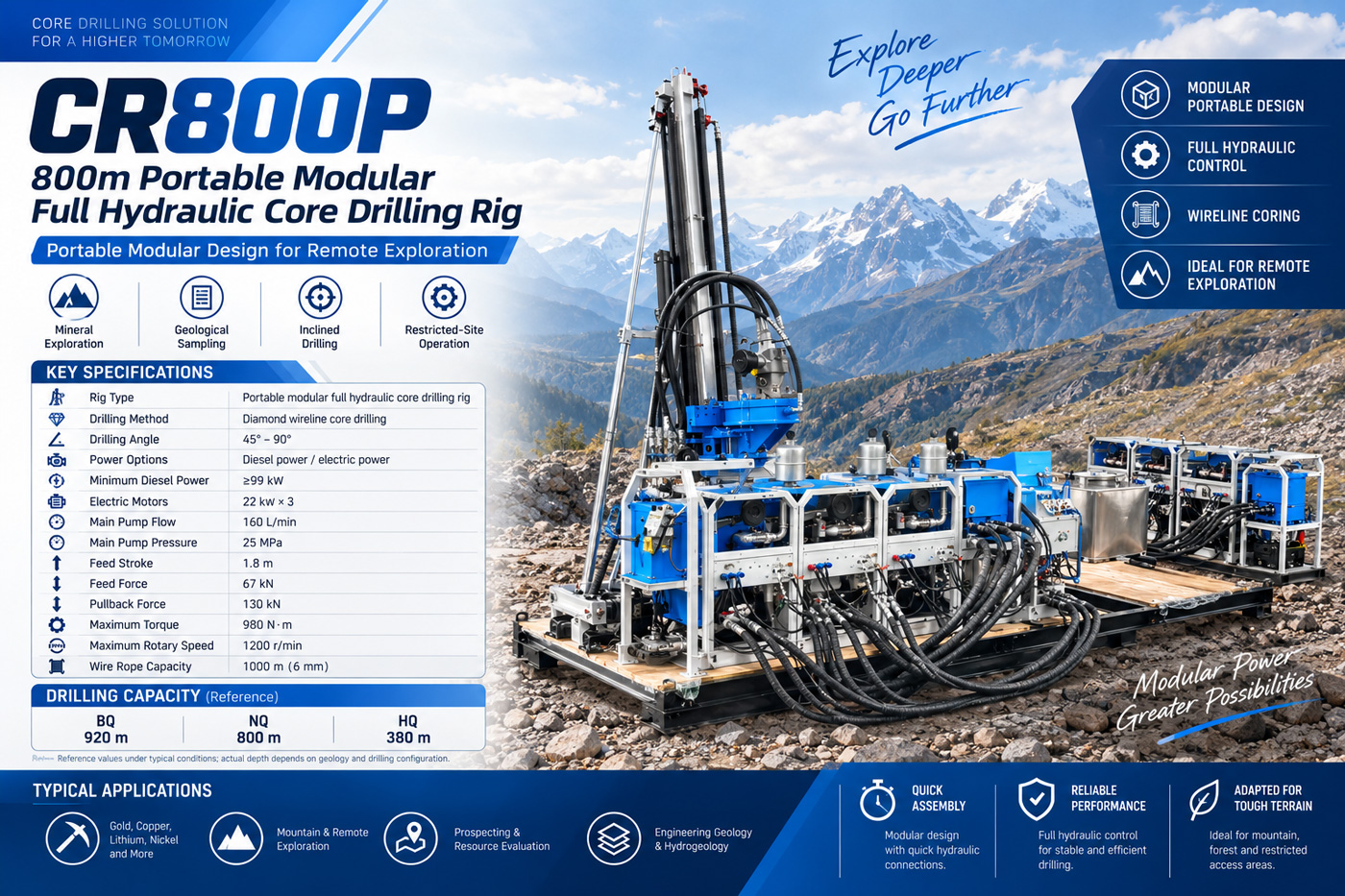
The drilling depth specifications in the related product data are: BQ reference depth 920 m, NQ reference depth 800 m, HQ reference depth 380 m. These values reflect reference capability at different coring diameters and cannot be treated directly as actual achievable depth in any formation. If the project goal is to trace several-hundred-meter holes with NQ diameter, this equipment's capability level roughly matches the need. If the target depth clearly exceeds the reference value for that diameter, a larger equipment class should be checked rather than converting parameters.
Step 2: Determine whether hole accessibility is the primary constraint
Mountain exploration lines typically cross ridges, gullies and forest areas, and access between holes may be only a dirt track or footpath. In such cases, an integrated rig may require road construction and heavy transport for every hole move, shifting organizational cost to relocation rather than drilling.
This is where the split structure matters: the power unit, control unit, hydraulic oil unit and mud unit can be transported separately. The reference module weights given are power unit 180–260 kg, control unit 140 kg, hydraulic oil unit (including oil) 160 kg, mud unit 95 kg, and overall unit weight 1380 kg. These values show that transport can be organized in multiple units, but "can be split" does not mean "accessible on any mountain." Manual carry routes, slope, wet-season passability and platform area still need to be verified hole by hole.
The decision can branch as follows
- If hole locations are scattered, single holes are shallow and moves are frequent, prioritize disassembly and transport organization, then check whether drilling depth is sufficient.
- If hole locations are concentrated, single holes are deep and tracing is the main purpose, prioritize drilling depth class, lifting force and wireline winch capacity, then check site access.
- If both constraints exist, assess whether the labor and time input of split transport can be accepted within the project schedule. There is no universal answer; it must be calculated based on actual hole count and road conditions.
Step 3: Match equipment features to specific needs
Several capabilities in this equipment's data are directly relevant to medium-deep hole coring in mountainous areas.
| Data item | Value or range | Corresponding operational need |
|---|---|---|
| Drilling angle | 45°–90° | Adjust hole angle where the orebody dips, improving ore intersection effectiveness from a limited platform |
| Lifting force | 130 kN | As hole depth increases, drill rod weight and wall friction rise, requiring margin for pulling out |
| Thrust force | 67 kN | Feed control within the feed stroke |
| Power head torque and speed | Max torque 980 N·m, max speed 1200 rpm | Adjust speed and bit pressure for different rock types |
| Wireline winch rope capacity | 1000 m (6 mm wire rope) | Rope margin for inner-tube lifting at NQ reference depth 800 m |
| Mud flow and pressure | 100 L/min, 7 MPa | Maintain circulation in fractured zones, unstable returns or greater hole depth |
| Feed stroke | 1.8 m | Works with 1 m or 1.5 m drill rods, affecting rod-connection rhythm |
Note that the values in the table are equipment capability items, not construction outcome commitments. Actual core recovery, hole-wall stability and run length are affected by formation, bit selection, flushing fluid performance and operating method. The statements in the data about "focusing on hole stabilization in heavily weathered layers, matching bits in intact hard rock, shortening runs in fault fracture zones, and controlling circulation in water-bearing or loss zones" describe drilling adjustment directions and should not be read as a fixed parameter table.
What site problems does multi-angle drilling address
Ore veins controlled by faults and shear zones often have significant dip. On limited mountain platforms, if only vertical holes can be drilled, the intersected ore thickness may be underestimated. Support for 45°–90° drilling means the hole angle can be adjusted on the same platform to identify mineralization zones, structural surfaces and alteration types. This is practically relevant for tracing gold veins and pegmatite-type lithium orebodies, but after adjusting hole angle, in-hole friction and drill-string loading change and must be considered separately in construction planning.
Power form and supply conditions in remote mining areas
The data show that the equipment can use diesel power with a diesel engine power requirement of ≥99 kW, or a 22 kW × 3 electric motor configuration. For mountain projects this is not a simple either-or choice: the diesel option requires assessment of fuel transport and maintenance resources, while the electric option requires assessment of power supply stability and cable layout. If a fixed mine platform has stable power, the electric configuration can reduce engine maintenance and fuel storage/transport. When hole locations are scattered and moves are frequent, diesel power's self-sufficiency reduces organizational cost. Both are optional configurations, and the final choice depends on site energy conditions.
Items still to confirm before purchase
- Which coring diameter the target hole depth corresponds to, whether NQ is primary, and what proportion is HQ.
- Actual access conditions between holes: track width, slope, wet-season passability, and maximum carry distance for a single module.
- Formation data: distribution of intact hard rock, heavily weathered layers, fracture zones and aquifers, and whether loss may occur.
- Water supply conditions: source of mud water, water storage and discharge arrangements.
- Power option: fuel supply radius or on-site power capacity.
- Drill rod and tool interface: maximum applicable drill rod diameter 114 mm, chuck through-hole 54–127 mm, to be checked against the intended tools.
- Post-disassembly inspection items: hydraulic quick couplings, chuck clamping pressure, winch wire rope condition and hydraulic oil temperature; formal operation and maintenance documentation should be provided by the supplier.
Returning to the original question: accessibility and hole depth are not mutually exclusive. A more practical order is to first confirm the project stage and coring diameter, then assess whether the degree of hole dispersion will make relocation cost dominant. For mountain projects with scattered holes that still require medium-deep tracing, a portable split hydraulic core drill is a type worth including in comparison; but actual suitability depends on whether hole access conditions, target depth and diameter, power supply and tooling can all be satisfied at the same time. When requesting a quotation, it is advisable to provide drilling purpose, formation profile, target depth and diameter, number and spacing of holes, access road conditions, and water, power and air supply conditions so the supplier can give targeted configuration information.