












Slope anchor holes, anchor cable holes, drainage holes, and foundation pre-drilling typically have depths within tens of meters, but hole positions are scattered, hole directions vary, and rock formations are relatively hard. When evaluating equipment for such engineering holes, the first question is often not "how deep can it drill," but whether the machine can stand stably on the slope, position at the designed angle, drill through hard rock, and move between sites easily. The 30m-class crawler hydraulic DTH drilling rig is designed with this approach in mind; whether it is suitable must be checked item by item.
First answer the core question: what this equipment is suitable and unsuitable for
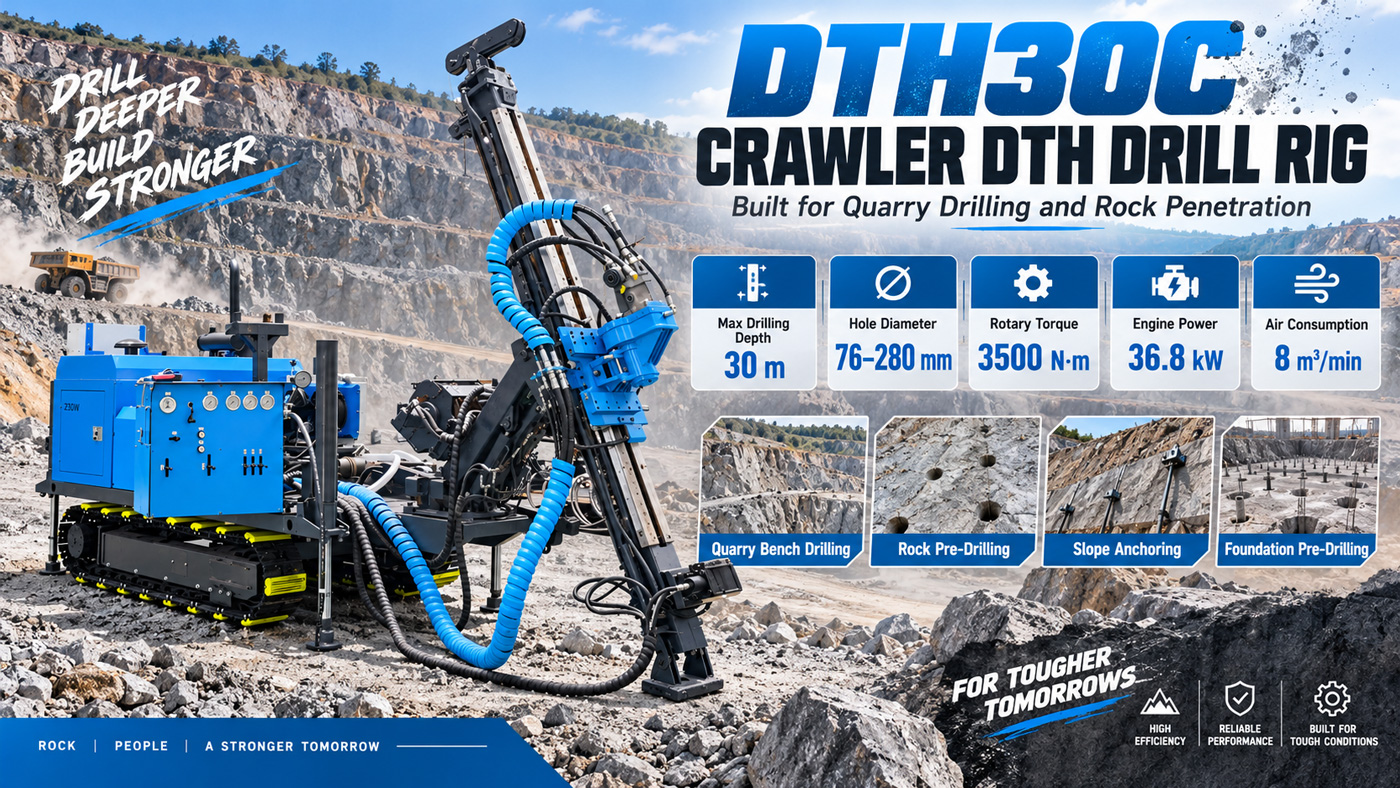
According to the product information on this site, the DTH30C has a maximum drilling depth of 30 m, a hole diameter of 76–280 mm, a maximum rotary torque of 3500 N·m, and is suitable for rock hardness of approximately f = 8–24. It is positioned for shallow to medium hole construction in medium to high hardness rock formations such as slope anchoring, foundation pre-drilling, quarries, and road projects. Its orientation is engineering holes, not deep wells: deep water wells of 200 m, 300 m or more should use dedicated water well drilling rigs, and a 30m-class engineering DTH drilling rig cannot be used as deep water well equipment. This is the first boundary for judging "suitability."
Hole depth and diameter: coverage must correspond to designed holes
Slope anchor holes, anchor cable holes, and drainage holes are generally far less than 30 m, and foundation pre-drilling, guardrail pile, and short pile holes are also at this magnitude. The hole diameter range of 76–280 mm covers common engineering DTH bit specifications. It should be noted that the maximum nominal drilling depth does not equal actual capability under any formation: as the hole deepens, the rock formation becomes more fractured, and the hole diameter increases, the resistance of the drill string and the difficulty of hole cleaning will increase, and the actual achievable depth must be based on on-site formation and supporting equipment.
Attitude adjustment: key capability when slope hole directions vary
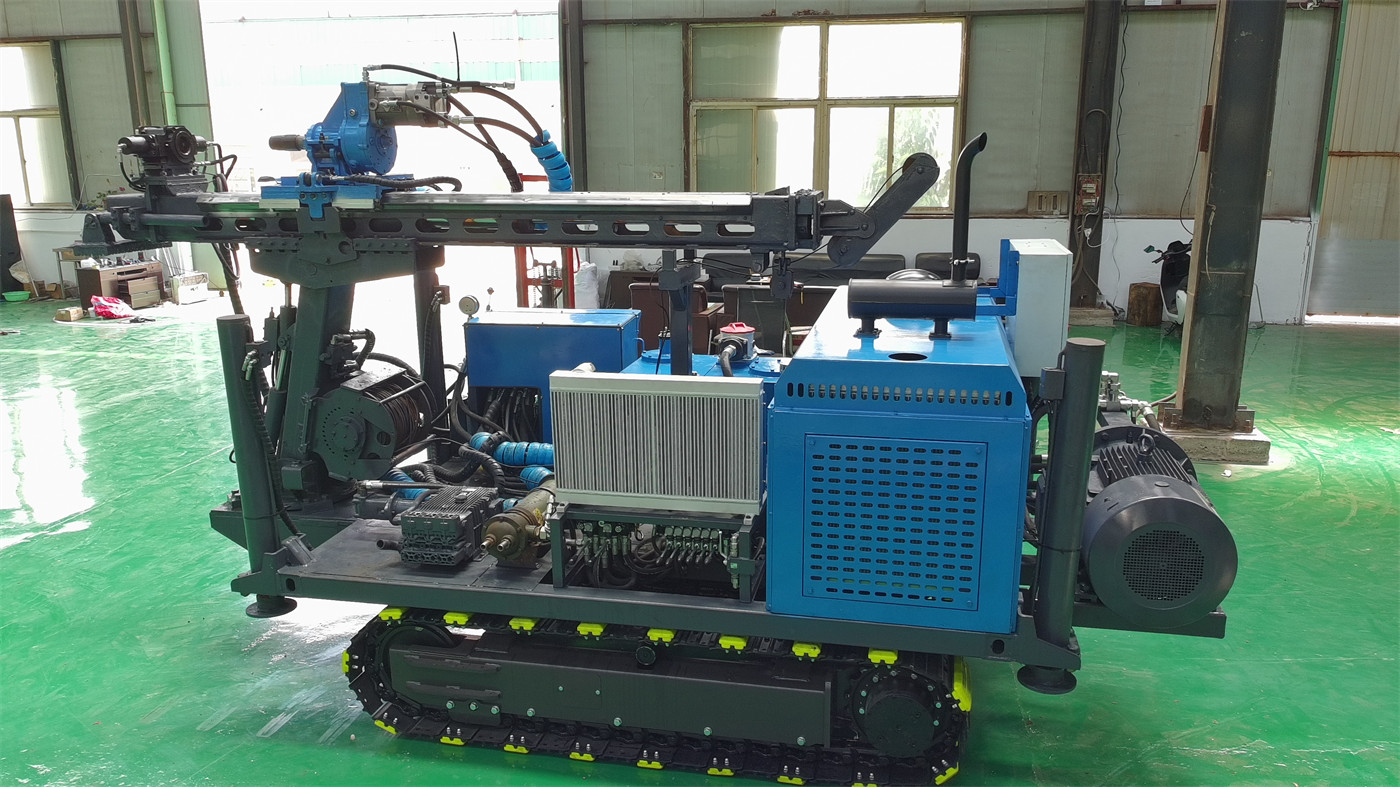
The equipment has a swing angle range of 18–180° and an inclination adjustment function, which can be used for vertical holes, inclined holes, and some lateral holes. For slope anchoring, this item is closer to actual needs than a simple drilling depth indicator—on the same slope, the design angles of anchor holes, anchor cable holes, and drainage holes are not consistent. However, the original data does not give the specific angle range of inclination adjustment; actual projects should be based on the final production configuration and technical confirmation documents, and specific angles cannot be inferred merely from "equipped with inclination adjustment function."
Mobility and site: what the crawler chassis provides and does not provide
The overall dimensions are approximately 3200 × 1200 × 1850 mm, width about 1.2 m, and overall weight about 2500 kg. It uses an engineering rubber crawler chassis with a travel speed of 5–10 km/h, suitable for compacted soil, gravel roads, construction access roads, and generally uneven sites. Rubber tracks have better traction on gravel, compacted soil, and not fully hardened roads, and are also friendlier to paved surfaces and concrete floors, suitable for factory areas, fenced construction sites, and narrow passages. However, this does not mean it can work directly on any slope: before slope construction, platform stability, rockfall risk, and support conditions must still be checked.
Air supply and drilling tools: the other half of DTH drilling efficiency
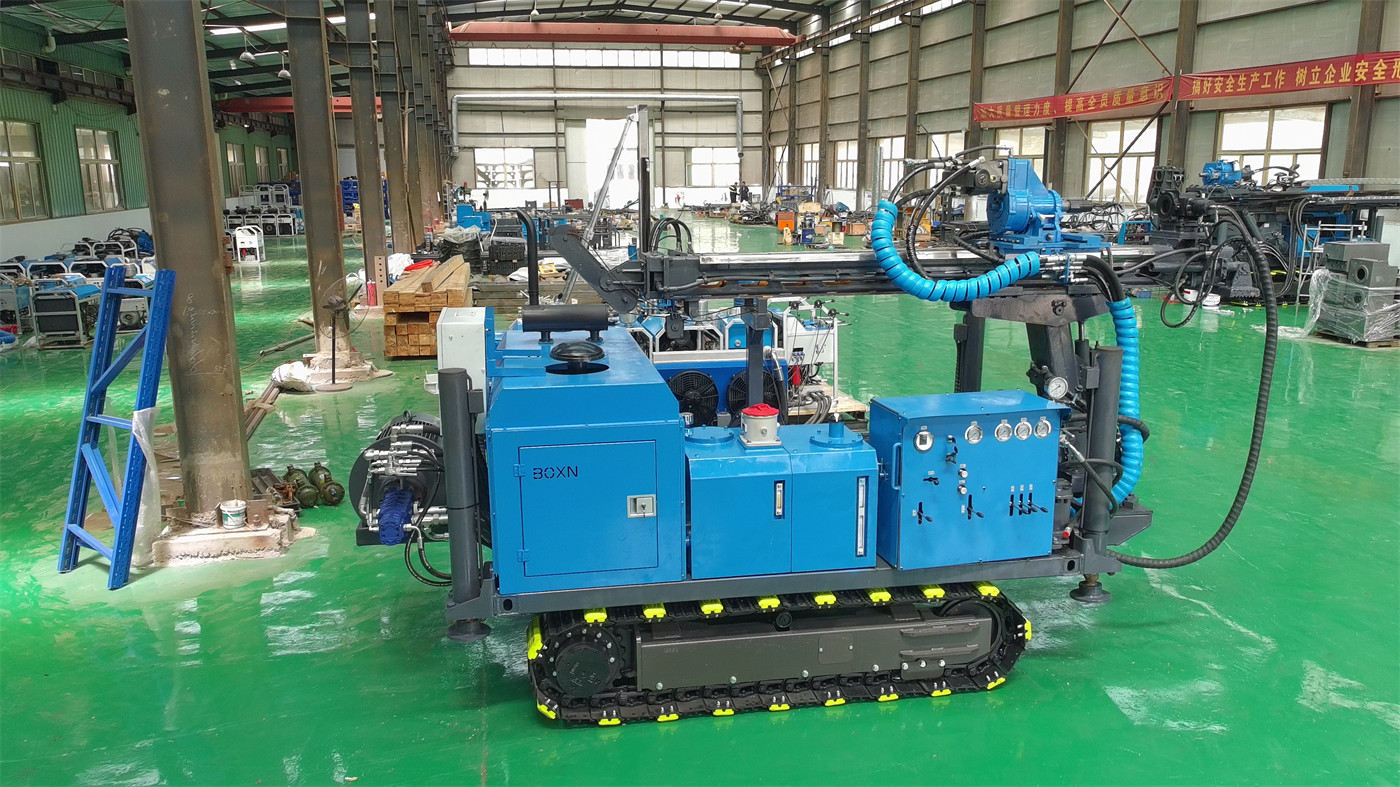
DTH drilling relies on compressed air to drive the DTH hammer and remove cuttings; the equipment itself is only the main machine. The reference air consumption in the data is about 8 m³/min, but the original table actually marks it as 8 m²/min. This article interprets it as m³/min according to the common compressed air flow unit, and the final value should be confirmed by official technical documents. The supporting equipment generally includes a DTH hammer, drill bit, drill pipe, casing tools, air compressor, high-pressure air hose, oil mist lubricator, and dust collector or water mist dust suppression device. Under hard rock conditions, air compressor capacity and DTH hammer lubrication greatly affect efficiency; larger hole diameters usually require higher air volume, and the specific matching should be confirmed in conjunction with the DTH hammer specifications.
Handling boundaries when formation changes
- Weathered rock, soil-rock mixed layers, and upper loose overburden are prone to unstable hole walls; penetration speed should be reduced, and casing or other upper hole stabilization methods should be used when necessary.
- Fractures and broken zones are prone to block falling, air leakage, and sticking; excessive penetration should be avoided and continuous hole cleaning maintained; if air pressure is abnormal or cuttings return suddenly stops, drilling should be stopped for inspection first.
- The 53 m/min in the data is the rapid movement speed of the propulsion mechanism, used for non-drilling actions such as power head return and drill pipe handling, and cannot be understood as the actual rock penetration rate.
Items to confirm before purchase
The following items are missing or questionable in the data and should be clarified item by item during inquiry:
- The specific angle range of inclination adjustment, and the actual positioning conditions of the 18–180° swing angle under various hole directions.
- The official unit and value of air consumption, and the recommended pressure and flow of the matching air compressor.
- The 36.8 kW diesel engine is optional; the correspondence between the final power configuration and the chassis form needs to be confirmed.
- Recommended specifications of the DTH hammer and drill bit for the target hole diameter, and whether casing tools are needed in broken formations.
- Transport vehicle load capacity, loading ramp bearing capacity and fixing points, turning space of the access passage, ground bearing capacity, and underground pipelines.
When inquiring, it is recommended to provide: drilling purpose (anchor, anchor cable, drainage, or foundation pre-drilling), rock type and hardness, target hole depth and diameter, hole direction requirements, access road and site conditions, and air compressor and water/electricity support. The data only explains the equipment's capability orientation and applicable boundaries; specific construction results are still affected by rock hardness, hole diameter, DTH hammer specifications, air compressor capacity, and operating methods, and should be based on on-site working conditions and technical confirmation documents.