












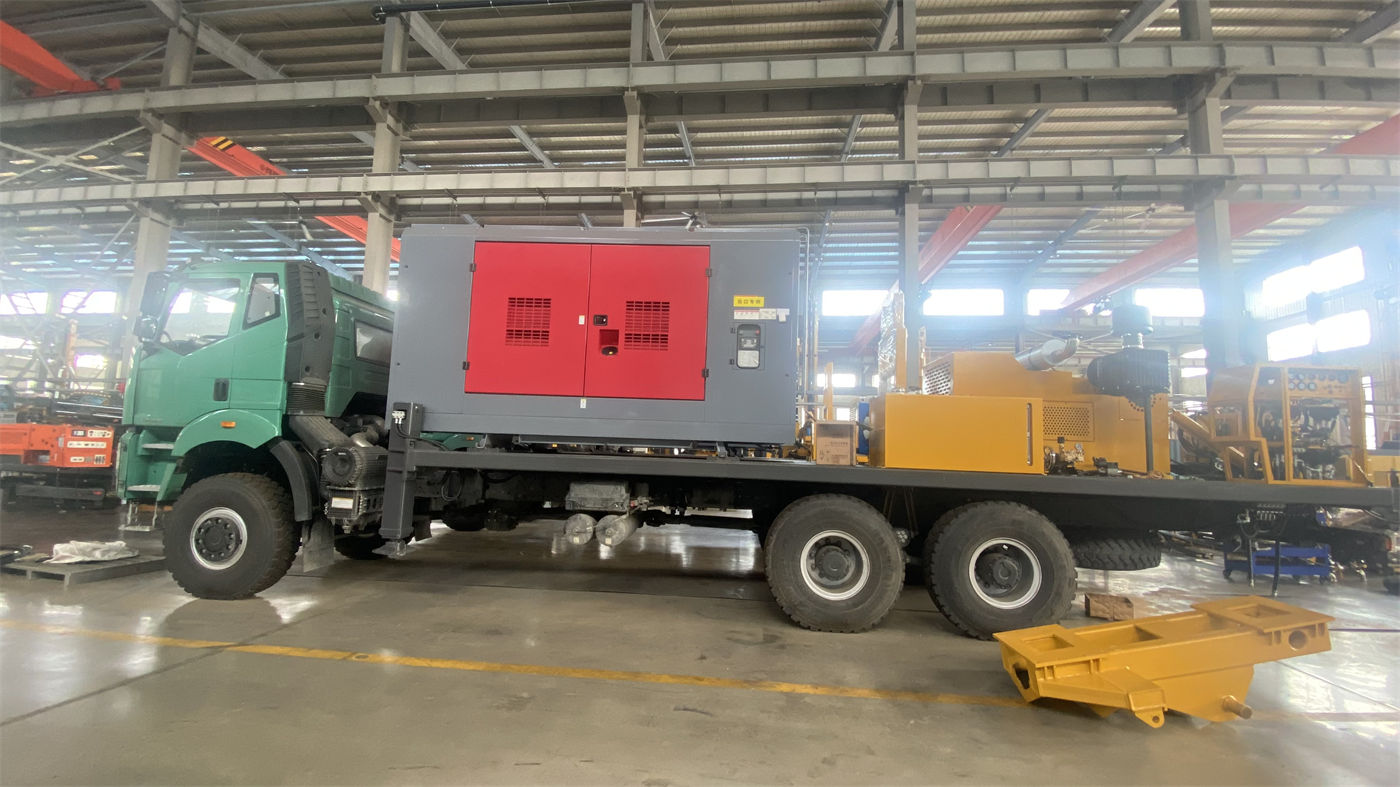
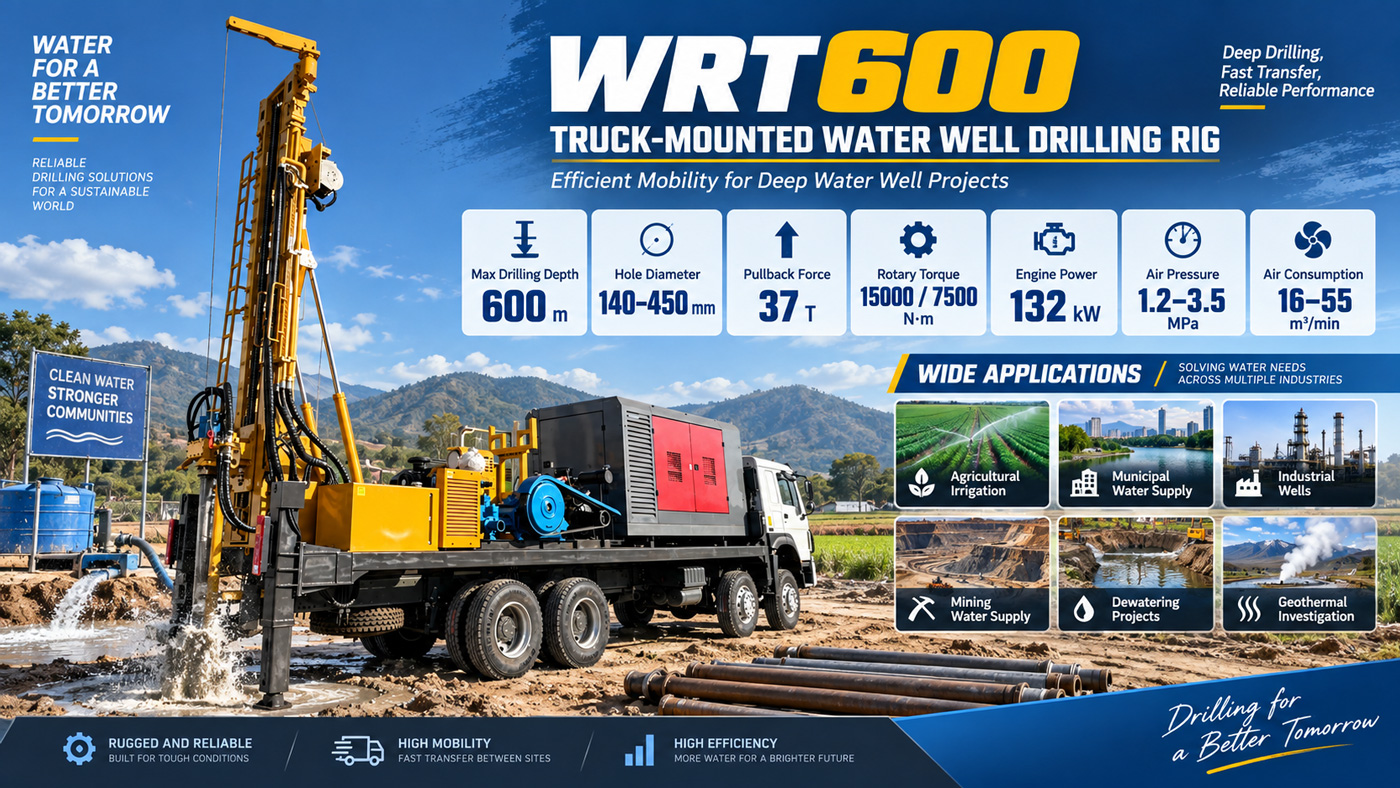
When one WRT600 is to be started in turn across several sites, the step most easily skipped is: first determine which site can drill upon arrival and which site still needs to wait for conditions after arrival. The WRT600 is a 600 m class truck-mounted direct mast fully hydraulic water well drilling rig. It uses a truck-mounted chassis for road relocation, has a maximum drilling depth of 600 m, a drilling diameter of 140–450 mm, is equipped with 37 T lifting force and 15000/7500 N·m dual-condition torque, weighs about 26 T, and has transport dimensions of about 10 × 2.48 × 3.75 m. These values determine that it relocates quickly, but they do not determine whether it can immediately start drilling after arrival. Sequencing startup is essentially ordering each site by the time point at which it "meets the conditions to start drilling," not ordering by distance on a map.
First criterion: whether the chassis can enter according to road conditions
What the truck-mounted structure reduces is the loading and unloading step, not the entry step. The 26 T overall weight and transport dimensions of about 10 × 2.48 × 3.75 m mean that for any hole location where any one of bridge load capacity, road width, height limit, turning radius, or drilling site ground bearing capacity is not satisfied, the entry time is not determined by scheduling, but by the completion time of road and site remediation. Even if such a site is nearby, it is not suitable to be placed first.
Specific access conditions to confirm include:
- Whether the width, slope, and turning radius of the entry road allow passage of a 10 m class vehicle length
- Whether the load capacity of bridges and culverts along the route covers a 26 T class load
- Whether there are height restriction points below 3.75 m (forest roads, village road gantries, cables)
- Whether the drilling site ground can withstand the combined load of the entire machine, outriggers, and drilling
Second criterion: whether the hole location itself already meets the conditions to start drilling
For the same water well drilling rig, the "preparatory work" waited on at different sites is not the same, and these waiting times should be included in the startup sequence judgment. According to construction organization, common prerequisites can be divided into three categories:
Site and preliminary work category
- Whether the well location has been set according to hydrogeological survey or design
- Whether the site is level and the entry and exit routes have been cleared of obstacles
- Whether power supply, fuel supply, and personnel accommodation have been arranged
Process configuration category
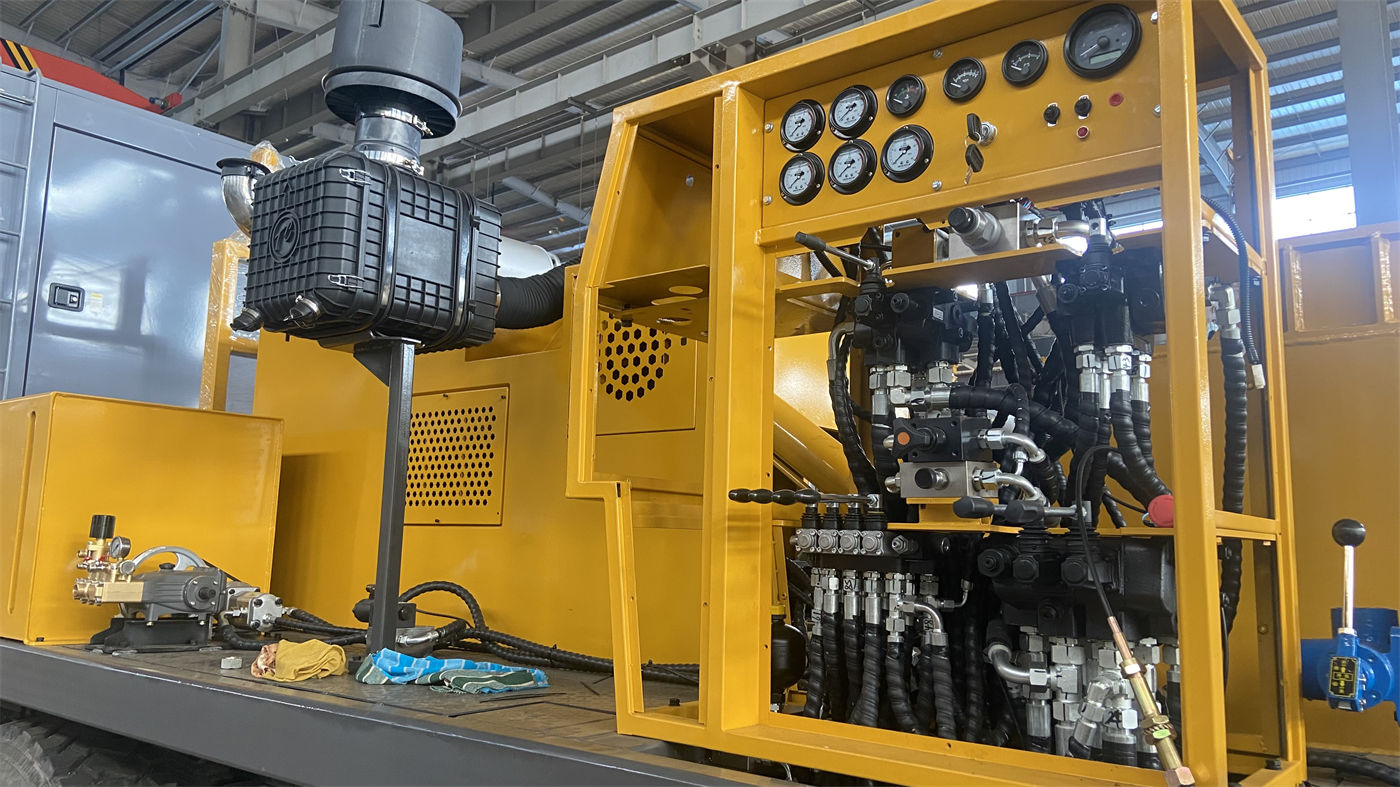
The WRT600 supports DTH down-the-hole hammer drilling and mud rotary drilling. DTH drilling recommends a working air pressure of 1.2–3.5 MPa and air consumption of 16–55 m³/min; mud rotary drilling requires a mud pump and corresponding drilling tools. If a site needs to use mud in the upper loose layer and switch to DTH in the lower hard rock, then mud materials, casing, down-the-hole hammer, and air compressor must be ready before the equipment arrives. If the air compressor pressure meets the standard but the displacement is insufficient, it will affect impact and cuttings removal—this item is a supporting condition that must be verified in advance during scheduling and cannot be supplemented after the equipment arrives at the site.
Well completion connection category
- Whether well pipes, filter pipes, and water-stop materials have arrived at the site
- Whether well washing and pumping tests after completion have been arranged
- Whether the hole cleaning method and casing plan need to be adjusted in strongly water-bearing intervals
Using three types of sites as examples to explain the sequencing logic
Assume one WRT600 faces three types of sites at the same time. You can judge who starts first by "number of waiting items" rather than "distance":
| Site type | Main waiting items | Sequencing reference |
|---|---|---|
| Agricultural irrigation well, site level, water source and materials ready | Few | Can be scheduled first to shorten equipment idle time |
| Municipal water supply well, needs to wait for well location approval and pipeline relocation | Medium | Schedule in the middle according to approval completion time |
| Mining area water supply well, road load capacity and air compressor support to be confirmed | Many | Enter after conditions are clear to avoid machine retention |
It should be noted that the above table only uses the number of waiting items as a sequencing reference and does not constitute a prediction for any specific project. Actual waiting time should be based on the project owner's progress.
Put drilling depth parameters into scheduling, not just into selection
600 m is the maximum drilling depth of the WRT600, but it does not mean that every well at every site is estimated at 600 m for the construction period. The construction period length of the same equipment is affected jointly by well depth, hole diameter, formation combination, and number of process switches. The drilling diameter range is 140–450 mm. The larger the hole diameter, the higher the drilling tool weight, annular clearance, and rotary load; for hole locations with thick upper overburden that require casing, auxiliary operation time also increases accordingly. Therefore, without hydrogeological data and target well depth for each site, an accurate single-well construction period cannot be given; only a relative comparison can be made based on hole depth and formation combination.
When scheduling, the occupation time of each site can first be estimated in the following order:
- Design well depth and opening and final hole diameters
- Thickness of the upper loose layer and whether casing wall protection is needed
- Whether the drilling process needs to be switched within the hole
- Arrangements for filter pipes, water stop, and well washing during the completion stage
Equipment status between relocations should also be included in the sequence
The relocation method of the truck-mounted chassis does not mean the equipment can relocate with a load. Before relocation, the mast and working mechanisms should be restored to a safe transport state, and the equipment should be secured according to road transport requirements; this means the time interval between two hole locations includes not only driving time, but also mast retraction, securing, and deployment and inspection after arrival. When sequencing startup, setting aside this type of operation time between hole locations separately is closer to reality than evenly allocating by driving distance.
Daily pre-start inspection items should also be included in construction organization: truck-mounted chassis, mast, hydraulic system, power head, winch, drill pipes, and high-pressure air hoses. During drilling, continuously observe air pressure, torque, cuttings return, water return, and pull-out resistance. If abnormal pull-out resistance occurs, it should be handled by judging through hole cleaning and in-hole conditions, and should not rely solely on the 37 T maximum lifting force for forced pulling.
Matters to confirm with the project owner before scheduling
The information on this site does not provide specific road parameters, terrain, and geological data for each site. The following items must all be verified by the project owner or on site before sequencing startup:
- Measured values of entry road, load capacity, height limit, and site clearance for each hole location
- Hydrogeological data, design well depth, and target hole diameter for each hole location
- Boundary depth between the upper loose layer and lower rock layer, and whether casing is needed
- Whether the pressure and displacement of the air compressor required for the DTH process are in place, and whether the corresponding down-the-hole hammer specifications match
- Mud pump, mud materials, and water conditions required for mud rotary drilling
- Arrangements for well pipes, filter pipes, water-stop materials, and well washing and pumping tests
- Actual road conditions and transport time restrictions between sites
Before these conditions are clear, any specific startup sequence is only an assumption. The operable approach is: first sequence each site by the "time point at which it meets the conditions to start drilling," then add relocation time and equipment retraction and deployment time, and finally revise according to the measured conditions of each road. The sequence produced in this way is closer to the site than simply arranging by distance.