












Foundation pre-drilling in PV sites rarely follows a single rhythm. When piles are laid out across a large array, the equipment must frequently move between adjacent pile positions, align the hole, drill down, retract the drill, and move to the next point. In contrast, box transformer foundations, fence posts, or local reinforcement holes within the site may be few in number but larger in diameter, constituting single-point operations. Both task types look like "drilling holes in a PV site," yet their demands on equipment differ: the former cares more about the efficiency of machine repositioning and hole alignment, while the latter cares more about rotational capability at large diameters and drill tool matching.
This article uses verified data for the tracked PV pile driver PV390 as a reference, analyzing the two demand types separately to explain which equipment features correspond to which type of work and which conditions need additional confirmation before purchase. It does not involve customer cases and makes no commitment regarding actual drilling efficiency.
The two task types have different motion compositions
The core motions of continuous pile construction are "short-distance movement—posture adjustment—hole alignment—drilling—retraction—move again." Pile spacing is usually fairly regular, and single-hole depth is governed by the PV mounting foundation design. The equipment spends most of its time on repeated positioning rather than on exercising its single-hole limit capability.
Single large-diameter operations involve fewer motions, but the load per hole is concentrated: larger diameter raises rotational resistance and increases spoil volume, placing more concentrated demands on the drill rod, drill bit, and feed control. If hole positions are scattered across the site, transition and positioning time are added.
Therefore, the two task types are not simply "the same machine running fast or slow"; their constraint points differ. Continuous construction first looks at the equipment's ability to reduce wasted motions; large-diameter operations first look at whether rotation, drill tools, and ground conditions match.
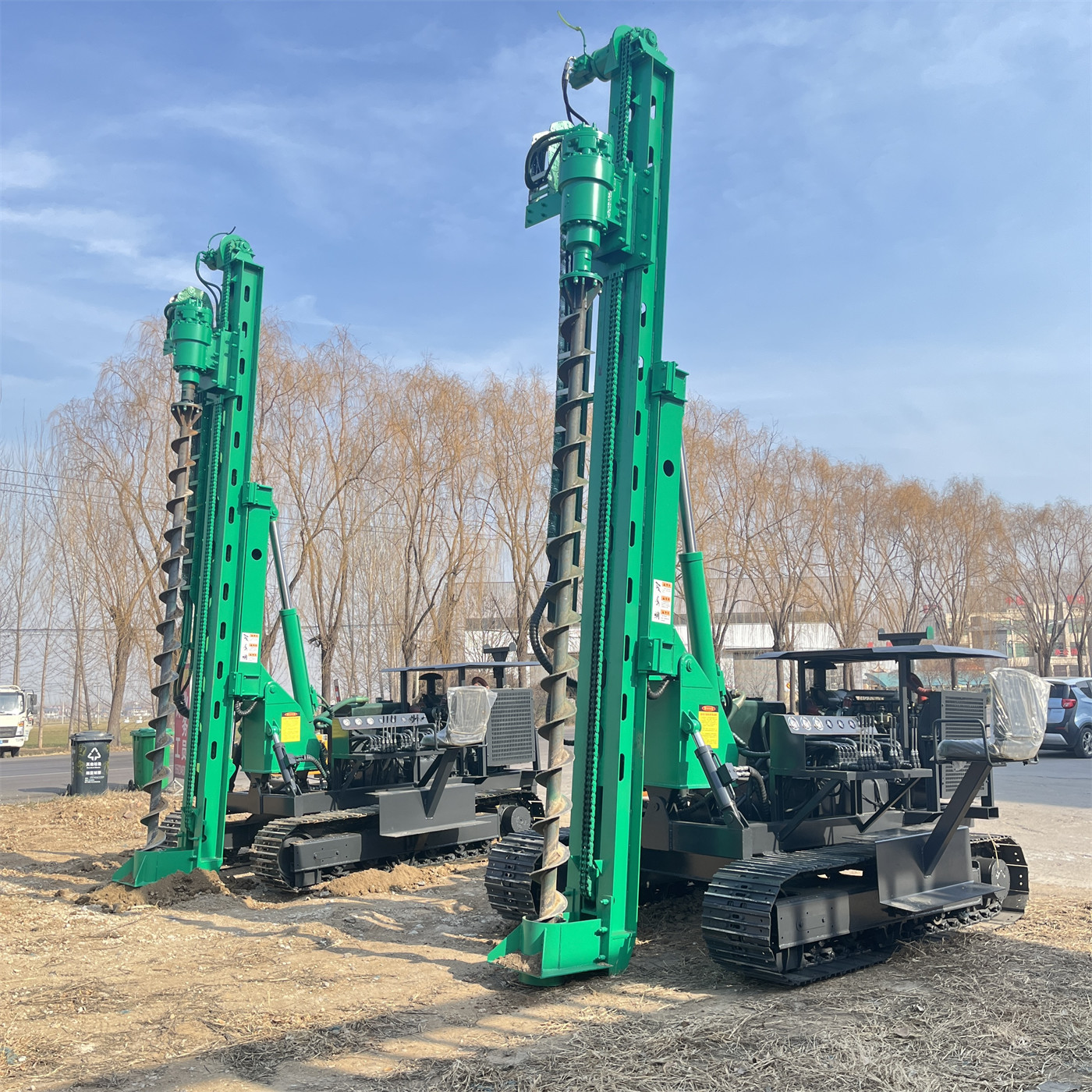
Continuous pile construction: first reduce repositioning and hole-alignment motions
The PV390 uses a tracked chassis with 400 mm track pads, and the data specifies a climbing angle of 35°. For short-distance transitions over unpaved ground within a PV site, a tracked structure adapts better than wheeled types to dirt roads, grass, and gravel. However, 35° is a data-specified value; actual slope travel must still be judged based on cross-slope, surface wetness, soil type, and machine center of gravity, and operations should not be arranged solely by the maximum climbing angle.
For hole alignment, the PV390's mast offers 120° pitch, dual-cylinder left-right swing arms, and 50 cm fore-aft telescopic compensation. Working together, these three features mean that after the machine is stabilized, the drilling position and angle can be adjusted within a certain range, reducing the need to fine-tune the entire machine forward, backward, left, and right at every pile position. For array-layout pile positions, this adjustment method helps shift positioning actions from "moving the machine" to "adjusting the mast," but the adjustable range has limits; when pile position deviation exceeds the compensation range, the entire machine still needs to be moved.
Continuous construction also depends on power and cooling. The PV390 is equipped with an 85 kW four-cylinder engine, providing hydraulic power for travel, rotation, chain feed, and mast adjustment. PV sites are usually far from fixed power sources, so diesel power suits independent field operation; under continuous high load, the condition of the cooling system, air filter, and fuel system affects operational continuity. These are items requiring focused inspection during use, and the data does not provide specific maintenance intervals.
Single large-diameter operations: torque and drill tool matching are key
The PV390 has a drilling diameter range of 80–600 mm, reducer torque of 13000 N·m, drill rod speed of 90 r/min, and drilling depth of 0–6 m. At the large-diameter end, rotational load is significantly higher than at small diameters; the 13000 N·m torque provides a basis for maintaining rotation, but the data also states that actual penetration depends on drill bit type, ground structure, and feed control. In other words, torque is a necessary condition, not a sufficient condition for drilling efficiency.
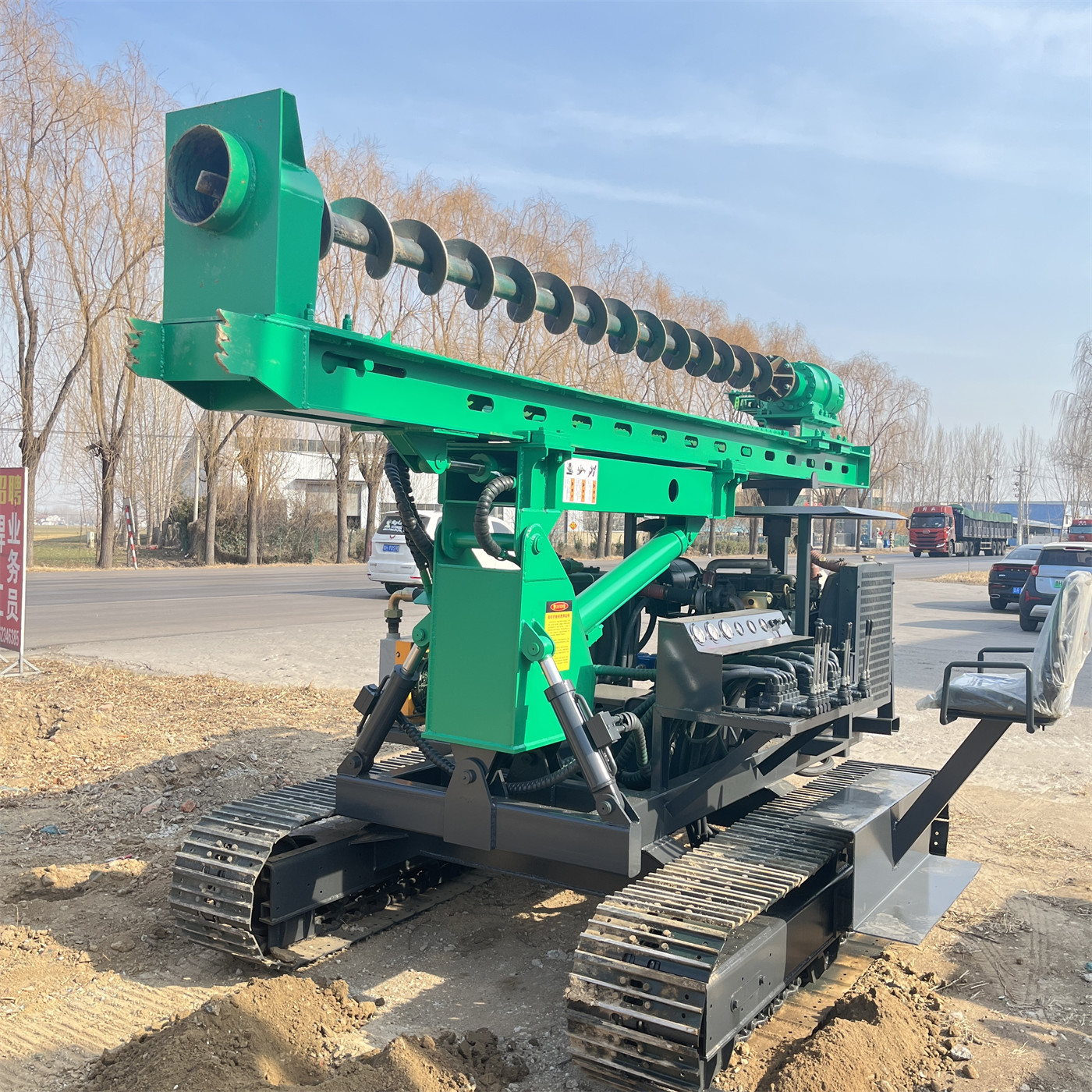
The equipment uses chain feed for continuous advancement. When encountering cobblestone, backfill layers, or strongly weathered rock, the data recommends controlling feed based on rotational load and drill tool condition to avoid excessive downward pressure causing hole deviation, stuck drills, or excessive impact on drill tools. This guidance is especially relevant to single large-diameter operations: the larger the diameter, the greater the contact area between drill tool and hole wall, and the more concentrated the risk from improper feed control.
Regarding ground conditions, the data lists soil, loess, clay, cobblestone sand, backfill waste layers, and strongly weathered rock and rock layers that can be worked after replacing with impact drilling tools. Among these, clay requires attention to bit balling and poor spoil discharge, while backfill waste layers require guarding against foreign objects, voids, and local jamming. These conditions may recur repeatedly in continuous pile construction, whereas in large-diameter single-point operations they may occur concentrated within the same hole; handling methods must be judged by actual load, and the data does not provide specific parameter adjustment values.
Site conditions affect the two task types differently
Sites for continuous pile construction are usually already roughly leveled, and the equipment mainly moves within the site; the main constraints are pile spacing, surface bearing capacity, and whether underground pipelines exist. If single large-diameter operations are located at the site edge or on slopes, access routes and positioning space may be more restricted. The PV390's overall dimensions are 5200 × 2300 × 2650 mm; before purchase, transport corridor width, turning radius, and clearance around the work point should be checked.
In slope scenarios, the 120° mast pitch and dual-cylinder swing arms can be used to adjust drilling posture, but equipment stability still depends on track adhesion and site preparation. The data does not provide specific limits for cross-slope operation; slope projects should treat cross-slope angle, surface wetness, and machine center of gravity as separate confirmation items.
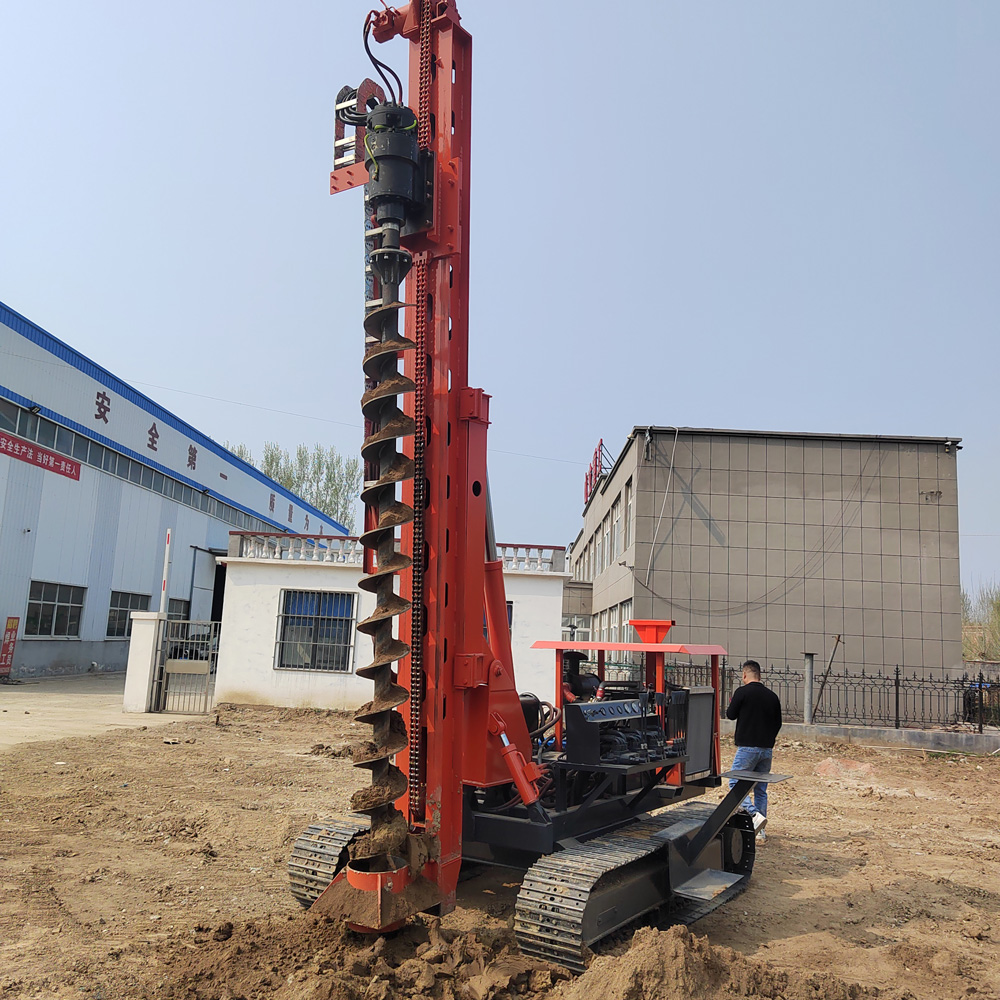
Which conditions the data covers and which still need confirmation
| Confirmation item | Information provided in the data | Still to be checked before purchase |
|---|---|---|
| Hole diameter and drilling depth | 80–600 mm, 0–6 m | Whether project design hole diameter and depth fall within range; ground conditions at the large-diameter end |
| Rotational capability | 13000 N·m, 90 r/min | Drill bit type and ground matching at target diameter; actual load performance |
| Pile positioning | 120° pitch, dual-cylinder swing arms, 50 cm telescopic compensation | Whether pile deviation falls within compensation range; relationship between array spacing and machine dimensions |
| Site access | Tracked, 400 mm track pads, climbing angle 35° | Actual cross-slope, surface bearing capacity, wetness, and transport corridors |
| Hard rock construction | Can be used on strongly weathered rock and rock layers after replacing with impact drilling tools | Impact drill tool model, rock hardness and integrity; data does not provide impact energy |
The purpose of this table is not to give conclusions but to separate the confirmation items shared by the two task types: continuous pile construction should focus more on the "Pile positioning" and "Site access" rows; single large-diameter operations should focus more on the "Hole diameter and drilling depth," "Rotational capability," and "Hard rock construction" rows. What both task types must check is whether the project design hole diameter and depth truly fall within the equipment range, and whether the ground data is sufficient to determine the drill tool type.
Information to prepare before purchase
Whether the project leans toward continuous pile construction or single large-diameter operations, inquiries should provide: the design pile type, hole diameter, and hole depth of the PV foundation; site ground data, especially the distribution of backfill layers, cobblestone layers, and strongly weathered rock; pile layout method and spacing; site leveling, slope, and transport corridor conditions; whether underground pipelines or cables are involved; power supply and fuel replenishment conditions; and whether impact drilling tools are needed. The impact hammer model, impact energy, and specific ground efficiency not given in the data should be separately confirmed during purchase communication and should not be quoted directly.
The PV390 is positioned for ground and mountainous PV foundation pre-drilling, with a drilling depth of 0–6 m, and is not deep-water well or deep-hole exploration equipment. Looking at continuous pile construction and single large-diameter operations together, the goal is not to select a machine that "does everything" but to first distinguish which side the project's main constraints fall on, then compare item by item against verified equipment data, and list the parts not covered by the data as items to be confirmed.