












When looking at reverse circulation rig specifications, the three numbers most easily singled out are drilling depth, drilling angle, and hole diameter. They look like the equipment's "capability scale," but in exploration projects, these three numbers actually answer three different questions: how deep the hole should be drilled, which direction the hole should face, and how large a channel the hole should leave. Reading them separately easily leads to the conclusion that "if the depth is enough, it can do the job"; reading them back in the context of the task reveals that each corresponds to different exploration decisions and supporting conditions.
The depth value first answers "the upper limit of hole depth," not "how deep it can actually drill"
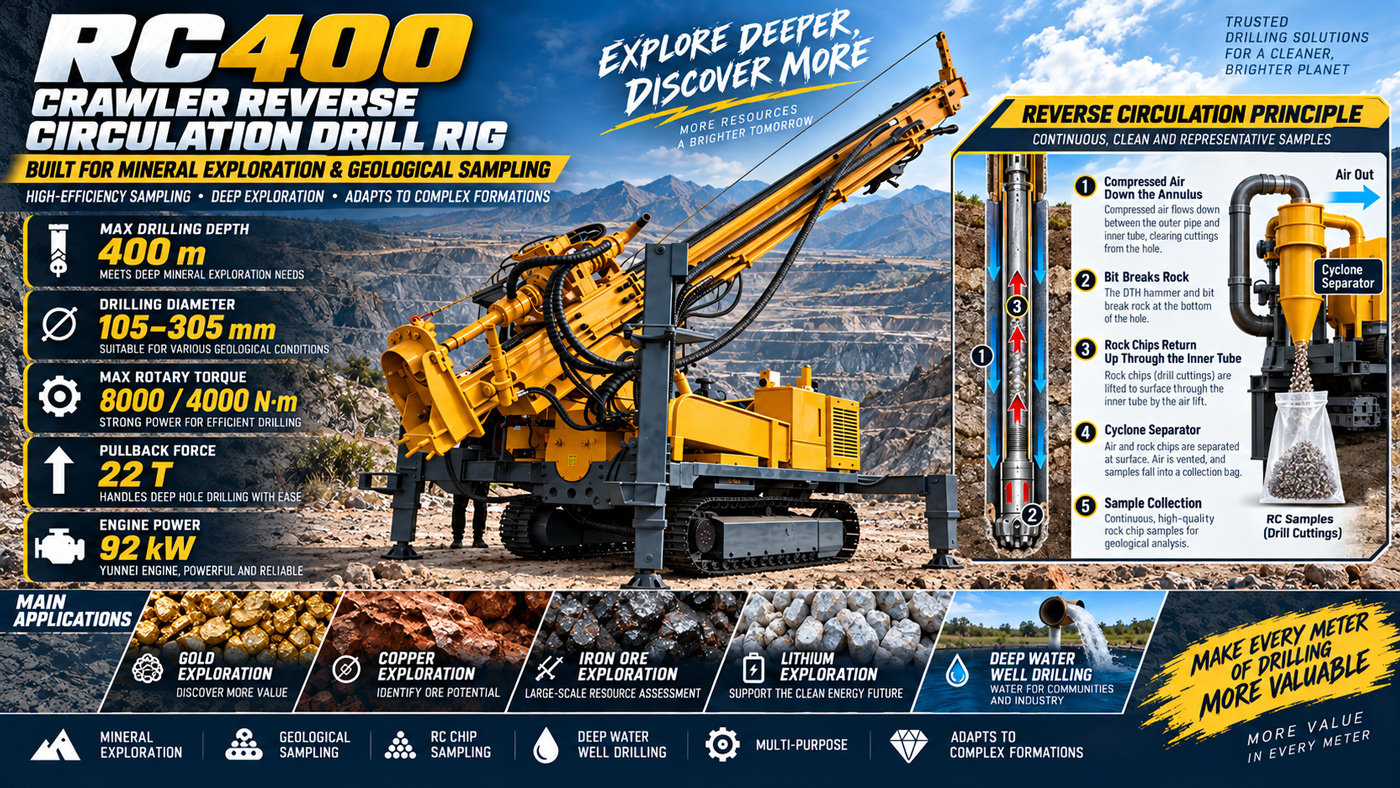
Taking the RC400 in this site's data as an example, the maximum drilling depth is marked as 400 m. This value is the reference capability of the equipment under typical configuration, not the actual hole depth achievable in any formation or any hole diameter. The data itself also states that actual drilling depth is affected by hole diameter, drill rods, air compressor capacity, formation conditions, hole deviation, and drilling tool wear.
Therefore, when the exploration design specifies a target hole depth, a more reasonable approach is not to directly compare the target depth with 400 m, but to list the conditions that affect actual drilling depth together:
- Which segment of 105–305 mm the target hole diameter falls into; the larger the diameter, the heavier the burden on cuttings removal and air supply;
- Whether the planned RC drill rods are 89 mm or 102 mm, with a rod length of 3 m; the drill string combination affects tripping and downhole resistance;
- Whether the supporting air compressor can stably supply air within the working pressure range of 1.2–3.5 MPa and air consumption of 16–55 m³/min;
- Whether the formation is loose overburden, weathered rock, or intact hard rock, and whether switching between mud drilling and pneumatic RC is required.
Before these items are confirmed, 400 m can only be used as a starting point for selection, not as a commitment to hole completion. Especially in deep hole sections, insufficient air supply or poor drill rod sealing will worsen cuttings return, thereby affecting sample continuity and hole bottom cleanliness.
45°/90° are not two decorative numbers; they correspond to hole layout direction
The working angles given in the data are 45° and 90°. 90° corresponds to a near-vertical hole, suitable for groundwater investigation, overburden exploration, and verification of some vertical ore bodies or anomaly zones; 45° corresponds to an inclined hole, which can be used for directional verification of inclined ore bodies, structural zones, or specific targets. These two angles answer "from which direction the hole approaches the target," not "whether the equipment can be arbitrarily set at some angle."
Once the angle enters construction organization, it affects site layout and stability conditions. During inclined hole construction, the force direction on the equipment differs from that of a vertical hole. The hydraulic outriggers with 1.6 m stroke in the data are used for equipment leveling and drilling support; on soft ground, additional pads are needed to prevent outrigger sinking during long-term high-load drilling. In other words, angle selection is not just a matter of geological design; before mobilization, it must also be confirmed whether the site can provide a stable support surface.
In addition, the data only gives two working angles, 45° and 90°; it should not be inferred from this that the equipment can be continuously adjusted at any intermediate angle. If the exploration design requires other angles, this should be verified with the supplier as a matter to be confirmed, rather than assumed based on existing data.
105–305 mm hole diameter constrains both the sampling channel and well completion conditions
Hole diameter has two meanings in reverse circulation drilling. When used for mineral exploration, the hole diameter must ensure matching among the dual-wall drill rods, bottom-hole drilling tools, and cuttings return channel; whether samples can be returned continuously by depth depends on hole diameter, air supply, and drill rod sealing. When used for deep water well construction, the hole diameter must also consider the well completion structure, casing, and water-producing layer requirements.
The data lists 105–305 mm as the drilling diameter range, but does not specify the recommended drilling depth or formation conditions for each hole diameter. Therefore, during the selection stage, a more prudent approach is to treat the target hole diameter as one of the input conditions and check it together with drilling depth, drill rod specifications, and air compressor displacement, rather than first fixing the hole diameter and then separately asking "whether it can drill to 400 m."
Only by putting several numbers together can it be clear where the exploration decision lies
The table below only organizes items in the data directly related to the questions in this article, to explain what each constrains; it does not constitute a capability commitment.
| Data item | Value or range | Question to be confirmed |
|---|---|---|
| Maximum drilling depth | 400 m | Whether the target hole depth has margin, and whether hole diameter, drill rods, air supply, and formation support it |
| Drilling diameter | 105–305 mm | How large a hole diameter is needed for the sampling channel or well completion structure, and whether it matches the drilling tools |
| Working angle | 45° / 90° | Whether the target direction is an inclined hole or near-vertical hole, and whether the site can provide stable support |
| Working pressure | 1.2–3.5 MPa | Whether the pressure of the supporting air compressor can cover the planned hole depth and diameter |
| Air consumption | 16–55 m³/min | Whether displacement and pressure are both satisfied, and whether cuttings return is continuous |
| RC drill rods | 89 / 102 mm, length 3 m | Whether the drill string combination, joint sealing, and tripping operations are matched |
As can be seen from the table, drilling depth, angle, and hole diameter are not three isolated specifications, but correspond respectively to hole depth decisions, hole layout direction decisions, and channel size decisions. Any change in one item may require recalculating the margins of the other two.
Which exploration tasks are suitable to consider under this set of conditions
The data lists the uses of the RC400 as mineral exploration, geological sampling, and deep water well construction, and states that it mainly obtains cuttings samples returned by depth, rather than continuous complete cores. From this, a conditional judgment approach can be formed:
- If the task is shallow anomaly verification, tracing mineralization boundaries, or large-area exploration hole screening, and is mainly based on cuttings samples, the reverse circulation sampling route can be prioritized for evaluation;
- If the task requires continuous complete cores to interpret rock structure and mineralization details, reverse circulation cuttings samples cannot replace coring, and the requirements for core drilling should be evaluated separately;
- If the same project also includes rural water supply, farmland irrigation, or mining area water supply wells, the data also lists deep water wells as one application, but water well completion focuses on well diameter, casing, and water-producing layers, and the hole diameter and procedures for exploration sampling cannot be directly applied;
- If the hole location is in mountainous areas or access roads are restricted, the crawler chassis travel speed is about 2.5 km/h and the overall weight is about 11 t; before relocation, ground bearing capacity and transport routes need to be confirmed, and the data does not provide further conclusions on road passability.
These judgments only indicate the scope supported by the data; they do not mean that a specific project has adopted this equipment, nor do they constitute a commitment to hole completion results or sampling quality.
Information to provide before inquiry
If the above conditions are to be applied to a specific equipment inquiry, at least the following information should be prepared for the supplier to check the configuration:
- Drilling purpose: mineral exploration cuttings sampling, geological survey, or water well completion;
- Target hole depth and target hole diameter, and whether inclined holes are required and the inclined hole direction;
- Expected formation: overburden, weathered rock, intact hard rock, or fractured zone, and whether mud drilling is required;
- Drilling method: pneumatic reverse circulation, mud circulation, or other methods;
- Supporting conditions: air compressor pressure and displacement, on-site water, electricity, and fuel supply, sampling and splitting equipment;
- Mobilization conditions: road width, slope, ground bearing capacity, and relocation distance.
Among these, whether the air compressor can simultaneously satisfy 1.2–3.5 MPa and 16–55 m³/min, the outrigger support conditions for inclined hole sections, and the drill rod combination under the target hole diameter are parts for which ranges are given in the data but still need to be verified according to the project. The drilling depth value can serve as a starting point for discussion, but should not be used as the sole basis.