












During reverse circulation drilling and sampling, site teams often treat "the cuttings came up" and "the sample is ready" as the same thing. In reality these are two separate steps: whether cuttings can continuously return from the hole bottom to surface determines whether there is a sample for that depth interval; how they are cyclone-separated, split, bagged and numbered after reaching surface determines whether that sample can be used for assay and comparison. Only when both steps hold up does the sample have meaning.
This article explains the two steps separately and, drawing on verified information for the 600 m class crawler reverse circulation drill rig RC600-CS3, clarifies which equipment features correspond to cuttings-return requirements, which correspond to splitting requirements, and what still needs to be confirmed before work begins.
Cuttings return: air volume, sealing and air leakage together determine whether a sample exists
In reverse circulation, cuttings return to surface through the inner tube of dual-wall drill rods. As hole depth increases, the return distance grows longer, and air volume loss, drill rod sealing and in-hole air leakage have a more pronounced effect on sample recovery. The RC600-CS3 has a recommended working air pressure of 1.6–6 MPa and air consumption of 16–75 m³/min, intended not only to drive the RC hammer but also to ensure cuttings can continuously return through the inner tube to the cyclone sampling system.
These figures show that the air compressor performs two tasks in a reverse circulation hole: providing impact energy to the downhole drilling tool and conveying cuttings from the hole bottom to surface. If air volume is insufficient, common symptoms are reduced cuttings return, delayed return and cuttings accumulation at the hole bottom. Air compressor selection should take hole depth, hole diameter and altitude into account together, rather than looking only at the drill rig's nominal drilling depth rating.
- A maximum drilling depth of 600 m and a hole diameter of 105–450 mm are the equipment's nominal range; actual drilling depth will vary with hole diameter, dual-wall drill rod weight, air compressor capacity and formation conditions.
- Fault fracture zones and large fissures cause air leakage; cuttings may linger in the hole and then return in a concentrated burst, degrading the correspondence between samples and actual depth. In such hole sections, reduce penetration, maintain hole cleaning and record separately.
- Soil, clay, sand and gravel layers are prone to hole collapse. The equipment supports mud rotation, so mud and casing can first be used to stabilize the upper hole section, then switch to RC or DTH methods once rock is reached.
Splitting: cyclone, splitting and bagging are a separate set of judgments
Cuttings returning to surface does not mean the sample is already usable. The three-in-one cyclone sampling system integrates cyclone separation, representative splitting and sample collection into one continuous process: after returning through the inner tube, cuttings enter the cyclone system for gas-solid separation, then proceed to splitting and bagging. Its role is to reduce manual sample handling and secondary transfer, making drilling, cuttings return, splitting and bagging connect more tightly, which suits mineral exploration projects with large daily sampling volumes.
However, a smooth process cannot replace sample management. On site, fixed sampling intervals can be set according to project requirements, for example collecting one bag of sample every 1 m or every 2 m, while simultaneously recording the hole number, start and end depths and sample number. Each sample bag should be marked with the hole number, sample number, start and end depths, date and shift, and site records should match the sample bags. If the project applies a QA/QC system, duplicate samples, standard samples and blank samples should also be set up as required.
Comparison of the two steps
| Step | Main influencing factors | Symptoms when problems occur |
|---|---|---|
| Cuttings return | Air volume, hole depth, hole diameter, dual-wall drill rod sealing, in-hole air leakage | Reduced or delayed cuttings return, cuttings accumulation at hole bottom, degraded sample-depth correspondence |
| Sample splitting | Cyclone separation, splitter, bagging and numbering, system cleaning | Mixing of adjacent sample intervals, inconsistency between sample numbers and records |
This table shows that the two issues need to be investigated separately: if cuttings return is discontinuous, the problem may lie in air supply or in-hole air leakage; if samples are cross-contaminated between intervals, the problem is more likely in sampling system cleaning and splitting records.
Supporting rig conditions and application boundaries
The RC600-CS3 is a crawler-mounted heavy-duty reverse circulation drill rig with an overall weight of about 12.5 T, dimensions of about 7 × 2.1 × 2.9 m, a travel speed of about 3.5 km/h, a maximum climbing angle of reference 21°, and a leg stroke of 1.7 m. This layout suits gravel roads in mining areas and generally uneven platforms, but on site the air compressor, cyclone sampling system, sample bags and transport vehicles must also be placed alongside the rig, so the drilling platform should reserve sufficient area to ensure smooth cuttings-return piping and safe personnel access.
In terms of drilling capability, the equipment supports working angles of 45° and 90°, a maximum rotary torque of 12000 / 6000 N·m, corresponding to rotary speeds of 75 / 150 r/min, a lifting force of 29 T, a winch lifting force of 2.5 T, and 132 kW of power. When drilling inclined holes or at high torque, the force directions on the whole rig are more complex, and leg loading and platform stability directly affect hole direction control and operational safety.
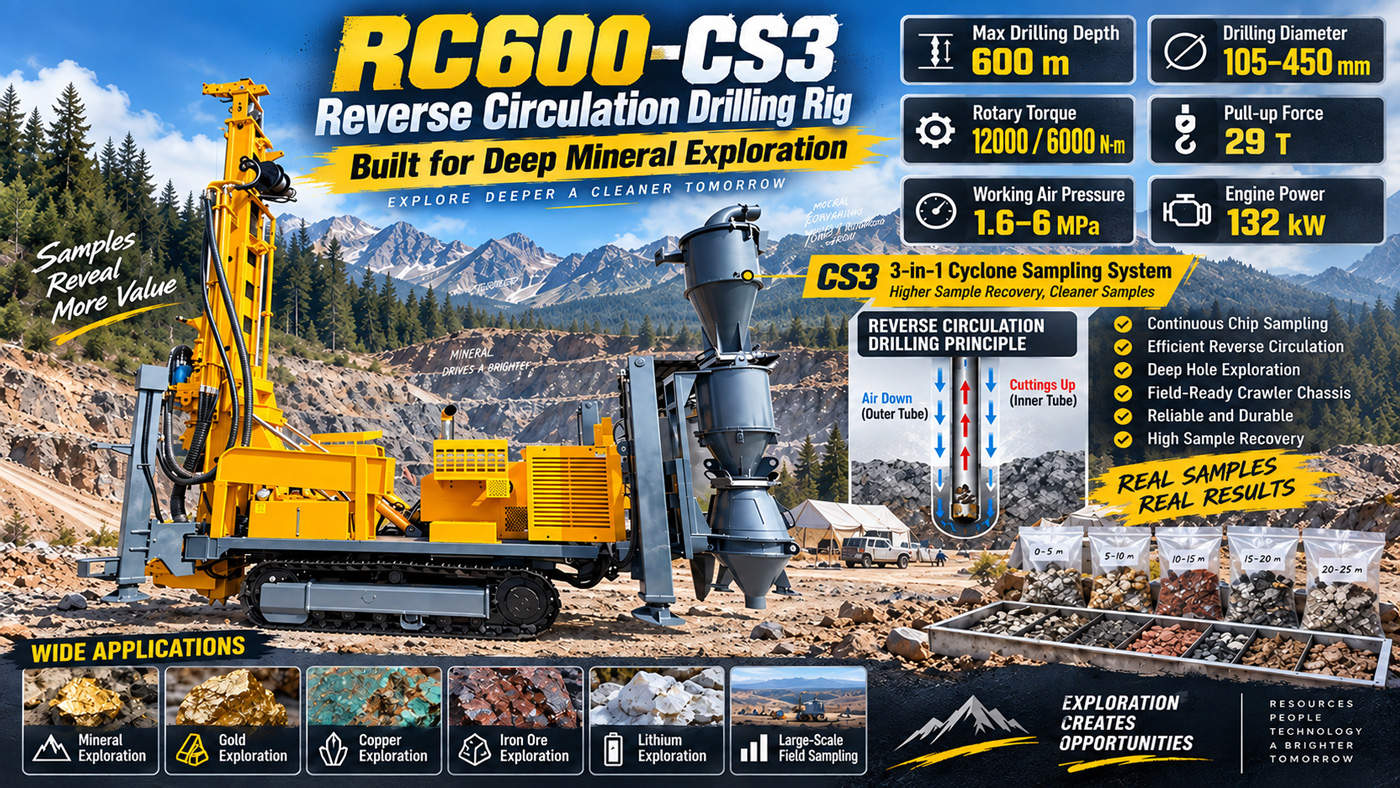
Application boundaries need to be clearly distinguished: the equipment can be used for mineral exploration such as gold and copper mines, and also for deep water wells and dewatering hole completion in mining areas; however, RC drilling obtains cuttings samples, not complete cores. For key anomalies requiring continuous coring, a separate core drill rig is still needed for detailed verification. Water well projects focus more on hole wall stability, aquifers and well completion structure, and do not necessarily need to activate the full sampling system; drilling tools and construction procedures should be changed according to purpose.
Items to confirm before work begins
- Whether the air compressor's actual displacement and pressure can cover the target hole depth, hole diameter and site altitude; 16–75 m³/min is the recommended air consumption range, not a guaranteed value under any working conditions.
- The interface and sealing condition of dual-wall drill rods, RC hammer and cuttings-return hose should be checked item by item before entering the site.
- Whether there is residue inside the cyclone, splitter and cuttings-return hose; check and clean before changing holes or entering a new key sampling interval to reduce the risk of sample contamination.
- Whether the sampling interval, sample numbering rules and QA/QC sample setup have been clearly defined by the geological design.
- Whether the platform area, road load-bearing capacity and slope meet the layout requirements for the 12.5 T rig plus air compressor and sampling system.
When requesting a quotation, it is recommended to provide the drilling purpose, formation data, target hole depth and diameter, drilling method, site access and transport conditions, and water, power and air supply conditions, so that equipment and supporting systems can be checked for compatibility.