












For engineering holes such as slope anchoring, equipment foundation pre-drilling, and short quarry holes, the common situation is: hole depth within tens of meters, scattered drilling points, site not necessarily level, and rock hardness not low. With rotary drills, penetration in intact medium-hard rock is slow and bit wear is fast; switching to larger equipment is constrained by site and relocation. Compact crawler DTH drills come into view precisely because of this contradiction.
The following uses public information on a 30 m-class crawler hydraulic DTH drill (DTH30C) as reference to explain how far such a model can go in hard rock shallow-to-medium hole work and which conditions need to be addressed in advance. The judgments here apply only to this equipment model's information and are not extended to other DTH models.
First, what such work demands of the equipment
Engineering holes and water supply wells have different objectives. Slope anchor bolt holes, anchor cable holes, drainage holes, guardrail pile foundation holes, and short pile pre-drilled holes are mostly within tens of meters deep, but hole positions are distributed according to design drawings, and hole orientations vary among vertical, inclined, and even near-horizontal. In construction organization, the equipment needs to be positioned on a small platform and able to move itself after finishing one hole, rather than arranging lifting or towing for every hole change.
Rock conditions are another constraint. The information gives an applicable rock hardness of approximately f = 8–24, covering medium-to-high hardness strata such as limestone, granite, sandstone, and basalt. DTH drilling itself relies on the hammer doing work at the hole bottom, which differs from rotary cutting, so it more easily maintains penetration in intact hard rock. But hardness is only a necessary condition; rock integrity, abrasiveness, and hole diameter all affect actual performance.
Working range corresponding to the 30 m-class positioning
The machine's maximum drilling depth is 30 m, with hole diameter 76–280 mm. These figures determine that it suits short and shallow-to-medium holes, not deep well equipment. The information also explicitly states: deep water wells of 200 m, 300 m and above should use dedicated water well drilling rigs. Therefore, when deep hole requirements appear in a project, this machine cannot extend its use by "adding a few more drill rods."
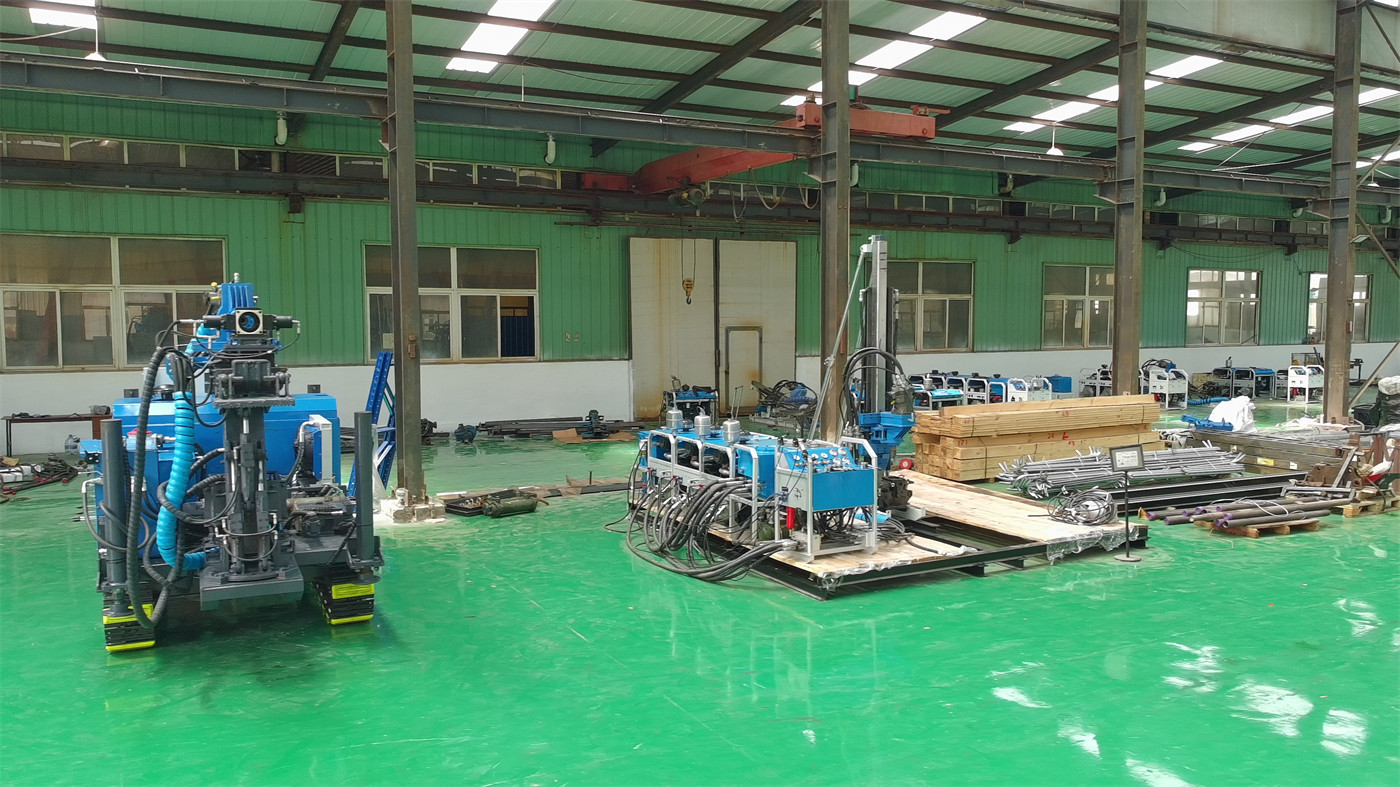
Within 30 m, the corresponding operations include:
- Anchor bolt holes, anchor cable holes, and drainage holes for highways, railways, foundation pits, and retaining walls;
- Pre-drilled holes for equipment foundations, guardrail piles, short piles, and hard rock foundations;
- Quarry bench holes and auxiliary engineering holes before rock breaking;
- Rock drilling in confined spaces of municipal and plant areas.
The common point of these uses is not "hole depth" but "hard rock + scattered hole positions + limited site." The configuration of 3.2 m slide frame stroke and 2.2 m effective stroke in the information also corresponds to the working rhythm of medium-short drill rods, not continuous deep hole drilling.
Site and relocation: what the compact body buys
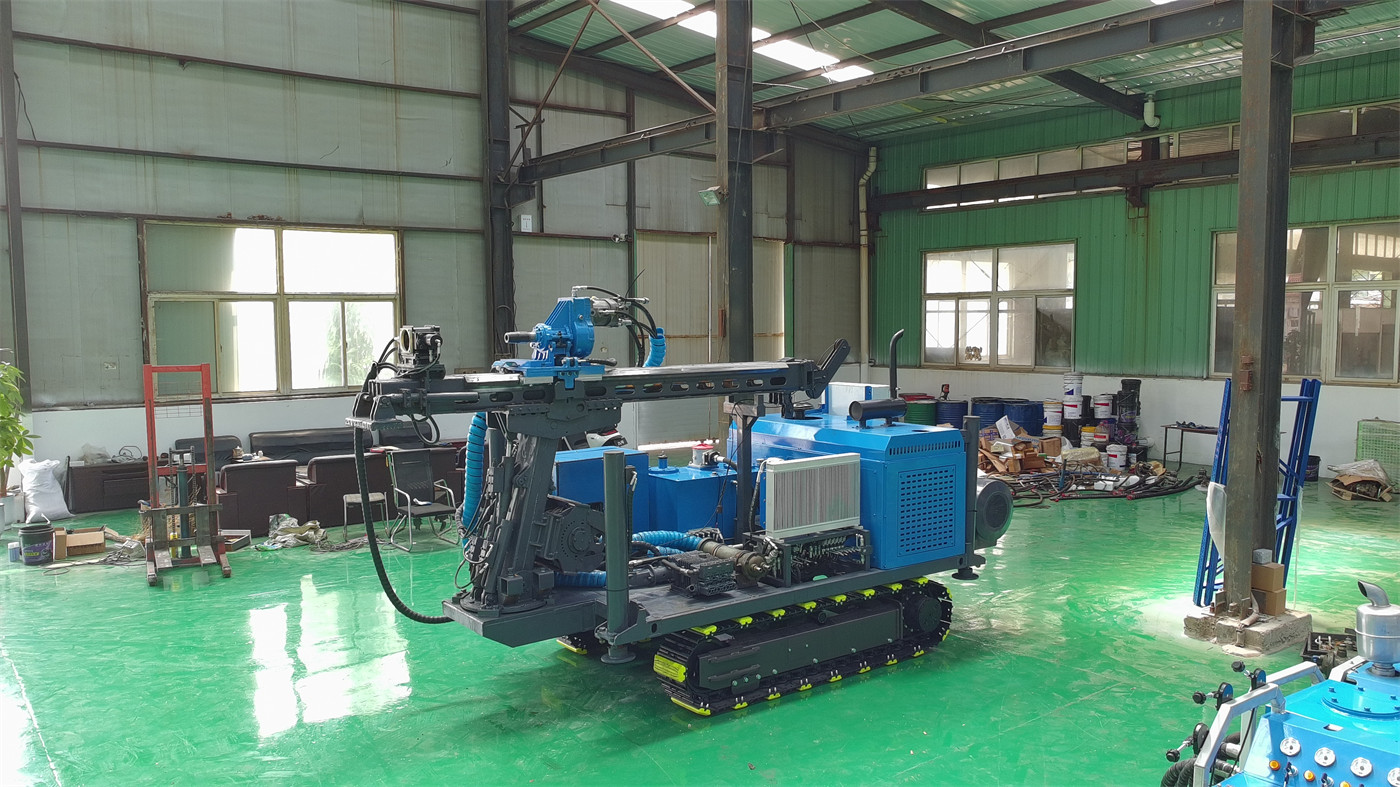
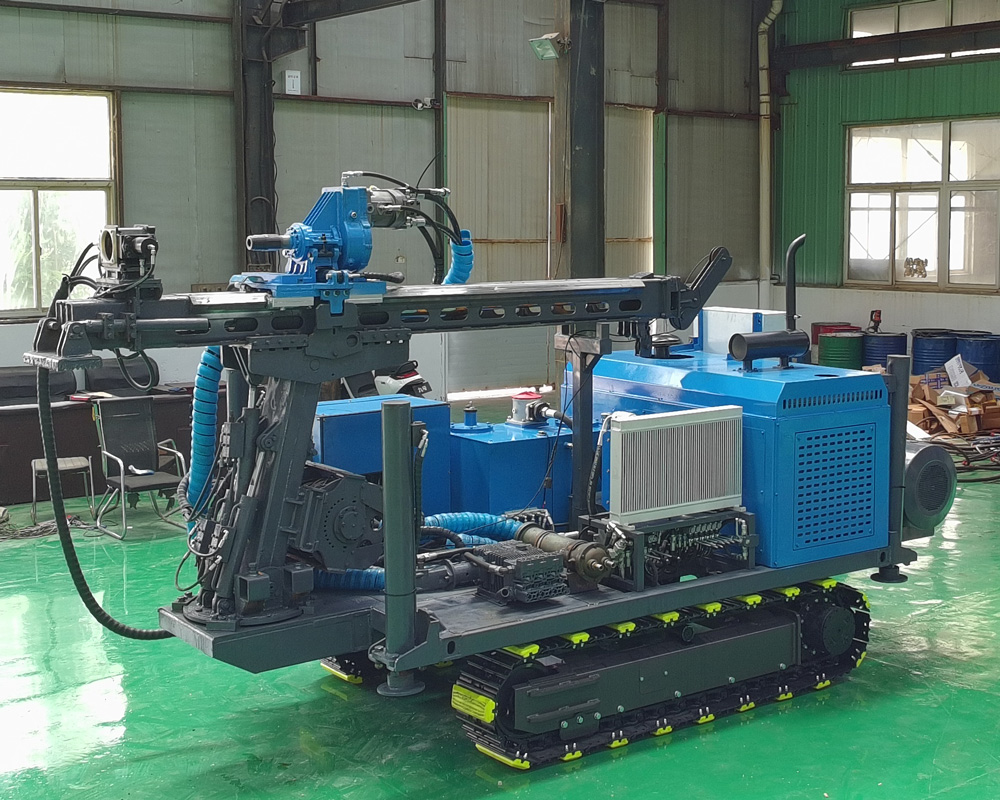
The overall dimensions are approximately 3200 × 1200 × 1850 mm, width about 1.2 m, and overall weight about 2500 kg. For spaces such as slope platforms, construction sites within fencing, and plant passages, a narrow body means easier entry and placement. The crawler chassis uses engineering rubber tracks, which the information says provide better adhesion on gravel, compacted soil, construction access roads, and generally uneven ground, and are also friendlier to paved surfaces and concrete floors.
The 2500 kg weight facilitates transport and loading/unloading with vehicles of matching capacity, and also suits frequent relocation within the site. But "facilitated" does not mean "casual": before entering a construction point, still confirm turning space, ground bearing capacity, underground pipelines, and surrounding buildings; loading ramps must have sufficient bearing capacity and prevent track side-slip during loading and unloading. The information does not give values for gradeability or ground pressure, so the feasibility of slope work and soft ground sites must be verified separately.
Hole orientation changes and attitude adjustment must be understood separately
The equipment has an 18–180° swing angle and is marked with a tilt adjustment function. Swing angle and tilt are two different expressions in the information, and the original information does not give the specific angle range for tilt. Therefore, in projects requiring precise inclined or side holes, hole orientation cannot be arranged based merely on "adjustable"; the final production configuration and technical confirmation documents should govern. Before slope construction, also check platform stability, rockfall risk, and support conditions; the equipment should not work directly on unstable slopes.
Rotation and feed: which process stage the values correspond to
The maximum rotation torque of 3500 N·m corresponds to the ability of the drilling tools to overcome rotational resistance in the hole. The information also gives a feed speed of 53 m/min and states that this is the rapid movement speed of the feed mechanism, used for power head return, drill rod handling, and non-drilling actions, and cannot be taken as actual rock penetration rate. Real penetration is jointly affected by rock hardness, hole diameter, DTH hammer specifications, air compressor capacity, and bit wear; before purchase, the value of any single item should not be taken as an efficiency commitment.
The information also mentions that if rotational resistance continues to increase, return cuttings decrease, or the bit jumps noticeably, parameters should be adjusted and the hole cleaned. This is a principle-level operational reminder and does not constitute construction parameter advice for specific strata.
Air supply: an unavoidable support condition for DTH drilling
The DTH hammer is driven by compressed air, and cuttings are also discharged by airflow. The information gives a reference air consumption of about 8 m³/min, and notes that the original table actually marked 8 m²/min, interpreted as m³/min according to the common unit for compressed air flow, with formal technical data governing. This item should be confirmed separately in procurement communication because it directly relates to the selection of the matching air compressor.
The air compressor's pressure level, continuous air supply capacity, and matching with the DTH hammer need to be determined according to specific drilling tool specifications. The information does not give the machine's specific requirements for air compressor pressure or air hose interface, nor does it state compatibility with any air compressor; this part should be confirmed in writing by the supplier during the inquiry stage. In addition, DTH drilling produces high-speed exhaust and large amounts of rock dust; dust collectors or water mist suppression systems can be configured according to the project, and protective equipment should be provided according to local construction regulations.
Which strata require slowing down or additional preparation
The information explicitly notes two types of strata: weathered rock, soil-rock mixed layers, and upper loose overburden are prone to unstable hole walls, so feed speed should be reduced and upper hole stabilization methods such as casing and starting drilling tools used as needed; fissures and fractured zones are prone to block falling, air leakage, and sticking, so excessively fast feed should be reduced, continuous hole cleaning maintained, and casing used when hole wall conditions are poor. If high-pressure air line pressure is abnormal or return cuttings suddenly stop, drilling should be stopped first for inspection.
These notes indicate that the machine's hard rock advantage is built on relatively intact rock conditions; overburden and fractured zones are sections requiring additional process coordination, and the equipment itself cannot be expected to eliminate hole wall risks.
Support list and items to confirm before purchase
According to the information, a complete construction configuration may include DTH hammer, bit, drill rods, casing tools, air compressor, high-pressure air hose, oil mist lubricator, and dust collection or water mist suppression device; if used for short piles or specific foundation pre-drilling, corresponding accessories can also be selected according to the project. The table below separates verified parameters from items requiring separate confirmation for easy comparison.
| Item | Provided in information | To be separately confirmed |
|---|---|---|
| Drilling capability | Maximum drilling depth 30 m; hole diameter 76–280 mm; applicable hardness approximately f = 8–24 | Actual penetration and drilling tool matching under specific strata |
| Rotation and feed | Maximum torque 3500 N·m; feed speed 53 m/min (rapid movement) | Parameter combinations under different hole diameters |
| Attitude | Swing angle 18–180°; tilt adjustment function | Specific tilt range, subject to technical confirmation documents |
| Air supply | Reference air consumption about 8 m³/min (original marked m²/min) | Pressure level, air hose interface, and air compressor matching |
| Transport and site | Dimensions approximately 3200 × 1200 × 1850 mm; overall weight approximately 2500 kg; rubber tracks | Gradeability, ground pressure, feasibility on soft ground and slopes |
| Power | 36.8 kW diesel engine (optional) | Actual delivery configuration and whether optional |
When inquiring, it is recommended to provide: drilling purpose (anchoring, pre-drilling, quarry, etc.), design hole depth and diameter, hole orientation and tilt requirements, stratum description and rock hardness range, hole position distribution and relocation distance, access road and platform dimensions, on-site power or fuel conditions, planned air compressor and DTH hammer specifications, and whether dust collection or suppression configuration is needed. Without this information, it is difficult for the supplier to give configuration recommendations matching the machine's capability; parts not covered by the information should also be specified in the contract in technical confirmation documents.
Finally, back to the title question: in shallow-to-medium hole hard rock work for slope and foundation engineering, this type of compact DTH drill can cover engineering holes within 30 m, in relatively intact rock, with scattered hole positions and limited site; when deep well requirements, thick overburden with unstable hole walls, or strata conditions beyond the information range are encountered, its role reaches its boundary, and the process must be changed or other equipment provided.