












In pile foundation construction for slope solar projects, the difficulty often lies not in drilling itself, but in whether the equipment can stand stably on undulating ground and align the drilling tool with the pile position. Mountain and hilly sites often have left-right height differences, uneven slopes, and continuous elevation changes between pile positions. A fixed-height standard crawler chassis on such terrain tends to have one side grounded and the other suspended, requiring repeated leveling or soil padding. A chassis with adjustable track height attempts to compensate for height differences by extending and retracting the tracks on both sides. The division of labor between these two chassis types in slope construction is something worth clarifying first during selection.
Three Specific Problems That Slope Construction Poses to the Chassis
Breaking down "slope" reveals that on-site constraints roughly fall into three areas: first, left-right height differences—when the equipment is parked laterally on a slope, the two tracks are not at the same height; second, continuous undulations between the longitudinal slope and pile positions, requiring frequent posture adjustments; third, ground contact conditions—the bearing and adhesion of the slope soil change after rain or disturbance. These three problems combine to determine what additional actions a standard crawler chassis must take on slopes, and also determine which part of the work high-low leg adjustment can save the construction team.
Differences in Actions Between the Two Chassis Types
A standard fixed-height crawler chassis can only achieve its posture on slopes through site leveling. When encountering left-right height differences, a common approach is to first use auxiliary equipment to create a nearly horizontal parking surface, or to level with padding, and then move the machine to align with the pile. This approach is acceptable for scattered pile positions, but when pile positions are dense and height differences change frequently, the leveling workload accumulates with the number of piles.
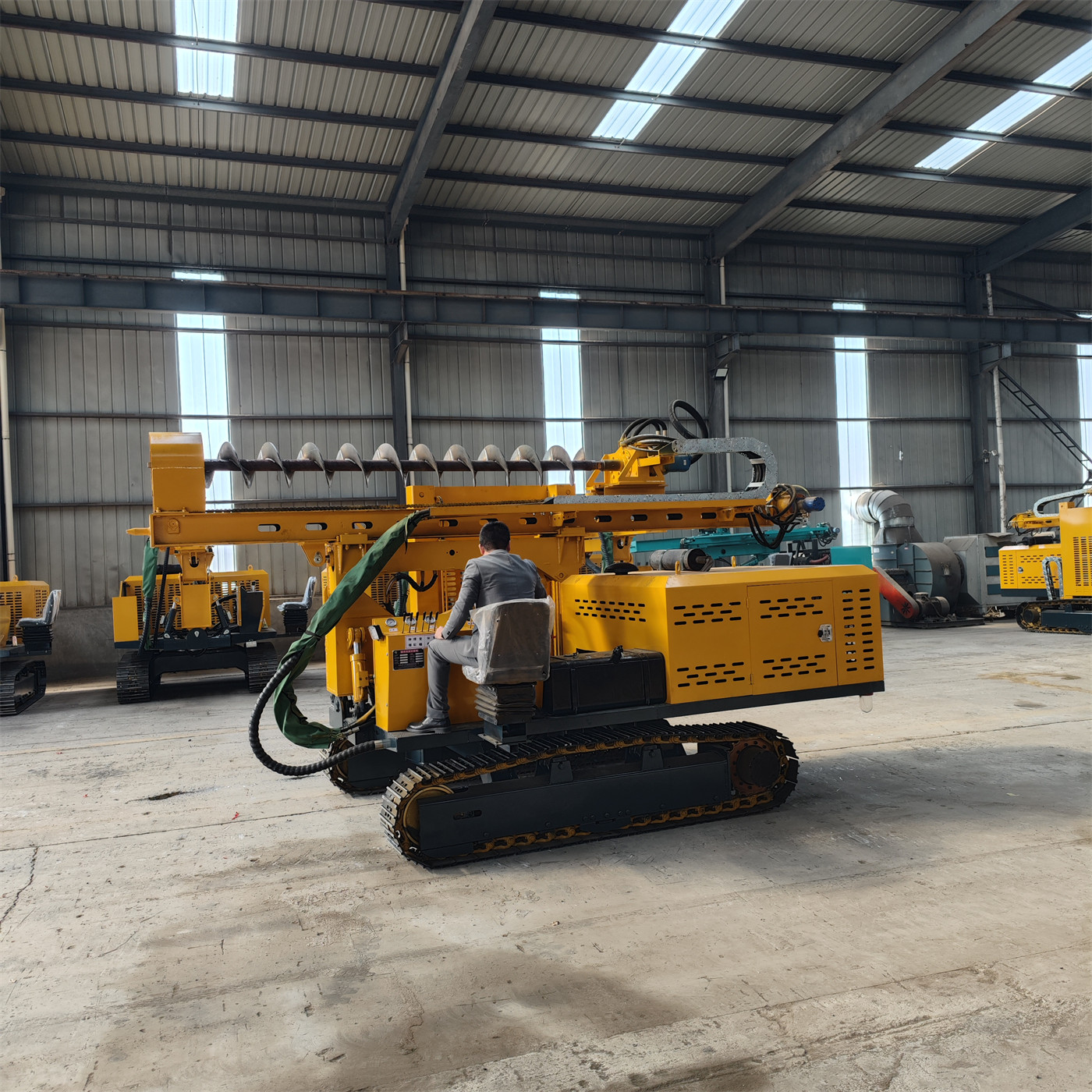
The high-low leg hydraulic solar pile driver takes a different approach. Taking the PV390H on this site as an example, its track height telescopic dimension is 1200 mm, and the height of the tracks on both sides can be adjusted separately according to the slope, enabling the whole machine to achieve a relatively stable construction posture on uneven ground; it is also equipped with 120° mast pitch, dual-cylinder left-right swing arms, and 450 mm telescopic compensation. Combined, these functions address the need to "fine-tune the drilling tool in lateral, fore-aft, and pitch directions after the chassis is stabilized," rather than merely leveling the machine.
| Comparison Item | Standard Fixed-Height Crawler Chassis | Height-Adjustable Crawler Chassis (based on PV390H data) |
|---|---|---|
| Handling left-right height differences | Mainly relies on site leveling or padding | Track heights on both sides can be adjusted separately; telescopic dimension 1200 mm |
| Drilling tool posture adjustment | Depends on chassis positioning and machine movement | Mast pitch 120°, dual-cylinder left-right swing arms, 450 mm telescopic compensation |
| Continuous construction between pile positions | Leveling frequency increases when height differences change significantly | Multi-directional fine adjustment after stabilization, reducing some leveling dependence |
| Source of stability | Ground contact area and site flatness | Track adjustment combined with site bearing capacity; still cannot replace a safe platform |
The comparison in the table only illustrates differences in action methods between the two chassis types and does not imply that any model can achieve a certain construction result on a specific slope. Actual usability depends on slope gradient, soil bearing capacity, equipment center of gravity, and on-site safety conditions.
What High-Low Leg Adjustment Covers and What It Does Not
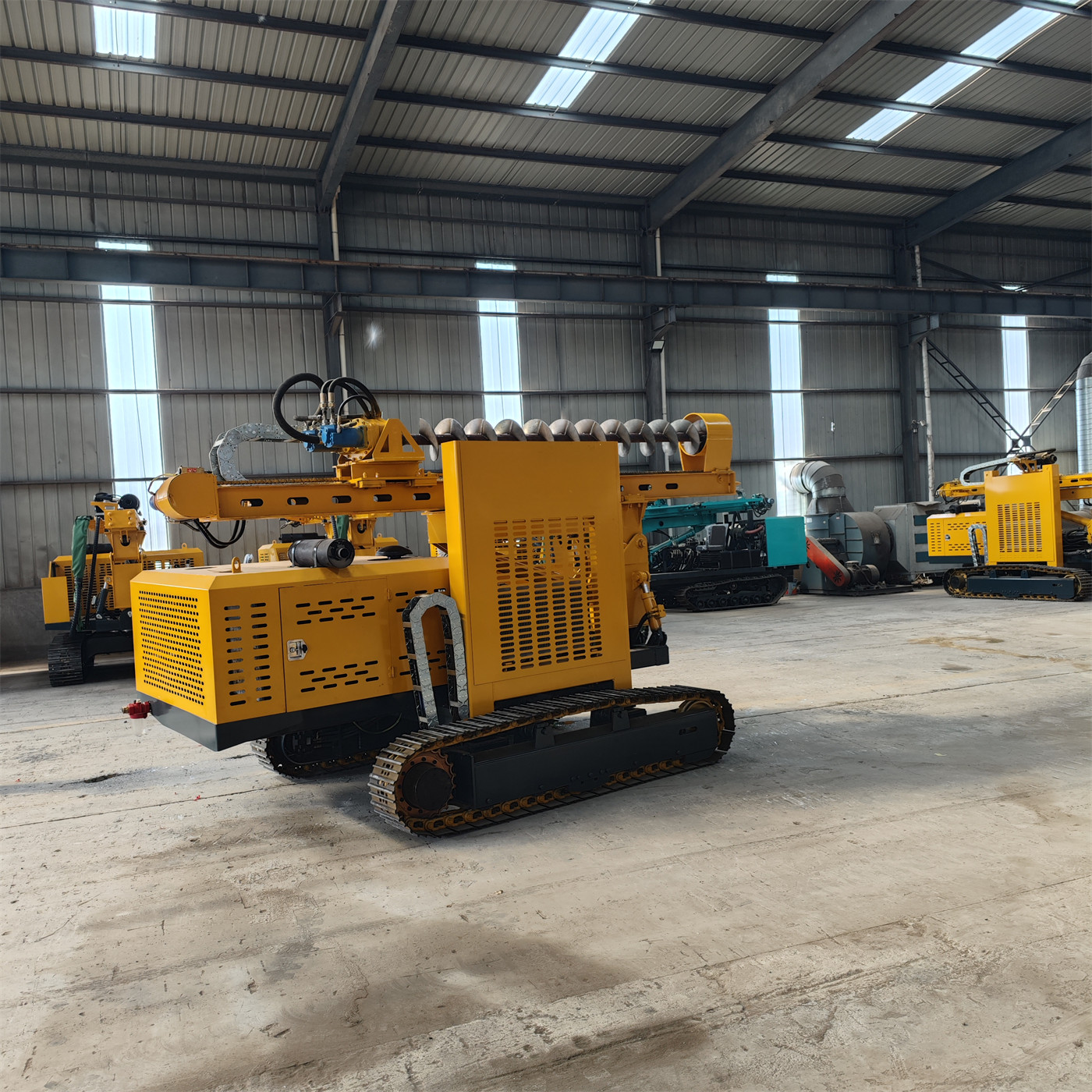
According to the data, the high-low leg function of the PV390H is intended for solar pile foundation construction in mountainous and hilly areas; track height can be adjusted according to slope, making it suitable for sites with pronounced left-right height differences. It reduces the repetitive action of "leveling before aligning at each pile position," allowing the equipment to enter a drillable state more quickly between consecutive pile positions. The accompanying mast pitch and swing arms serve the alignment process, so the chassis does not need to repeatedly reposition for deviations of a few hundred millimeters.
However, high-low leg adjustment is not a panacea. The data explicitly indicates that this function cannot replace a safe construction platform and foundation bearing capacity assessment. That is, if the slope has soft soil, is wet and slippery, has edges, or has excessive cross slope, track extension alone cannot guarantee equipment stability; adjusting one track too much can also cause center-of-gravity shift. Cross-slope construction, loess slopes after rain, and loose backfill areas still require on-site judgment on whether to perform site treatment first. This is an applicability boundary that cannot be fully answered by parameters alone.
Drilling Conditions Supporting the Chassis
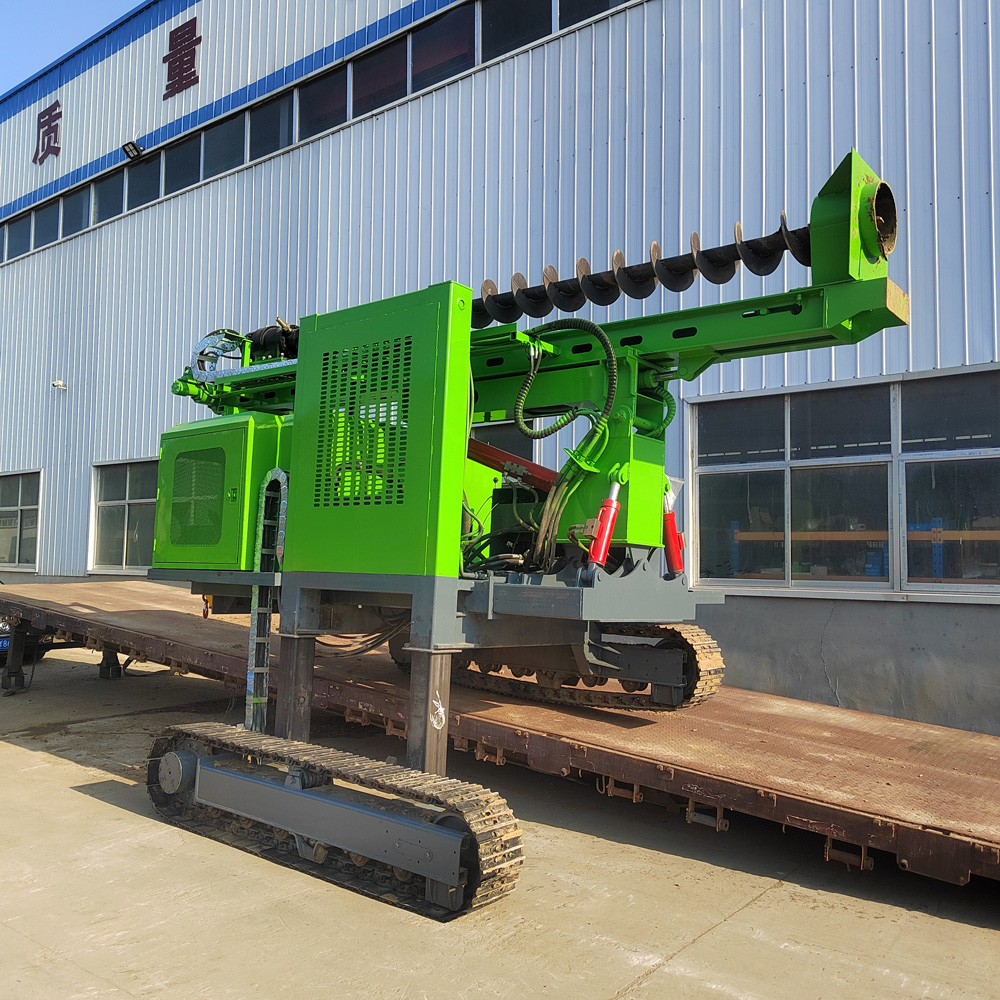
The chassis addresses standing stability and pile alignment, while drilling capability is determined by the power and drilling system. The PV390H is equipped with a 130 kW Yuchai six-cylinder turbocharged engine, 13000 N·m reducer torque, drill pipe speed 100 r/min, drilling diameter 80–600 mm, drilling depth 0–6 m, and chain feed. These values correspond to shallow foundation operations such as pre-drilling for solar mounting foundations and pilot holes for pile positions, not water well drilling. Pile type, design hole diameter, and strata determine tool selection: soil and loess are relatively suitable; clay requires attention to bit balling and cuttings removal; pebble sand and backfill debris layers are prone to hole deviation and jamming; only after switching to impact drilling tools are strongly weathered rock and rock layers involved. The data does not provide impact hammer model or impact energy, so drilling efficiency in hard rock cannot be inferred from it.
Conditions to Verify Before Purchase
- Actual slope gradient, cross-slope direction, and height difference range between pile positions, and whether access roads for equipment travel and parking are available.
- Surface soil bearing capacity and moisture condition, and whether adhesion and slip risk after rain are within controllable limits.
- Pile type, hole diameter, and hole depth in the solar foundation design, and whether they fall within the drilling range of 80–600 mm and 0–6 m.
- Stratum composition, especially the distribution of backfill, pebble layers, and rock layers, which determines tool configuration and whether impact processes are needed.
- Whether a winch is needed for steeper slope operations; if so, anchor points, wire ropes, and traction direction must be separately confirmed.
- Whether the overall transport dimensions of 5200×2300×2800 mm and track shoe width of 300 mm match site roads and turning radii.
- Equipment stability on slopes cannot be judged from data alone; it should be combined with on-site trial operation or assessed by qualified personnel.
The choice between the two chassis types essentially places the workload of slope adaptability either in the leveling process or in the equipment adjustment process. A standard crawler chassis is simple in structure and sufficient for flat sites; for projects with frequent slope height differences, it is necessary to assess whether the posture adjustment capability brought by high-low leg adjustment matches the site conditions. Whichever type is chosen, slope bearing capacity, cross-slope safety, and pile position design are conditions that precede model selection. When requesting a quote, provide slope and height difference descriptions, stratum data, pile type and target hole diameter/depth, access road and transport conditions, and whether auxiliary traction is needed, to facilitate verification of configuration and scope of application.