












Once a water well project's depth requirement is written into tender documents or construction plans, people often take the 600 m class directly as evidence that the equipment can drill a 600 m well. This understanding misses one link: rated maximum drilling depth is the equipment's capability ceiling under specific drilling tools and process conditions, not a completed well depth achievable in any formation with any hole diameter. Below, using the published parameters of a 600 m-class truck-mounted direct-mast water well drill, we explain item by item which capabilities are easily misread and what should be verified before procurement and scheduling.
Misreading 1: Treating maximum drilling depth as actual completed well depth
This equipment has a maximum drilling depth of 600 m and a hole diameter of 140–450 mm. These two values are meaningful only when viewed together: the larger the hole diameter, the higher the rotational resistance of the drill string in the hole, the greater the cuttings discharge volume, and the greater the required air volume or mud volume, so maintaining a large diameter in deep hole sections is more difficult than with a small diameter.
Actual completed well depth is also constrained by formation, hole wall stability, target aquifer depth, well casing and screen structure, final hole diameter and other factors. The materials do not give actual achievable depths under different formation and hole diameter combinations, so it cannot be promised that 600 m hole depth with 450 mm diameter will necessarily hold. During selection, the target well depth, well completion structure—especially the final section diameter—and hydrogeological conditions should be provided together, and the supplier should be asked to confirm the capability boundary under that combination, rather than looking only at the maximum drilling depth cell.
Misreading 2: Dual-mode torque means a two-speed gearbox
The published rotation parameters are maximum torque 15000 / 7500 N·m, corresponding to maximum rotation speeds of 70 / 140 r/min. This is a torque and speed pairing under two operating conditions, not a simple gear-shifting relationship.
The low-speed high-torque mode suits large hole diameters, hard rock and hole sections with greater resistance; the high-speed mode suits stable formations with less resistance. During construction, adjustment should be based on rotational load, cuttings return and drill string condition; the two figures in the parameter table should not be treated as fixed gears that can be switched at will. In addition, maximum torque is a capability ceiling; rotating for long periods under resistance close to the ceiling is a burden on both the drill string and the power system. The materials do not elaborate on this, and it belongs to the scope of on-site observation and control.
Misreading 3: If lifting force is large enough, a stuck drill can simply be pulled hard
This equipment is equipped with 37 T lifting force and 6 T bit pressure. At 600 m-class hole depths, the self-weight of the drill pipe, hole wall friction and casing weight all increase; the relatively large lifting force leaves margin for tripping drill pipe, recovering the DTH hammer and some casing operations.
However, the materials also note: if abnormal tripping resistance occurs, it should first be judged and handled through hole cleaning and in-hole condition assessment, and one should not rely solely on maximum lifting force to pull hard. Treating lifting force as a universal solution to stuck drills is another common misreading. Lifting force is the equipment's capability reserve, not a solution to in-hole problems.
Misreading 4: Truck-mounted structure means it can drive directly onto any site
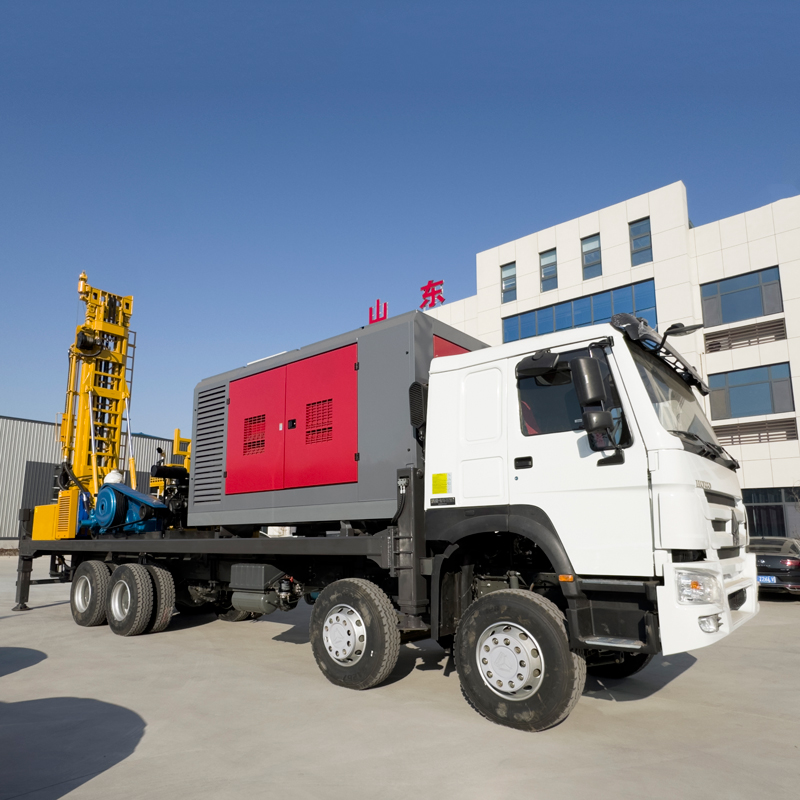
The truck-mounted integrated structure can reduce loading and unloading cycles and is suitable for frequent movement between multiple project sites; this is a practical difference from models that require separate towing. However, this whole machine weighs about 26 T, with transport dimensions of about 10 × 2.48 × 3.75 m.
Before entering the site, road width, bridge load capacity, height limits, turning radius and drilling site ground bearing capacity must be confirmed. The direct-mast structure has a direct overall load path and intuitive maintenance, but during transport and site entry it has requirements for road height limits, site clearance and turning space. What the truck mounting saves is loading, unloading and transfer organization, not the road conditions themselves.
| Data item | What it can indicate | What cannot be directly inferred |
|---|---|---|
| Maximum drilling depth 600 m | The order of magnitude of the equipment capability ceiling | Actual completed well depth in any formation and any hole diameter |
| Hole diameter 140–450 mm | The range of well completion structures that can be covered | Actual ability to maintain large hole diameter in deep hole sections |
| 15000 / 7500 N·m dual-mode torque | Low-speed high-torque and high-speed two-mode rotation orientation | That it can be treated as fixed gears switched at will |
| 37 T lifting force | Margin for handling deep-hole drill strings and casing | That it can replace hole cleaning when tripping is obstructed |
| Whole machine about 26 T, 10 × 2.48 × 3.75 m | Basis for checking road and site conditions | That all rural roads, field ridges and platforms are accessible |
Misreading 5: Looking only at the drilling method and not at the supporting equipment
In hard rock sections, this equipment can be equipped with medium- and high-pressure DTH hammers for DTH drilling, with recommended working air pressure of 1.2–3.5 MPa and air consumption of 16–55 m³/min. Air compressor selection must consider hole diameter, hole depth, DTH hammer specification, rock hardness and altitude at the same time; if pressure is reached but displacement is insufficient, impact will still be insufficient and cuttings discharge difficult.
For soil, clay, sand and gravel layers, a mud pump and corresponding drilling tools can be used for mud rotary drilling; when the upper loose layer is thick, casing can be used to establish a stable hole section before entering the lower rock layer and switching to the DTH process. Segmented process switching in mixed formations is a common way to use this type of equipment, but the process parameters for each section must be determined by on-site formation and drilling tools; the materials do not give a unified formula.
In arid and water-scarce areas, pneumatic drilling can be considered to reduce dependence on large amounts of drilling water, but if the upper loose layer is thick, mud or casing assistance may still be needed. Understanding "suitable for water-scarce areas" as "no water is needed in any formation" likewise exceeds the scope of the materials.
Feed stroke and drill pipe length: what they affect is rod-connection frequency
The feed stroke is 7 m, used with 3 m or 6 m drill pipes. 6 m drill pipes help reduce the number of rod connections, while 3 m drill pipes are more suitable for sites with limited space or ordinary handling conditions. The fast lifting speed of 30 m/min and fast advancing speed of 41 m/min are mainly used for drill pipe handling and power head return, not as drilling speed indicators. The materials do not give drilling efficiency under different formations, and any estimate of how many meters can be drilled per day lacks a basis.
Conditions to verify with the supplier before purchase
- Drilling purpose: agricultural irrigation, municipal water supply, industrial water wells, mining area water supply, engineering dewatering or geothermal investigation; different purposes have different requirements for well diameter, well depth and well completion structure.
- Formation data: overburden thickness, lithology, hard rock burial depth and main aquifer position determine the segmented arrangement of mud rotary and DTH.
- Target hole depth and final hole diameter: compare with the equipment's maximum drilling depth and hole diameter range to confirm whether the combination is within the capability range.
- Air compressor or mud pump support: matching of air pressure and displacement with DTH hammer specification, hole diameter and hole depth; the materials give recommended ranges, and the specific configuration must be confirmed according to site conditions.
- Site entry and transport conditions: road width, load capacity, height limits, turning radius and drilling platform dimensions should be checked item by item against the whole machine weight of about 26 T and the transport dimensions.
- Power and site conditions: 132 kW diesel power supplies rotation, feed, winch and auxiliary systems; for long-term construction, attention should be paid to cooling, air filtration and fuel system maintenance arrangements.
Rated drilling depth is the entry point for selection, not the conclusion. When placing this 600 m-class truck-mounted direct-mast water well drill into a specific project, only by matching hole diameter, formation, process switching, supporting air supply and site entry conditions item by item can one judge whether its capability margin is sufficient and which section it is most suitable for.