












When installing piles in mountainous or hilly PV sites, pile positions are not on the same horizontal plane: there are height differences along the slope, lateral offsets, and the pile point may differ fore-aft from the stabilized track position. If every deviation is eliminated by moving the entire machine, the rhythm of continuous construction is interrupted. The question is: how much deviation can attitude adjustment absorb, and from what point must the machine be moved?
Using the verified parameters of the PV390 PV pile driver as a reference, this explains which types of alignment deviations are covered by mast pitch, left-right swing arms, and fore-aft telescopic compensation, and the site conditions these adjustments cannot replace.
First, classify sloped pile position deviations
After the tracks are stabilized, several types of deviation between the drilling tool axis and the design pile point usually exist simultaneously:
- Angular deviation: The slope is inclined, and the angle between the design hole direction and the vertical needs adjustment.
- Lateral deviation: The drilling tool center and the pile point are not aligned left-right.
- Longitudinal deviation: There is a fore-aft distance between the drilling tool and the pile point.
- Height deviation: The slope itself has height differences, and after the machine is positioned, the drilling tool height does not match the pile point.
Among the first three types, some can be corrected by mast movement; height deviation depends more on machine positioning and site conditions.
Mast pitch addresses the hole direction angle
The PV390 mast pitch range is 120°. For sloped PV projects, the drilling attitude can be adjusted so the drilling tool adapts to the slope angle and design requirements.
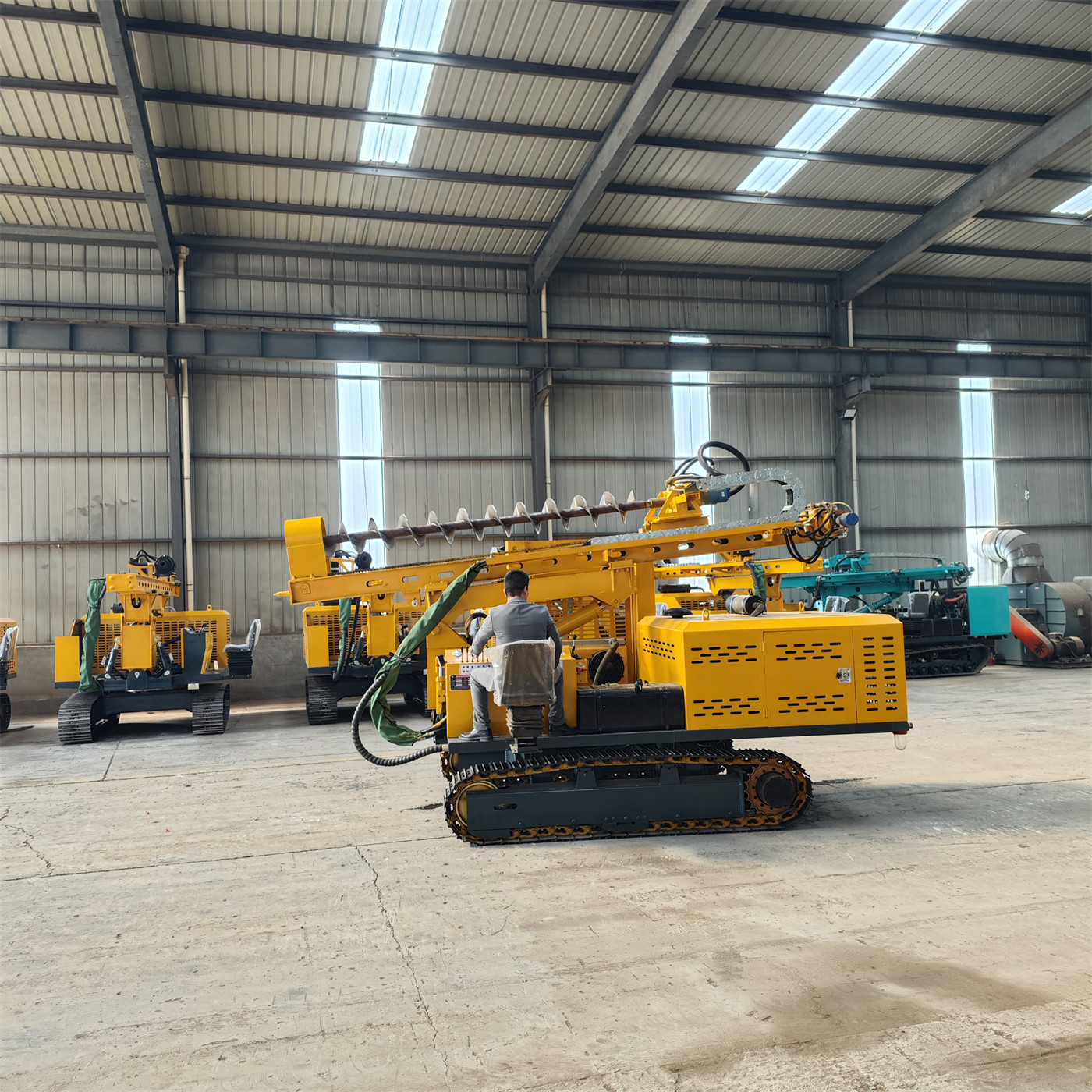
This action solves the angle problem, not the position problem: after adjusting the mast tilt angle, the drilling tool axis direction changes, but the drilling tool center does not automatically coincide with the pile point; lateral and longitudinal deviations still require other coordinated actions.
The data does not provide a conversion relationship between mast angle and slope gradient, so it cannot be directly inferred from the 120° pitch range what slope gradient the PV site can accommodate. The actual operable slope also needs separate confirmation based on machine stability, track adhesion, and pile design.
Dual-cylinder swing arms and 50 cm telescopic compensation handle position fine-tuning
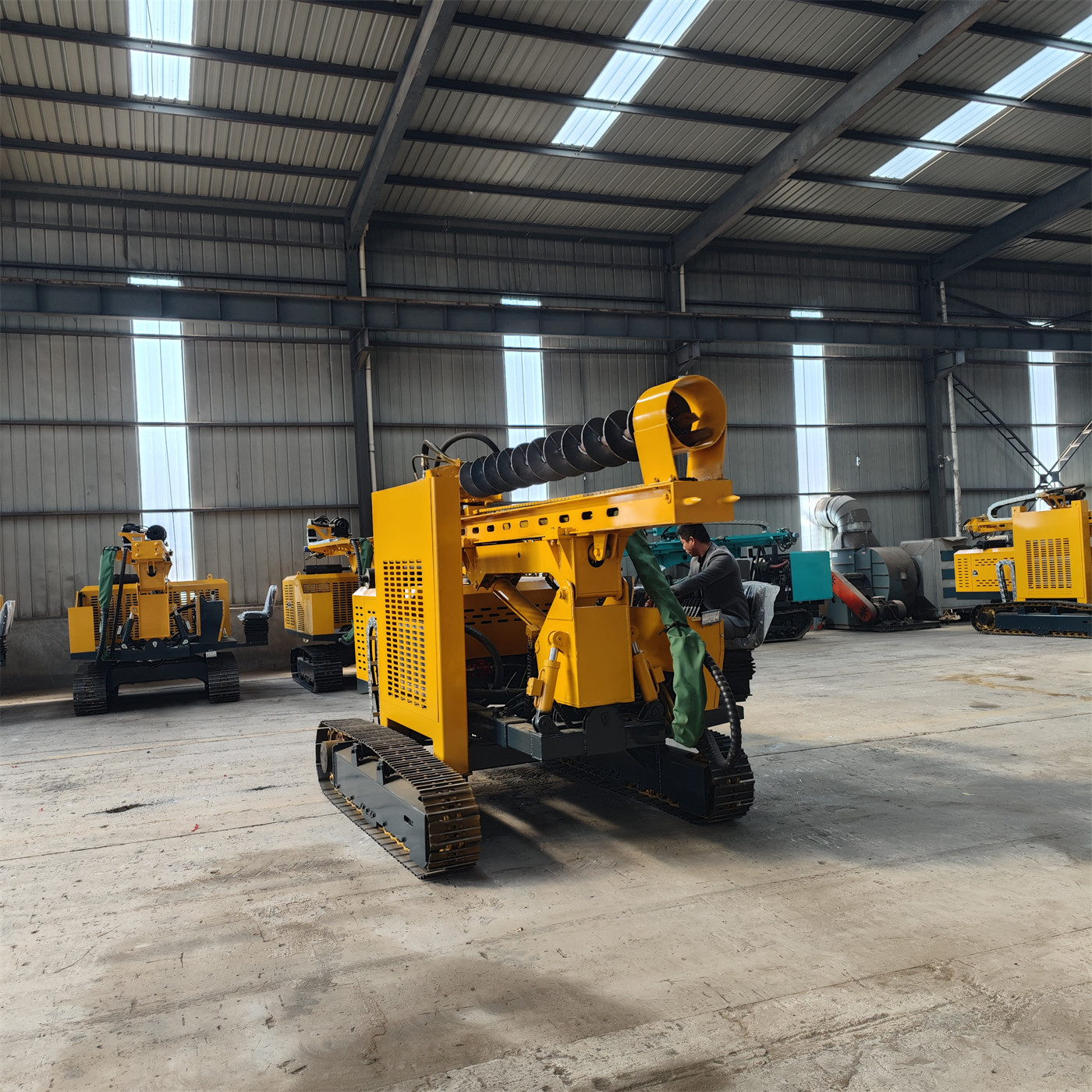
The PV390 mast uses dual-cylinder left-right swing arms and has 50 cm fore-aft telescopic compensation. Together with pitch, these form multi-directional pile position fine-tuning capability:
- Left-right swing arms: Adjust lateral deviation of the drilling position after the machine is stabilized, reducing the number of times the entire machine must be moved for each pile position.
- Fore-aft telescopic compensation: Provides a certain range of fine adjustment in the longitudinal direction; when there is a fore-aft gap between the pile point and the track position, compensation can be used first.
It should be noted that 50 cm is the stroke data of telescopic compensation, not a claim that every pile position can be arbitrarily offset by 50 cm for alignment. The usable compensation amount is related to the swing arm angle, current mast attitude, drilling tool length, and machine positioning; the compensation stroke cannot be directly treated as pile position tolerance.
What attitude adjustment really reduces is machine repositioning
In contiguous PV sites, pile positions are dense and regularly spaced. Each time the entire machine moves, the body must be re-stabilized and alignment redone; time is spent on moving and finding alignment. The value of mast pitch, left-right swing arms, and fore-aft telescopic compensation is to complete alignment within a limited range after the machine is stabilized, leaving machine repositioning for situations beyond adjustment capability.
However, the coverage of attitude adjustment is limited. When pile points exceed the swing arm or telescopic stroke, or when slope height differences require the machine to be re-leveled and repositioned, machine movement is still needed. Which conditions are absorbed by adjustment and which require repositioning depends on the actual combination of pile layout and slope; the data does not provide a unified boundary value.
Where coverage falls short, site and positioning still matter
Climbing capability and attitude adjustment cannot replace each other. The PV390 data specifies a climbing angle of 35° and is equipped with 400 mm track pads, intended for unpaved surfaces such as dirt roads, grass, and gravel. But the maximum climbing angle is not a basis for safe travel on any slope: cross-slope, ground wetness, soil conditions, and machine center of gravity all affect actual passage and stability. Before working on slopes, it is still necessary to judge whether the track position has stable support, rather than treating mast adjustment as a body stabilization measure.
In addition, attitude adjustment addresses drilling tool alignment, not hole wall stability, cuttings removal, or formation changes. The PV390 data indicates suitability for soil, loess, clay, cobble sand, and backfill waste layers; after changing to impact drilling tools, it can be used for strongly weathered rock and rock layers. When encountering backfill or gravel layers on slopes, deviation and jamming can still occur; drilling tools and advancement control cannot be ignored just because alignment is convenient.
Conditions to verify before purchase
If the project is mainly sloped PV, the following information should be provided to the supplier during selection discussions:
- Site slope conditions: slope range, cross-slope or longitudinal slope, and whether local steep steps exist.
- Pile layout: pile spacing, row spacing, design hole depth and diameter, and angle requirements of pile positions relative to the slope.
- Formation data: overburden thickness, whether gravel or backfill layers are present, and strongly weathered rock depth.
- Machine entry and transfer conditions: on-site road width, turning space, transport vehicles, and unloading positions.
- Power and supporting equipment: whether fuel supply is available on site, and matching specifications for drilling tools and impact drilling tools.
This information determines how much attitude adjustment can contribute, and whether coordination is still needed in site preparation, pile layout, and machine positioning arrangements.
Several commonly confused understandings
| Adjustment item | Main function | What it cannot replace |
|---|---|---|
| Mast pitch 120° | Adjust drilling attitude to adapt to slope angle | Lateral and longitudinal position deviation; machine stability |
| Dual-cylinder left-right swing arms | Lateral alignment fine-tuning after stabilization | Pile position deviation beyond swing arm range |
| 50 cm fore-aft telescopic compensation | Longitudinal alignment fine-tuning | Large-range pile position offset and slope height difference |
| 35° climbing angle | Passability reference specified in data | Safe travel on cross-slopes, wet ground, and arbitrary slopes |
Only by viewing these four items separately can one judge which pile positions in a given sloped PV site can be aligned by attitude adjustment, and which require adjusted positioning or site treatment. The data does not provide the actual coverage range of each adjustment item under different slope and pile position combinations; specific projects should be checked section by section according to the pile layout drawing and site conditions.