












When matching an air compressor to a drilling rig, it is easy to split the problem into two independent questions: is the pressure high enough, and is the air volume large enough. But what really determines whether drilling can continue is whether these two are satisfied simultaneously on site and align with the hammer's air consumption, cuttings removal channel, and power supply. No matter how high the pressure rating is, if the displacement at rated pressure cannot keep up, bottom-hole impact will be intermittent; no matter how large the air volume figure is, if the pressure is below the hammer's working requirement, cuttings removal will likewise slow penetration. Using the public information for the AC125D as a thread, this article explains how pressure rating and continuous air supply conditions should be judged together.
First clarify the air problem to be solved
In down-the-hole drilling and deep water well construction, compressed air serves two functions at the same time: driving the bottom-hole hammer to do work, and carrying cuttings out of the hole along the annulus. The former mainly depends on whether the pressure can reach the hammer's working requirement, while the latter mainly depends on whether the air volume can maintain sufficient return velocity. The deeper the hole and the larger the diameter, the more the pressure drop along the path and the required air volume change, so the air supply plan cannot be matched only according to a single figure marked by the drilling rig manufacturer.
Continuous air supply also has another meaning: drilling is continuous operation, and the air compressor must maintain output close to rated for several hours or even longer, not just a short-term peak. This involves power margin, cooling capacity, fuel reserve, and number of compression stages, not just the two figures on the nameplate.
The pressure rating depends on the working state corresponding to the word "rated"
The AC125D has a rated working pressure of 30 bar and adopts a two-stage compression structure. Two-stage compression is a common structural arrangement for high-pressure output conditions: air is compressed in two stages with interstage cooling, with the aim of maintaining output at higher pressure. For readers, the significance is that 30 bar is not an instantaneous peak but the pressure rating at which this machine continuously works under rated conditions; when matching, this value should be compared with the hammer's rated working pressure, with allowance for pressure loss along the path.
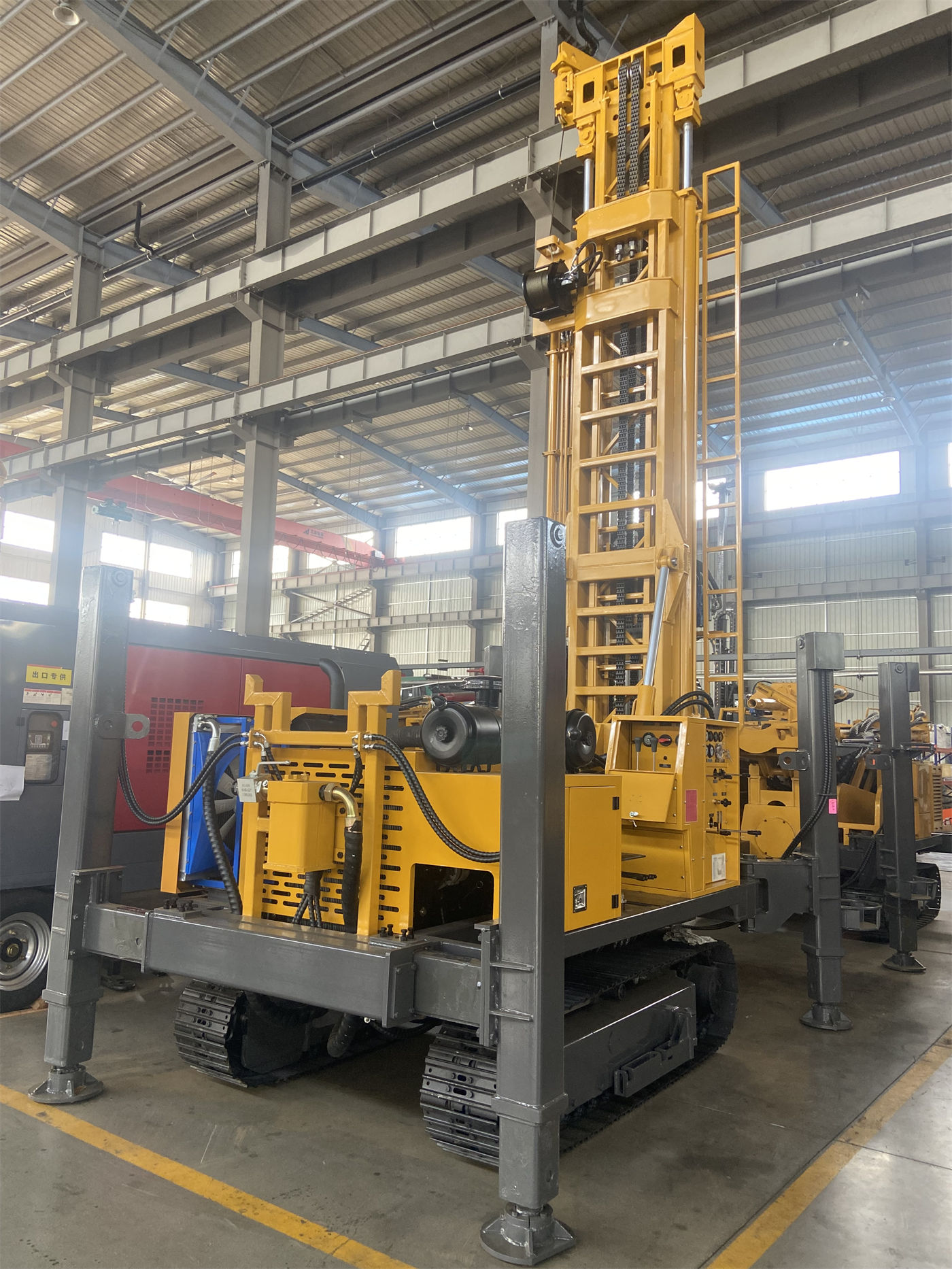
Once the pressure rating is set, the question at the other end still needs to be answered: at this pressure, can the displacement reach 36 m³/min? The published displacement of 36 m³/min and rated pressure of 30 bar are marked for the same machine. In actual matching, it should be confirmed with the drilling rig and hammer supplier under what pressure conditions their air consumption is measured, to avoid one side matching by low-pressure air volume and the other by high-pressure demand.
What conditions jointly support continuous air supply
Power and cooling
The equipment is equipped with a Cummins QSZ13-C550-30 engine, 410 kW (550 hp), water-cooled. Continuous high-displacement output means the engine must remain under relatively high load for long periods. Whether the water-cooling system can remove heat in summer high temperatures or high-altitude environments is one of the conditions that need to be confirmed on site; the published information does not provide output correction data for different ambient temperatures.
Fuel reserve
The 600 L fuel tank is a configuration that extends continuous operation time. It determines approximately how long an operating window can be covered between two refuelings, but actual fuel consumption is related to load rate, ambient temperature, and equipment condition. The published information does not provide hourly fuel consumption, so specific endurance hours cannot be calculated from it; evaluation requires on-site records or obtaining a fuel consumption curve from the supplier.
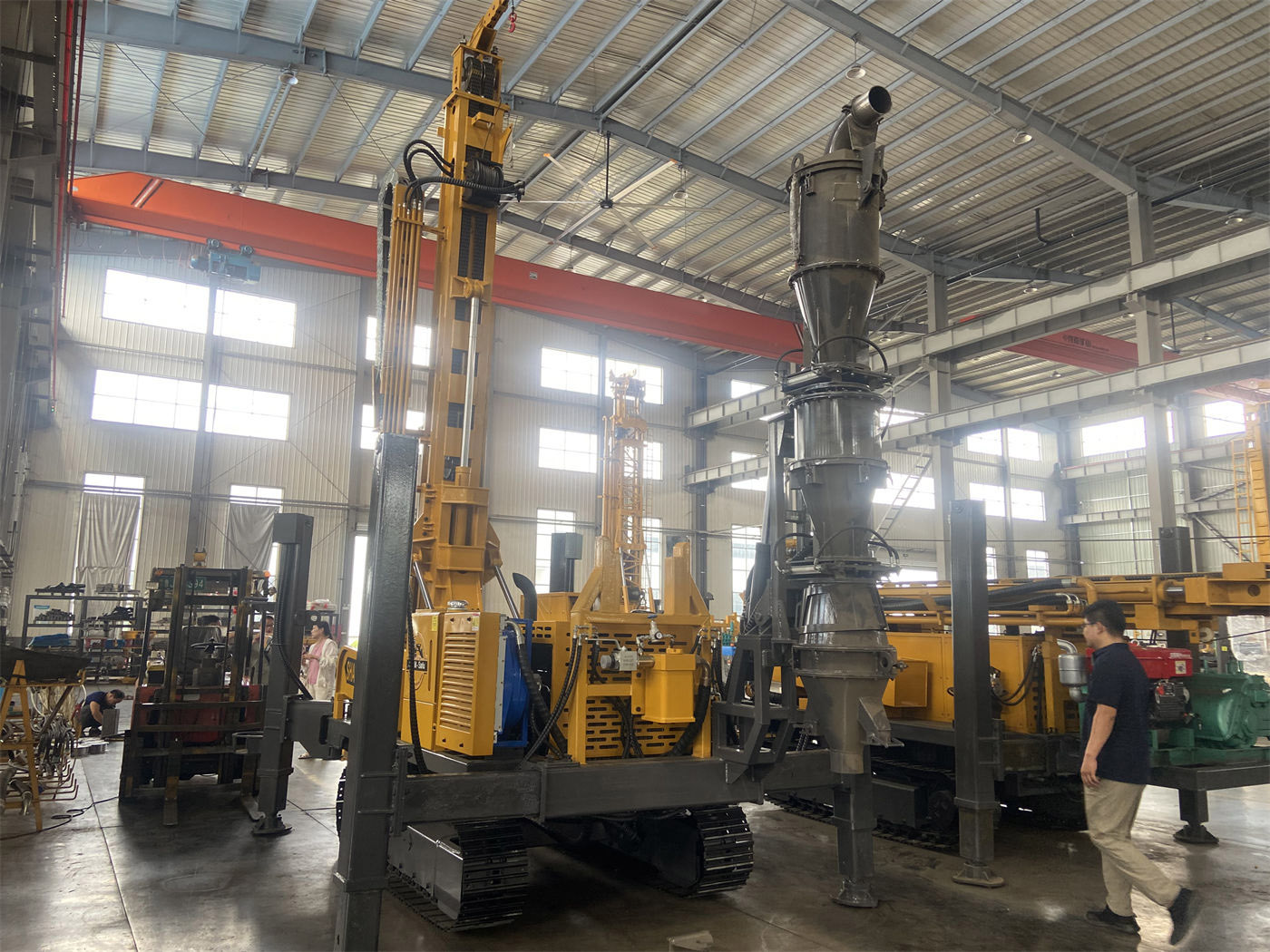
Number of compression stages and output stability
The significance of the two-stage compression structure under high-pressure conditions is to keep pressure and air volume relatively stable during continuous operation. This corresponds to the drilling rhythm: if the air source output fluctuates noticeably when the load in the hole changes, hammer efficiency will be affected, and cuttings removal will also be intermittent.
What operational needs these conditions correspond to
- Air source for deep water well drilling rigs: as hole depth increases, pressure loss along the path rises, and the 30 bar rating leaves corresponding room, but the specific hole depth still needs to be calculated according to the drill string assembly.
- Geothermal drilling: higher pressure is needed to maintain bottom-hole work, while the cuttings removal air volume cannot drop.
- Down-the-hole hammer drive: the hammer's rated pressure and air consumption are two inputs that must be satisfied simultaneously; neither can be omitted.
- Long outdoor operation: the 600 L fuel tank and diesel power are suitable for sites without stable electricity, but refueling arrangements must be planned in advance.
How far the equipment information can support
| Information item | Value | Corresponding judgment |
|---|---|---|
| Displacement | 36 m³/min | Compare with hammer air consumption and cuttings removal return velocity requirements |
| Rated working pressure | 30 bar | Compare with hammer working pressure and pressure loss along the path |
| Number of compression stages | Two-stage compression | A structural condition for continuous high-pressure output |
| Engine | Cummins QSZ13-C550-30, 410 kW | Power condition supporting long-term high-load operation |
| Fuel tank | 600 L | Operating window between two refuelings; fuel consumption must be checked separately |
| Air outlets | G1-1/2, G2-1/2 dual air outlets | Interface matching with drilling rig piping and flow distribution needs |
| Overall weight and dimensions | 5820 kg; 4220×2000×2300 mm | Site access roads, positioning space, and lifting conditions |
These data can show that the equipment has the output conditions of a 30 bar rating and 36 m³/min displacement, as well as the power and fuel basis to support continuous operation. But they cannot directly lead to conclusions such as "a certain well can definitely be drilled" or "how much penetration can be increased," because drilling speed also depends on rock formation, hole diameter, weight on bit, rotation speed, hammer condition, and operating method.
Conditions still to be implemented during matching
The air source is only one part of the drilling system. Before matching, it is recommended to implement the following items together: drilling rig model and planned hole depth and diameter; rated working pressure and air consumption of the down-the-hole hammer or drilling tools; pipeline length, diameter, and joint type—excessively long pipelines or undersized diameters will consume pressure; whether site roads can bear the passage and positioning of an approximately 5.8-ton machine; diesel refueling and maintenance arrangements. The published information gives a maintenance oil change volume of 120 L, which can serve as a reference for spare parts and consumables planning.
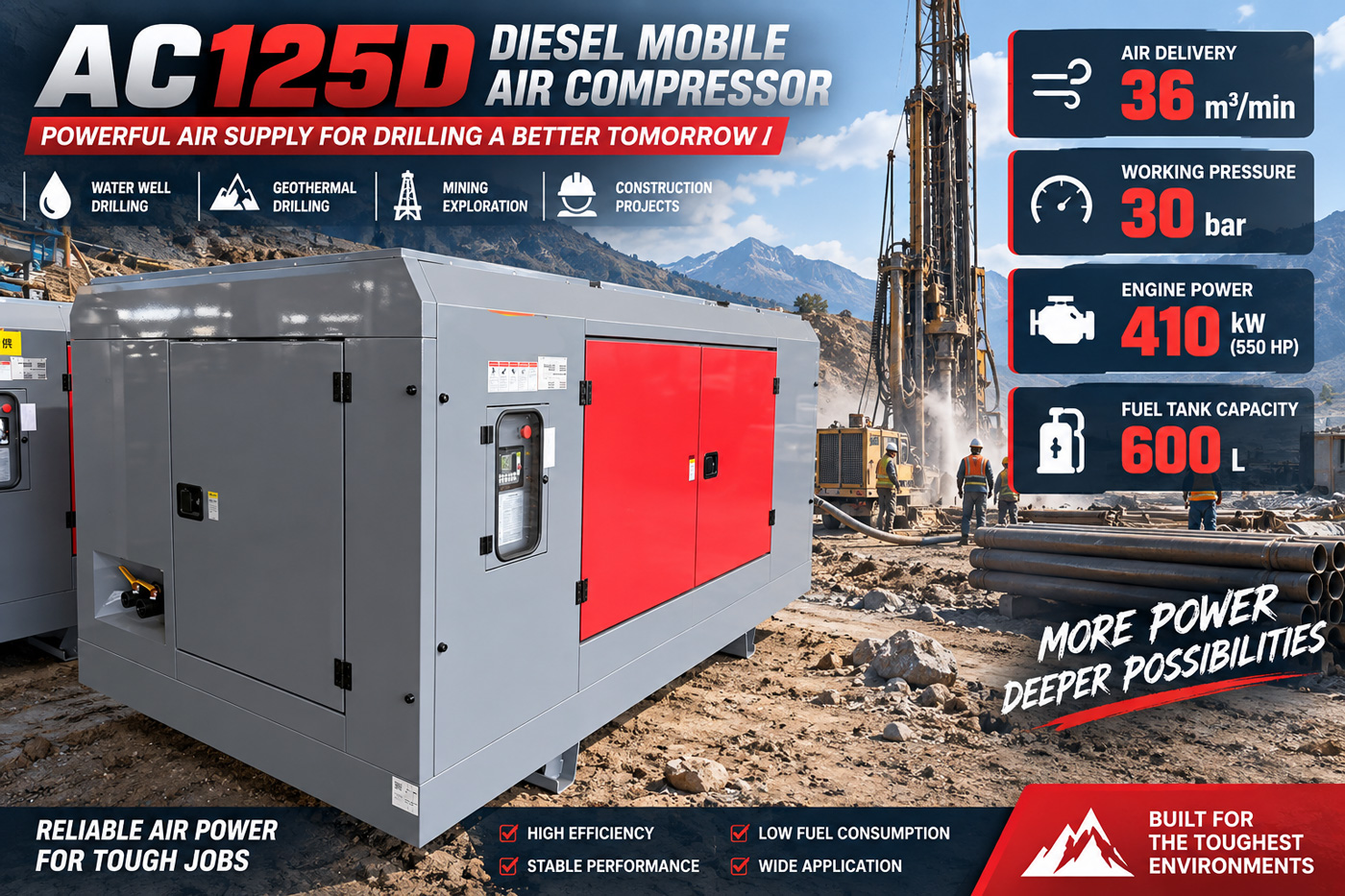
The noise value of 82 dB(A) is stated in the published information, meaning the sound level conditions during operation of this machine need to be considered in site layout, but the information does not provide attenuation data at different distances, so the range of impact on surroundings cannot be inferred from it.
Applicable boundaries and items to be confirmed
This machine is intended for high-pressure, high-displacement air supply conditions such as deep water well drilling rigs and geothermal drilling. If the project involves shallow holes, small diameters, and low air volume demand, the 30 bar rating and 36 m³/min displacement may exceed actual needs; in that case, recalculate rather than matching by "the larger the more stable." Conversely, if the hole diameter and depth exceed conventional ranges, it is also necessary to confirm with the drilling tool supplier whether the existing pressure and air volume still have margin.
Items not covered in the published information that need separate confirmation include: output correction at different ambient temperatures and altitudes; hourly fuel consumption; matching test data with specific hammer models; and the impact of piping configuration on the pressure actually reaching the hole inlet. If these conditions are not implemented, the two figures of pressure rating and displacement cannot independently constitute a selection conclusion.